
Published: 13 January 2026 | Last Updated: 13 January 2026
Instagram Marketing for UK Charities: The Complete 2026 Guide
UK charities must now primarily use Instagram for engagement and awareness rather than for direct donations, following Meta's removal of in-app fundraising tools in the UK and EEA in July 2024. With 34.71 million UK users and particularly strong reach among 25-34 year olds, Instagram remains essential for building supporter relationships—but strategy must focus on driving traffic to external donation pages. Whitehat's digital marketing services help charities navigate this shift effectively.
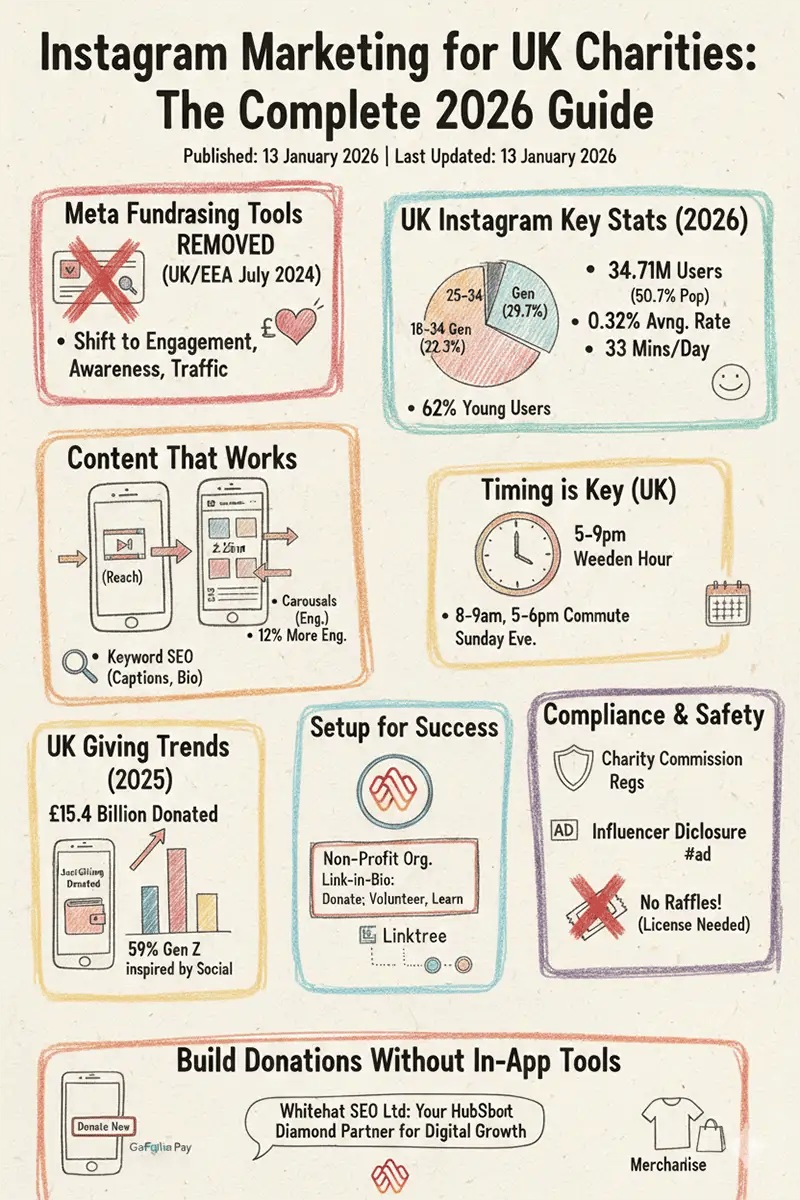
The Meta Fundraising Tool Removal Changes Everything for UK Charities
The most significant shift for charity Instagram marketing since the platform launched donation features: from 1 July 2024, Facebook and Instagram fundraising features were discontinued for all charities in the European Economic Area, including the United Kingdom. Donation stickers, personal fundraisers for charities, and built-in giving tools are no longer available to UK organisations.
Historical data reveals the scale of this change: over 7 million people in the UK had donated through Facebook Fundraisers since launch, and globally these tools raised over £4 billion in five years. The 88% repeat donation rate from users of these tools demonstrated their effectiveness for supporter retention. UK charities must now redirect Instagram engagement to external donation pages.
For UK charities specifically, Instagram now functions as an engagement, awareness, and traffic-driving platform rather than a direct fundraising channel. Strategy must focus on compelling content that builds trust and motivates action beyond the platform. This represents a fundamental repositioning of how the platform fits into charity digital strategies.
Current Instagram Statistics UK Charities Must Understand
Instagram reached 3 billion monthly active users globally in September 2025, making it the third-largest social network behind Facebook and WhatsApp. In the UK specifically, the platform now has 34.71 million users—approximately 50.7% of the population—with a demographic profile highly relevant to charities seeking younger supporters.
UK demographic breakdown reveals that 55% of users are female and 45% male, with the largest age cohort being 25-34 year olds at 29.7% of all users (approximately 10.3 million people). When combined with 18-24 year olds, these younger demographics represent over 62% of UK Instagram users—precisely the generations that charities must engage for future sustainability.
| Metric | UK Figure | Source |
|---|---|---|
| Total UK Instagram Users | 34.71 million | Statista 2024 |
| Non-profit Median Engagement Rate | 0.32% | Rival IQ 2025 |
| Average Daily Time on Platform | 33 minutes | Meta 2025 |
| Non-profits Using Instagram | 73% | NPTG 2023 |
| Instagram Donors Who Give Again | 83% | NPTG 2025 |
Time spent on the platform averages 33 minutes per day globally, with Reels now consuming approximately 35-50% of that time. For non-profit accounts specifically, engagement rates have settled at a median of 0.32% according to Rival IQ's January 2025 benchmarks, though top-performing charity accounts achieve rates above 1%.
Content Performance: Reels Dominate Reach While Carousels Win Engagement
Recent algorithm changes have created a clear hierarchy in content performance that UK charities must understand. Reels deliver 2.25× higher reach than single-image posts and 30.81% average reach rate, making them essential for audience growth. However, carousels generate 12% more engagement than Reels and 2.14× more than single images, making them optimal for deeper community connection and saves.
December 2024 brought significant algorithm changes: Instagram removed the ability to follow hashtags, substantially reducing their weight in content discovery. The platform now prioritises keyword-based SEO through captions, bio text, and alt text. Current best practice recommends 3-5 highly relevant hashtags per post rather than the previous maximum of 30.
Optimal Posting Times for UK Charity Audiences
- Weekday evenings 5-9pm consistently perform well
- 9pm identified as the UK "golden hour" for engagement
- Commuting times (8-9am, 5-6pm) show strong performance
- Sunday evenings capture high engagement during browsing
- Saturday shows lowest engagement despite longer activity periods
Recommended posting frequency for charities: 3-5 feed posts weekly (photos/carousels), daily Stories where possible, and 1-3 Reels per week. Average non-profit accounts post approximately 4.9 times per week across all formats. Consistency matters more than volume—a sustainable cadence outperforms sporadic bursts of activity.
UK Charitable Giving Trends Shape Instagram Strategy
The Charities Aid Foundation UK Giving Report 2025 reveals that UK public charitable giving reached £15.4 billion in 2024, up from £13.9 billion in 2023. Digital channels continue gaining ground, with 7% growth in charity digital income according to Wood for Trees' State of the Sector 2025 Report. However, the sector faces significant challenges in capitalising on this shift.
Mobile-first donation behaviour has become the norm: 61% of monthly donations are now made on mobile devices, with Apple Pay accounting for 30% of all one-off mobile donations—surpassing PayPal for the first time. Digital wallets now process 43% of single gifts, up from 39% the previous year. Charities without mobile-optimised donation journeys are missing the majority of potential transactions.
Generational patterns in charitable giving show Gen Z participation declining fastest—only 36% of 16-24 year olds donated in 2024, down from 52% in 2019. However, 50% of Gen Z participate in volunteering (the highest of any generation), and 59% report being inspired to donate by social media content. This suggests Instagram's role lies in inspiring engagement and building long-term relationships rather than immediate conversion. For charities looking to develop comprehensive inbound marketing strategies for non-profits, understanding these generational shifts is essential.
Successful UK Charity Instagram Campaigns: What Works in 2026
Macmillan Cancer Support's "We Need to Talk About Sex" campaign won the Third Sector Award for Best Use of Social Media in 2024, generating 750,000 impressions, 40,000 reactions, and 500,000 video views. The campaign partnered with Lovehoney to address intimacy after cancer diagnosis—a £20,000 video budget generated £120,000 in revenue from the corporate partnership. The success demonstrated that bold partnerships aligned with authentic storytelling outperform traditional charity messaging.
CALM's "Missed Birthdays" campaign created a physical installation of 6,929 balloons (each representing a young life lost to suicide) that generated nationwide coverage and thousands of emotional engagement interactions on Instagram. The charity extended campaign lifespan by pinning the post and creating Story Highlights—demonstrating how physical activations can drive sustained digital engagement.
Teenage Cancer Trust's partnership with influencer GK Barry achieved 2.3 million views and 62,800 likes by empowering the creator to maintain her authentic voice rather than delivering scripted charity messaging. The campaign targeted younger audiences effectively whilst building brand familiarity beyond existing supporters. Key success patterns across these campaigns include authentic storytelling that transforms statistics into personal narratives, bold partnerships with values-aligned commercial and cultural partners, and cultural moment timing to capture attention during high-engagement periods.
Setting Up Your Charity Instagram Account for Success
Before optimising your charity's Instagram presence, ensure you've registered as a business or creator account—this provides access to analytics, scheduling, and the ability to add action buttons. List your category as "Non-Profit Organisation" so visitors immediately understand your social mission. Approximately 90% of Instagram users follow at least one business account, and 62.7% actively research organisations on the platform.
Your profile picture should be your charity logo, cropped to display clearly within Instagram's circular frame. The Instagram bio allows only 150 characters, so be concise, direct, and compelling. Include a clear call to action—since Meta's fundraising tools are no longer available in the UK, your bio link becomes critical for directing supporters to external donation pages.
Use link-in-bio tools such as Linktree or HubSpot's free landing pages to provide multiple destination options from a single link. This allows supporters to access your donation page, volunteer sign-up, newsletter subscription, and latest campaign from one location. HubSpot onboarding services can help charities set up integrated landing pages that track Instagram traffic through to conversion.
Content Types That Drive Engagement for UK Non-Profits
Impact Stories: Share individual beneficiary stories (with appropriate consent) that transform statistics into personal narratives. Research from the US National Library of Medicine found that focusing on one person rather than aggregate numbers increases donations—the "collapse of compassion" means people give less as the number in need increases.
Behind-the-Scenes Content: Show the people, processes, and day-to-day work that makes your charity function. This builds authenticity and trust whilst humanising your organisation. Staff introductions, volunteer spotlights, and "day in the life" content consistently generate strong engagement.
Educational Content: Position your charity as an authority on issues you address. Charities have an unprecedented opportunity in 2026 to serve as trusted sources of news and information within their focus areas. Journalism-style content that tackles topical issues outperforms traditional brand posts, according to Funraisin's 2025 analysis.
User-Generated Content: Encourage supporters to share their own stories and experiences with your charity. Reposting volunteer photos, fundraiser achievements, and community events extends your reach and builds social proof. Always credit original creators and obtain permission before sharing. For comprehensive guidance on developing your charity's content approach, explore our content marketing strategies guide.
UK Regulatory Compliance for Charity Social Media
Charity Commission guidance mandates that all charities using social media must have a formal social media policy covering content guidelines, responsibility allocation, and crisis procedures. Trustees bear responsibility for ensuring social media use aligns with charitable purposes and complies with relevant legislation including GDPR, copyright, and defamation law.
The Fundraising Regulator's Code of Fundraising Practice (new version effective November 2025) applies to all charitable institutions including online platforms. Charities can register and display the Fundraising Badge on materials to demonstrate commitment to standards. The 2025 Code includes new support guides specifically for social media fundraising, online gaming, and events.
ASA/CAP rules require that all paid or incentivised content be "obviously identifiable" as advertising—#ad or "AD" labels must appear prominently at the start of content, not buried at the end or in bios only. Both the charity and influencer bear responsibility for compliance.
⚠️ Critical: Raffle and Lottery Compliance
Gambling Commission requirements create significant risk for charity raffles on social media: there are no exemptions allowing lotteries to be run remotely without licensing. Any paid-entry raffle on Instagram requires either a Society lottery licence (if over £250,000/year or £20,000/draw) or local authority registration. Running an unlicensed lottery is a criminal offence under the Gambling Act 2005. Free prize draws (where donations don't affect winning chances) and skill-based competitions remain available without licensing.
Building Donations Without In-App Fundraising Tools
With Meta's fundraising tools no longer available to UK charities, alternative approaches become essential. Direct supporters to mobile-optimised donation pages using your bio link—remember that 61% of charitable donations now occur on mobile devices. Ensure your donation journey requires minimal clicks and supports Apple Pay and Google Pay, which now process 43% of single gifts.
Partner with third-party platforms such as JustGiving, GoFundMe Charity, or Enthuse that provide Instagram-shareable fundraising pages. These platforms handle payment processing, Gift Aid claims, and provide supporters with personalised fundraising pages they can share within their own Instagram networks—enabling peer-to-peer fundraising even without Meta's native tools.
Consider merchandise as an alternative revenue stream using platforms like Shopify or Ecwid integrated with Instagram Shopping features. Charity merchandise creates ongoing visibility as supporters wear or use branded items, whilst providing an alternative engagement pathway for supporters who prefer tangible giving over direct donations.
Measuring Instagram Success for UK Charities
Track metrics at three levels: engagement (likes, comments, shares, saves), reach (impressions, follower growth, profile visits), and conversion (link clicks, donation page visits, actual donations attributed to Instagram). Instagram Insights provides native analytics for business accounts, showing when followers are most active and which content types perform best.
Use UTM parameters on all links shared from Instagram to track traffic through to your donation platform. Tools like HubSpot's tracking URL builder or Bitly enable campaign-specific tracking. This attribution is essential—charities that can prove social media ROI receive continued investment, whilst those that cannot demonstrate impact often see budgets cut.
Benchmark your performance against sector averages: the non-profit median engagement rate of 0.32% provides a baseline, though top charity accounts achieve rates above 1%. Track month-over-month trends rather than fixating on individual post performance. Consistency in posting and engagement typically produces compounding returns over 6-12 months.
Frequently Asked Questions
Can UK charities still use Instagram donation stickers?
No, Meta removed all in-app fundraising tools including donation stickers from the UK and EEA from July 2024. UK charities must now direct supporters to external donation pages using their bio link or Stories swipe-up features. This applies to Instagram donation stickers, Facebook Fundraisers, and charitable giving buttons across all Meta platforms.
How often should UK charities post on Instagram?
Whitehat recommends UK charities post 3-5 feed posts weekly (photos and carousels), daily Stories where resources permit, and 1-3 Reels per week. Consistency matters more than volume—a sustainable cadence produces better results than sporadic high-volume posting followed by silence. Average non-profit accounts post 4.9 times weekly across all formats.
What is a good engagement rate for charity Instagram accounts?
The non-profit sector median engagement rate is 0.32% according to Rival IQ's January 2025 benchmarks, slightly below the cross-industry median of 0.36%. Top-performing charity accounts achieve rates above 1%. Engagement rate is calculated as total interactions divided by followers, multiplied by 100.
Do charities need to disclose sponsored content on Instagram?
Yes, ASA/CAP rules require all paid or incentivised content to be "obviously identifiable" as advertising. The #ad or "AD" label must appear prominently at the start of content—not buried at the end or only in bios. Both the charity and any influencer partners bear responsibility for compliance. Failure to disclose can result in ASA rulings against the organisation.
Can UK charities run raffles on Instagram?
Any paid-entry raffle requires either a Society lottery licence (for draws over £250,000/year or £20,000/draw) or local authority registration under the Gambling Act 2005. Running an unlicensed lottery is a criminal offence. Free prize draws where donations don't affect winning chances, and skill-based competitions, remain available without licensing.
References and Sources
- Statista – Instagram Users in the United Kingdom (2024)
- Rival IQ – Live Social Benchmarks for Nonprofits (2025)
- Charities Aid Foundation – UK Giving Report (2025)
- Charity Commission – Charities and Social Media Guidance (GOV.UK)
- Fundraising Regulator – Code of Fundraising Practice (2025)
- ASA – Recognising Ads: Social Media and Influencer Marketing
- Blackbaud Institute – UK Charitable Support Trends by Generation (2024)
- Charity Digital – The Future of Digital Transformation (2025)
Need Help With Your Charity's Digital Marketing?
Whitehat helps UK charities and non-profits build effective digital marketing strategies that drive awareness, engagement, and donations. As a HubSpot Diamond Partner, we provide the expertise and tools to transform your Instagram presence into measurable results.
Speak to Our TeamClwyd Probert
CEO & Founder, Whitehat SEO Ltd
Clwyd Probert is the founder and CEO of Whitehat, a London-based HubSpot Diamond Solutions Partner. He leads the world's largest HubSpot User Group and serves as a guest lecturer at UCL, specialising in B2B marketing strategy and digital transformation. view our pricing