
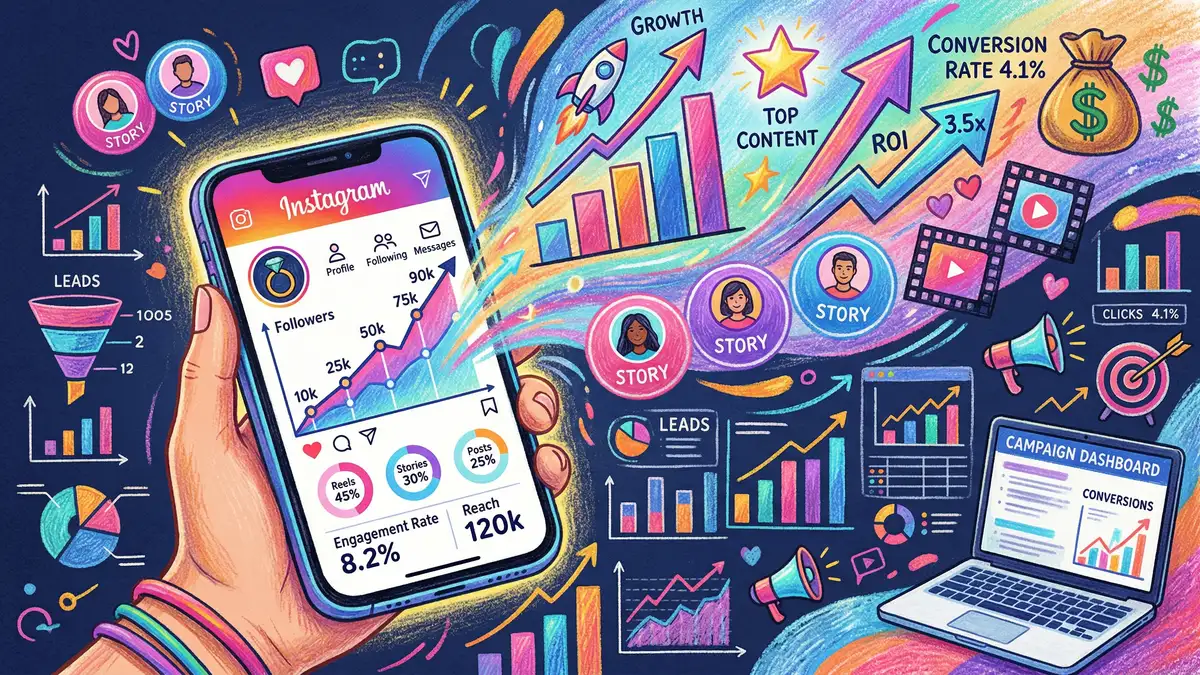
Instagram delivers an average 420% ROI for marketing campaigns in 2025, making it one of the highest-performing social platforms for brands seeking measurable returns. However, the platform has undergone its most significant algorithm transformation in years, shifting from hashtag-driven discovery to AI-powered recommendations that prioritise watch time, DM shares and original content. For marketers, this matters: average engagement rates have declined 24% year-over-year to 0.45%, yet businesses that adapt to Reels-first strategies and leverage micro-influencers are seeing substantially better results.
420%
Average Instagram ROI
-24%
YoY Engagement Change
3x
Nano vs. Macro Influencer Engagement
What are the Instagram ROI benchmarks in 2026?
Instagram's return on investment figures remain compelling for marketers willing to invest strategically. The beauty sector leads with 518% ROI from Instagram advertising, whilst influencer marketing delivers approximately £3.30 in earned media value per £1 spent. According to HubSpot's 2024 State of Marketing report, 29% of both B2B and B2C companies report Instagram (tied with Facebook) as their highest-ROI advertising platform.
Conversion metrics tell a nuanced story. Instagram ads achieve an average 1.6% conversion rate, outperforming Facebook's 1.1%. Carousel advertisements demonstrate particular strength, delivering 72% higher conversion rates than single-image ads. For e-commerce, approximately 46.8 million Americans made purchases through Instagram in 2024, with platform users maintaining the highest average order value among social platforms—roughly £52 per sale compared to Facebook's £44.
| Metric | 2025 Benchmark | Year-on-Year Change |
|---|---|---|
| Average CPC | £1.13 | +9% |
| Average CPM | £7.74 | +11% |
| Conversion Rate | 1.6% | Stable |
| B2B CPC | £0.86 | -7% |
| Reels Ad Revenue (Global) | $15.3B | +96% |
Sources: HubSpot Marketing Statistics 2025, Instagram Official Blog 2025
Cost metrics have shifted upward in 2025. Western European markets, including the UK, see higher CPMs around £9.16. However, B2B advertisers have benefited from improved targeting, with their CPC dropping to £0.86—a 7% decrease attributed to Meta's Advantage+ AI optimisation tools.
How has the Instagram algorithm changed in 2024-2025?
Instagram's recommendation system underwent its most significant transformation in December 2024 when the platform removed hashtag following entirely, shifting discovery toward keyword-based search and AI-driven recommendations. Users can no longer follow new hashtags, and previously followed hashtags stopped appearing in feeds—a fundamental change that requires marketers to rethink their discoverability strategy.
The platform now operates multiple distinct algorithms rather than a single system. Feed posts prioritise relationship strength and interaction history. Reels focus on entertainment value and retention metrics. Stories emphasise closeness and viewing frequency. The Explore page weights popularity signals more heavily than other sections.
Adam Mosseri confirmed in January 2025 that three signals matter most across all Instagram algorithms:
- Watch time — the primary factor, with users deciding within 1.7 seconds whether to continue watching
- Likes per reach — engagement rate matters more than raw numbers
- DM shares — the strongest signal for reaching new audiences, with 694,000 Reels sent via DM every minute
Comments, once a key metric, now factor into overall engagement time rather than standing alone. The December 2025 'Your Algorithm' feature represents Instagram's most transparent move yet—users can now view and customise the topics that shape their Reels recommendations, signalling that topic clarity and content consistency will increasingly determine algorithmic success.
Understanding these algorithm shifts is essential whether you're running paid social campaigns or building organic reach through your social media strategy.
Key Takeaway
Hashtags no longer drive Instagram discovery. Focus instead on watch time in the first 1.7 seconds, DM shares, and topic clarity to align with AI-powered recommendations.
Why have Reels become essential for Instagram success?
Reels dominate Instagram's content ecosystem with performance metrics that dwarf other formats. The format achieves an average reach rate of 30.81%—more than double carousels at 14.45% and static images at 13.14%. Critically, 55% of Reel views come from non-followers, making it Instagram's most powerful discovery tool for building new audiences.
Engagement patterns favour Reels significantly. The format generates 1.23-2.08% engagement rates compared to 0.70% for photo posts and 0.99% for carousels. For influencers, Reels achieve 2.08% engagement versus 1.17% for static images. Business Reels usage has increased 57.4% year-over-year, reflecting marketers' recognition of the format's superior performance.
Key Takeaway
Instagram's guidance on optimal Reel length has crystallised around under 90 seconds for maximum distribution—CEO Adam Mosseri explicitly stated that longer content "hurts distribution." The first 3 seconds are critical for retention, and users typically decide whether to continue watching within 1.7 seconds.
For advertisers, Reels ads reach 726.8 million users globally and generate 41% higher click-through rates than static advertisements. The platform's ad revenue composition reflects this shift: Reels ad revenue reached $15.3 billion in 2025, nearly doubling from $7.8 billion in 2024. Instagram now surpasses 50% of Meta's total US ad revenue for the first time, up from just 7.7% in 2015.
Can B2B brands succeed on Instagram?
Despite Instagram's reputation as a B2C channel, B2B brands are achieving remarkable engagement results. According to TrackMaven's analysis of 316 leading B2B brands, B2B companies receive 20 times more engagement on Instagram than on LinkedIn, despite having 36 times larger LinkedIn audiences. The engagement ratio tells the story: LinkedIn generates 1.98 interactions per post per 1,000 followers, whilst Instagram delivers 22.53 interactions—an 11x difference in engagement efficiency.
Currently, 49% of B2B marketing teams consider Instagram one of their most trusted platforms, though only 33% of B2B companies maintain an active presence—creating significant opportunity for differentiation. The lower competition means B2B content faces less algorithmic crowding than on LinkedIn, where professional content saturates feeds.

Content strategies that succeed for B2B audiences differ from consumer approaches. Behind-the-scenes culture content that humanises corporate brands performs strongly, as do client success stories and thought leadership carousel posts. Microsoft Teams demonstrated this approach effectively, achieving a 38% increase in social media followers and 28% higher engagement by adopting B2C-style empathy-driven content for their B2B product.
The platform comparison for B2B reveals complementary strengths. LinkedIn excels at direct lead generation and professional targeting, but Instagram offers a cost-per-lead of approximately £49 (the most cost-effective among major platforms) and superior brand awareness building. Strategic B2B marketers increasingly use both: LinkedIn for bottom-funnel conversion and Instagram for top-funnel awareness and employer branding.
At Whitehat, we help B2B companies build integrated strategies across platforms through our HubSpot onboarding services, connecting social media performance directly to your CRM for proper attribution.
Why are micro-influencers outperforming larger accounts?
The influencer marketing sector has reached $32.55 billion globally in 2025, growing 35.63% year-over-year. Instagram remains the dominant platform, with 57.1% of brands choosing Instagram for influencer campaigns and $2.21-2.56 billion spent on Instagram influencer marketing in the US alone—approximately double Facebook's influencer spend.
Return metrics support continued investment. Influencer marketing delivers an average ROI of 5.78x for every pound spent, with some studies reporting returns up to 11x—higher than print, television, or most digital channels.
The shift toward micro and nano-influencers accelerates. 73% of brands now prefer micro and mid-tier creators over celebrities, with 44% specifically preferring nano-influencers (1K-10K followers). The engagement data supports this preference: nano-influencers achieve 1.73% engagement rates on Instagram compared to 0.61% for macro-influencers with 100K-1M followers. This 3x engagement advantage comes at dramatically lower cost—nano-influencers charge £16-80 per post versus £1,200+ for influencers with 100K-150K followers.
| Influencer Tier | Follower Count | Engagement Rate | Typical Cost/Post |
|---|---|---|---|
| Nano-influencers | 1K–10K | 1.73% | £16–80 |
| Micro-influencers | 10K–100K | ~1.0–1.5% | Variable |
| Macro-influencers | 100K–1M | 0.61% | £1,200+ |
| Mega-influencers | 1M+ | 0.68% | Up to £800K+ |
Sources: Influencer Marketing Hub Benchmark Report 2025
Want to connect social media to pipeline? Whitehat SEO's B2B marketing services integrate social strategy with HubSpot for measurable ROI.
View Marketing ServicesHow should you measure Instagram ROI?
Instagram ROI measurement demands moving beyond vanity metrics to revenue-connected tracking. The core formula remains straightforward: ROI = ((Value Received − Investment) / Investment) × 100. However, determining 'value received' requires sophisticated attribution given that the average consumer needs 56 touchpoints before purchase—Instagram rarely drives conversions in isolation.
Single-touch attribution models (first-touch or last-touch) provide simplicity but miss the full picture. Multi-touch attribution better captures Instagram's role in complex customer journeys. The position-based (U-shaped) model assigns 40% credit each to first and last touchpoints with 20% distributed among middle interactions—a balanced approach for brands seeking to understand both awareness and conversion contributions.
UTM parameters remain essential for tracking Instagram's traffic contribution. The five standard parameters (source, medium, campaign, content, term) should follow strict conventions: lowercase only, no spaces (use dashes or underscores), and consistent naming across teams. Instagram's limited clickable placement options—bio links, Story link stickers, DMs, and ads—each require UTM tagging for proper attribution in Google Analytics 4.
The April 2025 Meta API changes deprecated impressions in favour of 'Views' as the primary metric, affecting historical comparisons and requiring analytics reconfiguration. Third-party tools like Sprout Social (from £199/month), Hootsuite (from £79/month), and Iconosquare (from £47/month) provide deeper analytics than native Instagram Insights, including competitor benchmarking and cross-platform reporting.
For HubSpot users, connecting Instagram analytics to your CRM provides proper closed-loop attribution. Our HubSpot CRM guide explains how to set this up effectively.
How does Instagram shopping drive e-commerce sales?
Instagram's commerce features drive significant purchasing behaviour: 130 million users tap product tags monthly, and 44% of users shop weekly using shopping tags and the Shop tab. Among social platforms, Instagram shoppers maintain the highest spending levels—7.6% more likely than users of other platforms to make purchases over £160.
The platform's commerce ecosystem includes in-app storefronts, product tags across Reels and Stories, native checkout, and integrations with Shopify, BigCommerce, and other major e-commerce platforms. Businesses using shopping features report up to 1,416% traffic increases and 20% revenue gains according to BigCommerce data.
However, 2025 presents challenges. Overall Instagram engagement has decreased 16% year-over-year, and average engagement per post has fallen to 0.43%. Competition from TikTok Shop intensifies, particularly among younger demographics. Brands succeeding in Instagram commerce increasingly combine product tags with Reels content, leveraging the format's superior reach to surface shoppable content to new audiences.
User-generated content amplifies commerce results substantially. UGC achieves 28% higher engagement than branded content and delivers 29% higher conversion rates. Instagram leads all platforms for product discovery through UGC at 62%, ahead of Facebook (53%) and TikTok (52%). Brands incorporating customer photos and videos into their Instagram presence see visitors convert at rates 102.4% higher than those interacting only with brand-created content.
What are the UK market opportunities on Instagram?
The UK represents a mature Instagram market with 34.71 million users as of late 2024—approximately 48.8% of the total population and 57.1% of the eligible audience aged 13+. The platform ranks fourth in UK social media usage behind WhatsApp, Facebook, and Facebook Messenger, but dominates among younger demographics: 86% of 16-24 year-olds use Instagram compared to just 21% of those 65+.
Demographic distribution skews toward young adults and women. The 25-34 age group represents 29.7% of UK Instagram users (approximately 10.3 million people), with the 18-24 bracket forming the second-largest cohort. Gender split favours women at 55% female to 45% male, with Instagram overtaking YouTube and Facebook as the second-most-visited smartphone app among 18-34 year-olds at 81.2% reach.
UK social media advertising is projected to reach £11 billion in 2026, growing at 11.95% annually to reach £19.4 billion by 2030. Instagram, combined with Facebook, grew 20%+ year-over-year in Q1 2024. The UK influencer marketing sector specifically reached £1.9 billion in 2024 with projected growth at 29.5% CAGR through 2033.
Business adoption reflects Instagram's commercial importance: 81% of top 500 UK online shops maintain Instagram presence, and 81% of UK brands use Instagram for influencer marketing campaigns. Meta properties (Instagram and Facebook combined) command 58% of UK social commerce revenue. Among young UK consumers, Instagram leads as the #1 platform for social buying at 37.3% preference, narrowly ahead of TikTok at 36.1%.
What should your 2026 Instagram strategy prioritize?
Instagram marketing in 2025 rewards adaptability over consistency. The platform's shift from hashtag-driven discovery to AI-powered recommendations based on watch time, DM shares and topic clarity fundamentally changes content strategy requirements. Here's what the data suggests you should prioritise:
- Commit to Reels — They achieve more than double the distribution of other formats. Keep them under 90 seconds and hook viewers in the first 3 seconds.
- Prioritise micro-influencers — Nano-influencers achieve nearly 3x the engagement rate of macro-influencers at a fraction of the cost. The authenticity premium is real.
- Invest in UGC — User-generated content delivers 29% higher conversion rates than brand-created content. Make it easy for customers to share.
- Build proper attribution — With 56 touchpoints before purchase, single-touch models miss the picture. Multi-touch attribution connected to your CRM is essential.
- Don't ignore B2B potential — 20x higher engagement than LinkedIn, lower competition, and cost-effective lead generation make Instagram worth testing for B2B brands.
The brands seeing the strongest results combine entertainment-focused Reels content (under 90 seconds, hook within 3 seconds), strategic micro-influencer partnerships, robust shopping integration, and measurement systems that connect social engagement to revenue outcomes.
Frequently Asked Questions
What is the average ROI for Instagram marketing in 2025?
Instagram delivers an average 420% ROI for marketing campaigns in 2025, with the beauty sector leading at 518% ROI. Influencer marketing specifically returns approximately 5.78x for every pound spent.
How has the Instagram algorithm changed in 2024-2025?
Instagram removed hashtag following entirely in December 2024, shifting to AI-powered recommendations based on watch time, likes per reach, and DM shares. The platform now runs multiple algorithms—one each for Feed, Reels, Stories, and Explore.
What is the optimal length for Instagram Reels?
Instagram recommends keeping Reels under 90 seconds for maximum distribution. CEO Adam Mosseri has stated that longer content "hurts distribution." The first 3 seconds are critical—users decide whether to continue watching within 1.7 seconds.
Is Instagram effective for B2B marketing?
Yes. B2B companies receive 20x more engagement on Instagram than LinkedIn, despite smaller audiences. Instagram also offers the most cost-effective cost-per-lead among major platforms (approximately £49). Behind-the-scenes content and client success stories perform particularly well for B2B.
Should I work with micro-influencers or macro-influencers?
Micro and nano-influencers typically deliver better results. Nano-influencers (1K-10K followers) achieve 1.73% engagement rates versus 0.61% for macro-influencers—a 3x advantage. They also cost significantly less: £16-80 per post versus £1,200+ for larger accounts.
Sources: HubSpot Marketing Statistics 2025, HubSpot Blog: 2024 Instagram Marketing Report, HubSpot State of Social Media 2024, Statista: Instagram Statistics and Facts, Instagram Official Blog, Influencer Marketing Hub: Benchmark Report 2025, BigCommerce: Instagram Shopping Guide
Ready to Turn Social Media Into Pipeline?
Whitehat SEO helps UK B2B companies build marketing strategies that connect every channel—including social—to measurable revenue outcomes.
Clwyd Probert
CEO & Founder, Whitehat SEO
Clwyd founded Whitehat SEO in 2011 and has grown it into a HubSpot Diamond Partner serving B2B companies across the UK. He runs the world's largest HubSpot User Group in London, guests lectures at UCL, and advises on AI implementation for marketing transformation.