
Online Marketing for Chiropractors: The Complete UK Guide
Online marketing for chiropractors succeeds through local SEO, Google Business Profile optimisation, and strategic patient review management. With 77% of patients searching online before booking appointments and 46% of Google searches having local intent, UK chiropractic practices must prioritise digital visibility to compete effectively. Whitehat SEO helps healthcare practices achieve patient acquisition costs of £130-155 compared to £330-660 for unoptimised marketing approaches. explore our digital marketing FAQs
Why Does Digital Marketing Matter for UK Chiropractors?
The UK chiropractic market represents significant growth opportunity for practices willing to invest in digital visibility. As of June 2025, the General Chiropractic Council registers 3,993 chiropractors across the UK, with 4% annual growth in the profession. The sector comprises approximately 3,710 businesses, with 78.7% operating as single-owner practices—making differentiation through marketing essential for sustainable growth.
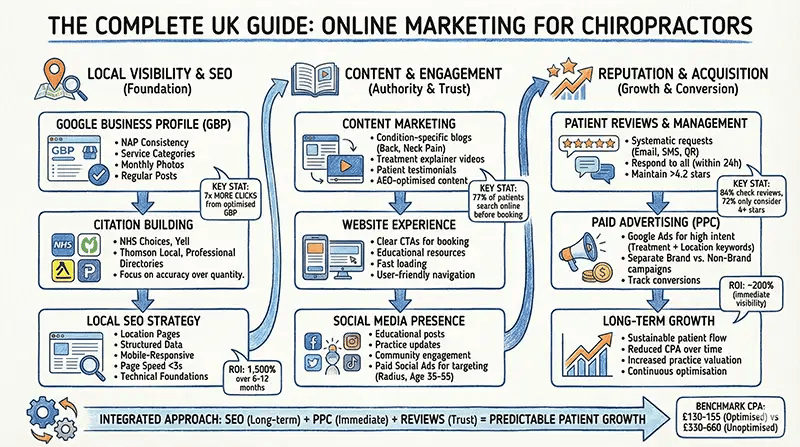
Patient behaviour has fundamentally shifted toward digital research before booking healthcare appointments. Research indicates that 77% of potential patients search online before scheduling with any healthcare provider. For local healthcare services specifically, 78% of searches demonstrate local intent, meaning patients actively seek providers in their geographic area. Practices without strong digital presence lose these patients to competitors who appear in search results.
Source: British Chiropractic Association
The UK private healthcare market, valued at £13.75-14.3 billion in 2024, continues expanding toward £18-18.7 billion by 2032-2033. Chiropractic care benefits from this growth as patients increasingly seek alternatives to NHS waiting times. Practices implementing comprehensive local SEO strategies position themselves to capture this expanding market share through improved search visibility.
How Should Chiropractors Optimise Google Business Profile?
Google Business Profile (GBP) optimisation delivers the fastest return on investment for chiropractic practices seeking local patient acquisition. Properly optimised GBP listings generate 7x more clicks than unoptimised profiles, with local pack results capturing 42-44% of all clicks for local healthcare searches. Position one in local results achieves 23.6% click-through rate, making GBP optimisation the highest priority for immediate visibility.
Essential GBP optimisation elements for chiropractic practices include accurate NAP (Name, Address, Phone) consistency across all online directories, comprehensive service categories covering specific treatments offered, high-quality practice photos updated monthly, and regular posts highlighting patient success stories and practice news. Mastering Google Business Profile requires systematic attention to these elements alongside consistent review management.
Healthcare-specific GBP features now available include appointment booking integration, health insurance acceptance details, and COVID-19 safety protocol information. Practices should complete every available field, as Google's algorithm favours comprehensive listings when determining local pack rankings. Whitehat SEO's marketing services include GBP audit and optimisation specifically configured for healthcare compliance requirements.
| GBP Element | Impact on Visibility | Priority |
|---|---|---|
| NAP Consistency | Foundation for all local SEO | Critical |
| Review Quantity & Quality | Primary ranking factor | Critical |
| Service Categories | Relevance signals | High |
| Photos (Monthly Updates) | Engagement signals | High |
| Regular Posts | Activity signals | Medium |
What Local SEO Strategies Work Best for Chiropractic Practices?
Local SEO for chiropractors extends beyond GBP to encompass website optimisation, citation building, and content strategy targeting geographic and treatment-specific keywords. Healthcare SEO delivers 1,500% ROI over time, though practices should expect 6-12 months before seeing significant organic traffic improvements. The investment proves worthwhile given patient lifetime values of £800-1,600 for UK chiropractic practices.
Effective chiropractic website optimisation requires location-specific landing pages for each treatment area, structured data markup enabling rich search results, mobile-responsive design (essential given 60%+ of healthcare searches occur on mobile devices), and page load speeds under 3 seconds. Technical foundations matter significantly—technical SEO issues prevent even excellent content from ranking.
Citation building establishes practice authority through consistent listings across healthcare directories, local business directories, and chiropractic-specific platforms. Priority citations for UK chiropractors include NHS Choices, Yell, Thomson Local, FreeIndex, and professional directories maintained by the British Chiropractic Association. Each citation reinforces location relevance signals that Google uses when determining local search rankings.
Content strategy for chiropractic practices should address patient questions throughout the treatment journey. Blog content covering condition-specific topics (back pain, neck pain, headaches) captures informational searches that convert to appointments. Starting local SEO from scratch requires systematic implementation of these elements over 6-12 months for sustainable results.
How Important Are Patient Reviews for Chiropractors?
Patient reviews represent the single most influential factor in chiropractic patient acquisition. Research demonstrates that 84% of patients check online reviews before booking healthcare appointments, with 72% only considering practices rated 4 stars or above. Perhaps most significantly, 61% of patients now prioritise online reviews over personal referrals when selecting healthcare providers—a fundamental shift from traditional word-of-mouth marketing.
Review management strategy for chiropractors must balance acquisition volume with response quality. Google's local algorithm favours practices with consistent review flow (rather than occasional bursts), average ratings above 4.2 stars, and thoughtful responses to both positive and negative reviews. Practices responding to negative reviews within 24 hours demonstrate patient care commitment that influences prospective patient decisions.
Systematic review requests should follow every positive patient interaction. Effective approaches include email follow-up 24-48 hours post-appointment, SMS review links for patients who prefer mobile communication, and in-practice signage with QR codes linking directly to Google review pages. Online reputation management requires consistent processes rather than sporadic efforts.
Source: Healthcare marketing industry benchmarks
Negative review response requires particular care for healthcare practices. Responses must maintain patient confidentiality (never confirm someone was a patient), acknowledge concerns professionally, and offer offline resolution pathways. Whitehat SEO includes review response templates and reputation monitoring within comprehensive SEO services for healthcare clients.
What Advertising Restrictions Apply to UK Chiropractors?
UK chiropractic advertising operates under strict regulatory oversight from the Advertising Standards Authority (ASA) and Committee of Advertising Practice (CAP), alongside professional standards enforced by the General Chiropractic Council (GCC). The GCC Code updated January 2026 requires all marketing claims to be evidence-based, honest, and not misleading to potential patients. Understanding these boundaries protects practices from complaints and regulatory action.
ASA/CAP guidelines updated June 2023 specify conditions chiropractors may advertise treating: general back pain, mechanical neck pain, joint pain from osteoarthritis, cervicogenic headaches, migraine prevention, ankle sprains, minor sports injuries, and tension-type headaches. Claims regarding whiplash treatment, sciatica pain intensity reduction, treatment of "all" or "most" sports injuries, and paediatric or pregnancy-related conditions require robust clinical evidence before advertising.
Compliant advertising focuses on evidence-supported claims and avoids absolute statements. Replace "cures back pain" with "may help manage back pain"; replace "treats all sports injuries" with "treats minor sports injuries." Digital advertising platforms including Google Ads and Facebook have additional healthcare advertising policies that restrict certain targeting options and require landing page compliance verification.
GDPR and PECR regulations govern patient data usage for marketing purposes. Email marketing requires explicit opt-in consent, patient testimonials require written permission for use, and any patient photos or case studies need documented approval. Healthcare practices face heightened scrutiny—GDPR compliance for marketers must inform all patient communication strategies.
Should Chiropractors Invest in Pay-Per-Click Advertising?
Pay-per-click advertising provides immediate visibility for chiropractic practices, particularly valuable during practice launches, seasonal slow periods, or when entering competitive markets. Healthcare paid search converts at 8.09%—significantly higher than many industries—reflecting the high intent of patients actively searching for treatment. PPC delivers approximately 200% ROI when campaigns are properly structured and targeted.
Google Ads for chiropractors should target treatment-specific and location-modified keywords. High-performing keyword categories include "[condition] treatment [location]" (e.g., "back pain treatment London"), "[service] chiropractor [location]," and "chiropractor near me" variants. Negative keyword management prevents budget waste on unrelated searches—exclude terms like "free," "NHS," "insurance," and unrelated conditions.
Campaign structure should separate brand terms (practice name searches) from non-brand terms (treatment and location searches), enabling different bidding strategies and budget allocation. Conversion tracking must measure appointment bookings, phone calls, and contact form submissions to calculate true patient acquisition cost. PPC management services from Whitehat SEO include healthcare-specific campaign optimisation and compliance review.
| Channel | Typical ROI | Time to Results |
|---|---|---|
| Local SEO | 1,500% | 6-12 months |
| Google Ads PPC | 200% | Immediate |
| Email Marketing | £36 per £1 | Ongoing |
| Social Media | Variable | 3-6 months |
Budget allocation between SEO and PPC depends on practice maturity and growth objectives. New practices benefit from PPC for immediate patient flow while SEO builds. Established practices often reduce PPC spend as organic visibility matures. The optimal approach combines both channels—SEO vs PPC analysis helps determine the right balance for specific practice circumstances.
How Can Chiropractors Use Content Marketing Effectively?
Content marketing establishes chiropractic practices as trusted authorities while capturing search traffic from patients researching conditions and treatments. Educational content addressing common questions—"What causes lower back pain?", "How many chiropractic sessions do I need?", "Is chiropractic safe?"—attracts potential patients at the awareness stage of their healthcare journey, nurturing them toward appointment booking.
Blog content strategy for chiropractors should balance condition-focused articles (back pain, neck pain, headaches, sciatica symptoms), treatment explanation content (what to expect during visits, adjustment techniques, recovery timelines), and local relevance signals (community involvement, local health tips, practice news). Each article should include clear calls-to-action guiding readers toward appointment booking or consultation requests.
Video content performs exceptionally well for healthcare practices. Patient testimonials (with documented consent), treatment explanation videos, practice tours, and chiropractor introduction videos build trust before patients ever visit. YouTube ranks as the second-largest search engine—optimised video content captures patients searching for visual information about chiropractic care. Video marketing strategy guides provide detailed implementation frameworks.
Answer Engine Optimisation (AEO) represents the emerging frontier for healthcare content. AI assistants increasingly answer patient questions directly—practices whose content gets cited by ChatGPT, Google AI Overviews, and similar platforms gain significant visibility. AEO services from Whitehat SEO structure content specifically for AI citation, future-proofing practice visibility as search behaviour evolves.
What Social Media Approach Works for Chiropractic Practices?
Social media marketing for chiropractors builds community presence and reinforces practice authority, though it typically delivers lower direct patient acquisition than search-based channels. Facebook and Instagram prove most effective for UK healthcare practices, enabling practice personality display, patient education content, and community engagement that strengthens relationships with existing patients while reaching their networks.
Content mix for chiropractic social media should include educational posts (posture tips, workplace ergonomics, exercise recommendations), behind-the-scenes practice content (team introductions, facility tours, day-in-the-life content), patient success stories (with appropriate consent), and community involvement highlights. Avoid overly promotional content—social media algorithms penalise posts that feel like advertisements.
Paid social advertising enables precise demographic targeting useful for chiropractic patient acquisition. Facebook and Instagram ads can target users by location (radius around practice), age (35-55 demographic shows highest chiropractic usage), interests (fitness, wellness, sports), and behaviours (recent movers often seek new healthcare providers). Budget £200-500 monthly for testing before scaling successful campaigns.
Social proof through consistent posting maintains practice visibility in patient feeds, reinforcing relationships and encouraging rebooking. Practices should post 3-5 times weekly across platforms, respond to comments and messages within 24 hours, and engage with local community content to build reciprocal relationships. Social media marketing strategy resources provide platform-specific guidance.
Ready to Grow Your Chiropractic Practice?
Whitehat SEO helps UK healthcare practices attract more patients through compliant, effective digital marketing. As a HubSpot Diamond Partner with extensive healthcare marketing experience, we understand the unique challenges chiropractors face.
Request a free website audit to identify your practice's growth opportunities.
Frequently Asked Questions About Chiropractic Marketing
How much should a chiropractor spend on marketing?
UK chiropractic practices typically invest 5-10% of revenue in marketing. For a practice generating £200,000 annually, this means £10,000-£20,000 per year. Practices using optimised digital marketing achieve patient acquisition costs of £130-155 compared to £330-660 for unoptimised approaches, making the investment highly profitable.
What can chiropractors legally claim in UK advertising?
Under ASA/CAP guidelines updated June 2023, UK chiropractors can advertise treatment for general back pain, mechanical neck pain, joint pain from osteoarthritis, cervicogenic headaches, migraine prevention, ankle sprains, minor sports injuries, and tension-type headaches. Claims about whiplash, sciatica, or treating children require robust clinical evidence.
How long does SEO take to work for chiropractors?
Local SEO for chiropractic practices typically shows initial results within 3-6 months, with significant improvements in 6-12 months. Google Business Profile optimisation often delivers faster results, with increased visibility in local map results within 4-8 weeks when properly optimised with consistent NAP information and regular reviews.
Do online reviews really matter for chiropractic practices?
Online reviews are crucial for chiropractic patient acquisition. Research shows 84% of patients check online reviews before booking healthcare appointments, with 72% only considering practices rated 4 stars or above. In fact, 61% of patients now prioritise online reviews over personal referrals when choosing a chiropractor.
Should chiropractors use paid advertising or SEO?
Both channels serve different purposes. SEO delivers 1,500% ROI over time but requires 6-12 months to mature. PPC advertising provides immediate visibility with healthcare paid search converting at 8.09%. The optimal approach combines local SEO for sustainable growth with targeted PPC for immediate patient acquisition during practice launches or quiet periods.
Taking Your Chiropractic Marketing Forward
Successful online marketing for chiropractors requires systematic implementation across multiple channels, with local SEO, Google Business Profile optimisation, and review management forming the foundation. UK practices face unique regulatory considerations that make healthcare-specific marketing expertise valuable—general marketing agencies often lack understanding of ASA/CAP compliance requirements and GCC professional standards.
Practices serious about growth should audit current digital presence against the benchmarks outlined in this guide: GBP completeness, citation consistency, review volume and velocity, website technical health, and content coverage of key patient questions. Gaps in any area represent immediate improvement opportunities that compound over time as search rankings improve.
Whitehat SEO specialises in healthcare marketing for UK practices, combining SEO expertise with HubSpot implementation for practices ready to systematise patient acquisition. Our approach integrates compliant content strategy, local visibility optimisation, and marketing automation that converts website visitors into booked appointments. Contact our team to discuss your practice's specific growth objectives. view our pricing