
Published: 11 January 2026 | Last Updated: 11 January 2026
HubSpot vs WordPress: Which CMS Is Right for UK B2B Companies in 2026?
For UK B2B companies, HubSpot Content Hub excels when marketing-sales alignment and native CRM integration are priorities, offering managed security and GDPR compliance out-of-the-box. WordPress suits organisations needing maximum customisation with strong technical teams, though requires careful plugin management for security and compliance. According to Patchstack's 2025 security report, WordPress sites face 22 new vulnerabilities daily—a 34% increase from 2023—making platform security a critical consideration for UK businesses handling customer data.
Understanding the CMS Landscape in 2026
WordPress dominates the global CMS market with 60.2% share (43% of all websites), according to W3Techs January 2026 data. HubSpot Content Hub holds just 0.3% of the CMS market but serves a fundamentally different purpose—it's the only CMS built natively on a CRM platform, designed specifically for revenue-focused marketing teams.
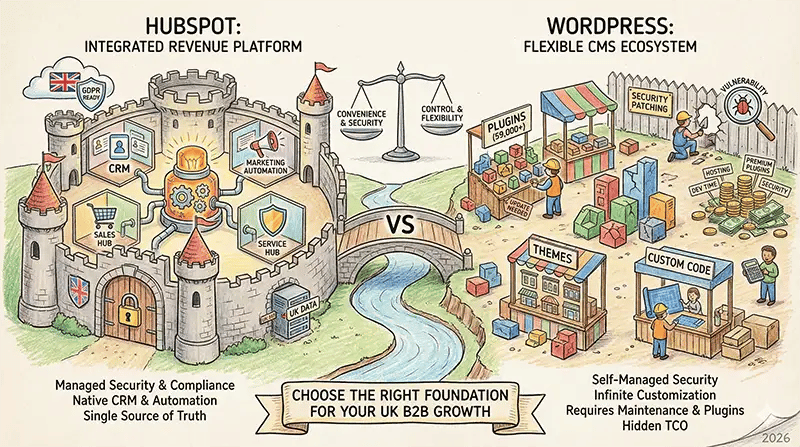
This distinction matters for UK B2B companies. WordPress excels as a flexible content publishing platform, whilst HubSpot Content Hub functions as an integrated marketing operations centre. With 247,939 paying HubSpot customers globally (21% year-on-year growth per Q4 2024 earnings), the platform's momentum reflects increasing B2B demand for unified marketing-sales systems.
Whitehat's experience as a HubSpot Diamond Partner reveals a clear pattern: organisations choosing between these platforms aren't comparing like-for-like. The decision hinges on whether you need a website platform (WordPress) or a revenue operations platform with website capabilities (HubSpot).
Security: The 7,966 Vulnerabilities Problem
WordPress security requires active management. Patchstack's 2025 State of WordPress Security report documented 7,966 new vulnerabilities in 2024—averaging 22 per day. Critically, 96% originate from plugins and themes, not WordPress core (which had only 7 vulnerabilities). For UK B2B companies processing customer data, this creates ongoing compliance risk.
WordPress Security Statistics (2024-2025):
- 7,966 new vulnerabilities identified in 2024
- 33% remain unpatched at time of disclosure
- 95.5% of CMS-based website infections affect WordPress
- Average site faces attack attempts every 22-32 minutes
- Wordfence blocked 9+ billion XSS attempts in 2024
HubSpot takes a fundamentally different approach. As a managed SaaS platform, security is handled centrally—SOC 2 Type II certified, with 99.99% uptime SLA and automatic updates. UK businesses benefit from HubSpot's EU data centre option in Frankfurt, addressing post-Brexit data residency considerations. However, HubSpot is not HIPAA compliant, making it unsuitable for healthcare organisations handling protected health information.
For UK B2B companies, the security question becomes operational: do you have the technical resources to maintain WordPress security continuously, or does managed security better fit your team structure? Whitehat's website audit service frequently identifies WordPress security gaps that accumulate over time—outdated plugins, misconfigured permissions, and missing security headers.
UK GDPR and Cyber Essentials Compliance
UK data protection requirements create distinct CMS considerations. The UK GDPR carries maximum penalties of 4% of global turnover or £17.5 million—making compliance a board-level concern. The Data (Use and Access) Act 2025 further refined requirements, simplifying some B2B email provisions whilst maintaining strict consent standards.
HubSpot provides built-in GDPR compliance tools: cookie consent management, data subject request workflows, lawful basis tracking, and EU data processing agreements. WordPress requires third-party plugins (CookieYes, Complianz) and manual configuration—adding ongoing maintenance overhead and potential compliance gaps.
For UK businesses supplying government contracts, Cyber Essentials certification is mandatory. Over 215,000 certificates have been issued, reflecting growing public sector security requirements. HubSpot's managed hosting satisfies most Cyber Essentials controls automatically. WordPress deployments require documented evidence of firewall configuration, secure configuration, access control, malware protection, and patch management—each requiring manual setup and ongoing verification.
The ICO's guidance for organisations emphasises accountability and documentation. HubSpot's audit trails and centralised consent management simplify compliance evidence, whilst WordPress implementations typically require additional tooling and processes. For detailed guidance on marketing compliance, see Whitehat's GDPR for Marketers resource.
Total Cost of Ownership: UK Pricing Analysis
Direct price comparison misleads because WordPress and HubSpot include different components. WordPress itself is free, but professional B2B deployments require hosting, security, premium plugins, development, and ongoing maintenance. HubSpot bundles hosting, security, CDN, SSL, and CRM integration into tiered subscriptions.
HubSpot Content Hub Pricing (GBP, January 2026):
| Tier | Monthly Cost | Key Features |
|---|---|---|
| Starter | £18-21 | Basic CMS, forms, limited reporting |
| Professional | £315-440 | Smart content, A/B testing, SEO tools |
| Enterprise | £1,050-1,310 | Multi-domain, advanced permissions |
WordPress TCO varies significantly based on requirements. Budget implementations run £500-1,200 annually, professional B2B sites typically cost £1,000-1,400 per year, whilst enterprise deployments requiring high availability and custom development reach £3,200-7,500 annually. Hidden costs include renewal price increases (many hosts offer discounted first-year pricing), security incident response (£160-400 per incident), and developer time for updates and troubleshooting.
Essential WordPress plugins add substantial cost: Yoast Premium (£99/year), Elementor Pro (£79/year), WPForms Pro (£160/year), and Wordfence Premium (£119/site/year). A properly equipped B2B WordPress site often matches or exceeds HubSpot Professional pricing once all components are included.
Marketing Automation and CRM Integration
Marketing automation delivers measurable returns: $5.44 ROI per $1 spent over three years, with 80% more leads generated compared to non-automated approaches. For UK B2B companies, the question is whether automation capabilities are native or bolted-on.
HubSpot Content Hub connects directly to HubSpot CRM—website visitor behaviour automatically enriches contact records, enabling personalised content and lead scoring without integration work. Smart content displays different messaging based on visitor lifecycle stage, company size, or previous engagement. This native connection means 91% attribution visibility for marketing-sourced pipeline.
WordPress requires third-party marketing automation platforms (HubSpot Marketing Hub, Mailchimp, ActiveCampaign) connected via plugins. Integration quality varies—some provide basic form sync, others offer deeper behavioural tracking. Each integration adds maintenance burden and potential data sync issues. B2B landing page conversion rates average 13.28% (Unbounce Q4 2024), but achieving this requires careful optimisation regardless of platform.
Whitehat's marketing services team frequently encounters WordPress-HubSpot integration challenges—duplicate contacts, missing attribution data, and workflow failures after plugin updates. Native integration eliminates these friction points.
SEO and Content Performance
Both platforms support strong SEO when properly configured. WordPress offers unmatched flexibility through plugins like Yoast and Rank Math, enabling granular technical SEO control. HubSpot provides built-in SEO recommendations, topic cluster tools, and content strategy features—less customisable but requiring less expertise.
For technical SEO, WordPress allows complete control over site architecture, schema markup, server configuration, and page speed optimisation. HubSpot handles technical SEO automatically—SSL, mobile responsiveness, CDN delivery, and Core Web Vitals—but limits advanced customisation.
The emerging priority is AI search optimisation (AEO). Gartner predicts 25% reduction in traditional search traffic by 2026, with ChatGPT Search commanding 82.6% of AI search market share. Content structure matters increasingly—direct answers, comprehensive FAQ sections, and authoritative statistics improve AI citation likelihood. HubSpot's structured content features support AEO patterns, whilst WordPress requires manual implementation.
Making the Right Choice for Your Business
Platform selection should align with organisational capabilities and priorities, not feature lists.
Choose HubSpot Content Hub when:
- Marketing-sales alignment and attribution are priorities
- You lack dedicated development resources
- UK GDPR compliance simplicity matters
- CRM integration must be seamless
- You prefer managed security over self-managed
Choose WordPress when:
- Maximum design and functionality flexibility is essential
- You have reliable development and maintenance resources
- Complex integrations require custom development
- Budget constraints favour lower initial investment
- You need complete control over technical implementation
For organisations using HubSpot CRM already, Content Hub creates natural synergies. For those requiring extensive customisation or operating with strong technical teams, WordPress may deliver better value. Whitehat works with both platforms—our HubSpot website design services help B2B companies maximise platform capabilities.
Frequently Asked Questions
Is HubSpot more secure than WordPress?
HubSpot provides managed security with SOC 2 Type II certification, automatic updates, and 99.99% uptime SLA—eliminating most security management burden. WordPress can achieve equivalent security but requires continuous monitoring, plugin updates, and security plugin configuration. With 7,966 new WordPress vulnerabilities in 2024, self-managed security demands ongoing attention.
Can I migrate from WordPress to HubSpot?
Yes, WordPress to HubSpot migration is straightforward for content but requires planning for URL structures, redirects, and functionality replacement. HubSpot provides migration tools for blog content. Custom functionality may need rebuilding using HubSpot's CMS modules or custom code. Most B2B migrations complete within 4-8 weeks.
Which platform is better for UK GDPR compliance?
HubSpot includes built-in GDPR tools: cookie consent, data subject request workflows, lawful basis tracking, and EU data centre options. WordPress requires third-party plugins for equivalent functionality. Both platforms can achieve compliance, but HubSpot reduces implementation effort and ongoing maintenance.
What does HubSpot Content Hub actually cost for UK businesses?
HubSpot Content Hub starts at £18-21/month (Starter), with Professional tier at £315-440/month including smart content and A/B testing. Enterprise runs £1,050-1,310/month. These prices include hosting, SSL, CDN, and security. WordPress appears cheaper initially but total cost including essential plugins, hosting, security, and maintenance often matches HubSpot Professional.
Does HubSpot support Cyber Essentials certification?
HubSpot's managed hosting satisfies most Cyber Essentials controls automatically—firewall protection, secure configuration, access control, and patch management are handled centrally. Organisations pursuing certification still need to document their overall security posture, but HubSpot simplifies the website component significantly compared to self-hosted WordPress.
Which platform offers better SEO capabilities?
WordPress offers more granular SEO control through plugins like Yoast Premium, enabling advanced technical optimisation. HubSpot provides built-in SEO recommendations and topic cluster tools with less customisation but simpler implementation. Both platforms support strong SEO performance—the difference lies in control versus convenience. For comprehensive guidance, consult a specialist SEO agency.