
What Makes Go-to-Market Strategies Succeed in an AI-Driven World?
Go-to-market success hinges on what Varun Anand of Clay calls "GTM alpha"—unique customer insights your competitors lack. In today's AI-driven market, winning strategies combine this proprietary knowledge with rapid iteration and multi-channel execution, whilst recognising that every competitive advantage has an expiration date requiring continuous reinvention.
Varun Anand, co-founder of Clay—the $3.1 billion GTM platform backed by Sequoia Capital and used by companies like OpenAI, Anthropic, and Canva—introduced a framework he calls "The Physics of GTM" at INBOUND 2025. His three laws provide a scientific approach to understanding why some go-to-market strategies create lasting competitive advantage whilst others fail.
The timing is critical. With 72% of organisations having adopted AI technologies (McKinsey, May 2024) and 83% of AI-enabled sales teams experiencing revenue growth (Salesforce, July 2024), the competitive landscape has fundamentally shifted. Traditional go-to-market playbooks no longer suffice when buyers leverage AI to research solutions, competitors deploy intelligent automation, and market dynamics evolve weekly rather than quarterly.
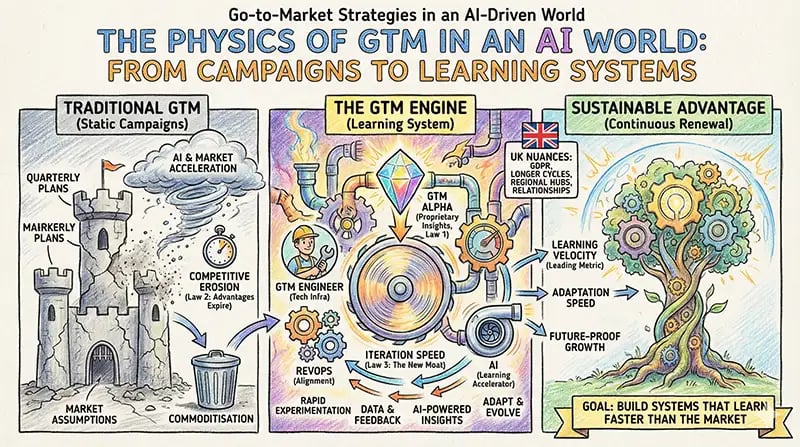
For UK B2B organisations navigating this transformation, understanding these principles isn't academic—it's survival. The question isn't whether to adapt your GTM strategy, but how quickly you can identify your unique advantages, recognise when they're eroding, and build systems that accelerate learning faster than competitors. Strategic marketing coaching helps organisations systematically apply these frameworks to their specific market context.
The Physics of Competitive Advantage: Why "GTM Alpha" Matters
Clay coined the term "GTM alpha" in April 2025 to describe the proprietary insights that give companies an unfair advantage. Like financial alpha—returns exceeding market benchmarks—GTM alpha represents knowledge about customers, markets, or channels that competitors cannot easily replicate.
This isn't about having better products or more budget. It's about possessing unique understanding. Examples include: knowing precisely which customer pain points drive purchasing decisions at specific revenue thresholds, having mapped the actual decision-making process within your target accounts, understanding which content types move prospects between buying stages, or discovering underutilised channels where your ideal customers congregate.
The challenge? Most organisations operate on market assumptions rather than proprietary knowledge. They copy competitor strategies, follow industry best practices, and execute campaigns based on what "should" work rather than what their data proves works. This commoditises their approach and eliminates competitive differentiation.
Consider the evidence: research from Aberdeen Group shows that companies deploying four or more integrated marketing channels achieve 300% better results than single-channel approaches. Yet the advantage isn't merely channel quantity—it's understanding which specific channel combinations resonate with your particular audience, at what journey stages, and why.
UK B2B companies face unique GTM alpha opportunities. British buyers conduct more thorough research than US counterparts, with 81% having preferred vendors before initial contact (6sense, 2024). This creates alpha for organisations that invest in educational content and thought leadership, positioning themselves during the invisible 70% of the buying journey that occurs before sales engagement.
The Expiration Date of Every Advantage: Competitive Erosion
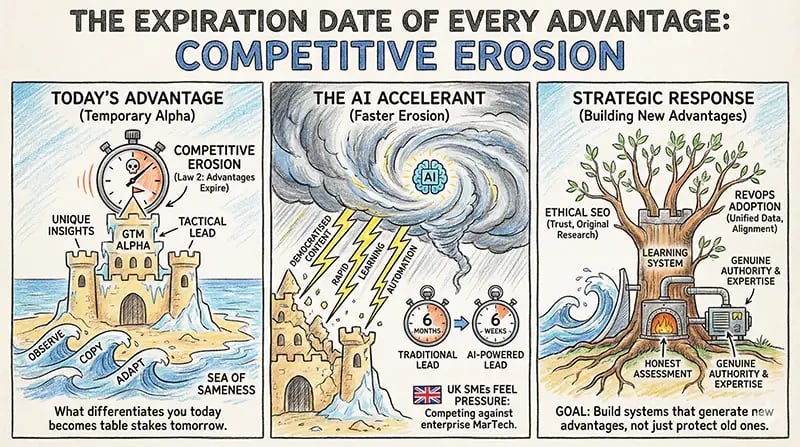
Anand's second law confronts an uncomfortable truth: every competitive advantage carries an expiration date. What differentiates you today becomes table stakes tomorrow as competitors observe, copy, and adapt. The question isn't whether your GTM alpha will erode, but how quickly.
This erosion accelerates in AI-enabled markets. When AI tools democratise content creation, data analysis, and campaign execution, tactical advantages compress. The six-month lead your team gained by mastering a new marketing automation feature? Competitors now learn it in six weeks through AI-powered training and implementation.
UK SMEs particularly feel this pressure. With 35% actively using AI (British Chambers of Commerce, 2025) and marketing technology spend exceeding £35.1 billion annually, smaller organisations compete against enterprises wielding sophisticated MarTech stacks. The traditional SME advantages—agility, personal service, local knowledge—require constant reinforcement as larger competitors automate relationship-building and local targeting.
The strategic response isn't protecting current advantages—it's building systems that generate new ones. This requires honest assessment of your GTM position. Which elements of your strategy depend on capabilities competitors could replicate within quarters? Which rest on truly proprietary insights or relationships that take years to develop?
Ethical SEO services exemplify sustainable advantage-building. Whilst AI can generate content at scale, genuine authority—earned through years of expertise, original research, and consistent value delivery—remains difficult to replicate. The organisations winning long-term focus less on tactics and more on building defensible market positions.
Revenue Operations adoption illustrates competitive erosion in action. Just 48% of organisations currently have RevOps functions (Gartner, 2024), but Gartner predicts 75% of highest-growth companies will deploy RevOps by 2025. What provides competitive advantage today becomes baseline expectation tomorrow. The organisations positioning themselves ahead of this curve—unifying data, aligning teams, optimising revenue processes—capture temporary alpha. Those arriving late simply match market norms.
Iteration Speed as Competitive Moat: The Learning Advantage
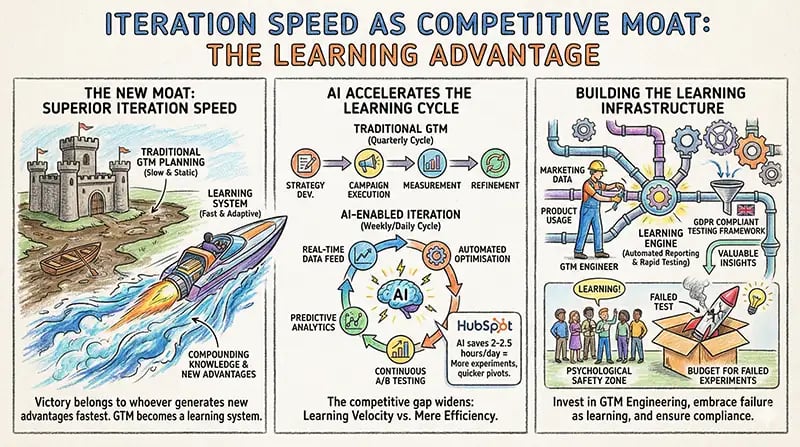
Anand's third law addresses how organisations outpace competitive erosion: through superior iteration speed. If every advantage expires, victory belongs to whoever generates new advantages fastest. This transforms GTM strategy from planning exercise to learning system.
The mathematics support this. Companies running systematic experimentation across messaging, channels, and audience segments accumulate compounding knowledge. Each test reveals insights—what resonates, what converts, which assumptions prove false. Over months and years, this experimental infrastructure creates information advantages competitors cannot replicate by simply copying visible tactics.
AI dramatically accelerates this cycle. Research from HubSpot shows AI saves sales professionals 2-2.5 hours daily through automation of repetitive tasks. This recovered time enables more experiments, faster analysis, and quicker pivots. The competitive gap widens between organisations leveraging AI for learning velocity versus those using it merely for efficiency.
Consider practical implementation. Traditional GTM planning operates quarterly: strategy development, campaign creation, execution, measurement, refinement. AI-enabled iteration operates weekly or daily. Real-time performance data feeds automated optimisation. A/B testing runs continuously across messaging variants. Predictive analytics identify winning approaches before full campaign deployment.
UK organisations face specific considerations. GDPR requirements for data handling and the Legitimate Interest basis for B2B marketing necessitate careful implementation. Yet constraints force creativity—organisations building GDPR-compliant testing frameworks often discover insights competitors miss through less disciplined approaches. Proper HubSpot implementation establishes this testing infrastructure whilst maintaining regulatory compliance.
The emerging role of "GTM Engineer"—coined by Clay to describe technical specialists building go-to-market infrastructure—reflects this shift. These professionals create data pipelines connecting marketing, sales, and product systems. They automate reporting, enable rapid testing, and build tools that accelerate organisational learning. Companies investing in GTM engineering capacity compound their learning advantages exponentially.
Importantly, iteration speed requires psychological safety for failure. Organisations where teams fear proposing experiments, or where politics punish unsuccessful tests, artificially constrain learning velocity. The fastest-learning companies explicitly budget for failed experiments, recognising that insights from what doesn't work prove as valuable as successes.
Building Your GTM Engine: From Strategy to System
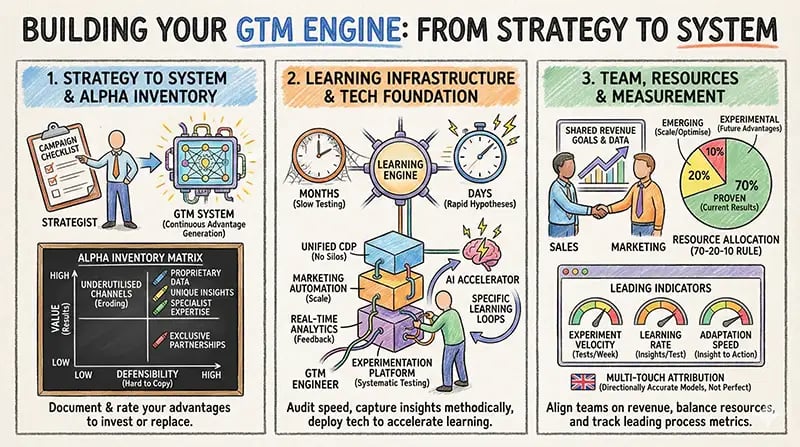
Translating Anand's physics into operational reality requires shifting from campaign thinking to systems thinking. Rather than asking "what marketing should we execute?" the strategic question becomes "what system will continuously generate new advantages?"
Start with your alpha inventory. Document your current competitive advantages: unique customer insights, proprietary data, exclusive partnerships, specialist expertise, or underutilised channels. Rate each advantage on two dimensions: value (how much it drives results) and defensibility (how difficult for competitors to replicate). This matrix reveals which advantages deserve investment in strengthening versus which require replacement as they erode.
Next, audit your learning infrastructure. How quickly can your organisation test new hypotheses? How many experiments did you run last quarter? How systematically do you capture and share insights across teams? Companies with mature GTM engines answer: days not months, dozens not handful, and methodically through centralised systems.
The technology foundation matters. AI implementation for marketing and sales isn't about adopting every new tool—it's strategically deploying technology that accelerates specific learning loops. Essential capabilities include: unified customer data platforms eliminating silos, marketing automation enabling personalisation at scale, analytics infrastructure providing real-time feedback, and experimentation platforms supporting systematic testing.
Team structure requires attention. The data supports sales and marketing alignment: organisations with strong alignment achieve 36% higher customer retention and 38% higher sales win rates. Yet true alignment transcends shared meetings—it requires shared data, shared metrics, and shared incentives for revenue outcomes rather than activity outputs.
Resource allocation follows the 70-20-10 rule borrowed from innovation management. Allocate 70% of resources to proven channels and tactics delivering current results. Dedicate 20% to optimising and scaling emerging opportunities showing promise. Reserve 10% for pure experimentation with unproven approaches. This balance maintains current performance whilst building future advantages.
Measurement frameworks must evolve beyond vanity metrics. Track leading indicators predicting future performance: experiment velocity (tests launched per week), learning rate (insights captured per experiment), and adaptation speed (time from insight to implementation). These process metrics reveal GTM engine health better than lagging revenue figures.
Marketing attribution remains challenging but critical. UK organisations operating across multiple regions face added complexity tracking buyer journeys spanning months. The solution lies not in perfect attribution but in directionally accurate models improved iteratively. Multi-touch attribution provides better insight than last-click models, whilst acknowledging limitations in tracking every touchpoint.
UK B2B Go-to-Market in 2025: Market-Specific Considerations
British organisations face distinct GTM dynamics requiring strategy adaptation. The UK holds 34% of the European marketing automation market share (Mordor Intelligence, 2024), indicating sophisticated buyer expectations and mature competitive landscapes. Success demands understanding these nuances rather than importing US-centric playbooks wholesale.
Budget realities differ. UK B2B firms allocate 9.44-10.78% of company budgets to marketing, comparable to but slightly lower than US norms. With 53% of UK SMEs increasing marketing investment (New Digital Age, 2024) despite economic uncertainty, the organisations winning share strategic investments in capabilities—technology, talent, testing infrastructure—over pure spending increases.
Sales cycles run longer. British buyers conduct exhaustive research, with 75% of business meetings still occurring in-person versus heavy US reliance on video calls. The typical UK enterprise sale spans 4-5 months compared to 3 months in the US. This demands patience and content strategies supporting extended evaluation periods. Educational content, case studies with detailed ROI analysis, and multi-stakeholder buying guides prove particularly effective.
Regional considerations matter more than many assume. London-centric strategies miss significant markets in Manchester, Edinburgh, Birmingham, and Bristol tech corridors. Each regional cluster carries distinct buyer characteristics, competitive dynamics, and networking ecosystems requiring localised approach elements within broader national strategy.
Regulatory compliance shapes competitive advantage. Organisations demonstrating GDPR sophistication, transparent data handling, and ethical AI usage signal trustworthiness to buyers increasingly concerned with responsible technology deployment. This proves particularly relevant in regulated sectors—financial services, healthcare, professional services—where compliance represents table stakes rather than differentiator.
The British professional services market—law firms, accountancies, consultancies—presents specific GTM opportunities. These sectors traditionally lag technology adoption but increasingly recognise competitive necessity. Partners who grew practices through relationships now confront reality that future growth requires systematic marketing. The organisations helping these sectors navigate this transition, particularly through proven GTM frameworks adapted to professional services constraints, capture underserved markets.
Brexit implications persist. Companies serving European markets from UK bases face added complexity in cross-border marketing, data transfer, and sales operations. Yet this complexity creates moats—organisations building Brexit-compliant GTM infrastructure possess capabilities smaller competitors cannot easily match.
Cultural factors influence messaging and positioning. British buyers respond to understated confidence over hyperbolic claims. Case studies emphasising practical results outperform aspirational brand messaging. Self-deprecating humour used judiciously builds rapport, whilst aggressive sales tactics trigger resistance. Understanding these subtleties separates effective UK GTM from American approaches transplanted without adaptation.
Budget planning tools help organisations align investments with market realities. The question isn't spending more but allocating strategically across brand building (developing long-term market position), demand capture (converting in-market buyers), and GTM infrastructure (building learning systems that compound advantages).
Frequently Asked Questions
What is a go-to-market strategy?
A go-to-market strategy is a comprehensive plan that defines how a company will reach target customers and achieve competitive advantage. It encompasses market positioning, customer segmentation, channel selection, pricing strategy, and the coordination of marketing, sales, and product teams to deliver value. Effective GTM strategies identify unique customer insights (GTM alpha), recognise when advantages erode, and build systems enabling rapid iteration and learning.
What are the key components of a go-to-market strategy?
Key GTM components include: target market definition and buyer personas based on deep customer research, unique value proposition and competitive positioning demonstrating GTM alpha, pricing and revenue model aligned with customer value perception, sales and distribution channels optimised for buyer preferences, marketing strategy and demand generation across multiple integrated channels (research shows 4+ channels deliver 300% better results), customer success and retention plans, and measurement frameworks with clear KPIs tracking both results and learning velocity.
What is a GTM engineer?
A GTM engineer is an emerging role focused on building technical infrastructure for go-to-market operations. They create data pipelines connecting marketing, sales, and product systems; automate workflows eliminating manual processes; integrate tools across the revenue stack; develop custom solutions addressing unique GTM challenges; and build systems enabling sales and marketing teams to operate efficiently at scale. This role reflects the shift from GTM as campaign execution to GTM as engineered system.
What is Revenue Operations (RevOps)?
Revenue Operations unifies marketing, sales, and customer success under shared goals, data, and processes. RevOps eliminates silos between teams, providing consistent reporting, streamlined tools, and coordinated strategy focused on revenue outcomes rather than functional metrics. Currently 48% of organisations have implemented RevOps functions (Gartner, 2024), with adoption accelerating. Companies with strong alignment achieve 36% higher customer retention and 38% higher sales win rates.
How do you measure go-to-market success?
GTM success metrics include: customer acquisition cost and payback period demonstrating efficiency, revenue growth and pipeline velocity showing momentum, market penetration and share gains versus competitors, customer retention and lifetime value ratios indicating product-market fit, sales cycle length revealing friction points, win rates versus competitors, and critically—learning velocity metrics like experiment frequency and adaptation speed. The specific mix depends on business model, growth stage, and strategic priorities. Leading indicators often prove more actionable than lagging revenue figures.
How is AI changing go-to-market strategies?
AI is transforming GTM through enhanced personalisation at scale, predictive analytics for targeting and prioritisation, automated content and outreach freeing time for strategy, improved lead scoring and qualification, faster market intelligence and competitive analysis, and dramatically accelerated testing and optimisation cycles. Research shows 83% of AI-enabled sales teams experienced revenue growth (Salesforce, 2024), whilst AI saves sales professionals 2-2.5 hours daily through automation (HubSpot, 2024). The competitive advantage shifts from tactical execution to learning velocity.
Why do go-to-market strategies fail?
Common GTM failures stem from: poor market understanding and targeting based on assumptions rather than data, weak differentiation or value proposition lacking genuine GTM alpha, misalignment between marketing, sales, and product creating internal friction, inadequate resources or unrealistic timelines undermining execution, failure to iterate based on market feedback, treating GTM as one-time plan rather than continuous system, and losing competitive advantages through slow adaptation as market dynamics shift. The root cause often traces to insufficient investment in learning infrastructure.
How long does it take to develop a GTM strategy?
Developing a comprehensive GTM strategy typically requires 6-12 weeks for initial planning, including market research, competitive analysis, positioning development, channel planning, and resource allocation. Implementation and optimisation continue for 3-6 months as you test approaches, gather market feedback, and refine based on results. However, modern GTM operates as continuous system rather than one-time project—the organisations building sustainable advantages invest in ongoing learning infrastructure, systematic experimentation, and rapid iteration capabilities that compound over years.
The Path Forward: Building Sustainable GTM Advantage
Varun Anand's Three Laws of GTM provide more than theoretical framework—they offer practical guidance for navigating markets where competitive dynamics shift faster than ever. The physics are clear: identify unique advantages (GTM alpha), recognise their inevitable erosion (competitive expiration), and build systems generating new advantages faster than old ones decay (iteration velocity).
For UK B2B organisations, this translates to specific imperatives. Audit your current competitive advantages honestly—which rest on proprietary insights versus copied tactics? Invest in learning infrastructure enabling systematic experimentation and rapid adaptation. Unify marketing, sales, and customer success around shared revenue goals and data. Deploy AI strategically for learning acceleration, not merely efficiency. Build defensible positions through capabilities requiring time to develop—deep customer relationships, original research, genuine expertise—rather than tactics competitors replicate quickly.
The organisations thriving in 2025 and beyond share common characteristics: they treat GTM as engineered system rather than campaign collection, invest in capabilities compounding over time, maintain disciplined focus on unique advantages whilst honestly assessing when those advantages erode, and create cultures where experimentation and learning receive explicit support and resources.
The question facing every B2B leader isn't whether their GTM strategy requires evolution—the evidence demonstrates it does. The question is whether they'll build learning systems generating sustainable advantages, or continue executing tactics providing temporary results until competitors inevitably catch up. The physics are unforgiving, but they're also liberating: focus on proprietary insights, acknowledge nothing lasts forever, and build engines that learn faster than markets evolve.
Understanding AI's impact on marketing provides essential context for building these capabilities, whilst systematic approaches to marketing operations and technology translate strategic intent into operational reality. marketing services view our pricing