
A go-to-market (GTM) strategy is a comprehensive business plan that outlines how you'll deliver your product or service to target customers, establish market positioning, and generate revenue. Unlike a marketing strategy (which focuses on demand generation and brand messaging), GTM encompasses product-market fit validation, buyer journey mapping, channel selection, pricing strategy, and sales enablement—integrating marketing, sales, product, and customer success into one cohesive roadmap.
60%
Buyers Research Independently
Before initial contact
13
Decision-Makers per Deal
Average B2B buying committee
25%
Product Launches Succeed
Without strategic GTM
57%
B2B Teams Using ABM
With positive ROI reported
Sources: Prospeo 2026, BCG Product Launch Analysis, HubSpot ABM Report 2026
What Is a Go-to-Market Strategy?
A go-to-market strategy is the operational playbook for bringing a product or service to customers profitably and at scale. It answers five critical questions:
- Who is your ideal customer? (Ideal Customer Profile)
- What problem do you solve for them? (Value proposition)
- How will they discover and buy from you? (Buyer journey and channels)
- What's your pricing and packaging? (Commercial model)
- How will you measure success? (KPIs and benchmarks)
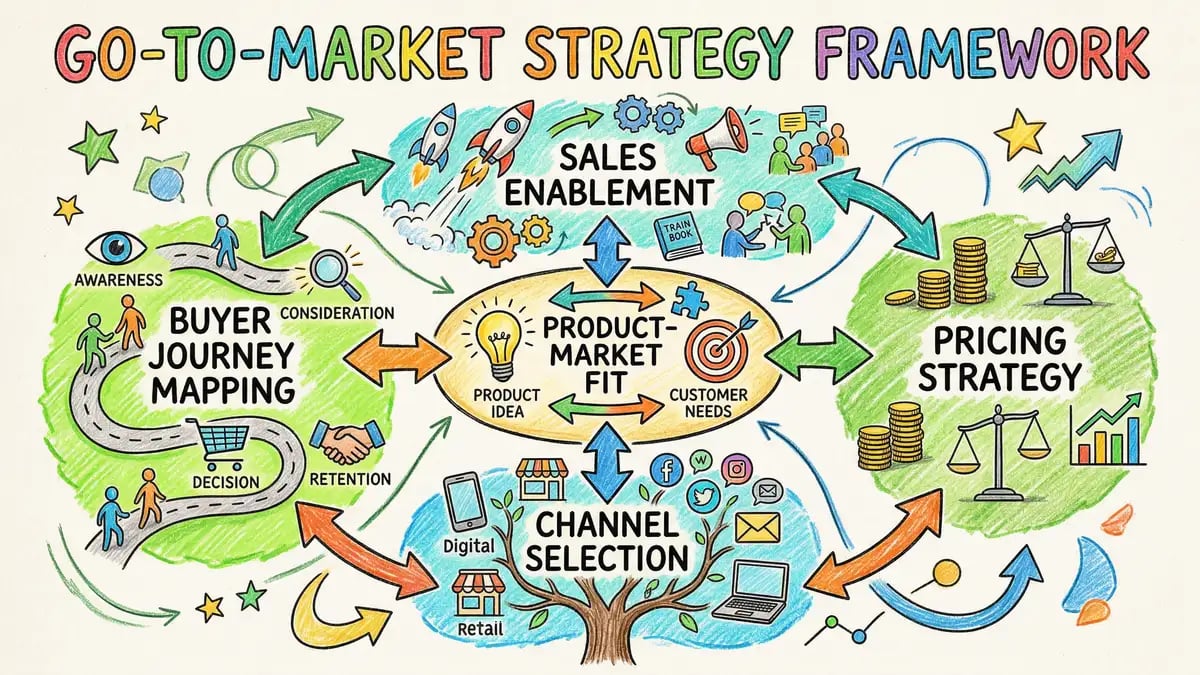
GTM Strategy vs. Marketing Strategy
The terms are often confused, but they're distinct:
GTM Strategy (Broader)
Encompasses product positioning, pricing, sales model, customer success, and market entry. Cross-functional and holistic.
Marketing Strategy (Narrower)
Focused on demand generation, brand messaging, content, campaigns, and lead nurturing. Marketing-owned, supporting GTM.
Why Go-to-Market Strategy Matters in 2026
The B2B buying landscape has fundamentally shifted. Today's buyers are more informed, more fragmented, and less reliant on sales reps than at any point in the past decade:
- 60% of buyers research independently before initial contact with your sales team.
- 80% of B2B interactions are now digital, not phone or in-person.
- 83% of buyers define their requirements before engaging a vendor—making early positioning critical.
- 95% of qualified prospects expect to be on your Day One shortlist if you didn't show up early.
Without a coherent GTM strategy, you're reactive—chasing leads that should have been warm prospects six months earlier. With one, you're proactive: you control when and how buyers discover you, qualify leads at higher intent levels, and compress sales cycles.

Key Takeaway
A strong GTM strategy is no longer optional—it's the difference between product success and market rejection. UK B2B companies that define their ICP, buyer journey, and value prop early control their growth trajectory.
The 7-Step Go-to-Market Framework
A practical GTM roadmap follows this sequence, with feedback loops at each stage:
Define Your Ideal Customer Profile (ICP)
Who are your highest-value customers? Define firmographics (company size, industry, geography), buyer roles (job titles involved in decision-making), psychographics (pain points, goals), and technographics (tech stack used). Run 5–10 customer discovery calls to validate. An accurate ICP saves months in wasted marketing spend and shortens sales cycles by 25–40%.
Map the Buyer Journey
Understand the path from awareness → consideration → decision. How do buyers discover solutions like yours? What information do they consume in each stage? Who are the key decision-makers and influencers? Use this to align marketing (awareness), sales (consideration/decision), and product (post-sale). Each stage has different messaging and channel requirements.
Craft Your Value Proposition
What unique outcome does your product deliver to your ICP? Don't say "we're easy to use" (feature)—say "we cut onboarding time by 60%, freeing your team to focus on strategy instead of setup" (outcome). Test your value prop with 20 prospects. If less than 70% say it resonates, refine it. A strong value prop is your North Star for all marketing and sales messaging.
Select Distribution Channels
How does your ICP want to be reached? (e.g., LinkedIn, industry events, content + email, direct sales, partnerships, self-serve e-commerce). Test 2–3 channels with a small budget (£5k–£15k per channel). Track cost per lead, conversion rate, and deal size. Double down on the 1–2 channels that generate the best ROI. For most B2B SaaS, inbound content + ABM outperforms paid ads.
Set Pricing & Packaging
Use value-based pricing: "If our product saves you £X, what would you pay?" Interview 10 prospects. Set price at 20–30% of annual benefit. Test with real deals for 90 days. If sales cycles are long or objection rates high, you're likely overpriced. If close rates exceed 50%, you're probably underpriced. Adjust quarterly based on market feedback.
Enable Your Sales Team
Equip your sales team with battle cards, pitch decks, case studies, and ROI calculators. Train them on your ICP, buyer journey, and value prop. Use CRM data to identify which messaging resonates. Create a weekly feedback loop: sales tells marketing what prospects are asking about, marketing refreshes content. Aligned sales and marketing teams compress sales cycles by 30–50%.
Measure & Iterate
Track leading indicators (pipeline, traffic, MQL volume) and lagging indicators (win rate, deal size, CAC). Review monthly. If pipeline is flat after 90 days, something's broken in steps 1–4. If pipeline is growing but win rate is declining, adjust your pitch or pricing. GTM is not a set-it-and-forget-it plan; it's a living hypothesis that you refine based on real market data.
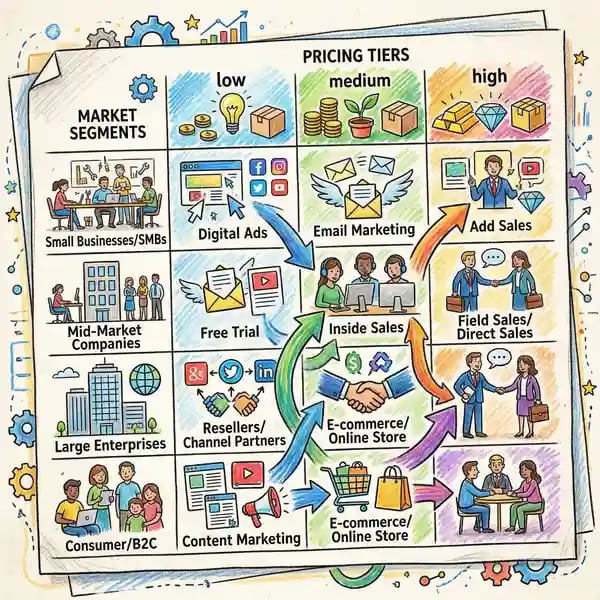
Each step informs the next. A misaligned ICP cascades into messaging failure, poor channel fit, and wrong pricing. Spend time getting steps 1–3 right before moving to 4–7.
Need a GTM Diagnostic?
We run a 30-minute GTM audit: review your ICP, positioning, and channel strategy. Spot growth leaks and fix them fast.
Book a GTM AuditGTM Strategy Best Practices for UK B2B
UK B2B markets have unique dynamics: longer sales cycles (90–180 days), more stakeholders per deal, compliance focus (GDPR, sector regulations), and a preference for proven, experienced vendors. Here's how to tailor your GTM:
| Best Practice | Why It Matters | How to Implement |
|---|---|---|
| Multi-stakeholder Mapping | UK buying committees average 13 people. You need to reach all of them, not just the champion. | Create stakeholder personas: finance controller (ROI-focused), ops manager (ease of use), IT (security/compliance), C-suite (strategic fit). Tailor messaging to each role. Use account-based marketing to warm all stakeholders in parallel. |
| Compliance & Risk Messaging | UK buyers want assurance: GDPR compliance, data residency, security certifications, audit trails. Ignore this and you lose deals in the legal/compliance review stage. | Put security, compliance, and data handling front and center in your website, pitches, and case studies. Get SOC 2 Type II certified if you're handling data. Include compliance info in your demo environment. |
| Proof-Driven Sales | UK B2B buyers value evidence: case studies, testimonials, third-party reviews, benchmarks. They're risk-averse and prefer vendors with proven track records. | Build a library of case studies (at least 5 in their industry if possible). Get reviews on G2, Capterra, and industry-specific platforms. Use testimonials and logos prominently. Run reference calls late in the sales cycle. |
| Content + ABM Combo | UK buyers research independently (60%) and want to educate themselves before talking to sales. Content builds trust; ABM personalizes at scale. | Publish 2–4 high-value pieces per month (guides, benchmarks, case studies). Run ABM campaigns to your top 50 accounts: 1:1 emails, custom landing pages, LinkedIn ads, direct outreach. Track engagement and hand off to sales at high intent. |
Common GTM Pitfall
Don't assume your GTM works across geographies. The US market (short sales cycles, 1–2 decision-makers, self-service adoption) is different from the UK (long cycles, 13 stakeholders, compliance-heavy). UK companies often fail because they copy a US GTM without localizing for buyer behavior, regulations, or channel preferences. Audit your GTM for geography-specific bottlenecks quarterly.

Sales & Marketing Alignment is Non-Negotiable
Your GTM lives or dies by alignment. When marketing and sales are fighting over lead quality, prioritizing different ICP segments, or sending conflicting messages, your GTM fails. Here's what to do:
- Share GTM ownership: GTM is not marketing's job or sales' job—it's both. Monthly GTM reviews should include marketing, sales, product, and leadership.
- Define MQL/SQL criteria together: What makes a lead sales-ready? Use CRM data to back this up (not politics). Adjust quarterly.
- Build shared KPIs: Both teams own pipeline growth and win rate. Don't optimize for "marketing touches" or "sales conversations"—optimize for revenue.
- Weekly SLA reviews: Does marketing hit its pipeline target? Do sales follow up within 24 hours? Are conversion rates improving? If not, dig in fast.
GTM Benchmarks for UK B2B
What does "good" look like? Use these benchmarks to set targets and audit your performance quarterly:
| Metric | UK B2B Benchmark | GTM Lever to Improve |
|---|---|---|
| Website Conversion Rate (Visitor → Lead) | 2–5% | Improve your value prop headline, refine ICP-relevant content, simplify CTAs (remove friction), test form fields (fewer = higher conversion). |
| Lead-to-Opportunity Rate | 10–20% | Improve lead quality (tighter ICP filtering in ads/content), nurture sequence (email, webinars, case studies), sales qualification (use BANT, MEDDIC frameworks). |
| Win Rate | 25–35% | Improve early positioning (awareness/consideration content), use proof (case studies, testimonials, reviews), sharpen your value prop (vs. competitors), train sales on objection handling, align pricing with perceived value. |
| Customer Acquisition Cost (CAC) | £8k–£25k | Improve onboarding (faster time-to-value), reduce churn (proactive support), increase upsell (success team enabled), extend contract length. |
| Sales Cycle Length | 60–90 days | Use buyer intent signals (earlier outreach), simplify decision-making (fewer stakeholders involved), streamline demos (quick qualification). |
| Win Rate vs. Competitors | 30–40% of deals entered | Improve your positioning early (awareness phase), use proof (case studies, testimonials), build internal champions, align price with value. |
| Self-Service / E-commerce Revenue | 30–40% of total revenue | 73% of B2B buyers are now comfortable spending £50k+ online (up from 59% in 2022). Invest in frictionless self-service purchasing. |
Sources: SiriusDecisions 2026 Benchmarks, Gartner B2B Buying Study, HubSpot Sales Benchmark Report
Frequently Asked Questions: GTM Strategy
How long does it take to develop a GTM strategy?
4–8 weeks for a solid initial GTM (ICP, value prop, buyer journey, channel strategy). The first 4 weeks focus on validation through customer interviews and win/loss analysis. Weeks 5–8 involve channel testing, pricing experiments, and sales enablement. Expect to refine and iterate quarterly as you get market feedback.
Should we use ABM (account-based marketing) from the start?
Not necessarily. ABM works best once you have a clear ICP and value prop. Start with targeted inbound (content + paid) to build awareness with your ICP, measure conversion rates, then layer in ABM for high-value accounts (£100k+ deals). 57% of B2B teams are now executing ABM with 52% reporting positive ROI.
How do we handle a GTM that's not working mid-year?
Don't wait until end-of-year. Conduct a rapid GTM audit: Are you reaching the right ICP? Is your value prop resonating? Which channels are converting best? Which worst? Then do a 30-day pilot test: pick one hypothesis (e.g., "our ICP was wrong—let's target smaller companies"), validate it with 10 conversations, and pivot fast. Most GTM fixes don't need a full rewrite; they need faster feedback loops.
How do we price our product if we don't have market comparables?
Start with value-based pricing: "If our product saves you £50k a year in operational costs, what would you pay?" Interview 10 prospects in your ICP. Take the range you hear (e.g., £8k–£20k per year), land in the middle, and test it with real deals. You'll learn if you're too high (long sales cycles, high objection rate) or too low (cheap positioning, wrong buyer attracted). Adjust quarterly based on conversion patterns and win/loss data.
What's the difference between GTM and product launch?
A product launch is a moment in time (announcement, press release, event). A GTM strategy is the 12–24 month plan for how you'll reach, convert, and retain customers. A product launch is part of your GTM (usually Weeks 1–4). Your GTM starts before the launch (customer research, messaging, channel prep) and continues long after (ongoing demand generation, sales enablement, expansion revenue).
How do we know if our GTM is working?
Track leading and lagging indicators: Website traffic and conversion rate (leading); pipeline generation, deal velocity, and win rate (lagging); customer acquisition cost and lifetime value (efficiency). A working GTM shows: (1) consistent month-on-month pipeline growth, (2) win rate improving (or stable at 30%+), (3) sales cycles shortening, (4) customer acquisition cost trending down. If any of these are flat or declining after 3 months, audit and iterate fast.
Ready to Build or Fix Your GTM Strategy?
Our GTM consulting combines customer research, buyer journey mapping, and channel strategy to help you reach product-market fit faster and scale revenue predictably. We've helped 50+ UK mid-market B2B companies refine their GTM and unlock growth.
Clwyd Probert
GTM Strategist & Founder, Whitehat
Clwyd helps UK B2B companies (especially tech and deep tech) build go-to-market strategies that align product, messaging, and sales. He's worked with 50+ mid-market scale-ups on buyer journey mapping, ABM strategy, and revenue acceleration. When not consulting, he writes about GTM, AEO, and AI-driven sales.
Last updated: 31 March 2026 | Originally published: 22 March 2026