
· 12 min read
TikTok for UK B2B Companies: The 2026 Guide to Employer Branding and Thought Leadership
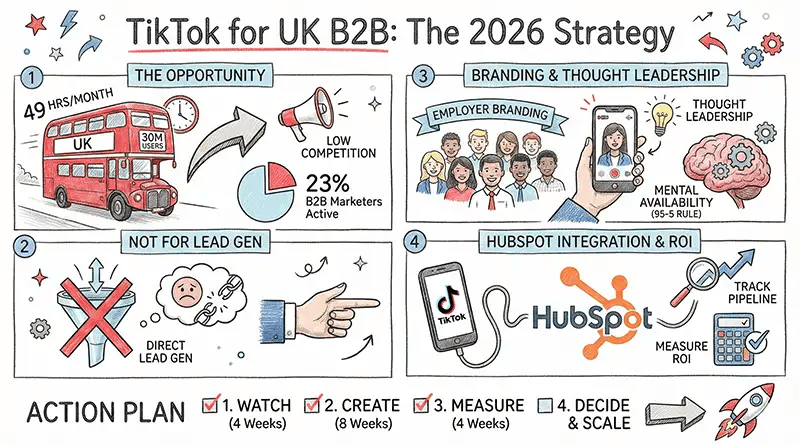
UK B2B companies can use TikTok effectively by focusing on employer branding and demand creation rather than direct lead generation. With 30 million UK users, engagement rates five times higher than Instagram, and only 23% of B2B marketers currently active on the platform, TikTok offers a low-competition opportunity for companies willing to feature real employees, create educational content, and track results through HubSpot's native TikTok integration.
If you are a marketing director at a UK B2B company wondering whether TikTok deserves a place in your channel mix, this guide provides the strategic framework you need. We will cover what actually works, how to measure ROI when attribution is difficult, UK regulatory requirements, and how to test the platform without wasting resources.
Why UK B2B Companies Should Consider TikTok in 2026
The opportunity on TikTok for B2B is counter-intuitive: low competition combined with massive reach. According to TikTok's UK Newsroom, the platform crossed 30 million regular UK users in late 2025. Yet the Social Media Examiner's 2025 industry report found that only 23% of B2B marketers use TikTok, compared to 85% who cite LinkedIn as their primary platform.
The demographic perception is also outdated. While TikTok began as a Gen Z platform, 42% of users are now aged 30 to 49. UK users spend an average of 49 hours and 29 minutes per month on TikTok, according to Sprout Social's UK statistics. That is more than double YouTube and triple Facebook. Three in five TikTok users follow brand accounts specifically for community and belonging.
For B2B marketers, this creates a strategic opportunity aligned with the 95-5 rule from the Ehrenberg-Bass Institute: only 5% of your potential buyers are in-market at any given time. The remaining 95% will buy eventually, but not today. TikTok's strength lies in building mental availability with those future buyers through consistent, engaging content that keeps your brand memorable when they do enter the market.
The business ecosystem is growing rapidly. Oxford Economics research commissioned by TikTok found that 1.5 million UK businesses now use the platform, contributing £1.6 billion to the UK economy and supporting 32,000 jobs. This is not a consumer-only platform anymore.
TikTok Is Not a Lead Generation Channel for B2B
Let us be direct: if you approach TikTok expecting LinkedIn-style lead generation, you will be disappointed. TikTok's value for B2B lies in two specific use cases: employer branding and thought leadership. Both build long-term brand equity rather than immediate pipeline.
Employer Branding and Talent Acquisition
The recruitment data is compelling. The Zety 2025 Gen Z Career Trends Report surveyed 896 respondents and found that 46% of Gen Z have secured a job or internship through TikTok. More strikingly, 95% said a company's social media presence impacts their decision to apply. TikTok's role in job searching jumped from 10.2% in 2023 to 22% in 2024.
UK-specific data from the Association of the British Pharmaceutical Industry found that among UK young people, TikTok (50%) and Instagram (46%) have overtaken LinkedIn (36%) as the leading platforms for career inspiration. The CareerTok hashtag has generated over 2 billion views globally.
Battenhall, a London-based social media agency, posted a single TikTok highlighting their flexible working policy that reached over 3 million views. It became their biggest driver of speculative job applications. Hogan Lovells, the UK law firm, created a dedicated TikTok account using "come with me" formats where trainees share real moments. They visited 40 UK university campuses, deployed 25 campus ambassadors, and won recognition at the RAD Awards for recruitment advertising.
Thought Leadership and Demand Creation
The second use case is building brand awareness with the 95% of potential buyers who are not currently in-market. This is demand creation rather than demand capture. Your content builds familiarity and trust so that when buyers do enter the market, your company is already on their mental shortlist.
Siemens launched a TikTok pilot in 2023 focused on "edutainment," featuring real employees explaining complex technical topics rather than professional speakers. The results after 12 months: 120,000 followers, 3.8% engagement rate (versus 0.7% on LinkedIn), 373% ROI through improved employer brand metrics, and a 28% reduction in time-to-fill for hard-to-hire technical roles. Videos featuring real employees achieved 3.2 times higher engagement than professional speakers.
VILPE, a Finnish ventilation manufacturer, proves that even "boring" B2B industries can succeed. Their CEO participates directly in content including charity livestreams. They have built over 100,000 TikTok followers with organic reach 3 to 30 times higher than Instagram or Facebook. Most importantly, they have won actual B2B sales through TikTok. This is manufacturing, not consumer products.
What B2B TikTok Content Actually Works
B2B brands succeeding on TikTok share common traits. They feature real people rather than logos, blend education with entertainment, and adapt to platform-native formats rather than repurposing corporate content. Research from Brixon Group found that content successful on LinkedIn achieves 87% less engagement on TikTok when not specifically adapted.
Accounts with identifiable faces achieve 3.7 times more engagement than anonymous brand accounts. Authentic, less-polished videos achieve 23% more engagement than highly produced content. The optimal format is the "day in the life" video showing real employees in genuine work situations.
Content Formats by Industry
Technology and SaaS: HubSpot posts relatable marketing humour and educational tips. Notion uses opinion-based videos with startup founders answering provocative questions. Semrush creates funny, relatable work videos incorporating TikTok trends. The pattern is educational value delivered with personality.
Professional Services: The LawTok community has generated over 950 million views, with lawyers explaining legal concepts in accessible language. Accounting firms finding success are those first to explain regulatory changes in plain language. Consulting firms show "messy brainstorming sessions" and strategy pivots, demonstrating thinking rather than polished outputs.
Manufacturing: VILPE demonstrates that industrial content can work. Apex Motion Control personified their food service robots using trending formats and accumulated over 4 million likes. Pierce Manufacturing showcases daily operations and company culture to strong engagement from the first responder community.
Life Sciences: Klinikum Dortmund generated 1.1 million likes through employee-generated content showing healthcare professionals' daily lives, turning TikTok into a legitimate recruitment funnel. The industry is increasingly using TikTok to combat talent shortages in STEM roles.
For optimal B2B performance, videos should be 45 to 75 seconds long with strong hooks in the first three seconds. Post two to three videos per week minimum. Follow the 80/20 rule: 80% valuable educational content, maximum 20% promotional. Developing an effective content marketing strategy that works across platforms is essential.
The HubSpot-TikTok Integration Advantage
This is the most significant and underreported opportunity for UK B2B companies already using HubSpot. In October 2023, HubSpot became TikTok's first CRM partner for lead generation. Despite this, no competing B2B TikTok marketing guide covers how to use this integration effectively.
The native integration enables no-code connection between TikTok for Business and HubSpot's Smart CRM. Leads captured through TikTok Instant Forms sync in real-time directly into HubSpot contacts. Field mapping, automated workflow triggers, and AI-powered reporting are all supported with no daily sync limits.
The practical value for B2B attribution is substantial. Post-integration, teams can create active HubSpot lists filtered by source (TikTok), trigger personalised email nurture sequences, and track full pipeline attribution from TikTok form submission through MQL, SQL, and closed revenue stages. This transforms TikTok from an unmeasurable awareness channel into a trackable part of your revenue engine.
Whitehat SEO, as a HubSpot Diamond Solutions Partner, can configure this integration as part of your HubSpot implementation, ensuring proper field mapping and workflow automation from day one.
Measuring TikTok ROI When Attribution Is Difficult
The measurement reality for TikTok is challenging but not impossible. Research from Precis, TikTok's measurement partner, found that TikTok's true ROI is up to 10.7 times higher than last-click attribution models reveal. Their analysis of 10 e-commerce brands using Bayesian regression found traditional models dramatically undervalue TikTok's contribution.
A critical technical point: 100% of all visits from TikTok are marked as "direct" traffic in analytics platforms. No referral data passes through. This means standard web analytics severely undercount TikTok's influence. B2B buying decisions increasingly happen in "dark social" channels like Slack, WhatsApp, and direct messages where TikTok content is shared but untracked.
For B2B specifically, TikTok should be measured as an "assisted pipeline engine" rather than a "last-click hero." Recommended measurement approaches include self-reported attribution by adding "How did you hear about us?" to forms, monitoring brand search lift via Google Search Console, using HubSpot pipeline tracking through the native integration, and for larger budgets, employing Marketing Mix Modelling to isolate TikTok's incremental contribution.
Cost comparisons favour TikTok at the top of funnel. TikTok B2B leads reportedly cost 60 to 70 percent less than LinkedIn leads. LinkedIn B2B SaaS ads average £250 per lead; TikTok's estimated cost per lead is £6 to £12 for B2B, though lead quality may be lower. The strategic positioning is TikTok for high-reach, low-cost demand creation at the top of funnel, with LinkedIn and Google capturing higher-intent mid-to-bottom funnel demand.
UK Regulatory Compliance for TikTok Marketing
UK B2B companies need to understand the regulatory landscape before committing to TikTok. The good news: there is no TikTok ban for general public or business use in the UK, and no legislation pending for one. Government device restrictions have been in place since March 2023, banning TikTok from devices used by ministers and government employees, but this does not affect private businesses.
The GDPR picture requires attention. The ICO fined TikTok £12.7 million in April 2023 for failing to obtain parental consent for under-13 users. In March 2025, the ICO launched a new investigation into how TikTok uses 13 to 17 year olds' personal information for content recommendations.
More significantly, the Irish Data Protection Commission fined TikTok €530 million in April 2025 for transferring EEA user data to China without adequate safeguards. This is the largest TikTok GDPR fine to date. TikTok admitted that "limited EEA user data had been stored on servers in China," contradicting previous assurances. The decision is currently stayed pending TikTok's appeal.
TikTok's response is Project Clover, a €12 billion European data security initiative. Data centres in Ireland, Norway (fully operational as of April 2025 with 100% renewable energy), and Finland (under construction) form a European Data Enclave. NCC Group provides continuous third-party security monitoring.
Practical compliance checklist for UK B2B companies: Implement TikTok Pixel only with explicit consent via a consent management platform. Conduct a Data Protection Impact Assessment before deploying TikTok ads or pixels. Update privacy notices to disclose TikTok integration. Create clear employee social media policies covering confidential information and intellectual property. For regulated industries such as financial services, healthcare, and life sciences, coordinate with legal and compliance teams on advertising standards and required disclaimers.
How to Test TikTok Without Wasting Resources
A structured approach minimises risk while generating meaningful data. The five-phase testing framework adapted from Brixon Group provides a practical roadmap for UK B2B companies exploring TikTok.
Phase 1: Watch (4 weeks). Study what works in your industry before creating anything. Follow competitors, adjacent industries, and successful B2B accounts. Identify content formats, posting frequency, and engagement patterns. Document the TikTok-native style that resonates.
Phase 2: Create (8 weeks). Produce 10 to 15 test videos across different formats: educational content, behind-the-scenes, employee spotlights, industry commentary. Use employees willing to be on camera. Keep production simple; authenticity outperforms polish.
Phase 3: Measure (4 weeks). Configure HubSpot tracking from day one. Monitor engagement rates, profile visits, website clicks, and any form submissions. Expect 3 to 4 weeks before the algorithm learns your content and performance stabilises.
Phase 4: Decide. Based on data, determine whether to scale or exit. If engagement rates exceed industry benchmarks (aim for above 3%) and you are seeing profile visits convert to website traffic, continue. If not, reallocate resources without regret.
Phase 5: Scale. If the pilot succeeds, expand content production, test Spark Ads to amplify top performers, and explore creator partnerships. Spark Ads deliver 30% higher completion rates and 142% higher engagement than standard in-feed ads at CPMs of £0.80 to £3.20.
Budget guidance: start with £1,000 to £2,000 per month covering content creation costs and small paid amplification. TikTok CPMs average approximately £6.30 in the UK. Total timeline: allow 3 to 6 months for a meaningful test. Integrating TikTok into your broader social media marketing strategy ensures consistent messaging across channels.
TikTok vs LinkedIn for UK B2B Marketing
The honest comparison is not "either/or" but "when to use each." Both platforms serve different stages of the buyer journey and should be deployed strategically.
| Factor | TikTok | |
|---|---|---|
| Average CPM | £6.30 | £5.10 to £16+ (26% pay over £16) |
| Average CPC | £0.28 to £0.80 | £3.15 |
| Organic reach | High (algorithm favours content quality) | Declining (pay-to-play increasing) |
| B2B lead source | Emerging (primarily awareness) | 80% of B2B social leads |
| Buyer intent | Low (entertainment/discovery) | High (professional context) |
| Attribution | Difficult (100% shows as direct) | Good (native tracking) |
| Best for | Employer branding, demand creation | Lead generation, thought leadership |
The complementary strategy: use TikTok for high-reach, low-cost awareness building with the 95% of buyers not currently in-market. Use LinkedIn for engaging the 5% who are actively researching and ready to convert. Both feed into HubSpot for unified attribution and nurture workflows. A strong social media presence for B2B increasingly requires presence across multiple platforms rather than concentration on one.
Frequently Asked Questions
Is TikTok appropriate for "serious" B2B industries like manufacturing or professional services?
Yes. Siemens, an engineering company, achieved 373% ROI from their TikTok pilot. VILPE, a ventilation manufacturer, has won actual B2B sales through TikTok. Hogan Lovells, a law firm, won recruitment advertising awards for their TikTok strategy. The key is educational, authentic content featuring real employees rather than dance videos or trends that do not fit your brand.
How much should a UK B2B company budget for TikTok marketing?
Start with £1,000 to £2,000 per month for a three to six month pilot. This covers content creation costs and small paid amplification to test what resonates. TikTok CPMs average £6.30 in the UK, significantly cheaper than LinkedIn. Scale budget only after the pilot demonstrates positive engagement and website traffic metrics.
What is the minimum commitment to see if TikTok works for our company?
A proper test requires 10 to 15 videos posted over eight weeks, with HubSpot tracking configured from day one. Expect three to four weeks before the algorithm learns your content and engagement patterns stabilise. Total timeline for meaningful evaluation: three to six months. Anything shorter will not generate reliable data.
How do we handle GDPR compliance with TikTok marketing?
Implement TikTok Pixel only with explicit consent via your consent management platform. Conduct a Data Protection Impact Assessment before running ads. Update privacy notices to disclose TikTok integration. For regulated industries like financial services or life sciences, coordinate with your legal team on sector-specific advertising requirements and disclaimers.
Can TikTok actually help with recruitment and employer branding?
Definitively yes. Research shows 46% of Gen Z have found jobs through TikTok, and 95% say a company's social presence affects their decision to apply. UK firms like Battenhall and Hogan Lovells have made TikTok their primary recruitment channel with measurable results including millions of views and increased job applications.
How do we connect TikTok activity to HubSpot for proper attribution?
Use HubSpot's native TikTok integration to sync leads from TikTok Instant Forms directly into your CRM in real-time. This enables pipeline tracking from initial form submission through to closed revenue. Configure field mapping and workflow triggers to automate lead nurture. Whitehat can set this up as part of HubSpot implementation services.
Making the Decision for Your Business
TikTok is not a lead generation channel for B2B. It is an employer branding and demand creation engine that builds mental availability with future buyers. The HubSpot integration makes attribution possible for companies willing to configure it properly. With only 23% of B2B marketers currently on the platform, the window of low competition remains open for early movers.
The question is not whether TikTok "works" for B2B. The evidence shows it can. The question is whether the investment in employer branding and top-of-funnel awareness aligns with your current marketing priorities. For companies struggling to attract talent or seeking to build brand awareness beyond LinkedIn's saturated environment, a structured pilot makes strategic sense.
If you are exploring TikTok as part of a broader strategic social media marketing initiative, start with the five-phase testing framework, configure HubSpot tracking from day one, and measure against realistic expectations. The brands succeeding on TikTok are those treating it as a long-term brand investment rather than expecting immediate pipeline returns.
References and Sources
- TikTok UK Newsroom. "TikTok expands investment and presence in the UK as number of regular users crosses 30 million." December 2025.
- Social Media Examiner. "Social Media Marketing Industry Report." 2025.
- Sprout Social. "2025 TikTok UK Statistics: Growth, Demographics and Engagement." 2025.
- Zety. "Gen Z Career Trends Report." 2025.
- Association of the British Pharmaceutical Industry. "Gen Z are turning to TikTok for career advice and inspiration." June 2025.
- Battenhall. "How TikTok is revolutionising employer branding." 2025.
- Brixon Group. "TikTok for B2B: The 5-Phase Method for Low-Risk Platform Testing." 2025.
- HubSpot. "HubSpot and TikTok Partner to Turn Engaged Audiences into Loyal Customers." October 2023.
- Precis. "TikTok Strategy 2025: A Research-Backed Playbook." 2025.
- Irish Data Protection Commission. "DPC fines TikTok €530 million." May 2025.
- TikTok Newsroom. "Project Clover: €12bn European Data Security Programme." 2025.
- Brafton. "61% of B2B Marketers Are Using TikTok: Survey Results." 2025.