
| 8 min read
The critical insight for marketers: AI adoption has crossed a tipping point with 95% of B2B marketers now using AI tools, but platforms are fighting back. LinkedIn's detection systems penalise obvious AI content with 30% reduction in reach and 55% lower engagement compared to human-written equivalents. This creates a strategic dilemma that requires careful navigation.
B2B Social Media in 2026: The Algorithmic Shift Toward Expertise and Authenticity
LinkedIn's algorithm changes have reduced organic reach by 50% for generic content while boosting specialist posts by 124%, according to Richard van der Blom's Algorithm Insights 2025 report. For B2B marketers, this algorithmic shift signals the end of corporate messaging that plays it safe—personal authority, employee advocacy, and AI-augmented content now drive measurable results. Whitehat SEO's analysis of these trends reveals three strategic imperatives for the next 18 months that will separate market leaders from the invisible.
Why LinkedIn Remains the Only B2B Platform That Truly Matters
LinkedIn captures 80% of all B2B social leads and delivers 192% ROI on paid social—no other platform comes close, according to FirstPageSage research. With 1.2 billion registered members globally and ad reach covering 82% of UK adults aged 18+, LinkedIn's dominance in B2B marketing has intensified rather than diminished.
For UK B2B marketers specifically, LinkedIn's position is even stronger. Whitehat SEO's work with HubSpot clients consistently shows that 82% of B2B marketers achieve their greatest success on LinkedIn, slightly above the global average. The platform's Revenue Attribution Report now includes 12 months of CRM activity with native integrations to HubSpot, Salesforce, and Microsoft Dynamics—making ROI proof significantly easier.
How LinkedIn's Algorithm Now Evaluates Your Content
LinkedIn's algorithm underwent its most dramatic transformation in late 2025, shifting from rewarding engagement volume to prioritising engagement quality. The new algorithm evaluates content through a four-stage distribution process: an initial quality check in the first 60 minutes, a "golden window" in the first two hours, an 8-hour review, and a final push at 24 hours.
Comments now carry 3× more weight than likes in content ranking, and interactions from recognised industry experts carry 7-9× more algorithmic value than those from random connections. This means building genuine professional networks matters more than posting frequency.
Content Format Performance in 2026:
- Document carousels deliver 278% more engagement than videos and 596% more than text-only posts
- Multi-image posts achieve 6.6% average engagement—the top-performing format
- Native video under 90 seconds with vertical orientation delivers 80% better performance than horizontal
- External links face up to 80% reach reduction—native content is essential
For posting strategy, the data supports higher frequency than commonly assumed. Buffer's analysis of 2 million posts found that accounts posting 6-10 times weekly gained +5,001 additional impressions per post, while those posting 11+ times weekly gained +16,946 impressions. However, posts within 24 hours of each other compete for the same audience's attention.
Which Other Platforms Deserve Your Attention
While LinkedIn dominates B2B, the supporting cast of platforms has evolved considerably. Whitehat SEO's marketing services increasingly incorporate these emerging channels for clients seeking diversified reach.
Meta's Platforms for B2B Mid-Funnel Nurturing
Meta's platforms have matured into effective retargeting and awareness channels. Facebook's 3+ billion monthly users make it valuable for mid-funnel nurturing, while Instagram now sees 49% of B2B marketers considering it a trusted platform. Meta's Advantage+ suite has been transformative—advertisers report 22% improvement in return on ad spend, with the platform generating £4.52 for every pound spent on AI-enabled campaigns.
TikTok's Emergence as a Legitimate B2B Channel
Despite regulatory uncertainty, TikTok has emerged as a legitimate B2B channel. 60% of B2B marketers now actively use the platform, and 67% of B2B decision-makers report using TikTok for information gathering—up 22% year-over-year. Early B2B adopters report up to 62% lower cost-per-lead than established platforms, with organic reach 3.4× higher for accounts less than 12 months old.
YouTube Shorts for B2B Video Discovery
YouTube Shorts represents the largest opportunity for B2B video discovery. Shorts now generate 200+ billion views per day, with 53% of B2B buyers watching short-form video before filling out contact forms. Critically, 74% of Shorts views come from non-subscribers, making it a powerful discovery mechanism. Channels combining Shorts with long-form content grow 41% faster than those using either format alone.
How AI Is Reshaping B2B Content Creation
The adoption of generative AI in B2B marketing has crossed a critical threshold. 95% of B2B marketers now use AI-powered tools, with 90% using ChatGPT, 51% using Google Gemini, and 33% using Claude. The most common applications are content creation (90%), idea generation (90%), and draft creation (89%).
The performance gains are substantial: 82% of marketers using AI report measurable efficiency improvements, 73% see tangible lifts in engagement rates, and sales professionals leveraging AI tools are 3.7× more likely to meet quotas. AI-assisted outreach doubles response rates (10.3% versus 5.1% for traditional cold email).
The AI Content Dilemma:
Platforms are actively penalising obvious AI content. The emerging best practice is AI augmentation rather than replacement. Use AI for research, ideation, first drafts, and optimisation—but maintain genuine human insight and personal voice. The EU AI Act, effective August 2026, will require mandatory disclosure for content significantly generated by AI when directed at EU users.
Whitehat SEO's AI consultancy services help B2B companies navigate this balance—leveraging AI efficiency whilst maintaining the authentic voice that algorithms reward.
Why Employee Advocacy Delivers Returns Brand Content Cannot Match
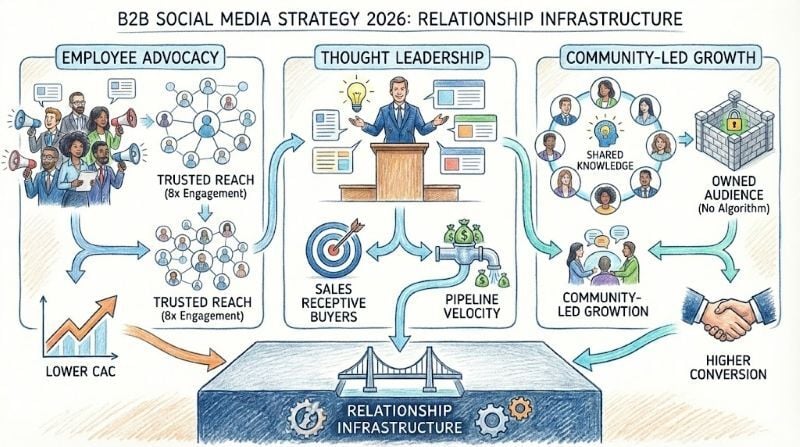
Employee advocacy has become the highest-ROI strategy in B2B social media. Employee posts generate 8× more engagement than brand channel posts, and their networks average 10× broader reach than company page followers. Content shared by employees receives 561% more reach than the same content shared through official brand channels.
The ROI is compelling: 85% of organisations report positive ROI from advocacy initiatives, with some programmes reducing paid media spend by up to 91% and acquisition costs by up to 30%. A documented case study of a 50-user programme generated 3,850 clicks, 4,000 shares, and approximately £17,400 in earned media value.
Founder and executive personal branding has become equally critical. 44% of company market value now derives from CEO and leadership reputation, and companies with multiple C-suite members posting regularly see up to 38% higher digital impact. The 2025 Edelman-LinkedIn research found that 95% of "hidden buyers"—decision-makers who influence purchases without direct vendor contact—say thought leadership makes them more receptive to sales outreach.
How Dark Social Has Broken Traditional Attribution
The measurement infrastructure that B2B marketers relied upon has fundamentally deteriorated. Dark social—private sharing through Slack, WhatsApp, email, LinkedIn DMs, and text messages—now accounts for 84% of all social shares and 58% of all web traffic. Traffic from these channels appears as "direct" in analytics, making traditional attribution impossible.
The challenge is particularly acute for B2B: 77.5% of B2B buyers share links through dark social channels, and over 40% of B2B deals stall due to internal misalignment involving hidden stakeholders engaging via untracked channels. A buyer may consume extensive content through private sharing before ever touching a trackable link.
Privacy changes have compounded the problem. Whilst Google reversed its decision to deprecate third-party cookies, Safari (17% market share) blocks them by default, and iOS App Tracking Transparency sees 95% of US users opting out. Whitehat SEO's HubSpot onboarding services address this challenge through account-level engagement metrics that illuminate dark social effects.
The Strategic Response to Dark Social:
- Shift from individual touchpoint attribution to account-level engagement metrics
- Implement self-attribution—simply ask customers how they heard about you
- Use tools like 6sense, HockeyStack, or Dreamdata for account-based approaches
- Prioritise account engagement depth, pipeline velocity, and multi-stakeholder engagement patterns
Specific Considerations for UK B2B Marketers
The UK market presents specific dynamics that differentiate it from global trends. LinkedIn has 45 million UK members representing 65% of the UK population. Regulatory requirements are also becoming more stringent, which affects how B2B marketers must operate.
From January 2026, the ASA mandates exclusive use of "AD" or "#ad" labels for all influencer disclosures, monitored by an AI-based Active Ad Monitoring System analysing over 50,000 pieces of content. The Online Safety Act 2023, enforced from March 2025, applies to approximately 100,000 online services targeting UK users with penalties up to £18 million or 10% of global revenue.
UK B2B Buyer Characteristics:
- More risk-averse with expanded buying committees
- 78% report longer sales cycles due to economic uncertainty
- Prioritise proven relationships over new supplier relationships
- Respond to "business-focused, restrained, functional" messaging rather than informal approaches
- Prefer long-form articles of 1,900-2,000 words on LinkedIn
- Engage more with text posts and static images than video (contrary to global trends)
From a budget perspective, UK B2B companies typically allocate 7-12% of annual revenue to marketing, with high-growth companies at 12-15%. Digital formats now account for 81% of total UK ad spend. Notably, 50% of UK B2B marketers must justify marketing spend to the C-suite monthly, creating pressure for attributable results that Whitehat SEO's SEO services and HubSpot integration directly address.
Strategic Priorities for the Next 18 Months
The convergence of these trends points to clear priorities for B2B social media strategy through 2027.
Community-Based Marketing
Community-based marketing has emerged as the counter-strategy to algorithmic unpredictability. Nearly 50% of B2B companies now use community as a core go-to-market motion, and 58% of top SaaS businesses host dedicated user communities. Communities reduce customer acquisition costs by 32%, members convert faster than typical leads, and community-driven word-of-mouth increases conversions by 22%.
Social Search Optimisation
Social search optimisation represents an emerging opportunity. 51% of Gen Z now prefer TikTok over Google as their search engine, and 40%+ use TikTok or Instagram for searches. Using relevant keywords in TikTok captions boosts visibility by 20-40%. For B2B targeting younger professionals entering decision-making roles, optimising for social search alongside traditional SEO becomes necessary.
HubSpot Integration Considerations
HubSpot users should note that social media features require Marketing Hub Professional (£890/month minimum) and the platform does not support TikTok, Pinterest, or Threads—significant gaps as these platforms gain B2B traction. The platform's strongest asset is native CRM integration for attribution, connecting every social interaction to contact records. Whitehat SEO's HubSpot onboarding ensures clients maximise this attribution capability.
The Bottom Line
The fundamental shift in B2B social media is from broadcasting to relationship building. Algorithms reward genuine expertise, personal networks amplify content beyond brand page limitations, and community spaces create owned audiences independent of platform algorithms.
The marketers who thrive over the next 18 months will be those who invest in employee advocacy programmes, build thought leadership positioning for executives, develop community-led growth strategies, and embrace AI as an augmentation tool whilst maintaining authentic human voice.
The age of corporate social media as broadcast channel has ended. The age of social media as relationship infrastructure has begun.
Frequently Asked Questions
What percentage of B2B leads come from LinkedIn?
LinkedIn generates 80% of all B2B leads from social media, making it the dominant platform for B2B lead generation. The platform delivers 192% ROI on paid social and 229% ROI for organic social over a three-year period, according to FirstPageSage research.
How has LinkedIn's algorithm changed in 2025-2026?
LinkedIn's algorithm now prioritises engagement quality over volume. Comments carry 3× more weight than likes, interactions from industry experts carry 7-9× more algorithmic value, and generic content sees 50% reduced reach whilst specialist posts see 124% increased reach.
What content format performs best on LinkedIn in 2026?
Document carousels deliver 278% more engagement than videos and 596% more than text-only posts. Multi-image posts achieve 6.6% average engagement rate. Native video under 90 seconds with vertical orientation performs 80% better than horizontal video.
Does AI-generated content hurt LinkedIn performance?
Yes. LinkedIn's detection systems result in 30% reduction in reach and 55% lower engagement for obvious AI-generated content compared to human-written equivalents. The best approach is AI augmentation—using AI for research and drafts whilst maintaining authentic human voice and insight.
What is dark social and how does it affect B2B marketing?
Dark social refers to private sharing through Slack, WhatsApp, email, LinkedIn DMs, and text messages. It now accounts for 84% of all social shares and 58% of web traffic. This traffic appears as "direct" in analytics, making traditional attribution impossible and requiring account-based measurement approaches.
Ready to Transform Your B2B Social Media Strategy?
Whitehat SEO helps B2B companies navigate the algorithmic shift with HubSpot-integrated social strategies that prove ROI. As a Diamond HubSpot Solutions Partner and leaders of the world's largest HubSpot User Group, we bring proven frameworks for employee advocacy, attribution, and AI-augmented content creation.
Book a discovery call to discuss how we can help future-proof your marketing.
References
- Hootsuite — How the LinkedIn Algorithm Works in 2025
- Agorapulse — LinkedIn Algorithm 2026: What Has Changed
- DSMN8 — 26 B2B Social Media Statistics You Need To Know
- Martal Group — LinkedIn Statistics 2026: Global Trends & Social Selling Data
- SocialBee — The LinkedIn Algorithm Explained (2026 Guide)
- LinkedIn Marketing Solutions — 2025 B2B Marketing Benchmark