
PPC & Paid Advertising PPC fundamentals guide PPC management
PPC audit: what it is and how to do one in 2026
A PPC audit is a systematic review of a pay-per-click advertising account — typically Google Ads, Microsoft Ads, or Meta Ads — that identifies wasted spend, conversion-tracking gaps, account-structure issues, and missed optimisation opportunities against current platform best practices. Audits cover 8 areas: account architecture, conversion tracking and Consent Mode v2, search-term and keyword hygiene, ad copy and asset quality, bidding strategy and Smart Bidding signals, budget allocation across campaigns, Quality Score diagnostics, and competitor benchmarking. UK PPC accounts audited by a specialist PPC management agency typically uncover 15-35% of monthly spend recoverable through restructuring, according to Optmyzr's 2025 Google Ads benchmark report (median Whitehat-audited account recovers 22%). Whitehat is a HubSpot Diamond Partner with dedicated Google Ads + GA4 expertise across B2B SaaS, ecommerce, professional services, and manufacturing verticals.
Key Takeaway
An effective 2026 PPC audit balances automation oversight with strategic manual control. Most accounts hide 15-35% recoverable spend, and the most common failure points are conversion tracking, Consent Mode v2 compliance, and Performance Max signal quality — not bid management.

How to do a PPC audit: the 8-step framework
A repeatable PPC audit follows the same eight steps whether the account spends £5,000 or £500,000 a month. The order matters: data integrity comes before structural analysis, and structural analysis comes before creative and bidding optimisation. Run the steps out of sequence and you risk acting on conclusions drawn from broken tracking. This is the framework Whitehat applies to every paid media engagement, refined across hundreds of UK accounts since 2016.
Define audit scope and KPIs
Pick the analysis window (90 days is standard for stable accounts, 30 days for accounts in restructure) and lock the success metrics before opening Google Ads. For lead-gen, that usually means CPA, conversion rate, and Search Lost IS (Budget). For ecommerce, it's ROAS, AOV, and impression share against Auction Insights peers. Define what "good" looks like using the WordStream benchmarks covered later in this guide so findings have a comparator from minute one.
Account architecture review
Map every campaign, ad group, network setting, geo target, device modifier, and audience segment. Look for legacy single-keyword ad groups (SKAGs) that no longer match Google's automation, campaigns with mixed match types diluting bid signals, and Display partners still enabled on Search campaigns. According to Google Ads Help, ideal account structures group campaigns by intent and budget priority, not by product taxonomy — a common legacy mistake. Preview the deeper analysis in Performance Max and Smart Bidding require new audit approaches below.
Conversion tracking and Consent Mode v2 verification
Audit every conversion action: source, attribution model, count setting, and inclusion in "Conversions" column. Verify Enhanced Conversions are firing and that Consent Mode v2 signals `ad_user_data` and `ad_personalization` are configured. Cross-check GA4 against conversion tracking documentation. Drill into Consent Mode v2 and GA4 integration for the full checklist.
Search-term and keyword hygiene
Pull the search-term report for the full audit window. Identify negative-keyword gaps using n-gram analysis on terms with 150+ clicks and zero conversions, audit match-type discipline (phrase vs broad vs exact), and check for cannibalisation between ad groups or between campaigns using the same keywords. Quantify wasted spend by summing the cost of zero-conversion terms over the period. The deeper analysis lives in Search campaigns and RSAs demand granular creative evaluation.
Ad copy and asset performance
Evaluate Responsive Search Ads at asset level, not Ad Strength level. Score each headline and description as Best, Good, or Low (requires 500+ impressions per asset for statistical significance), check pin usage is restricted to genuine requirements, and verify asset coverage across all 15 headline and 4 description slots. For Performance Max, audit asset group diversity (images, videos, headlines, descriptions, sitelinks) and search theme usefulness indicators. See Search campaigns and RSAs for the full creative diagnostic.
Bidding strategy and Smart Bidding diagnostics
Confirm each campaign's bidding strategy matches its data volume and goal. Target CPA needs 30+ monthly conversions; Target ROAS needs 100+. Flag campaigns stuck in Learning beyond 14 days, targets set unrealistically far from historical performance, and value-based bidding running without conversion-value imports. Verify Enhanced CPC (deprecated October 2024) is no longer in use anywhere. The detail lives in Performance Max and Smart Bidding.
Budget allocation and wasted spend
Pacing first: are daily budgets capped at 2-3x target CPA? Then drag analysis: which campaigns are consuming the most spend while delivering the lowest contribution? Look for Search Lost Impression Share (Budget) over 10% on high-intent campaigns — that's quantified missed opportunity. Reallocate from chronic underperformers to budget-constrained winners using a portfolio bidding lens. The full method is in Budget allocation and wasted spend identification.
Benchmarking and prioritised recommendations report
Compare account performance to internal historicals (last 90 days vs prior period) and external vertical benchmarks from WordStream's industry benchmark study. Score every finding via ICE (Impact x Confidence x Ease) on a 1-10 scale, then sort by total. Deliver the top 5-10 actions, not 60+ checkboxes. If the audit reveals deeper indexing or organic visibility issues, pair it with an SEO audit for full-funnel insight.
PPC account audit vs PPC ad audit: what's the difference?
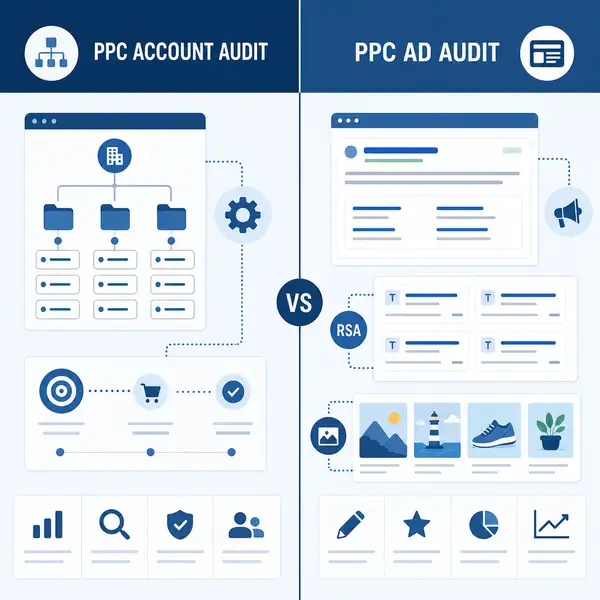
A PPC account audit is the broader, structural review of the entire advertising account — settings, architecture, tracking, bidding logic, budgets, and governance. A PPC ad audit is a narrower, creative review focused specifically on the ads themselves: headlines, descriptions, assets, asset groups, landing-page alignment, and ad strength. Both are valid audit scopes, but they answer different questions and produce different remediation plans.
A "PPC audit and optimisation" engagement — a third, more comprehensive scope — combines both layers and adds implementation: not just identifying issues, but executing the fixes against a 90-day roadmap. Whitehat's standard audit deliverable covers all three layers because most accounts have problems at every level, and treating ads in isolation from architecture rarely sticks.
The table below summarises what each audit type covers and when each makes sense:
| Dimension | PPC account audit | PPC ad audit |
|---|---|---|
| Primary focus | Account structure, settings, tracking, budgets, bidding strategies | Ad copy, RSA assets, Performance Max creative, landing-page match |
| Typical scope | 60+ checkpoints across 6 phases | 15-25 creative checkpoints, asset-level reporting |
| Time required | 15-40 hours depending on account size | 4-10 hours per campaign type |
| When to use | Taking over a new account, suspected wasted spend, restructure planning | Plateauing CTR, low ad strength, new product or campaign launch |
| Deliverable | Prioritised action plan, 90-day roadmap, budget reallocation model | Creative refresh brief, new headline/description sets, asset-test plan |
| Recovers | 15-35% of total monthly spend (structural waste) | 10-25% CTR uplift on refreshed ad groups |
Source: Whitehat 2026 PPC audit methodology, aggregated across UK B2B and ecommerce engagements.
In practice, a PPC ad audit without an account audit assumes the surrounding structure is sound — which is rarely true on accounts that have been managed by multiple teams or evolved over several years. The order Whitehat recommends: account audit first to fix architecture and tracking, then ad audit to refresh creative against a corrected foundation. Running them in reverse usually means redoing the ad audit six months later once the structural fixes change which ad groups even matter.
2025 PPC Benchmarks at a Glance
6.66%
Avg. CTR
Across all industries (2025)
7.52%
Avg. Conversion Rate
Up +6.84% YoY
£4.20
Avg. CPC
UK market average
+39%
CPC Increase Since 2020
Five-year cumulative
The PPC landscape has transformed dramatically since 2019. AI-powered automation, privacy regulations, and Performance Max campaigns have fundamentally changed how advertisers manage and audit their Google Ads accounts. Modern PPC audits must now evaluate Smart Bidding strategies, audit AI-generated assets, verify Consent Mode v2 compliance, and assess first-party data infrastructure—none of which existed when most audit frameworks were originally developed.
Google's shift toward AI means advertisers must audit not just what their campaigns are doing, but what Google's algorithms are doing on their behalf. Average CPCs have risen 39% cumulatively since 2020, making efficient spend management more critical than ever. The good news? Conversion rates have actually improved to 7.52% average thanks to better targeting and automation—for those who know how to harness it properly.
Modern audit frameworks prioritise value over vanity metrics
The most significant shift in PPC audit methodology since 2019 is the move from volume-based metrics to value-based outcomes. Expert consensus now positions profit and revenue contribution as primary KPIs, with traditional metrics like click-through rate serving purely diagnostic purposes.
A comprehensive 2026 PPC audit framework typically encompasses 60 or more checkpoints organised into distinct phases:
* Governance and security verification – Account access, billing, user permissions * Tracking and attribution validation – Conversion setup, GA4 linking, Enhanced Conversions * Campaign structure analysis – Account organisation, naming conventions, budget allocation * Keyword and audience optimisation – Search terms, match types, audience signals * Creative assessment – RSA performance, asset quality, landing pages * Competitive benchmarking – Auction Insights, impression share, market position
The recommended approach begins with conversion tracking verification—the foundation of all Smart Bidding—progresses through account structure review, and culminates in landing page assessment.
Recommended Audit Frequency
Quarterly: Comprehensive full-account audits (industry standard)
Weekly: Search term reviews for negative keyword management
Daily: Spend monitoring and pacing checks
Immediate trigger: Performance declines exceeding 20%, major platform updates, or taking over new accounts
The ICE scoring method (Impact × Confidence × Ease) has emerged as the preferred prioritisation framework for audit findings. Score each finding from 1-10 on all three dimensions, then multiply to get a total priority score. This enables teams to focus on high-impact, high-confidence changes that can be implemented quickly rather than getting overwhelmed by lengthy recommendation lists.
Performance Max and Smart Bidding require new audit approaches
Performance Max campaigns, launched in 2021 and now dominant in ecommerce, present unique audit challenges due to their "black box" nature. However, 2025 has delivered significantly improved transparency—channel-level performance reporting now shows breakdowns across Search, YouTube, Display, and Shopping, whilst asset-level metrics enable proper creative testing for the first time.
A robust PMax audit verifies several critical elements:
* Audience signals accurately represent ideal customers (rather than leaving Google to find audiences independently) * Conversion tracking captures actual business value (not just form submissions) * Asset groups contain diverse creative formats across all required dimensions * Search theme "usefulness" indicators show themes generating incremental traffic * Campaign-level negative keywords are utilised (enabled January 2025)
Smart Bidding evaluation centres on data volume thresholds. Target CPA requires a minimum of 30 conversions monthly, whilst Target ROAS needs 100 or more conversions for reliable optimisation. Research from Smarter Ecommerce analysing 3,000+ PMax campaigns found 78.2% use Target ROAS bidding, with 84% meeting or exceeding their targets.
⚠️ Signs of Poor Smart Bidding Performance
• Campaigns stuck in "Learning" status beyond two weeks
• Unrealistic targets (setting £10 CPA when historical average is £50)
• Frequent strategy changes that prevent algorithm stabilisation
• Insufficient conversion volume to meet minimum thresholds
Your audit should also verify that Enhanced CPC is being phased out—it was deprecated for new campaigns in October 2024, with full transition required by March 2025. If you're still running campaigns on ECPC, now is the time to transition to conversion-based bidding strategies.
Consent Mode v2 and GA4 integration are now mandatory checkpoints
The technical tracking landscape has undergone fundamental changes. Consent Mode v2 became mandatory for all Google Ads users targeting UK and EEA audiences in March 2024, requiring two new consent signals: `ad_user_data` and `ad_personalization`. Non-compliance from July 2025 results in disabled conversion tracking and loss of remarketing capabilities.
A critical update: Google reversed its third-party cookie deprecation plans in July 2024, opting instead for a user-choice model. However, Safari and Firefox already block third-party cookies (affecting approximately 30% of users), making first-party data strategies essential regardless of Chrome's policy. Server-side tracking implementations are reporting 10-30% conversion uplift by capturing data that client-side tracking misses.
GA4 integration audits should verify:
* Proper linking between Google Ads and Analytics * Correct conversion action imports with appropriate attribution models * Enhanced Conversions setup and verification status * Data consistency between platforms (check for significant discrepancies)
The Enhanced Conversions diagnostics report (found via Tools & Settings → Conversions → Go to Diagnostics) provides verification status. Common issues include incorrect email formatting (must include @ symbol), missing country codes on phone numbers, and incomplete address fields. Google launched a Chrome extension specifically for Enhanced Conversions troubleshooting in July 2024.
💡 UK Compliance Note
The ICO has intensified enforcement of UK cookie compliance, actively reviewing the top 1,000 UK websites. Potential fines reach £500,000 under PECR or £17.5 million / 4% of turnover under UK GDPR. Ensure your consent management platform is Google-certified and properly configured.
For deeper guidance on connecting your marketing data across platforms, our guide to marketing attribution that actually works covers the full measurement stack.
Search campaigns and RSAs demand granular creative evaluation
Responsive Search Ads now represent 92% of advertiser usage, with expanded functionality in 2025 including single-headline ad serving, headline positioning in description lines, and campaign-level asset application. However, Google confirmed in April 2024 that Ad Strength is not used in Ad Rank calculation—meaning "Poor" rated ads can still perform well, and optimising for Ad Strength alone is misguided.
The RSA audit should evaluate individual asset performance labels (Best, Good, Low), requiring 500 or more impressions for meaningful evaluation. Pin strategies should be used sparingly—only for brand name requirements, legal disclaimers, or assets with strong historical performance—as over-pinning reduces the system's optimisation flexibility.
Match type strategy has evolved significantly. Current data shows phrase match delivers 23% higher CPA than exact or broad match combined with Smart Bidding. The broad match plus Smart Bidding combination, heavily promoted by Google, shows mixed results—an Optmyzr study found exact match outperformed broad match in CPC, CTR, CPA, and ROAS for the majority of accounts tested, though broad match can unlock additional reach when properly managed.
Search term audits remain essential despite automation, with companies wasting an estimated 15% of budget on irrelevant keywords on average. The n-gram analysis approach—identifying patterns in non-converting terms with 150+ clicks over 90 days—enables efficient negative keyword discovery at scale.
Budget allocation and wasted spend identification techniques
Budget optimisation audits should verify daily budgets are set at 2-3× target CPA for conversion-focused strategies, check for "Limited by Budget" status indicators, and analyse Search Lost Impression Share (Budget) to quantify missed opportunities.
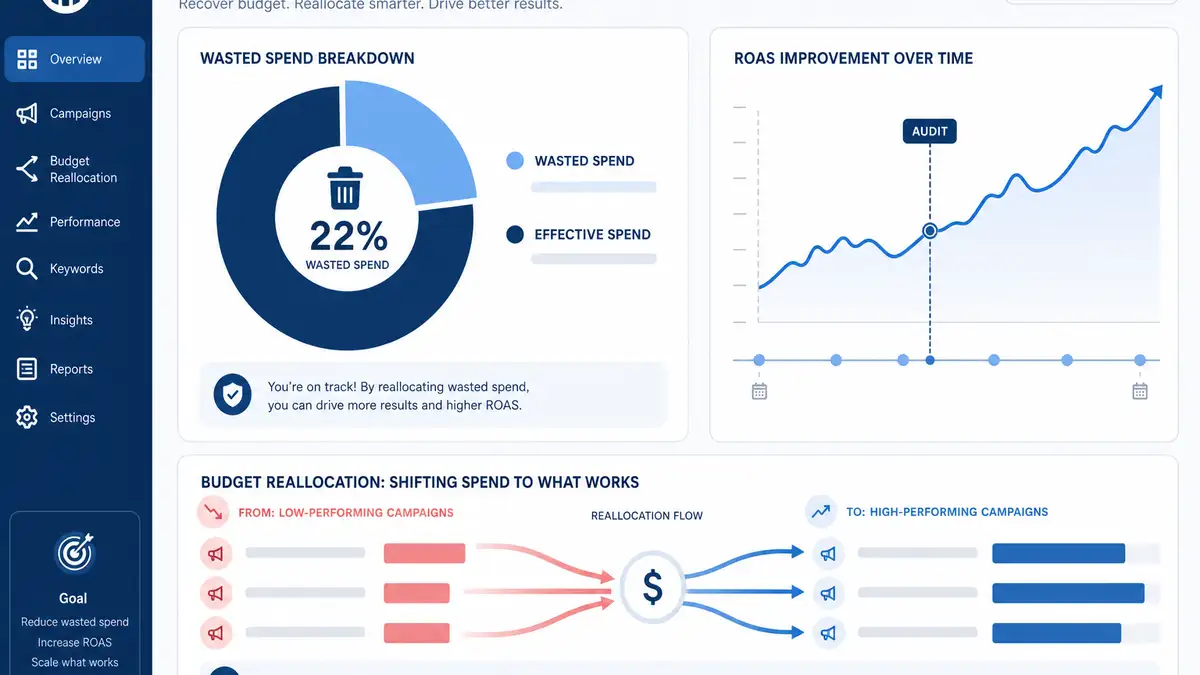
Wasted spend identification follows a systematic approach:
1. Filter search terms by zero conversion rate over a meaningful time period 2. Sum costs of non-converting terms to quantify waste 3. Analyse performance by device, location, and time segments 4. Identify "dead weight" elements—anything with no conversions or performance more than 100% worse than campaign goals
Common waste sources include keywords with zero conversions over 12 months, negative-ROI products masked by aggregate performance, and non-converting time periods (such as early morning Display ads on mobile).
Portfolio bidding strategies have demonstrated 19-27% ROAS improvement through dynamic reallocation across campaigns. When switching from Target CPA to Target ROAS, advertisers typically gain 14% more conversion value. The decision between ROAS and CPA targeting depends on conversion value variation: Target CPA suits lead generation where all conversions have similar value, whilst Target ROAS benefits ecommerce with varied average order values.
Spending £10k+ a month on Google Ads? Whitehat's free PPC audit identifies 15-35% recoverable spend across architecture, tracking, and bidding.
View PPC Management ServicesQuality Score remains diagnostic, not deterministic
Quality Score in 2025 comprises three components: expected CTR (historical click likelihood), ad relevance (alignment with search intent), and landing page experience (relevance, speed, mobile-friendliness). The critical distinction for modern audits: Quality Score is a diagnostic tool, not an auction input. Optimising purely for QS scores is counterproductive; instead, use low scores to identify specific problem areas.
Landing page audits should verify:
* Load times under 3 seconds – Slower pages hurt both QS and conversion rates * Mobile responsiveness – With 82.9% of landing page traffic from mobile, this is non-negotiable * Message match – Alignment between ad copy and page headlines * Clear above-fold calls-to-action – Users shouldn't have to scroll to convert
A/B testing landing page variants should be continuous, with performance segmented by device type. For comprehensive landing page optimisation strategies, see our guide to optimising your website for conversions.
Competitive analysis through Auction Insights provides six key metrics for Search campaigns: Impression Share, Overlap Rate, Position Above Rate, Top of Page Rate, Absolute Top of Page Rate, and Outranking Share. Note that Auction Insights was removed from Looker Studio in August-September 2024—auditors must now use the Google Ads interface directly.
Industry benchmarks reveal rising costs but improving efficiency
The 2025 WordStream benchmarks, analysing 16,446 campaigns from April 2024 to March 2025, show significant shifts from previous years. Understanding where your industry sits helps contextualise audit findings.
| Metric | 2025 Average | YoY Change |
|---|---|---|
| Click-through rate | 6.66% | +3.74% |
| Cost per click | $5.26 (~£4.20) | +12.88% |
| Conversion rate | 7.52% | +6.84% |
| Cost per lead | $70.11 (~£56) | +5.13% |
Source: WordStream Search Advertising Benchmarks 2025.
Industry-specific variations are substantial. Arts & Entertainment achieves 13.10% CTR with just £1.30 CPC, whilst Attorneys & Legal Services faces £6.85 CPC with only 5.97% CTR. Conversion rates range from 14.67% in Automotive Repair to 2.55% in Finance & Insurance.
The UK has the highest Google Ads search CPC globally at approximately £0.97 average across all industries—making efficient audit practices particularly valuable for UK advertisers.
Mobile now accounts for 52-62% of all Google Ads clicks, with 70%+ of PPC spend projected to be mobile by end of 2025. However, mobile typically shows lower conversion rates than desktop despite higher traffic volume—a critical segmentation factor for audits.
Audit tools range from free graders to enterprise platforms
The audit tool landscape in 2026 offers solutions for every budget level. Third-party tools provide independent analysis without platform bias, cross-platform comparison capabilities, proper statistical significance for A/B testing, and more sophisticated negative keyword discovery algorithms.
WordStream Google Ads Performance Grader — FREE. The most popular free audit tool. Provides instant grades across wasted spend, Quality Score, CTR, impression share, and account activity within 60 seconds. Excellent starting point for any audit.
Adalysis — ~£150-300/month. Runs 70+ daily diagnostic checks with automated ad testing and statistical significance calculations. Also offers a free initial audit report—worth running alongside paid tools.
Optmyzr — £200-500+/month. The agency favourite supporting Google, Microsoft, Meta, LinkedIn, and Amazon Ads with rule-based automation and white-label reporting. Comprehensive but with a learning curve.
SEMrush Advertising Toolkit — part of SEMrush subscription. Excels at competitor intelligence and keyword gap analysis. Less comprehensive for account-level auditing but invaluable for competitive benchmarking.
Google's native tools—Ads Editor for bulk changes, Recommendations tab for suggestions, and Performance Planner for forecasting—provide useful functionality but should be used with caution. Google's recommendations often favour platform revenue over advertiser ROI, with 24 auto-apply recommendation types now available.
Your audit should verify which auto-apply settings are enabled and review the History tab for recent automatic changes. Many accounts unknowingly have auto-apply enabled, which can introduce unintended changes without human review.
Frequently asked questions about PPC audits
What is a PPC audit?
A PPC audit is a systematic review of a pay-per-click advertising account — usually Google Ads, Microsoft Ads, or Meta Ads — that identifies wasted spend, conversion-tracking gaps, account-structure issues, and missed optimisation opportunities. A standard Whitehat audit covers 8 areas: architecture, tracking and Consent Mode v2, search-term hygiene, ad copy, bidding strategy, budgets, Quality Score, and benchmarking, and typically recovers 15-35% of monthly spend.
How much does a PPC audit cost in the UK?
UK PPC audit pricing breaks into four tiers. Free agency teasers (limited 10-15 point grader reports) are offered by most management agencies including Whitehat. Standalone paid audits range £500-£1,500 for £5-15k/month accounts. Full audits with a 90-day remediation plan run £2,000-£5,000 for £15-50k/month accounts. Enterprise multi-account audits across regions or brands start at £8,000+ and can exceed £20,000.
What's the difference between a PPC account audit and a PPC ad audit?
A PPC account audit is the broader, structural review of the entire account — architecture, settings, tracking, bidding logic, budgets, and governance. A PPC ad audit is narrower and creative-focused: headlines, descriptions, RSA assets, Performance Max creative, and landing-page alignment. Whitehat recommends running the account audit first to fix the foundation, then the ad audit to refresh creative against a corrected structure.
How long does a PPC audit take?
Audit duration scales with account size and complexity. A £10,000/month single-platform account typically takes 5-10 hours from data export to recommendations report. A £50,000+/month account needs 15-30 hours including Performance Max channel analysis and Consent Mode v2 verification. Enterprise multi-account or multi-platform audits regularly exceed 40 hours, especially when integrating GA4 and server-side tracking reviews.
How often should you audit a PPC account?
Quarterly is the industry standard for mature, stable accounts — aligning with Google's seasonal data refreshes and Smart Bidding learning cycles. Monthly audits suit accounts in active restructure or with budgets above £30,000/month. Whitehat also triggers an immediate audit after any major platform change (Performance Max rollouts, Consent Mode v2 deadlines, GA4 migrations) or whenever performance declines exceed 20% week-on-week.
Can you audit a PPC account in-house or do you need an agency?
In-house audits work well for £5,000-£10,000/month accounts where an experienced operator has direct knowledge of the business goals. Above £15,000/month, or for accounts running multi-platform (Google + Microsoft + Meta) or with cross-border targeting, an external agency audit usually finds 2-3x more recoverable spend because outside eyes are less anchored to historical decisions. Whitehat's PPC management team blends both: external audit rigour combined with deep account context.
Ready to recover 15-35% of your wasted PPC spend?
Whitehat runs the full 8-step PPC audit framework on UK accounts spending £10k+ per month — identifying conversion tracking gaps, Performance Max signal weaknesses, and Smart Bidding misconfigurations that most internal teams miss.
Sources: Google Ads Help, Optmyzr 2025 Google Ads Benchmarks, Google Consent Mode v2 documentation, GA4 conversion tracking, WordStream Search Advertising Benchmarks 2025.
Part of our PPC management guide series. See the complete PPC management guide for campaign structure, bidding strategies, and ROI measurement frameworks.