
B2B Marketing Strategy explore our digital marketing FAQs
UK mobile dominance is no longer debatable. According to Ofcom's authoritative Online Nation Report (December 2025), Britons now spend an average of 4 hours 30 minutes online daily, with 77% of that time on smartphones—up from previous years. Women spend 79% of their online time on mobile; men 75%.
Mobile Conversion Optimisation for B2B: The 2026 Complete Guide
UK B2B websites are leaving significant revenue on the table. Here's how Marketing Directors and Demand Generation leaders can close the mobile conversion gap and drive measurable results.
The Bottom Line
Desktop converts at roughly twice the rate of mobile across UK B2B websites, yet 77% of online time now happens on smartphones. Whitehat's analysis reveals that only 3% of B2B websites achieve a "good" mobile performance score—representing the single largest untapped revenue opportunity for mid-market companies. This guide provides the complete framework to close that gap.
The UK Mobile Landscape Has Shifted Decisively
The infrastructure supports this shift. Ofcom's Connected Nations 2025 report confirms 94–97% outdoor 5G coverage from at least one operator, with mobile data volumes up 18% year-on-year. The technical ceiling that once justified desktop-first thinking has effectively disappeared.
77%
of UK online time now happens on smartphones, according to Ofcom's 2025 research
B2B mobile usage lags consumer patterns but is accelerating. Research indicates that 60% of B2B buyers now use mobile for business queries, with mobile influencing over 40% of revenue in leading B2B organisations. Critically, mobile usage by B2B decision-makers spikes during commuting hours and after 6PM—precisely when senior buyers conduct independent research.
The key insight for B2B is device-switching behaviour: buyers research on mobile but often convert on desktop. This makes mobile UX critical for top-of-funnel engagement even when final conversions happen elsewhere. For companies running SEO programmes, this means optimising for mobile discovery, not just desktop conversion.
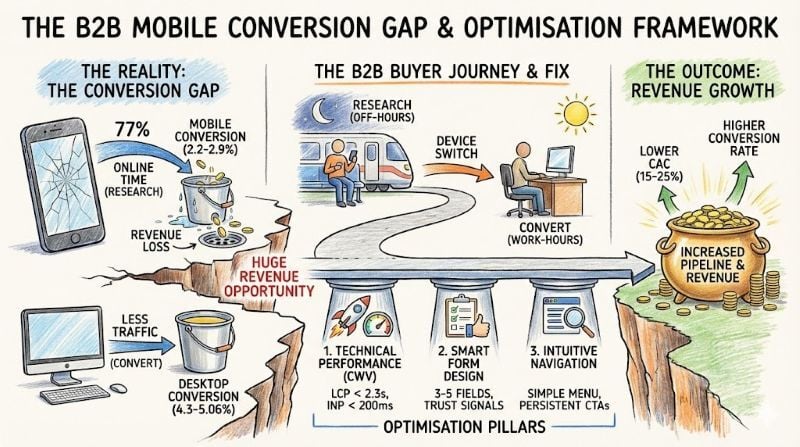
The Mobile Conversion Gap Is a Revenue Problem Hiding in Plain Sight
The desktop-to-mobile conversion gap is stark and consistent. Desktop converts at 4.3–5.06% versus mobile at 2.2–2.9% across all sectors. For B2B specifically, average website conversion rates sit at 1.8–2.9% overall, with mobile converting at roughly half the desktop rate.
| Metric | Desktop | Mobile |
|---|---|---|
| Average Conversion Rate | 4.3–5.06% | 2.2–2.9% |
| Bounce Rate | 43% | 51% |
| Average Page Load Time | 2.5 seconds | 8.6 seconds |
| PageSpeed Score (B2B Average) | 84/100 | 66/100 |
The revenue implications are significant. A 1-point conversion rate lift (for example, from 2% to 3%) can reduce customer acquisition cost by 15–25% for B2B companies. Sites loading in 1 second see conversion rates as high as 40%, dropping to 29% by 3 seconds. Every additional second of delay increases mobile bounce by 8.3%.
For companies investing in HubSpot onboarding and marketing automation, these numbers underscore a critical point: all the sophisticated nurturing in the world won't help if mobile visitors bounce before becoming leads.
Core Web Vitals: Google's December 2025 Update Raised the Bar
The three Core Web Vitals metrics remain stable for 2026: LCP (Largest Contentful Paint) ≤2.5 seconds, INP (Interaction to Next Paint) ≤200 milliseconds, and CLS (Cumulative Layout Shift) ≤0.1. INP officially replaced FID in March 2024.
What has changed is enforcement. Google's December 2025 Core Update significantly raised the bar for technical performance. Analysis across multiple sources indicates:
- Sites with LCP above 3 seconds experienced 23% more traffic loss than faster competitors
- Sites with poor INP scores (above 300ms) saw 31% more traffic drops, particularly on mobile
- Sites with CLS above 0.15 experienced 19% more traffic loss
- Performance penalties begin around LCP 2.3 seconds—more aggressive than the official 2.5-second threshold
⚠️ Current State
Mobile CWV pass rates are improving but remain far behind desktop. According to HTTP Archive data, 48% of mobile origins pass all three CWV versus 56% on desktop. LCP remains the hardest metric, with only about 66% of sites achieving "good" scores.
The conversion correlation is well-documented. Case studies show that optimising for good LCP scores can deliver a 61% increase in conversion rate, whilst INP improvements have produced 7% more sales and contributed to 80–100% increases in mobile conversion rates. As a general benchmark, every 100ms improvement in mobile speed can lift conversion by over 1%.
Mobile Form Design: Where B2B Conversions Are Won or Lost
For B2B lead generation, form optimisation is where theory meets revenue. Research indicates that 85% of users are reluctant to complete forms when unsure about security, and form abandonment rates on mobile typically exceed 60%.
The most impactful mobile form optimisations include:
Field Reduction
Reducing form fields from 11 to 4 can boost conversion rates by up to 120%. For mobile B2B forms, target 3–5 fields maximum. Use multi-step forms for longer requirements—they outperform single-page forms by 86%.
Smart Input Types
Use HTML5 input types to trigger the correct mobile keyboard (email, tel, number). Auto-fill support for company domain email addresses reduces friction significantly on mobile devices.
Thumb-Friendly Design
Minimum touch targets of 48×48 pixels, with adequate spacing between interactive elements. Primary CTAs should sit in the "thumb zone"—the lower-middle area of the screen where thumbs naturally rest.
Trust Signals
83% of users trust recommendations from known sources. Client logos, case studies, security badges, and privacy policies should appear near mobile CTAs and forms.
For companies using HubSpot, the platform's Smart Fields for progressive profiling are particularly valuable—they allow mobile forms to show fewer fields to returning visitors without losing lead intelligence. Whitehat's B2B marketing services include full mobile form audits as part of conversion optimisation programmes.
B2B Mobile Navigation: Serving Multiple Audiences on a 6-Inch Screen
B2B mobile navigation must serve technical evaluators, executives, and procurement teams simultaneously—all within thumb's reach. Poorly designed mobile navigation can lead to a 40% increase in bounce rates.
The recommended approach for B2B combines hamburger menus for comprehensive site structure with persistent bottom-bar CTAs for conversion actions. Key principles include:
- Limit primary destinations to 3–5 items with no more than two levels of navigation accessible from the mobile menu
- Replace vague labels like "Services" with specific terms like "SaaS Solutions" or "Industries We Serve"
- Visible search functionality with auto-suggestions—essential for complex B2B sites
- Persistent conversion CTAs (Demo, Pricing, Contact) outside the hamburger menu
- AI chatbot integration—captures leads from visitors who might not submit a form
For companies exploring inbound marketing website design, mobile navigation architecture should be a Day 1 consideration, not an afterthought.
HubSpot-Specific Mobile Optimisation
For HubSpot users, the platform offers built-in responsive frameworks, a native CDN for global delivery, mobile preview tools, and mobile-optimised templates. However, HubSpot CMS mobile PageSpeed scores commonly struggle due to the platform's own scripts.
Key optimisation tactics for HubSpot sites include:
- Compress images to WebP format before upload
- Minimise and combine CSS/JavaScript via HubSpot Design Manager
- Defer non-critical scripts and enable native lazy loading
- Remove unnecessary features (removing footer newsletter signup eliminates forms.js)
- Delay HubSpot chat load by 7 seconds to reduce initial JavaScript impact
- Use text compression for up to 10x file size reduction
As a HubSpot Diamond Partner, Whitehat regularly audits client HubSpot sites for mobile performance issues and implements these optimisations as part of our technical SEO programmes.
The B2B Mobile Conversion Audit Checklist
Use this framework to systematically identify and prioritise mobile conversion opportunities across your B2B website.
Technical Performance
- ☐ LCP under 2.3 seconds (practical threshold)
- ☐ INP under 200ms for optimal conversions
- ☐ CLS under 0.1 across all key pages
- ☐ Mobile PageSpeed score above 70
Form Optimisation
- ☐ Maximum 3–5 fields for primary lead gen forms
- ☐ Touch targets minimum 48×48 pixels
- ☐ Correct HTML5 input types for mobile keyboards
- ☐ Trust signals visible near submit button
Navigation & UX
- ☐ Primary CTAs in thumb zone
- ☐ Navigation limited to 3–5 primary items
- ☐ Search functionality with auto-suggestions
- ☐ Persistent conversion CTAs outside hamburger menu
Ready to Close Your Mobile Conversion Gap?
Whitehat's technical SEO audits include comprehensive mobile performance analysis with prioritised recommendations based on commercial impact.
Book a Mobile AuditFrequently Asked Questions
What is a good mobile conversion rate for B2B websites?
The average B2B mobile conversion rate sits at 1.8–2.9%, roughly half the desktop rate. Top performers achieve 3–4% on mobile. Any improvement toward closing the desktop-mobile gap represents significant revenue opportunity—a 1-point lift can reduce customer acquisition costs by 15–25%.
How do Core Web Vitals affect B2B lead generation?
Core Web Vitals directly impact both search visibility and conversion rates. Sites with poor mobile performance experienced up to 31% more traffic loss after Google's December 2025 update. Every 100ms improvement in mobile speed can lift conversion rates by over 1%, creating a compound effect on lead generation.
Why do B2B buyers research on mobile but convert on desktop?
Device-switching reflects the complexity of B2B purchases. Buyers conduct initial research during commutes or off-hours (when they're on mobile), but complete forms and make purchasing decisions on desktop during work hours. This makes mobile UX critical for top-of-funnel engagement, even when final conversions happen elsewhere.
How many form fields should a B2B mobile form have?
Target 3–5 fields maximum for mobile B2B forms. Research shows reducing form fields from 11 to 4 can boost conversion rates by up to 120%. For longer requirements, use multi-step forms—they outperform single-page forms by 86% on mobile devices.
What mobile page load time should B2B sites target?
Target LCP under 2.3 seconds (the practical threshold identified after Google's December 2025 update), with INP under 100ms for optimal conversions. The official "good" thresholds are LCP ≤2.5s, INP ≤200ms, and CLS ≤0.1, but competitive B2B sites should aim below these benchmarks.
References & Further Reading
- Ofcom (2025). Online Nation Report 2025. Available at: ofcom.org.uk
- Ofcom (2025). Connected Nations Report 2025. Available at: ofcom.org.uk
- Google Developers (2025). Understanding Core Web Vitals. Available at: developers.google.com
- web.dev (2025). Web Vitals: Essential metrics for a healthy site. Available at: web.dev
- DebugBear (2025). Core Web Vitals Metrics and Thresholds. Available at: debugbear.com
About Whitehat
Whitehat is a London-based HubSpot Diamond Partner and full-service inbound marketing agency. We run the world's largest HubSpot User Group (London HUG), delivering SEO, HubSpot implementation, and demand generation programmes for B2B companies across the UK and Europe.
Learn more about us →