
Conversion & UX
This guide covers what B2B marketing directors, demand generation leaders, and RevOps managers need to know about UX design in 2025-2026: the metrics that matter, the design principles that drive conversions, and the practical implementation strategies that connect user experience to revenue.
User Experience Design for B2B Websites: The 2025-2026 Strategic Guide
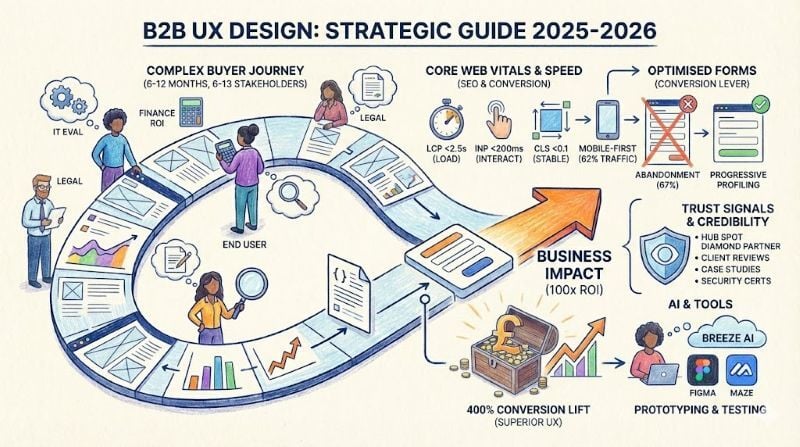
Good UX delivers a £100 return for every £1 invested, making it one of the highest-ROI investments B2B organisations can make. With 75% of B2B buyers now preferring a rep-free purchasing experience, your website must serve multiple personas, build consensus, and enable self-service at every stage of increasingly complex buying journeys.
The burden of persuasion has shifted from sales teams to digital experiences. According to Gartner's research, buyers now spend only 17% of their total purchasing time with sales representatives—meaning 80% of the B2B buying journey happens without direct vendor contact. When the average B2B purchase involves 6-13 stakeholders spending months researching solutions independently, your website's user experience becomes the primary driver of pipeline generation.
What UX Design Means in the Current B2B Landscape
User experience design encompasses all aspects of an end-user's interaction with a company, its services, and its products. The Nielsen Norman Group—the research organisation founded by UX pioneers Don Norman and Jakob Nielsen—defines true UX as going far beyond giving customers what they say they want or providing checklist features. The ISO 9241-210 standard frames it as a person's perceptions and responses that result from the use or anticipated use of a product, system or service.
For B2B organisations, the distinction between UX and UI remains critical. UX designers function as architects, considering the overall experience and user journey. UI designers serve as interior experts responsible for the final look, feel, and functionality. Both matter, but UX forms the strategic foundation.
Nielsen's Ten Usability Heuristics (30 Years Strong)
Visibility of system status, match between system and real world, user control and freedom, consistency and standards, error prevention, recognition rather than recall, flexibility and efficiency of use, aesthetic and minimalist design, help users recover from errors, and accessible documentation. These foundational principles celebrated their 30-year anniversary in 2024—and remain as relevant as ever for B2B website design.
Design-led companies have outperformed the S&P 500 by 228% over ten years, according to the Design Management Institute. Organisations typically allocate 10-11% of project resources to UX efforts—a figure that often delivers outsized returns when applied strategically.
How UX Directly Impacts Search Engine Rankings
Google's page experience signals represent the clearest connection between UX and SEO performance. Core Web Vitals—now fully enforced as ranking factors—establish three measurable thresholds that every B2B website must meet:
| Metric | Target | What It Measures |
|---|---|---|
| Largest Contentful Paint (LCP) | ≤2.5 seconds | Loading performance |
| Interaction to Next Paint (INP) | ≤200 milliseconds | Interactivity responsiveness |
| Cumulative Layout Shift (CLS) | ≤0.1 | Visual stability |
Note that Interaction to Next Paint (INP) officially replaced First Input Delay (FID) in March 2024. Google evaluates these metrics at the 75th percentile, meaning at least 75% of page visits must meet the "Good" threshold. Currently, only 47-54% of websites pass all three Core Web Vitals—representing significant competitive opportunity for organisations that optimise effectively.
The Business Impact of Page Speed
- A one-second delay reduces conversions by 7%
- A 0.1-second improvement can lift conversions by 8-10%
- Vodafone achieved a 31% LCP improvement that drove 8% higher sales
- Sites loading in one second convert at 2.5x the rate of sites loading in five seconds
- 53% of mobile visitors leave if pages take longer than three seconds to load
Mobile-first indexing completed its full transition in July 2024—all websites are now crawled exclusively with Googlebot Smartphone, and sites not accessible on mobile devices are no longer indexed. With 62% of global web traffic now mobile, mobile UX directly determines search visibility. Whitehat SEO's website audit service includes comprehensive Core Web Vitals analysis to identify specific performance bottlenecks affecting your rankings.
B2B Buyer Behaviour Demands Specialised UX Approaches
B2B purchasing fundamentally differs from B2C in ways that require distinct UX strategies. The average B2B buying cycle spans 6-12 months, with 58% of respondents reporting even longer cycles in 2024. Purchases involve 6-13 decision makers on average, with younger executives involving nearly twice as many stakeholders as older ones.
The self-service trend has transformed B2B expectations. Gartner's survey of 771 B2B buyers found that 75% prefer a rep-free sales experience, though more recent 2024 data shows this has moderated to 61%. Critically, buyers are 67% through their purchase process before engaging sellers. However, buyers are 20-22% more likely to regret digital commerce purchases, believing they could have used more information.
This creates a clear UX imperative: B2B websites must serve multiple stakeholder personas simultaneously. The CFO holds final decision-making power in 79% of purchases, whilst legal teams can slow or block 65% of deals. IT evaluates security compliance, finance verifies ROI against budgets, and end users assess daily usability.
Effective B2B UX Provides:
- Technical documentation for IT security evaluation
- ROI calculators for finance and procurement
- Implementation guides for end users
- Executive summaries for leadership sign-off
- Easily shareable content for internal consensus building
77% of B2B buyers describe their purchasing experience as complex or difficult. Reducing that friction through thoughtful UX isn't just good design—it's competitive advantage. Companies using HubSpot's smart content features can serve different stakeholder personas with personalised experiences based on CRM data, increasing relevance for each visitor.
Form Design: The Critical Conversion Lever
Form design represents one of the highest-impact UX elements for B2B lead generation. The average form abandonment rate stands at 67%, with average abandonment time at just 1 minute 43 seconds. Every unnecessary field costs you leads.
| Form Optimisation | Impact |
|---|---|
| Reducing fields from 11 to 4 | +120% conversions |
| Inline validation | -22% errors, -42% completion time |
| CAPTCHAs | -40% conversion rate |
| Single-column layouts | Faster completion |
Security concerns drive 29% of form abandonment, whilst 27% cite forms being too long. B2B-specific best practices include progressive profiling across multiple interactions (gathering more data over time rather than all at once), matching field count to offer value, and using multi-step forms that break complex qualification into digestible stages.
HubSpot's form builder enables progressive profiling natively—returning visitors see new questions rather than repeating information they've already provided. This approach respects user time whilst building richer contact profiles for sales qualification. Learn more about creating smart content in HubSpot.
Trust Signals That Drive B2B Credibility
92% of B2B buyers are more likely to purchase after reading trustworthy reviews. Case studies remain the most effective content type for 53% of marketers, whilst 44% of buyers prefer third-party content over vendor-produced material.
Effective trust signals for B2B websites include client logos (particularly recognisable brands), aggregate ratings from platforms like G2 and Capterra, security certifications (SOC 2, ISO 27001, GDPR compliance badges), analyst recognition (Gartner Magic Quadrants, Forrester Waves), and team bios that humanise the organisation.
For HubSpot implementation specifically, partner tier matters. As a HubSpot Diamond Partner, Whitehat SEO sits in the top 3% of the partner ecosystem globally—a credential that provides independent validation of expertise and track record.
Statistics That Quantify UX Business Impact
The ROI case for UX investment is compelling. Forrester Research established that, on average, every dollar invested in UX yields an impressive return of $100—a 9,900% ROI. Superior UX design can achieve conversion rates up to 400% higher than poor experiences, whilst well-crafted UI alone can raise conversions by 200%.
£100
return for every £1 invested in UX
Source: Forrester Research
Cart and checkout abandonment represents massive recoverable revenue. The average cart abandonment rate stands at 70.22% based on Baymard Institute's analysis of 50 studies. Better checkout design offers a potential 35.26% conversion rate increase. The average checkout flow contains 23.48 form elements when the ideal is just 12-14.
Staples increased their online revenue by 500% after a UX-focused redesign. These aren't marginal improvements—they're transformational business outcomes from prioritising user experience.
Accessibility: Legal Requirement and Competitive Advantage
Accessibility statistics reveal widespread failures and growing legal risk. 94.8% of the top million homepages have detectable WCAG failures, with an average of 50 accessibility errors per page. Low-contrast text alone affects 83.6% of pages.
In the UK, one in five people have a disability, yet only 68% of UK public sector websites achieved partial or full accessibility compliance during 2022-2024 monitoring. US digital accessibility lawsuits reached 4,187 in 2024, with 77% targeting retail and eCommerce. Notably, 25% of lawsuits targeted sites using accessibility overlay widgets that failed to deliver promised compliance—proving that shortcuts don't work.
WCAG 2.2, released October 2023, introduces nine new success criteria including minimum 24x24 CSS pixel touch targets, alternative controls for drag-and-drop interactions, consistent help placement, and accessible authentication. The European Accessibility Act requires compliance for all products by 2030, whilst UK Public Sector Bodies Regulations officially require WCAG 2.2 AA minimum.
Tools and AI Transforming UX Workflows
Figma dominates the UX design landscape with 80-90% market share in UI/UX, used by 95% of Fortune 500 companies. Key 2025 additions include Figma Sites for direct website publishing, Figma Make for AI-powered prototyping, and Dev Mode for seamless developer handoff with CSS, iOS, and Android code snippets.
AI integration has transformed design workflows. 77.6% of individual contributors have adopted AI (up from 65%), with 85.2% of design leaders using AI tools. Primary applications include generating copy and documentation (75.2%), accessibility checking, and UI generation from text prompts.
For prototyping and testing, Maze leads with 121,000+ panel participants and AI-powered results analysis. Microsoft Clarity provides completely free professional-grade heatmaps and session recordings—an essential tool for budget-conscious teams wanting to understand actual user behaviour.
HubSpot CMS offers B2B-specific UX capabilities including drag-and-drop page building, smart content personalisation based on CRM data, built-in A/B testing, multi-step forms for progressive profiling, and seamless integration with marketing automation. The Breeze AI features accelerate content creation whilst maintaining brand consistency.
Design Trends Shaping 2025-2026 Experiences
AI as a design collaborator will have the most impact according to 73% of designers surveyed. The shift is from AI as novelty feature to standard infrastructure—the differentiator becoming what AI does better, not whether AI is present. Salesforce's predictive layouts have achieved 3.2x higher lead conversion rates, whilst Adobe's AI-powered Sensei delivers 30% time savings on routine tasks.
Purposeful motion design is experiencing a renaissance. Apps with effective micro-interactions log 15-20% longer sessions. 50% of designers now add micro-interactions and animations, with ideal duration being 200-500 milliseconds. The key principle: every animation must solve a problem, not just decorate.
Sustainable UX has emerged as both ethical imperative and competitive advantage. The internet produces approximately 3.7% of global carbon emissions. 62% of consumers would choose one brand over another if websites were clearly greener. W3C's Web Sustainability Guidelines recommend data-light patterns, efficient caching, and asset budgets.
Visual Trends to Watch:
- Bento grid layouts—modular systems displaying multiple content blocks (research shows only 1% of visitors click carousel slides beyond the first)
- Soft brutalism—raw aesthetics combined with usability through visible grids and bold typography
- Glassmorphism fading—designers explicitly noting accessibility concerns with this style
Measurement Frameworks That Matter
The System Usability Scale (SUS) remains the gold standard for usability measurement. The average SUS score is 68 based on 500+ studies; scores above 80 indicate top 10% performance where users will actively recommend the product.
Testing with just 5 users reveals approximately 85% of usability problems—testing 5 users across 3 iterations proves more effective than testing 15 users once. This makes user testing accessible even for organisations with limited research budgets.
Key metrics to track include task success rate (percentage completing goals), time on task (efficiency indicator), error rate (confusion indicator), SUS scores for standardised comparison, and Net Promoter Score for loyalty prediction. Heatmaps and session recordings from tools like Hotjar, Crazy Egg, FullStory, or Microsoft Clarity reveal where users click, scroll, and struggle.
A/B testing requires clearly defined goals, single variable changes, statistical significance, and combination with qualitative research to understand the "why" behind numbers. Common mistakes include small sample sizes, short testing periods, and minor changes that don't meaningfully impact behaviour. Learn more about conversion rate optimisation strategies.
The Most Costly UX Mistakes to Avoid
The most costly UX mistakes follow predictable patterns:
- Accessibility failures: 94.8% of websites fail WCAG standards, with low-contrast text affecting 79% of pages
- Cart abandonment: 70.22% average, largely due to checkout complexity
- Form abandonment: 67% when users encounter complications, with password fields having the highest abandonment rate
- Mobile neglect: Mobile users are 5x more likely to abandon tasks on non-optimised sites
- Slow loading: 40% of visitors leave sites that take more than 3 seconds to load
Each of these represents recoverable revenue. A systematic approach to UX improvement—starting with quick wins like form simplification and page speed, then progressing to deeper structural improvements—typically yields measurable results within 90 days.
Turning UX Investment into Pipeline
The convergence of B2B buyer self-service preferences, Google's page experience signals, and the maturation of AI design tools creates an inflection point for B2B website UX. Organisations that invest in user experience can expect demonstrable returns—potentially £100 for every £1 spent—through higher conversion rates, improved search visibility, and competitive differentiation.
The path forward requires balancing multiple imperatives: accessibility compliance that serves the 15% of users with disabilities whilst avoiding legal risk; page performance that meets Core Web Vitals thresholds whilst delivering rich experiences; multi-stakeholder navigation that serves the 6-13 decision makers in typical B2B purchases; and AI integration that adds genuine value rather than following trends without strategy.
For B2B organisations specifically, the research points to several underappreciated priorities: shareable content formats that enable internal consensus-building, form designs that balance lead qualification with user tolerance, trust signals that address the risk-averse B2B buyer mindset, and mobile experiences that perform despite desktop's continued dominance for complex B2B tasks.
The organisations that master these elements will capture disproportionate advantage as the self-service trend accelerates. Your website isn't just a brochure—it's your primary sales tool for the 80% of the buying journey that happens before prospects speak to your team.
Ready to Improve Your B2B Website's UX?
Whitehat SEO's website audit identifies exactly what's preventing your site from ranking, converting, and generating revenue—including Core Web Vitals performance, mobile usability, and conversion bottlenecks.
Get Your Free Website AuditFrequently Asked Questions
What is the ROI of investing in B2B website UX?
According to Forrester Research, every £1 invested in UX typically returns £100—a 9,900% ROI. This return comes through higher conversion rates, reduced development rework, lower support costs, and improved customer retention. Design-led companies have outperformed the S&P 500 by 228% over ten years.
How does UX affect B2B search engine rankings?
Google's Core Web Vitals—Largest Contentful Paint, Interaction to Next Paint, and Cumulative Layout Shift—are direct ranking factors. Only 47-54% of websites currently pass all three metrics, meaning strong UX performance provides genuine competitive advantage in search visibility. Mobile-first indexing also means poor mobile UX directly prevents indexing.
What are the most important UX metrics to track for B2B websites?
Key metrics include task success rate, time on task, System Usability Scale (SUS) scores, form completion rates, and Core Web Vitals. For B2B specifically, track content shareability (how often visitors share pages internally) and multi-session journeys that reflect committee-based buying decisions.
How can HubSpot help improve B2B website UX?
HubSpot CMS provides smart content personalisation based on CRM data, multi-step forms with progressive profiling, built-in A/B testing, and drag-and-drop page building. The platform's integration with marketing automation enables personalised experiences for different stakeholder personas whilst maintaining consistent performance and security.
How long does it take to see results from UX improvements?
Quick wins like form simplification and page speed improvements can show measurable conversion lifts within 30 days. More substantial UX redesigns typically demonstrate clear ROI within 90 days. Core Web Vitals improvements may take 2-4 weeks to reflect in Google Search Console data after implementation.
References & Further Reading
- Gartner: The B2B Buying Journey – Research on buyer preferences and self-service trends
- Nielsen Norman Group: 10 Usability Heuristics for User Interface Design – The foundational UX framework
- Baymard Institute: UX Statistics – Comprehensive ecommerce UX research and benchmarks
- Google Web.dev: Core Web Vitals – Official documentation on page experience metrics
- Eficode: Achieving ROI with UX Design – Forrester research on UX investment returns
- WebAIM: The WebAIM Million – Annual accessibility analysis of top websites
About Whitehat SEO
Whitehat SEO is a London-based HubSpot Diamond Solutions Partner and full-service inbound marketing agency. We run the world's largest HubSpot User Group and have been delivering ethical, results-focused digital marketing since 2011. Our services include SEO growth programmes, HubSpot onboarding, website design, and integrated marketing services.
80a Uxbridge Road, London W12 8LR | Join our HubSpot User Group view our pricing