
Published: 6 January 2025 | Last Updated: 6 January 2025
Growth-Driven Design: The Modern Approach to Building Websites That Actually Deliver Results
Growth-driven design (GDD) is an iterative website development methodology that replaces risky big-bang redesigns with continuous, data-informed improvements. Unlike traditional 12-18 month redesign projects—which fail 80% of the time according to SoftwareReviews 2023 research—GDD launches a strategic "Launch Pad" website in 60-90 days and systematically optimises based on real user behaviour. Whitehat SEO implements GDD principles within HubSpot CMS to help UK B2B companies build websites that compound in performance over time.
The methodology originated from HubSpot's ecosystem around 2015, championed by Luke Summerfield. While HubSpot deprecated its formal GDD certification in May 2025, the principles remain relevant—perhaps more so as AI-powered tools now accelerate both the initial launch and ongoing optimisation phases. Today, over 1,500 practitioners continue developing GDD through the community-led GDD Slack community, and 940+ agencies worldwide still practise the methodology.
What Is Growth-Driven Design and How Does It Differ from Traditional Redesigns?
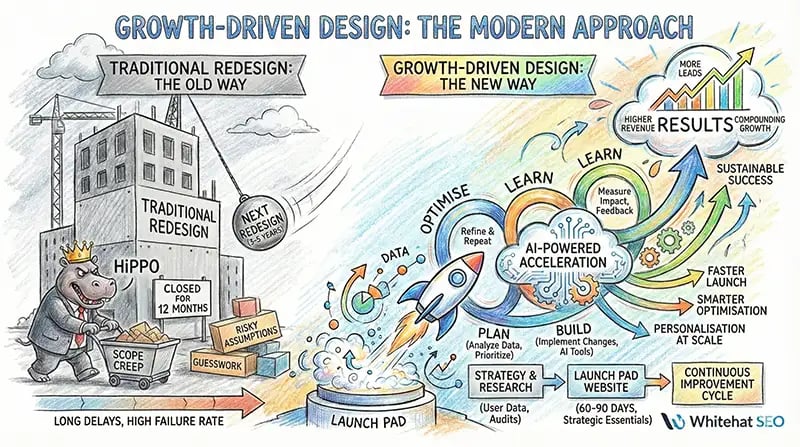
Growth-driven design fundamentally inverts the traditional website redesign model. Instead of spending 6-18 months planning and building a "perfect" website—only to launch and hope it works—GDD practitioners launch quickly with strategic essentials and then improve continuously based on actual user data.
The contrast is stark. Traditional website redesigns operate like construction projects: extensive planning, fixed scope, big reveal, and then minimal changes until the next redesign 3-5 years later. This approach creates enormous risk. The 2024 Forrester Digital Transformation Research found that 54% of digital transformation projects fail, while the PMI 2024 Pulse of the Profession report identified scope creep in 52% of projects.
Growth-driven design treats your website as a living asset rather than a static project. The GDD approach acknowledges an uncomfortable truth: you cannot predict exactly what your users need before launch. Instead of guessing, GDD uses website audit data and user research to make informed improvements continuously.
Traditional Redesign vs Growth-Driven Design
| Factor | Traditional Redesign | Growth-Driven Design |
|---|---|---|
| Time to Launch | 6-18 months | 60-90 days |
| Budget Model | Large upfront investment | Smaller initial + monthly |
| Improvement Approach | Wait 3-5 years for next redesign | Continuous monthly cycles |
| Risk Profile | High (80% failure rate) | Low (iterative validation) |
| Decision Basis | Assumptions and opinions | User data and behaviour |
Why Traditional Website Redesigns Fail (and GDD's Solution)
The 80% failure rate for traditional website redesigns (SoftwareReviews, 2023) stems from predictable patterns. Projects suffer from scope creep, HiPPO-driven decisions (Highest Paid Person's Opinion), extended timelines that cause stakeholder fatigue, and the fundamental problem of designing for imagined users rather than real ones.
Traditional redesigns also create a dangerous launch-and-pray dynamic. After months of development, organisations launch their new website hoping it performs better than the old one. If it doesn't—and data shows many redesigns actually decrease performance initially—there's no systematic approach to course-correct. The Baymard Institute 2024 research found that the average e-commerce conversion rate sits at just 2.1%, suggesting most websites have substantial room for improvement that traditional redesign cycles miss entirely.
Growth-driven design solves these problems through its core philosophy: reduce risk by launching quickly with strategic essentials, then use continuous improvement cycles to optimise based on real user behaviour. Whitehat SEO's HubSpot onboarding process incorporates GDD principles, ensuring clients launch with a solid foundation and clear optimisation roadmap.
The Hidden Costs of Traditional Redesigns
Beyond project failure rates, traditional redesigns carry hidden costs that compound over time. The average UK B2B website redesign costs £15,000-£50,000 for mid-market companies, yet research from BCG (2023) shows that organisations investing in continuous optimisation achieve 20% average conversion rate improvements—gains that traditional redesign cycles leave on the table for years between projects.
There's also the opportunity cost. Every month spent in the planning and development phase of a traditional redesign is a month where your website isn't improving. For B2B companies where 46% of revenue now flows through digital channels (Gartner 2024), this represents significant lost opportunity.
The Three Pillars of Growth-Driven Design
Growth-driven design rests on three foundational pillars that together create a systematic approach to website development and optimisation. Understanding these pillars helps organisations implement GDD effectively rather than simply adopting superficial elements.
Pillar 1: Strategy (Minimise Risk Through Research)
The strategy phase involves deep research into user behaviour, business goals, and competitive positioning before touching design or development. This includes developing detailed buyer personas, mapping user journeys, conducting Jobs-to-be-Done research, and establishing clear success metrics. Unlike traditional redesigns that skip straight to design mockups, GDD's strategy phase ensures the Launch Pad website addresses genuine user needs. Whitehat SEO's inbound marketing approach naturally aligns with this research-first methodology.
Pillar 2: Launch Pad (Get Live Quickly With Strategic Essentials)
The Launch Pad concept represents GDD's biggest departure from traditional thinking. Rather than building a "complete" website, GDD practitioners launch with strategic essentials—the 20% of features that deliver 80% of user value. This Launch Pad website typically goes live within 60-90 days, significantly faster than traditional redesign timelines. Original GDD research from HubSpot (2017) documented average launch times of 60 days for GDD versus 108 days for traditional approaches.
Pillar 3: Continuous Improvement (Optimise Based on Data)
After launch, GDD enters its most valuable phase: continuous improvement cycles. Teams work in monthly or bi-weekly sprints, using analytics data, heat mapping, session recordings, and user feedback to identify optimisation opportunities. Each cycle follows a plan-build-learn loop, prioritising improvements based on impact potential and implementing changes systematically. This is where GDD creates compounding value—each improvement builds on previous gains.
How to Implement GDD: Building Your Launch Pad Website
Implementing growth-driven design requires shifting organisational mindset as much as changing development processes. The Launch Pad website is not a "minimum viable product" or compromise—it's a strategic first release designed to learn from real users as quickly as possible.
Step 1: Conduct Strategy Research
Begin with comprehensive research into your users, goals, and competitive landscape. This includes analysing existing website data (if available), conducting user interviews, developing or refining buyer personas, mapping user journeys, and establishing baseline metrics. Whitehat SEO recommends starting with a comprehensive website audit to understand current performance before planning improvements.
Step 2: Create Your Wish List and Prioritise
Document every idea, feature, and improvement you could potentially include on your website—your "wish list." Then ruthlessly prioritise using impact versus effort analysis. For the Launch Pad, select only items that score high on impact and low-to-medium on effort. Everything else moves to the continuous improvement backlog.
Step 3: Build and Launch Your Launch Pad
Development proceeds using agile principles with regular sprint cycles. The goal is launching a website that looks professional, communicates your core value proposition clearly, and includes essential conversion pathways—within 60-90 days. This is not about cutting corners; it's about focusing on what matters most for initial user validation.
Step 4: Establish Your Continuous Improvement Rhythm
Post-launch, establish regular improvement cycles—typically monthly sprints. Each cycle involves analysing recent data, identifying opportunities, prioritising improvements, implementing changes, and measuring results. This rhythm transforms your website from a static asset into a continuously improving engine for business growth.
The Continuous Improvement Cycle: Where GDD Creates Compounding Value
The continuous improvement phase is where growth-driven design delivers its most significant returns. While the Launch Pad gets you live quickly, systematic improvement cycles create compounding gains that far exceed traditional redesign approaches.
Original HubSpot GDD research (2017) documented remarkable results: +16.9% leads generated and +11.2% revenue increase at the six-month mark for organisations using GDD methodology. These improvements compound over time—each optimisation builds on previous gains, creating exponential rather than linear growth.
The Monthly Improvement Sprint
Effective continuous improvement follows a structured cycle. The plan phase involves reviewing analytics, heat maps, session recordings, and user feedback to identify opportunities. Teams then prioritise opportunities using the ICE framework (Impact, Confidence, Ease) or similar scoring methods. Implementation follows using agile development practices, with changes measured against baseline metrics.
Whitehat SEO's SEO services integrate seamlessly with GDD continuous improvement cycles, ensuring search optimisation improvements align with broader website enhancement efforts.
Essential Tools for Continuous Improvement
The technology stack for GDD continuous improvement has evolved significantly. Core requirements include analytics platforms for quantitative data, heat mapping and session recording tools for qualitative insights, A/B testing capabilities for validating changes, and a robust CMS that supports rapid updates. The A/B testing landscape shifted in September 2023 when Google Optimize sunset, leading many organisations to tools like VWO, Optimizely, or AB Tasty.
Essential GDD Technology Stack
- Analytics: Google Analytics 4, HubSpot Analytics
- Behaviour Analysis: Hotjar, Microsoft Clarity, FullStory
- A/B Testing: VWO, Optimizely, AB Tasty
- CMS: HubSpot CMS, WordPress with Gutenberg
- AI-Powered Optimisation: VWO Copilot, Optimizely Opal, Evolv AI
GDD in 2025: AI-Powered Optimisation and the Future of Website Development
The growth-driven design methodology has transformed significantly since its 2015 origins. Artificial intelligence now accelerates both the Launch Pad creation and continuous improvement phases in ways early GDD practitioners couldn't have imagined.
AI website builders like Wix AI and Framer AI can now create functional, professional websites in hours rather than weeks—potentially compressing the Launch Pad phase from 60-90 days to days or even hours for simpler sites. For B2B companies with complex requirements, AI assists with content generation, design variations, and automated testing at scales previously impossible.
AI in Continuous Improvement
The most significant AI impact appears in the continuous improvement cycle. AI-powered CRO tools now offer capabilities that transform optimisation speed and effectiveness:
- VWO Copilot: Uses AI to analyse session recordings and suggest optimisation hypotheses automatically
- Optimizely Opal: AI-driven experimentation platform that predicts test outcomes and suggests winning variations
- Evolv AI: Runs continuous multivariate experiments with AI-driven variation generation
- HubSpot Breeze AI: Integrates AI capabilities across the HubSpot platform including content creation and personalisation
These tools accelerate the plan-build-learn cycle that sits at the heart of GDD methodology. Where teams once spent days analysing data to identify opportunities, AI can now surface insights in minutes.
Personalisation at Scale
AI also enables personalisation capabilities that align perfectly with GDD's user-centric philosophy. Rather than building one website for all visitors, organisations can now create dynamic experiences that adapt to individual user behaviour, firmographic data, and intent signals. HubSpot CMS's smart content features exemplify this capability, allowing Whitehat SEO clients to deliver personalised experiences without complex technical implementations.
How Much Does Growth-Driven Design Cost in the UK?
Understanding GDD pricing requires shifting from traditional project-based thinking to a model that accounts for both initial launch and ongoing optimisation investment. For UK B2B companies, typical costs break down as follows.
Launch Pad Investment
The initial Launch Pad website typically costs £15,000-£50,000 for mid-market UK B2B companies. This includes strategy research, design, development, and launch. The cost compares favourably to traditional redesigns, which often exceed £50,000+ when scope creep and timeline extensions are factored in. Whitehat SEO's digital services pricing provides transparent guidance on expected investment levels.
Continuous Improvement Retainer
Post-launch, organisations invest in monthly improvement cycles, typically ranging from £2,000-£8,000 per month depending on sprint scope and complexity. This ongoing investment funds the analytics analysis, optimisation planning, design updates, development work, and testing that drives continuous improvement.
ROI Considerations
The GDD investment model often delivers superior ROI compared to traditional redesigns. By launching faster, organisations start generating returns earlier. The BCG 2023 research finding that continuous optimisation delivers 20% average conversion rate improvements illustrates the compounding value of ongoing investment versus periodic big-bang redesigns that leave websites stagnant between projects.
UK GDD Investment Summary
- Launch Pad Website: £15,000-£50,000 (one-time)
- Continuous Improvement: £2,000-£8,000/month
- Annual Total (Year 1): £39,000-£146,000
- vs Traditional Redesign: £50,000-£150,000 every 3-5 years with no improvements between
GDD and HubSpot: A Natural Fit for B2B Companies
Growth-driven design and HubSpot share a common heritage—the methodology emerged from HubSpot's ecosystem and the platforms align naturally. For UK B2B companies already invested in HubSpot, implementing GDD creates powerful synergies.
HubSpot CMS Hub provides the technical foundation GDD requires: easy content updates without developer involvement, built-in A/B testing, smart content personalisation, and seamless CRM integration. These capabilities enable marketing teams to implement continuous improvement cycles without constantly engaging development resources.
Why HubSpot Accelerates GDD Success
The integration between HubSpot CMS and HubSpot CRM creates a closed-loop system essential for data-driven improvement. Website visitor behaviour connects directly to contact records, enabling analysis of which pages and content contribute to actual pipeline and revenue—not just traffic metrics. This connection supports the attribution analysis central to effective GDD continuous improvement.
As a HubSpot Diamond Solutions Partner, Whitehat SEO brings deep platform expertise to GDD implementations. This combination of methodology knowledge and technical capability ensures clients extract maximum value from both their HubSpot investment and GDD approach.
HubSpot Breeze AI and GDD
HubSpot's Breeze AI platform, launched in 2024, adds new capabilities that accelerate GDD cycles. AI-powered content creation speeds up the development of new pages and variations. Predictive lead scoring helps prioritise which website improvements will most impact pipeline. And the Breeze Copilot provides AI assistance across the platform, reducing the time required for analysis and implementation tasks.
Is Growth-Driven Design Right for Your Organisation?
Growth-driven design delivers exceptional results for organisations with certain characteristics. Understanding whether GDD fits your situation helps avoid misaligned expectations and ensures successful implementation.
GDD Works Best When:
- You have sufficient website traffic to generate statistically significant data for improvement decisions (typically 10,000+ monthly visitors)
- Leadership commits to ongoing investment rather than viewing the website as a one-time project
- Your organisation values data over opinions and will act on user research findings
- Marketing has autonomy to implement changes without extensive bureaucratic approval processes
- Your sales cycle is trackable so you can connect website improvements to revenue outcomes
GDD May Not Suit:
- Organisations with very low website traffic (insufficient data for optimisation)
- Companies requiring complete brand overhauls where iterative improvement isn't appropriate
- Industries with heavy compliance requirements that slow approval processes
- Organisations unable to commit to ongoing retainer investment post-launch
For UK B2B companies in the HubSpot ecosystem, Whitehat SEO provides consultation to assess whether GDD aligns with your specific situation and goals.
Frequently Asked Questions About Growth-Driven Design
How long does it take to launch a growth-driven design website?
A GDD Launch Pad website typically launches within 60-90 days, compared to 6-18 months for traditional redesigns. Original HubSpot research documented 60 days average for GDD versus 108 days for traditional approaches. The faster launch means organisations start generating data for improvement cycles earlier, accelerating the compounding value of continuous optimisation.
What happened to HubSpot's GDD certification?
HubSpot deprecated its formal GDD certification in May 2025, though the methodology remains widely practised. Over 1,500 practitioners continue developing GDD through the community-led Slack group, and 940+ agencies worldwide still implement GDD principles. The deprecation reflects HubSpot's evolving certification strategy rather than any issues with the methodology itself.
Can growth-driven design work with WordPress or other CMS platforms?
Yes, GDD methodology works with any modern CMS that supports easy content updates and A/B testing. While HubSpot CMS offers native features that accelerate GDD implementation, WordPress with appropriate plugins (Gutenberg editor, testing tools, analytics integration) can support the methodology. The principles of launching quickly and improving continuously are platform-agnostic.
How much traffic do I need for growth-driven design to work?
GDD typically requires 10,000+ monthly website visitors to generate statistically significant data for A/B testing and conversion optimisation. With less traffic, improvement decisions rely more on qualitative data (user research, heat maps, session recordings) than quantitative testing. Whitehat SEO can assess whether your traffic levels support effective GDD implementation.
What results can I expect from growth-driven design?
Original HubSpot GDD research (2017) documented +16.9% leads generated and +11.2% revenue increase at six months. BCG's 2023 research found organisations investing in continuous optimisation achieve 20% average conversion rate improvements. Results vary by organisation, but the data-driven continuous improvement approach consistently outperforms traditional redesign-and-forget models.
Ready to Explore Growth-Driven Design for Your Website?
Whitehat SEO helps UK B2B companies implement growth-driven design methodology within HubSpot CMS. As a HubSpot Diamond Solutions Partner, we combine deep platform expertise with proven GDD principles to create websites that compound in performance over time.
Request a Website Audit Discuss Your Project professional website design