
The most reliable way to evaluate a marketing agency in 2026 is to assess five critical dimensions: delivery track record, AI integration maturity, ROI measurement capability, team stability, and platform certifications. According to the ANA/4As Client-Agency Relationship Tenure Study (April 2025), average agency relationships have more than doubled to approximately 7 years — yet 40% of clients still plan to switch partners within six months.
7 years
Average Agency Tenure
More than doubled since 2016
40%
Plan to Switch
Within 6 months despite longer tenure
48%
Leave Over Delivery
Up 14 pts — now the #1 reason
Agency budgets are shrinking to 20.7% of marketing spend whilst expectations around AI, transparency, and measurable outcomes have never been higher. The cost of getting agency selection wrong is staggering: the ANA/4As found that the average client-side pitch costs approximately £325,000, whilst European agencies spend an average of €650,937 per year on pitching.
At Whitehat, we've spent 14 years building agency-client relationships, running the largest London HubSpot User Group, and observing what separates partnerships that thrive from those that fail. This guide distils 2025–2026 research into a practical evaluation framework.
The Relationship Paradox: Longer Tenures, Persistent Churn
Agency relationships are lasting longer than ever, yet dissatisfaction and switching remain high. The ANA/4As study revealed that clients without mandatory review periods average 8.1 years, whilst those with frequent reviews average just 3.8 years. Meanwhile, the Setup 6th Annual Marketing Relationship Survey found that 40% of clients plan to switch within six months.

| Reason for Ending Relationship | 2024 Rate | YoY Change |
|---|---|---|
| Dissatisfaction with delivery | 48% | +14 pts (now #1) |
| Agency didn't understand business | Tied #2 | +10 pts |
| Dissatisfaction with strategy | Tied #2 | Stable |
| Budget cuts | Declining | Down |
| Leadership changes | Declining | Down |
key takeaway
Delivery quality has overtaken price and strategy as the primary driver of agency departures. Retainer-based agencies see 18% annual churn with 56-month average lifespans, whilst project-based agencies face 42% churn with just 24-month lifespans. Ask any prospective agency for their client retention data and average relationship tenure.
The data also reveals significant variation by specialisation: PPC agencies experience the highest churn at 49%, SEO agencies at 38%, and full-service agencies the lowest at 25%. At Whitehat, we track retention rigorously because we believe in transparency — and because our retention rates are a competitive advantage.
The Budget Reality: Why Agency Spend Is Under Pressure
Marketing budgets are stuck. The Gartner 2025 CMO Spend Survey (402 CMOs across North America, UK, and Europe) found that marketing budgets have flatlined at 7.7% of overall company revenue — well below the 9.5% recorded three years earlier. The allocation picture tells a stark story: paid media takes 30.6% (up 11% YoY), martech 22.4%, labour 21.9%, and agencies just 20.7% — a declining share for the fifth consecutive year.
Perhaps most significantly, 22% of CMOs said GenAI has already reduced their reliance on external agencies. This creates an uncomfortable reality: agencies need to deliver measurably better outcomes to justify their shrinking slice. Modern marketing agencies must connect every activity to pipeline generated, not just traffic reported.
watch out
The hybrid model is now dominant: Sagefrog's 2026 B2B Marketing Mix Report found 46% of B2B companies use in-house-plus-agency combinations (up from 36% in 2025). The top reason for agency partnerships shifted from 'specialised expertise' to 'faster execution' at 38%. Agencies that cannot demonstrate speed and efficiency face displacement.
Want to see how your current agency stacks up? Our free audit benchmarks your marketing performance against 2026 industry standards.
Get Your Free AuditAI Capability: The New Non-Negotiable
AI capability assessment must become a core evaluation pillar. With 60% of marketing leaders already cutting agency spend due to AI, and only 30% of agencies having fully integrated AI, the gap between AI-capable and AI-lagging agencies will widen sharply. When evaluating an agency's AI capability, assess four dimensions:
Tool Integration: What AI tools does the agency actively use in production workflows — not just experimentation? Process Enhancement: Which specific processes have been enhanced by AI? "We reduced content research time by 40%" is meaningful; "We're exploring AI opportunities" is not. Human Oversight: What governance is in place for AI-generated outputs? Demonstrated Capability: Can they show case studies with measurable outcomes versus generic "AI washing" claims?
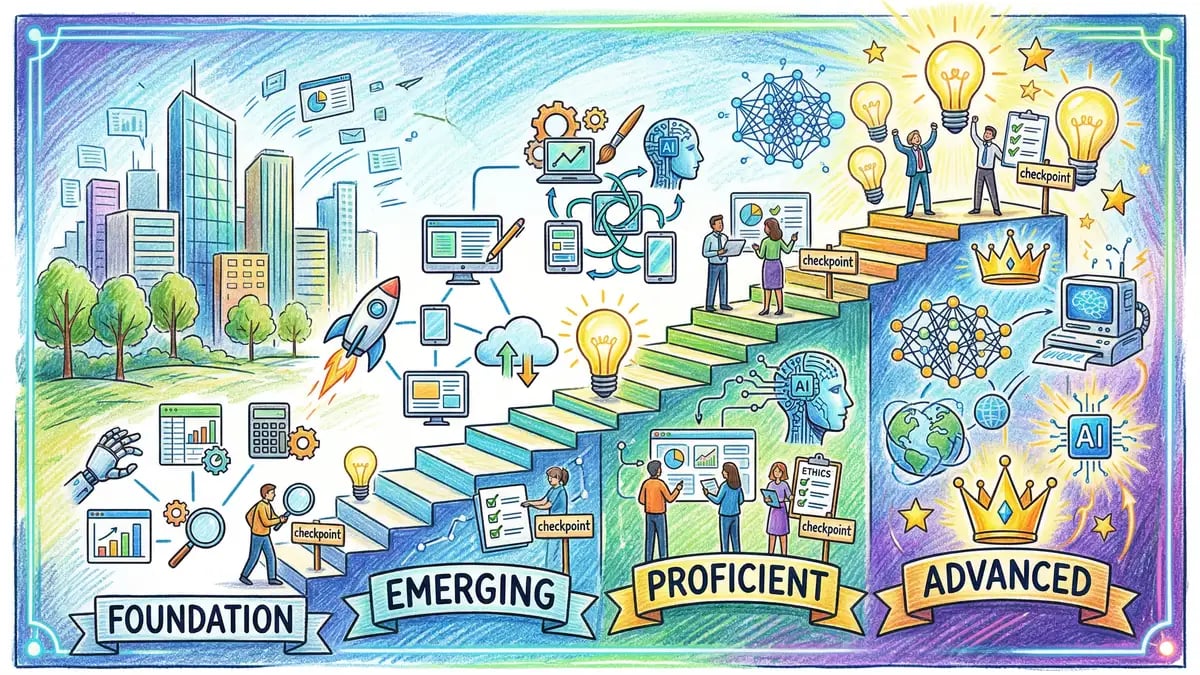
HubSpot's 2026 Ecosystem Kickoff introduced a new AI Excellence Impact Award and AI Partner Advisory Council, signalling that AI capability will increasingly differentiate partners. Agencies that have invested early in AI-enhanced processes — not just AI tools — will deliver faster execution and better outcomes.
ROI Benchmarks: What Good Looks Like by Channel
With 73% of marketers saying budgets face more leadership scrutiny, agencies that cannot connect activities to business outcomes are increasingly vulnerable. Here's what 2025–2026 research tells us about channel ROI:
| Channel | ROI Benchmark | Key Insight |
|---|---|---|
| Email Marketing | £36–42 per £1 | Automated workflows generate 30x higher returns |
| SEO | 748% median | Compounds over time; 6–12 months to materialise |
| HubSpot Implementation | 505% over 3 years | Investment payback in 4 months (IDC study) |
| PPC | 200–800% | Fastest results but requires continuous spend |
| Content Marketing | 317% average | Long-term asset building; compounds with SEO |
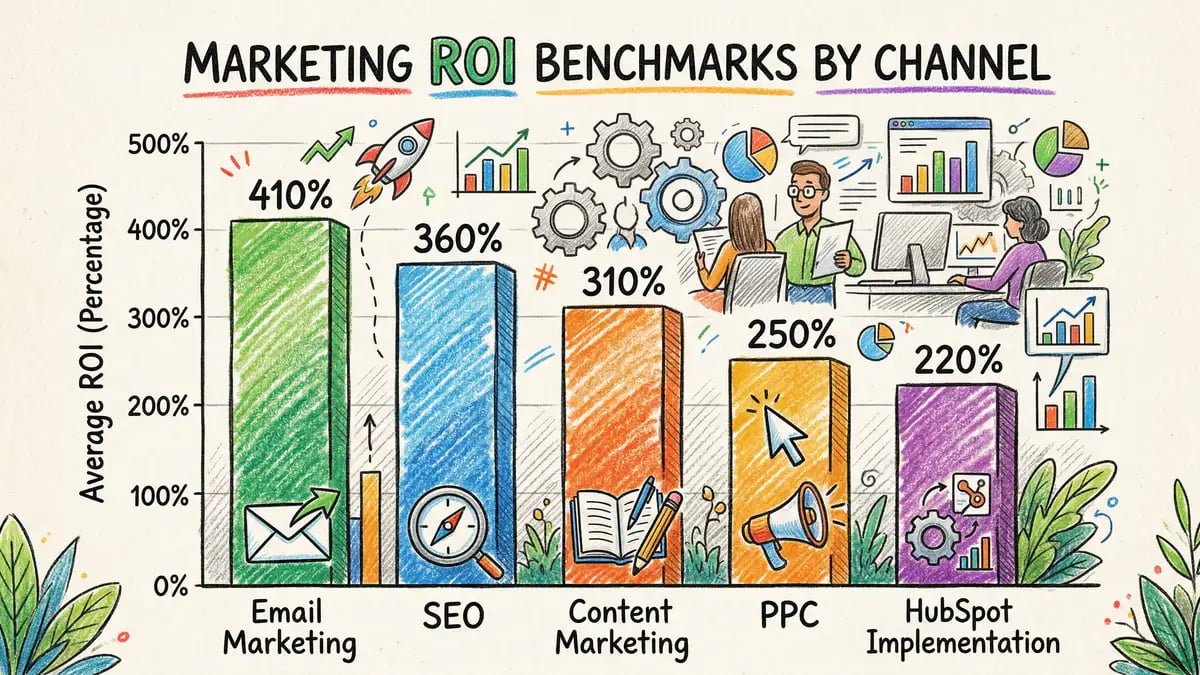
For HubSpot implementations specifically, the IDC-commissioned ROI Report (268,000+ customers, 135 countries) shows users generate 129% more inbound leads, close 50% more deals, and launch campaigns 68% faster.
Understanding HubSpot Partner Tiers: What They Actually Mean
HubSpot Diamond Partner status represents genuine scarcity — only 164 Diamond Partners worldwide, less than 3% of all tiered agencies out of 7,000+ certified partners globally. The partner tier system was updated in January 2026 with a transition to "Deal-Based Tiers," and tiers are evaluated twice annually (January 15 and July 15), meaning current status reflects ongoing performance — not a one-time achievement.
Whitehat is a HubSpot Diamond Solutions Partner because we consistently deliver results that retain clients. The 80% Gross Revenue Retention requirement means Diamond Partners must prove ongoing client value, not simply accumulate certifications.
the bottom line
Only 164 agencies worldwide hold HubSpot Diamond Partner status — less than 3% of 7,000+ certified partners.
Diamond Partners must maintain 80% Gross Revenue Retention, evaluated twice annually.
Benefits include one-to-one HubSpot support, early access to tools, and eligibility for the $10 million Partner Growth Fund.
Agency Team Stability: The Hidden Client Risk
Agency talent retention directly impacts client outcomes. The ANA estimates industry-wide agency turnover at approximately 30% annually — the second-highest rate of any industry after tourism. SHRM estimates replacing an employee costs 50–60% of annual salary, with total costs ranging from 90–200%.
A telling correlation from Predictable Profits (2025): 8-figure agencies invest £5,900 per year per employee in training and achieve 3.4-year average retention versus 2.1 years at 7-figure agencies. When evaluating agencies, ask about annual staff turnover, average team tenure, training investment per employee, knowledge transfer processes, and client turnover rates (above 20% is a red flag).
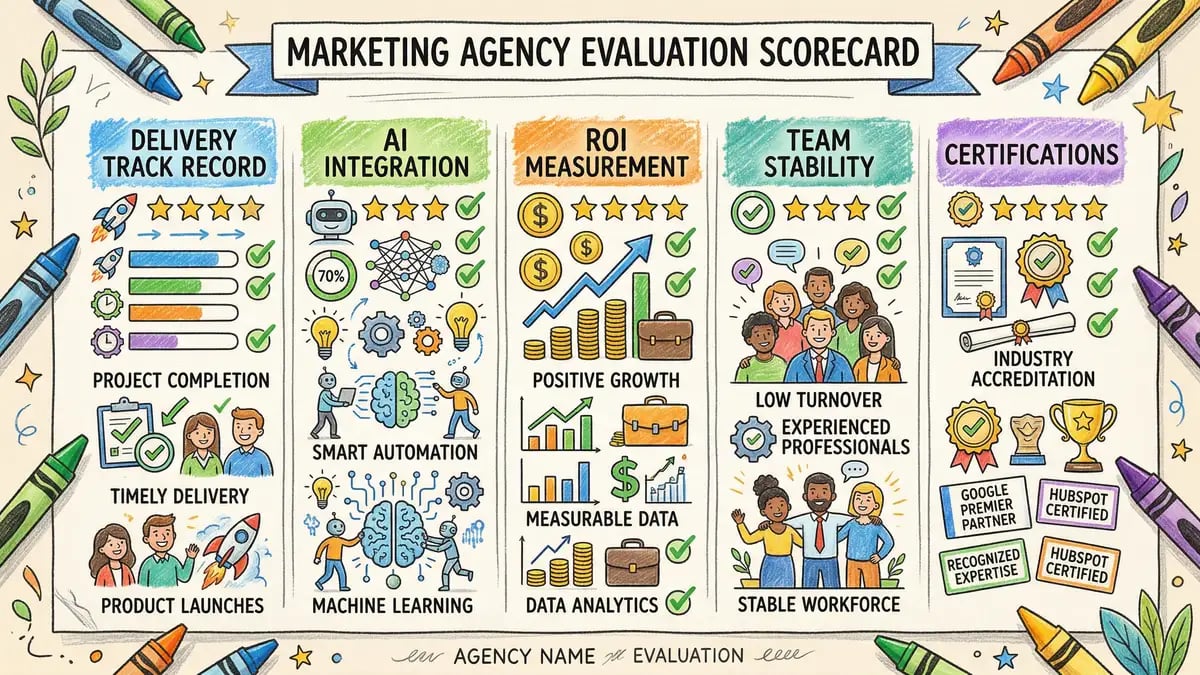
The 2026 Agency Evaluation Scorecard
Based on the research findings, here is Whitehat's recommended five-dimension framework for evaluating agency partners. Weight each dimension based on your organisation's priorities:
Dimension 1 — Delivery Track Record (30% weight): Client retention rate, case studies with quantified business outcomes, references from similar-sized companies, evidence of long-term partnerships.
Dimension 2 — AI Integration Maturity (25% weight): Specific AI tools used in production, quantified efficiency gains, clear governance processes, answer engine optimisation (AEO) capability.
Dimension 3 — ROI Measurement Capability (20% weight): Clear attribution methodology, CRM integration (HubSpot, Salesforce), business-outcome reporting, ability to demonstrate ROI to leadership.
Dimension 4 — Team Stability and Expertise (15% weight): Staff turnover below 20%, average tenure above 2.5 years, training investment per employee, knowledge transfer processes.
Dimension 5 — Platform Certifications (10% weight): HubSpot partner tier, relevant accreditations, Google Partner status, industry-specific certifications.
Sources: ANA/4As Client-Agency Relationship Tenure Study (April 2025), Gartner 2025 CMO Spend Survey, Setup 6th Annual Marketing Relationship Survey (2024), Sagefrog 2026 B2B Marketing Mix Report, IDC-commissioned HubSpot ROI Report, Focus Digital Agency Retention Study (2025), Predictable Profits Agency Benchmarks (2025)
Frequently Asked Questions
What is the average cost of a marketing agency pitch in 2026?
The average client-side pitch cost is approximately £325,000 ($408,500) according to ANA/4As research. European agencies spend an average of €650,937 per year on pitching, with each pitch costing €43,000+. UK pitch costs rose 26% to over £50,000 per agency pitch.
How many HubSpot Diamond Partners exist worldwide?
There are only 164 HubSpot Diamond Partners worldwide — less than 3% of all tiered agencies out of 7,000+ certified partners globally. Only 33 agencies hold Elite tier. Diamond Partners must maintain at least 80% Gross Revenue Retention and are evaluated twice annually.
What percentage of marketing budget should go to agencies?
According to Gartner's 2025 CMO Spend Survey, agencies receive 20.7% of marketing budgets — a declining share for the fifth consecutive year. With 39% of CMOs planning agency budget cuts, agencies must demonstrate clear ROI to justify their share.
What is the top reason clients leave their marketing agency?
Dissatisfaction with delivery is now the number one reason at 48%, up 14 percentage points year-on-year. This has overtaken budget cuts and leadership changes, signalling a fundamental shift toward holding agencies accountable for execution quality.
How do I evaluate an agency's AI capability?
Assess four dimensions: tool integration (specific platforms used in production), process enhancement (quantified efficiency gains), human oversight (governance for AI outputs), and demonstrated capability (case studies with measurable outcomes versus generic AI washing claims).
Clwyd Probert
Managing Director, Whitehat
Clwyd Probert is Managing Director of Whitehat, a London-based SEO and inbound marketing agency and HubSpot Diamond Partner. With over 14 years helping B2B companies connect marketing to revenue, Clwyd leads the largest London HubSpot User Group and specialises in AI-enhanced search strategies.
Ready to Score Your Current Agency?
Use Whitehat's five-dimension evaluation framework to benchmark your agency — or discover what a HubSpot Diamond Partner delivers. Book a free 30-minute strategy call.