
Business & Strategy
How to Choose a Marketing Agency in the UK (2026 Guide)
Published: January 2026 | Last Updated: January 2026 | Reading time: 8 minutes
When choosing a marketing agency in the UK, prioritise agencies that demonstrate genuine expertise in your industry, transparent pricing (typically £1,250–£16,750 per month for retainers), and measurable results with clear KPIs. Look for evidence of platform certifications such as HubSpot Diamond Partner status, strong case studies with quantified outcomes, and a consultative discovery process. Avoid agencies that guarantee rankings, demand lengthy lock-in contracts without exit clauses, or cannot explain how they measure ROI.
The UK marketing agency market has grown to £20.4 billion in 2025, with over 16,000 agencies competing for your business. With 46% of UK companies now outsourcing marketing activities—rising to 50% among B2B organisations—finding the right agency partner has become a critical business decision.
Yet the sheer volume of options makes evaluation challenging. How do you distinguish between agencies that will genuinely accelerate your growth and those that will drain budget whilst delivering little value? This guide provides an evidence-based framework for making that decision, with UK-specific pricing data and expert perspectives on what separates effective agencies from the rest.
Whether you're a Marketing Director evaluating HubSpot partners, a business owner seeking inbound marketing support, or a RevOps leader needing CRM integration expertise, the principles here apply. The goal isn't finding the cheapest agency—it's finding the right agency for your specific situation.
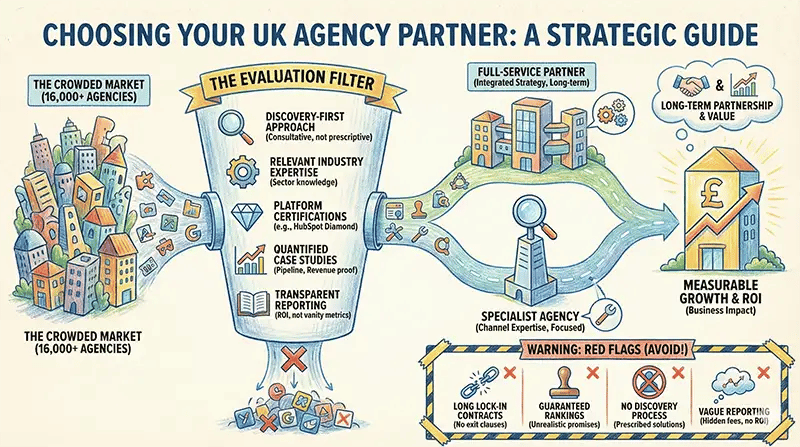
What to Look for When Hiring a Marketing Agency
The best agency-client relationships begin with thorough discovery. As Neil Perkin, author of the IPA's "Partnering for Growth" report, explains: agencies that invest time understanding your business before recommending solutions demonstrate the consultative approach that correlates with long-term success.
Research from the IPA shows that agencies embedding effectiveness roadmaps into their work deliver measurably better commercial outcomes. When evaluating potential partners, prioritise these criteria:
Relevant industry experience: Agencies with sector-specific expertise understand your buyers, competitive landscape, and regulatory constraints. A B2B SaaS company needs different capabilities than a multi-location professional services firm.
Platform certifications: Certifications like HubSpot Diamond Partner status indicate proven implementation experience. Only 164 agencies globally hold Diamond tier—representing less than 3% of HubSpot's 6,000+ partners.
Transparent reporting: Effective agencies connect marketing activity directly to revenue, not vanity metrics. Ask to see example dashboards and reporting cadences before committing.
Case studies with quantified outcomes: Vague claims like "improved performance" mean nothing. Look for specific numbers: pipeline generated, conversion rate improvements, cost-per-acquisition reductions.
Cultural alignment: You'll work closely with this team. Their communication style, responsiveness, and values matter as much as technical capability.
Whitehat's marketing services approach emphasises discovery before prescription—typically investing 2–4 weeks understanding your business before recommending any specific tactics. This consultative model ensures recommendations match your actual situation rather than a templated playbook.
How Much Do Marketing Agencies Cost in the UK?
UK marketing agency costs vary significantly based on scope, agency size, and service complexity. According to 2025 industry benchmarks, here's what to expect:
| Service Type | Monthly Range (UK) |
|---|---|
| Basic digital (SEO, social, reporting) | £1,250–£3,500 |
| SEO-focused retainer | £750–£3,000 |
| PPC management | £830–£1,100 |
| Social media management | £1,000–£4,000 |
| Full-service retainer | £3,500–£16,750 |
| Enterprise-level partnerships | £12,000–£75,000+ |
London-based agencies typically charge a 30–40% premium over regional UK agencies. Project work—such as HubSpot implementations, website builds, or strategic audits—usually ranges from £5,000–£75,000 depending on complexity.
The Gartner 2025 CMO Spend Survey found that marketing budgets now average 7.7% of company revenue, with agencies representing approximately 20.7% of that spend. For a £5 million revenue company, this suggests annual agency investment of roughly £77,000–£85,000.
Questions to Ask Before Signing with an Agency
The questions you ask during evaluation reveal as much about your sophistication as the agency's answers reveal about their capability. Use these to separate genuinely strategic partners from those following templated playbooks.
About their process:
- How do you approach discovery before making recommendations?
- What does your typical onboarding process look like?
- How will you integrate with our existing team and systems?
About measurement:
- How do you connect marketing activity to revenue?
- What attribution model do you recommend, and why?
- Can you show me example reports from similar clients?
About experience:
- What experience do you have in our specific industry?
- Who will actually be working on our account?
- Can I speak with a current client in a similar situation?
Nicole Causapin at DesignRush advises: "Focus on clear KPIs like customer acquisition cost and lifetime value to ensure measurable results, not vanity metrics. Evaluate agencies for strategic fluency, full-funnel skills, and data-driven, customised approaches."
Red Flags That Should Disqualify an Agency
Experienced marketers can spot problematic agencies before signing contracts. These warning signs indicate potential issues with capability, ethics, or alignment:
Guaranteed rankings or results: Ben Dutter, Chief Strategy Officer at Power Digital, warns: "If an agency guarantees results, especially in unrealistic timelines, it's a major red flag. Real growth takes time, strategic execution, and continuous optimisation."
Long contracts without exit clauses: Industry expert Krunal Soni advises: "Be careful with 12-month contracts that give you no way out. We've had clients come to us stuck in agreements they couldn't leave, even when the agency wasn't delivering."
No discovery process: Agencies that prescribe solutions before understanding your business are selling packages, not strategy. Effective partnerships require investment in understanding your specific situation.
Lack of customer understanding: Dutter adds: "A comprehensive understanding of your customer base is foundational. If an agency doesn't ask who your ideal customer is, or how you engage with them across various touchpoints, that's a serious red flag."
Vague reporting or hidden fees: Transparency in pricing and reporting indicates trustworthiness. Agencies that obscure their methods or costs often have something to hide.
Learn more about how effective marketing agencies actually work to calibrate your expectations and evaluation criteria.
Full-Service vs Specialist Agencies: Which Is Right for You?
The choice between full-service and specialist agencies depends on your internal capabilities, budget, and strategic needs. Both models have legitimate advantages.
| Consideration | Full-Service Agency | Specialist Agency |
|---|---|---|
| Best for | Businesses wanting one strategic partner | Specific channel expertise needed |
| Coordination | Agency handles cross-channel integration | You coordinate multiple vendors |
| Depth of expertise | Broad but potentially less deep | Deep expertise in specific area |
| Typical cost | Higher monthly retainer | Lower per-vendor but adds up |
Data from the ANA/4As shows that integrated full-service agency relationships average 7.3 years, compared to 3.7 years for specialist-only arrangements. This suggests full-service partnerships, when they work, create more durable value. However, specialist agencies often deliver superior results in their area of focus. The right answer depends on your situation.
How to Measure Marketing Agency Success and ROI
Only 52% of CMOs successfully prove marketing ROI, according to Gartner research. This makes establishing clear measurement frameworks essential before engaging any agency.
Effective ROI measurement begins with baseline documentation. Before launching any programme, capture current metrics across marketing (lead volume, conversion rates, cost per lead), sales (deals closed, average deal size, sales cycle length), and service (ticket volume, resolution time, customer satisfaction).
The best UK agencies deliver measurable improvements within defined timeframes. Based on 2025 industry benchmarks:
- SEO: Average ROI of 748% over three years, with significant traffic improvements typically visible by month 4–6
- Email marketing: £36–£42 return per £1 spent (3,600%+ ROI)
- PPC: Immediate visibility with strong performers achieving 2:1 or better ROAS
- HubSpot implementation: Average 505% ROI over three years for users of the unified platform
UK advertising generates £4.11 return for every £1 spent by medium and large firms. If your agency relationship isn't tracking toward similar returns, something needs to change—either the strategy, the measurement, or the partnership itself.
Frequently Asked Questions
How much does a marketing agency cost in the UK?
UK marketing agency retainers typically range from £1,250–£16,750 per month depending on scope. Basic digital services (SEO, social media, reporting) start around £1,250–£3,500 monthly, whilst full-service partnerships with integrated strategy and execution range from £3,500–£16,750. Project work averages £5,000–£75,000.
How long does it take to see results from a marketing agency?
Results vary by channel: PPC delivers immediate visibility, whilst SEO typically requires 3–6 months for significant impact. Most agencies deliver initial quick wins within 30–60 days. Full marketing programme impact—including pipeline and revenue attribution—usually becomes measurable at 90–180 days.
Should I hire a marketing agency or build an in-house team?
Agencies provide immediate access to diverse expertise without recruitment overhead—ideal for businesses needing breadth of capability. In-house teams offer deeper integration and institutional knowledge. Many successful companies use both: an internal team for strategy and coordination with agency partners for specialist execution.
What is a typical marketing agency contract length?
Initial engagements typically span 3–6 months before transitioning to ongoing arrangements. Rolling monthly contracts with 30-day notice periods are increasingly common among quality agencies. Be wary of 12-month lock-ins without exit clauses—these often indicate agencies that retain clients through contracts rather than results.
Why does HubSpot Diamond Partner status matter?
HubSpot Diamond Partners represent less than 3% of the 6,000+ partner ecosystem. Diamond status requires demonstrated implementation expertise, minimum managed recurring revenue thresholds, and ongoing HubSpot certification. This tier receives enhanced HubSpot support and resources that benefit client implementations.
How do I evaluate marketing agency case studies?
Look for specific, quantified outcomes rather than vague claims. Strong case studies include before/after metrics, clear timelines, similar industry context, and ideally direct client contact for reference. Be sceptical of percentage improvements without baseline context—"200% increase" means nothing without knowing the starting point.
What should be included in agency reporting?
Effective agency reporting connects marketing activity to business outcomes. Expect: traffic and engagement metrics, lead generation and quality indicators, conversion rates through the funnel, revenue attribution by channel, and progress against agreed KPIs. Reports should inform decisions, not just document activity.
When should I consider switching marketing agencies?
Consider switching when results consistently underperform agreed targets, communication breaks down, strategic recommendations stop evolving, or the agency can't demonstrate clear ROI after 6+ months. Before switching, ensure you've provided adequate briefs, budgets, and internal support—agency underperformance sometimes reflects client-side issues.
Ready to Find the Right Agency Partner?
Choosing a marketing agency is a significant decision. The right partner accelerates growth; the wrong one wastes budget and opportunity cost. At Whitehat, we've been helping UK B2B companies navigate this since 2011—both as an agency ourselves and through the London HubSpot User Group, where we've seen what works (and what doesn't) across hundreds of implementations.
Learn more about our approach, or book a discovery call to discuss whether we're the right fit for your situation.
Sources & References
- Gartner (2025). "2025 CMO Spend Survey." gartner.com
- IBISWorld (2025). "Digital Advertising Agencies in the UK - Market Size." ibisworld.com
- IPA (2024). "Building an Effectiveness Culture in Agencies." ipa.co.uk
- HubSpot (2025). "HubSpot Partner Program FAQs." hubspot.com
- Power Digital (2024). "8 Critical Agency Red Flags to Avoid." powerdigitalmarketing.com
- DesignRush (2025). "How To Choose the Right Digital Marketing Agency." designrush.com