
B2B companies using professional social media agencies report 178–300% ROI, while gaining access to £8,000–£40,000+ worth of enterprise tools their competitors cannot justify individually. According to Whitehat’s analysis of 2024–2025 industry benchmarks, agencies also provide specialised expertise that internal teams—facing a 36.9% data analytics skills gap—struggle to replicate. With LinkedIn algorithm changes causing 50% drops in organic reach and 60% of marketers now using AI tools daily, the complexity of social media management has reached a tipping point where agency expertise delivers measurable competitive advantage.
This guide examines the evidence—real benchmarks, documented case studies, and cost comparisons—to help you determine whether agency partnership makes strategic sense for your business. We’ll cover what professional social media management actually delivers, when the timing is right, and how to evaluate potential partners.
the bottom line
B2B companies outsourcing social media achieve 43% higher ROI compared to managing entirely in-house, with agencies providing access to £8,000–£40,000+ in enterprise tools and specialised expertise that internal teams cannot match.
The B2B Social Media Landscape in 2026

Social media has become non-negotiable for B2B marketing. 93% of B2B marketers now use LinkedIn, making it the dominant platform for professional audiences. The total global social media user base has reached 5.24 billion—64% of the world’s population—creating both unprecedented opportunity and competitive pressure for businesses seeking visibility.
93%
B2B Marketers on LinkedIn
Dominant professional platform
80%
B2B Leads from LinkedIn
Primary lead generation channel
45%
C-Suite Read LinkedIn Articles
Reaching decision-makers
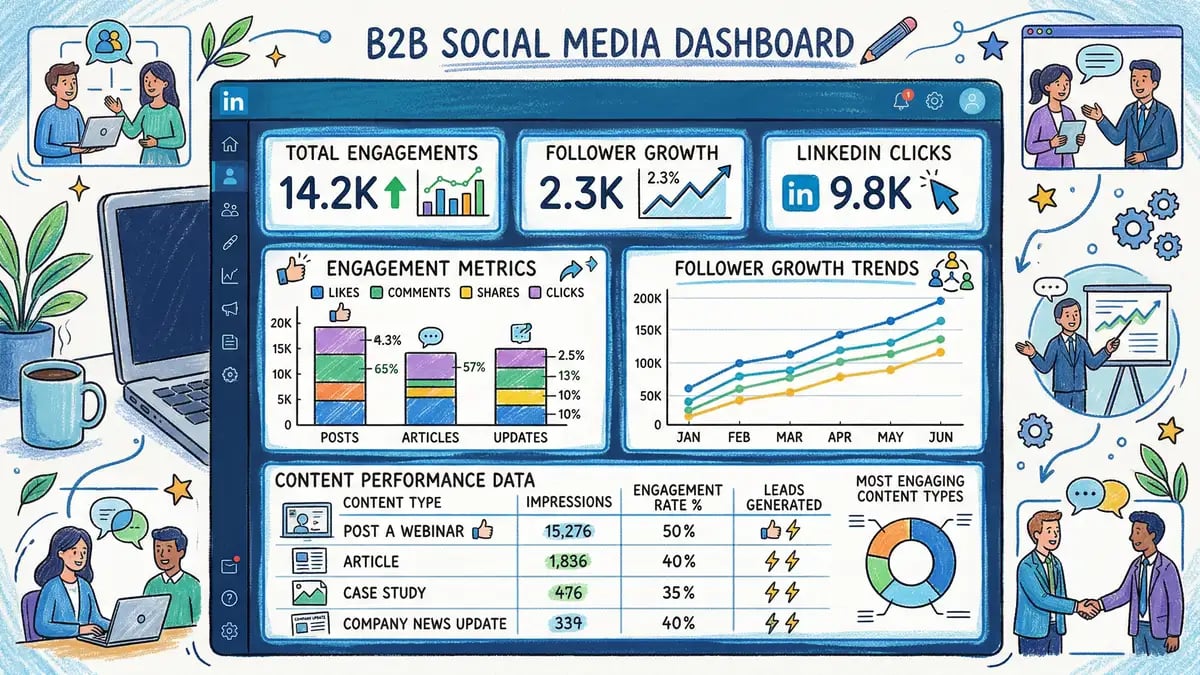
Platform preferences reveal where strategic priorities lie: 97% of B2B marketers use LinkedIn specifically for content distribution, while 87% now incorporate video marketing into their approach. More telling is the shift toward AI integration—90% of social media marketers believe building an active online community is crucial to success, and 87% say AI tools will be critical to their strategy.
The True Cost of In-House vs Agency

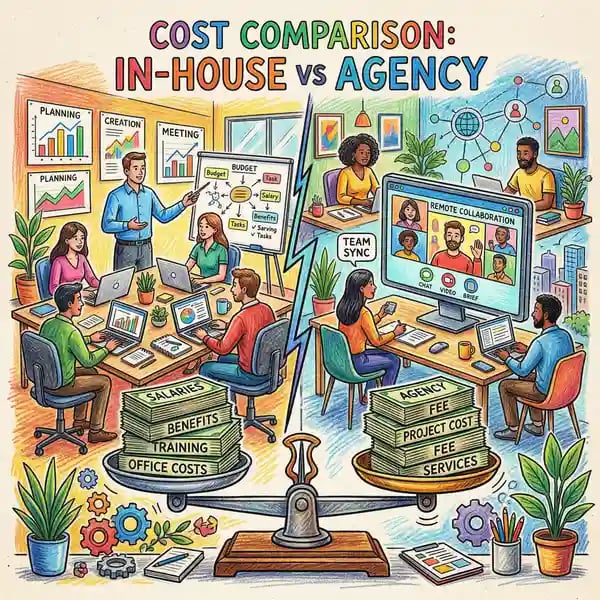
The financial comparison between in-house social media management and agency partnership often surprises business owners. A dedicated social media manager in the UK commands £33,000–£70,000 annually depending on experience level, but that figure tells only part of the story.
When accounting for benefits, overhead, training, and the enterprise tools required for professional-grade work, the loaded cost per in-house employee reaches £68,000–£95,000 annually. To match full agency capabilities internally—strategy, content creation, paid advertising, analytics, and multi-platform management—companies typically need a Marketing Director (£80,000+), Digital Marketing Manager (£55,000+), Content Specialist (£40,000+), and Social Media Manager (£45,000+). That totals £350,000+ annually before tools and software licensing.
| Resource | Annual Cost |
|---|---|
| In-house Social Media Manager (loaded) | £68,000–£95,000 |
| Full in-house team (4 specialists) | £350,000+ |
| Agency retainer (comprehensive) | £30,000–£60,000/year |
| Enterprise tool access via agency | £8,000–£40,000+ included |
Sources: Marketing Week Career & Salary Survey 2024, Sprout Social 2025, HubSpot State of Marketing 2025
Agency Investment Benchmarks
Agency retainers for comprehensive social media management typically range from £1,000–£15,000 per month depending on scope, with the most common SME engagement falling between £2,500–£5,000 monthly. Whitehat’s experience with B2B clients suggests that companies benefit most from agency partnership when they value strategic integration between social media, content marketing, and SEO services—rather than treating social as an isolated channel.
What Agencies Deliver That Internal Teams Cannot
The data strongly favours agency effectiveness across several dimensions. Businesses outsourcing marketing achieve 43% higher ROI compared to managing entirely in-house, and 64% of companies report that agencies provide better access to specialised expertise. Teams with dedicated, specialised roles—the structure typical of agencies—deliver 47% better content ROI than generalists juggling multiple responsibilities.
watch out
The 2024 Marketing Week Career and Salary Survey revealed a 36.9% data analytics skills gap among UK marketers (up from 34.4% in 2023), with 48.8% reporting NO upskilling opportunities from employers. This widening gap makes agency expertise increasingly valuable.
Enterprise Tools and Technology Access
Agencies amortise enterprise tool costs across multiple clients, providing capabilities that most businesses cannot justify individually. Professional social media management platforms cost £8,000–£40,000+ annually at enterprise tiers. Beyond the platforms themselves, agencies provide access to proprietary benchmark data, AI-powered analytics, Salesforce and HubSpot integrations, employee advocacy tools, and social listening capabilities.
Documented ROI: Case Studies with Measurable Outcomes
Abstract claims about agency value mean little without evidence. Here are documented results from B2B organisations working with social media agencies:
| Organisation | Key Result | Detail |
|---|---|---|
| Antalis (€2.1B distributor) | 300% increase in web traffic | 87% employee ambassador adoption, recruitment shortened by 3 weeks |
| Sprout Social customers | 268% ROI | £1M+ NPV over 3 years, payback under 6 months |
| HubSpot Agency Partners | 178% increase in sales opps | £170K+ MRR; manufacturers generated 738 MQLs, 31 new customers |
These figures align with Whitehat’s experience working with B2B clients through integrated inbound marketing services—social media performs best when connected to broader content strategy, lead nurturing, and attribution systems that demonstrate real business impact.
Why Platform Complexity Now Requires Specialist Expertise
The 2024–2025 period saw fundamental changes to major platforms. LinkedIn’s algorithm underwent significant updates: organic views dropped 50%, engagement fell 25%, and follower growth declined 59%. Posts now stay visible for 2–3 weeks if they generate meaningful engagement, but LinkedIn implemented large language models to surface relevant content, penalising engagement bait and prioritising meaningful conversations.
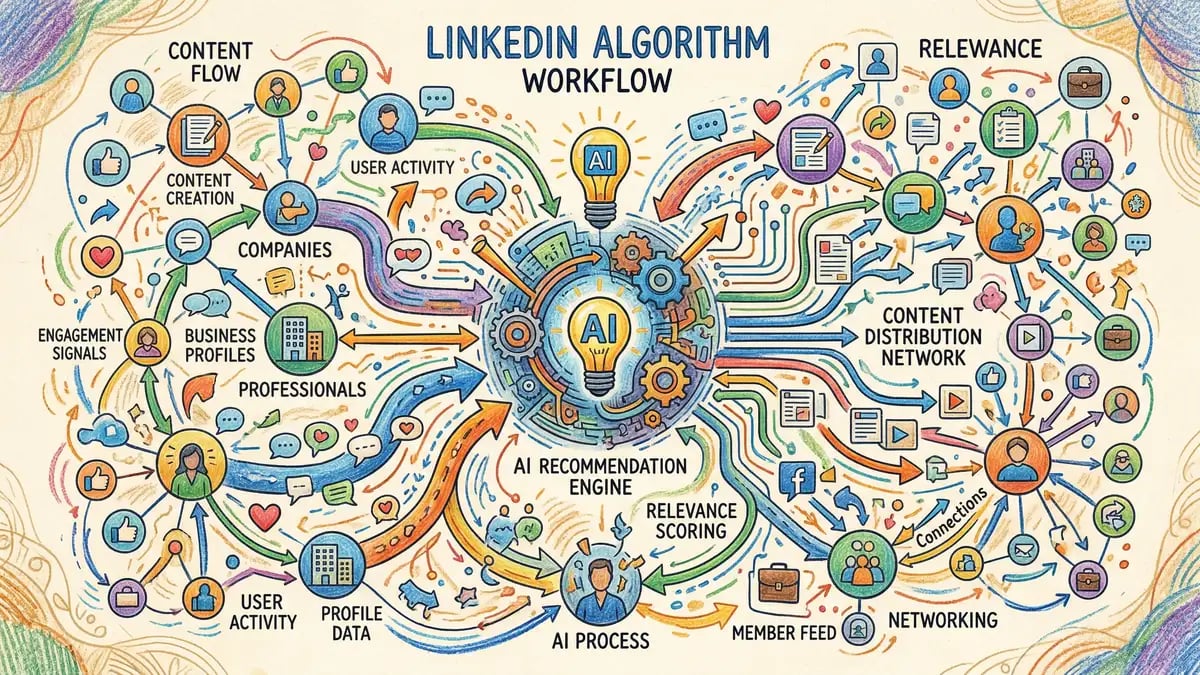
Meta’s “Andromeda” algorithm completely replaced old targeting systems—the platform now controls targeting using creative content rather than manual audience selection. AI-driven discovery means up to 50% of a user’s feed comes from accounts they don’t follow.
AI Integration Has Become Essential
AI adoption has reached critical mass: 60% of marketers now use AI tools daily (up from 37% in 2024), with 84% reporting increasing usage over the past year. Only 3.6% of social media managers avoid AI entirely. Strategic roles use AI more than execution roles—75%+ of C-level executives and VPs use AI for social strategy. Agencies that have built AI into their workflows deliver efficiency gains that internal teams still learning to adopt these tools cannot match. For businesses exploring AI applications, AI consultancy and implementation can accelerate adoption.
Want to see what a professional social media strategy could deliver for your B2B business? Get a free consultation from our team.
Book a Strategy CallWhen to Hire a Social Media Agency: Six Clear Signals
Not every business needs agency support, and timing matters. Based on documented triggers, consider professional help when you recognise these patterns: 1. Inconsistent posting and inactive profiles (brands posting daily see 66% engagement increases). 2. Low engagement despite effort (superior brands average 1–2% engagement; without strategy you’ll fall under 0.5%). 3. Difficulty measuring ROI (nearly four in ten businesses struggle here). 4. Your team is wearing too many hats. 5. Entering a scaling or growth phase. 6. Competitors are visibly outperforming you (70% of marketers struggle with cross-platform strategy).
What to Ask When Evaluating Agencies
These questions help separate genuine strategic partners from order-takers: Do you have experience in our industry? Ask for specific results from similar businesses. How do you define and measure success? Look for agencies connecting social metrics to pipeline, not vanity metrics. Who actually manages our account? Understand whether you’ll work with senior strategists or junior team members. How do you stay current with algorithm changes? Agencies should demonstrate systematic monitoring approaches. What happens when something isn’t working? The best agencies have clear processes for strategy adjustment based on performance data.
Avoid agencies promising overnight results, focused on follower counts rather than conversions, guaranteeing top rankings, or offering one-size-fits-all approaches without understanding your specific brand positioning and buyer personas.
Frequently Asked Questions
How much should I budget for social media agency services?
B2B social media agency retainers typically range from £2,500–£10,000 per month for comprehensive management, with SME engagements averaging £2,500–£5,000 monthly. We recommend starting with 10–15% of your overall marketing budget for social media, adjusting based on goals and competitive intensity.
How long before I see results from agency-led social media?
Expect initial engagement improvements within 30–60 days as strategy takes hold. Meaningful lead generation typically requires 3–6 months of consistent activity. According to Forrester research, most B2B organisations achieve payback within six months, with full ROI realisation over 12–18 months.
Can I combine in-house marketing with agency support?
Yes, and hybrid models often deliver the best results. Research indicates that combining in-house brand knowledge with agency execution achieves 5–20% lower three-year total cost of ownership than full in-house operations, with results delivered 30–60% faster.
Which platforms should B2B companies prioritise?
LinkedIn dominates B2B—85% of marketers rate it as delivering the best value, and it generates 277% more leads than Twitter or Facebook. YouTube matters for decision-maker research (50.9% prefer it). Focus on two to three platforms done well rather than spreading thin across all of them.
How do I measure social media ROI for my CFO?
Connect social metrics to CRM data using proper attribution tracking. Key metrics include social-sourced pipeline value, cost per lead by channel, influenced revenue, and brand share of voice. HubSpot’s attribution reporting provides CFO-ready dashboards connecting social activity to closed revenue.
Clwyd Probert
CEO and Founder, Whitehat SEO Ltd
Clwyd Probert is CEO and Founder of Whitehat SEO Ltd, a London-based HubSpot Diamond Solutions Partner. He leads the world’s largest HubSpot User Group (London HUG) and serves as a guest lecturer at UCL on digital marketing strategy. Whitehat helps UK B2B companies build integrated marketing programmes that prove ROI.
Ready to Discuss Your Social Media Strategy?
Whitehat integrates social media with HubSpot-powered inbound marketing, content strategy, and SEO to create measurable pipeline impact. As a HubSpot Diamond Solutions Partner running the world’s largest HubSpot User Group, we bring perspective from hundreds of B2B implementations.