
Life Science Marketing Agency London: Digital Strategy for Biotech and Pharma Companies
· 9 min read · Written by Clwyd Probert
Life science marketing requires specialist expertise that combines regulatory compliance knowledge, understanding of scientific buyer behaviour, and proven digital strategy. With 81% of B2B buyers now choosing their preferred vendor before speaking to sales, UK biotech and pharma companies must build online authority to capture the pre-sales research window where purchasing decisions are actually made.
Why Life Science Companies Need Specialist Marketing Partners
The UK life sciences sector represents a £146.9 billion market employing 359,600 people across 6,170 businesses. Yet many biotech and pharmaceutical companies struggle to translate their scientific excellence into effective digital marketing. The reasons are straightforward: heavy regulatory constraints, complex buyer journeys, and the specialist knowledge required to communicate with scientific audiences.
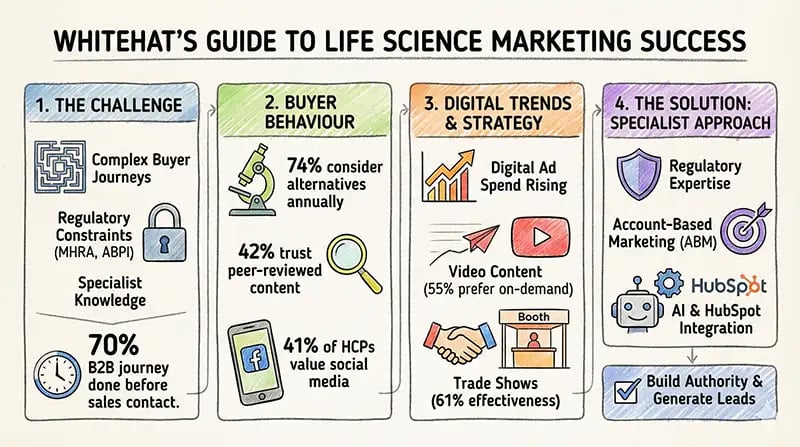
Research from 6sense reveals that 70% of the B2B buying journey now completes before any seller engagement. Buyers conduct an average of 800+ interactions across content and people during an 11.5-month journey involving 11 stakeholders. For life science companies, this means your website, content, and digital presence must do the heavy lifting that sales teams once handled.
The commercial implications are significant: the vendor contacted first wins 84% of deals. If your life science company isn't visible during the anonymous research phase, you're not even in the consideration set. This is where a specialist inbound marketing approach becomes essential—building authority and trust before prospects are ready to engage. Our comprehensive guide to life science marketing strategy explores how to build this authority across the full buyer journey.
How Scientists and Healthcare Professionals Research Products
Understanding scientific buyer behaviour is fundamental to effective life science marketing. BioInformatics Inc. research shows that 74% of life science researchers consider alternative suppliers annually, creating both opportunity and competitive pressure for vendors seeking to win or retain business.
Content format preferences among healthcare professionals reveal clear patterns. A 2024 PMC study of 511 HCPs found their preferred formats are short articles (70.9%), videos (63.4%), and slide sets (57.9%). Self-guided, on-demand learning modules rank highest overall, with weeknight consumption being the preferred time—insights that should shape your content marketing strategy.
Scientific Buyer Behaviour: Key Statistics
- 74% of researchers consider alternative suppliers annually
- 53% of scientists plan technology purchases in 2024 (lowest recorded Q1 intent)
- 42% trust peer-reviewed content above other sources
- 41% of HCPs consider social media important for scientific information
- 64% of HCPs under 34 rate social media as important (vs 41% overall)
Social media presents a nuanced picture for life science marketing. Among healthcare professionals, 41% now consider social media important for scientific information—up from 33% in 2021. This rises to 64% among those under 34. ResearchGate reaches 25+ million researchers with 130 million monthly visits, whilst LinkedIn hosts 1.9 million academics globally. A well-executed social media strategy can significantly extend your reach into scientific communities.
Digital Marketing Trends Reshaping Life Sciences
Marketing budgets across life sciences grew 19.7% in 2023 following an 8% decline in 2022, with biotech firms nearly tripling investments from $3.9M to $10.9M year-over-year. Digital now dominates: US healthcare and pharma digital ad spending reached $19.66 billion in 2024, projected to hit $24.77 billion in 2025—a 13.3% year-over-year increase.
2025 marks the first year social media ad spending will surpass linear TV in healthcare and pharma, with digital expected to constitute 82% of all sector ad spending by 2027. Yet traditional channels retain power: 62% of consumers cite TV ads as their primary source for learning about new medications, demonstrating the importance of integrated multichannel approaches.
Trade shows have recovered decisively post-pandemic. The 2024 BIO International Convention drew 19,500+ attendees with a record 61,000+ partnering meetings. SCORR Marketing's 2024 survey gave trade shows a 61% effectiveness rating—highest of any tactic surveyed—with 56% of companies increasing trade show spending. Understanding how to leverage event marketing through HubSpot can help capture and nurture these valuable leads.
Video content has become essential. ON24's 2025 Life Sciences Benchmarks show 55% of HCPs prefer on-demand content, though live webinar engagement averages an impressive 52 minutes when they do attend. A robust video marketing strategy is no longer optional for life science companies seeking to educate and engage scientific audiences. For practical guidance on building a content engine that serves these formats, see our guide to life science content marketing.
Navigating UK Life Science Marketing Regulations
Regulatory compliance is non-negotiable in life science marketing—and a key reason to work with specialist partners who understand the framework. The Human Medicines Regulations 2012 (Part 14) governs medicines advertising in the UK, implementing EU Directive 2001/83/EC as it stood pre-Brexit. The MHRA Blue Guide (Third Edition, updated March 2025) provides definitive guidance, with criminal penalties including unlimited fines and up to two years imprisonment for violations.
The ABPI Code of Practice 2024, effective 1 January 2025, introduces significant changes that affect digital marketing directly. QR codes are now acceptable for prescribing information, mandatory written agreements are required for HCP support, and Disclosure UK gateway links are mandatory. Crucially, prescription-only medicines cannot be advertised to the public—social media platforms like Twitter/X are prohibited for promotional POM information due to general accessibility.
Important: The ABPI's 2023 Social Media Guidance extends compliance to all work-related personal social media posts. Even "liking" non-compliant overseas content can trigger UK compliance issues. Any life science marketing partner must demonstrate deep familiarity with these requirements.
This regulatory complexity creates opportunity for UK companies. Most authoritative life science marketing content online is US-centric, leaving a significant gap for UK-specific guidance addressing MHRA compliance, ABPI Code implications, and NHS engagement strategies. Companies that establish authority in this space gain competitive advantage in both traditional search and AI-powered discovery.
Account-Based Marketing: A Proven Approach for Life Sciences
Account-based marketing has emerged as the growth strategy of choice in life sciences, and the data supports the investment. ITSMA research shows 87% of B2B marketers report ABM initiatives outperform other marketing investments in ROI, with over 80% measuring ROI saying ABM outperforms other marketing—and 50% indicating a "significant" difference.
Healthcare-specific results are equally compelling. Boston Digital reports 80% of marketers using ABM reported improved customer lifetime values, and 86% reported improved win rates. For life science companies with complex, high-value sales cycles and multiple stakeholders, ABM provides the focused approach needed to move deals forward.
Whitehat's HubSpot onboarding services include ABM functionality setup, enabling life science companies to identify target accounts, coordinate multi-touch campaigns, and track engagement across buying committees. Combined with robust B2B lead generation strategies, ABM provides the foundation for predictable pipeline growth. For a detailed walkthrough, read our complete guide to account-based marketing for life sciences.
Implementation in life sciences requires institutional and individual NPI# data and D&B numbers for account identification. The approach must reach diverse stakeholder groups—formulary committees include medical staff, pharmacists, prescribers, and nurses. Events are identified as particularly effective environments for ABM execution, making integration with trade show strategies essential.
Preparing for AI-Powered Discovery in Life Sciences
The convergence of AI-mediated discovery and pre-sales buyer autonomy creates specific imperatives for life science marketing. McKinsey estimates generative AI's value potential for pharma at $60-100 billion, but the more immediate concern for marketing teams is how AI tools are reshaping how scientists and healthcare professionals discover information.
Analysis of AI citation patterns reveals actionable insights. ChatGPT and similar tools prioritise "answer capsules"—self-contained summary blocks that directly address specific questions. Original and proprietary data amplifies citation likelihood significantly. For life science companies, this means structured content with clear answers, supported by credible statistics and regulatory accuracy.
The current AI citation landscape for life science marketing queries is dominated by US agencies, with BioStrata as the most prominent UK voice. This creates opportunity: UK-specific regulatory content (MHRA, ABPI Code specifics), NHS engagement strategies, and UK biotech cluster analysis are largely absent from top AI results. Understanding how to appear in AI search results is increasingly critical for life science marketing success.
Whitehat's approach combines traditional SEO services with answer engine optimisation, ensuring life science clients are visible both in traditional search and emerging AI-powered discovery channels. Our HubSpot Content Hub expertise enables the structured content creation that both search engines and AI tools reward.
What to Look for in a Life Science Marketing Agency
Selecting the right marketing partner for your life science company requires evaluating capabilities beyond generic digital marketing expertise. Regulatory knowledge is table stakes—your agency must understand MHRA requirements, ABPI Code compliance, and the specific constraints around prescription-only medicines marketing.
Life Science Marketing Partner Checklist
- Demonstrated UK regulatory knowledge (MHRA, ABPI Code)
- Experience with scientific buyer journeys and technical content
- Marketing automation expertise (HubSpot Diamond Partner preferred)
- ABM implementation capability for complex sales cycles
- Integrated SEO and content strategy for authority building
- Track record with measurable ROI in regulated industries
As a HubSpot Diamond Partner, Whitehat brings both the marketing automation expertise and the strategic understanding required for life science marketing success. Our HubSpot coaching services can help your team build internal capabilities, whilst our full-service marketing support provides comprehensive campaign execution. Use our life science marketing checklist to evaluate your current programme against proven benchmarks.
The 72% of life science companies now outsourcing marketing (up from 58% in 2020) reflects recognition that specialist expertise delivers better outcomes than generalist approaches. With the right partner, life science companies can build the digital authority needed to win in today's buyer-controlled marketplace.
Frequently Asked Questions
What makes life science marketing different from general B2B marketing?
Life science marketing requires specialist knowledge of regulatory frameworks (MHRA, ABPI Code), understanding of scientific buyer behaviour, and ability to create technically accurate content that resonates with researchers and healthcare professionals. Generic B2B approaches fail to address compliance requirements and the extended, multi-stakeholder buying journeys typical in life sciences.
How long does it take to see results from life science marketing?
Given the 11.5-month average B2B buying journey in life sciences, expect 6-12 months for significant pipeline impact. However, early indicators like increased website traffic, engagement metrics, and lead quality improvements should be visible within 3-4 months of implementing a comprehensive strategy.
Can life science companies use social media for marketing?
Yes, but with important constraints. Social media is effective for brand awareness and thought leadership—41% of HCPs consider it important for scientific information. However, prescription-only medicines cannot be promoted on public social platforms under UK regulations. A compliant social strategy focuses on disease awareness, corporate communications, and non-promotional scientific content.
What marketing budget should life science companies allocate?
Biotech firms are now investing an average of $10.9M annually in marketing (up from $3.9M), reflecting the shift toward digital-first buyer journeys. Budget allocation should prioritise content marketing, SEO, marketing automation, and ABM infrastructure, with trade shows remaining important for high-value relationship building.
How important is HubSpot for life science marketing?
Marketing automation is essential for managing complex life science buyer journeys with multiple stakeholders and extended timelines. HubSpot provides the ABM capabilities, lead scoring, nurture workflows, and attribution reporting that life science companies need to demonstrate ROI and optimise marketing investment.
Ready to Transform Your Life Science Marketing?
Let's discuss how Whitehat can help your biotech or pharma company build digital authority and generate qualified leads.
Book a Discovery CallReferences and Sources
- 6sense (2024) B2B Buyer Experience Report
- UK Office for Life Sciences - Life Science Sector Data 2024
- MHRA Blue Guide: Advertising and Promoting Medicines (Third Edition)
- ABPI Code of Practice for the Pharmaceutical Industry 2024
- FiercePharma - Pharma Marketing News and Analysis
- ON24 Life Sciences Digital Engagement Benchmarks 2025
- SCORR Marketing - Life Sciences Marketing Trends Report 2024
- McKinsey - Life Sciences Industry Insights