
Technical SEO
Google has explicitly stated there are "no additional requirements to appear in AI Overviews" beyond standard SEO practices—pages must be indexed and eligible for regular search snippets. However, indirect relationships exist through user engagement signals and crawl efficiency.
Google Page Experience in 2026: What B2B Marketers Need to Know
Google's Core Web Vitals remain the only page experience signals that directly influence search rankings in 2025, with Interaction to Next Paint (INP) replacing First Input Delay as the responsiveness metric since March 2024. The business case for B2B companies is compelling: sites meeting Core Web Vitals thresholds see conversion improvements of 8% to 92%, and Whitehat SEO's analysis shows B2B sites loading in one second convert three times better than those taking five seconds.
The INP Transition Changed Everything About Responsiveness Measurement
The March 2024 transition from First Input Delay (FID) to Interaction to Next Paint (INP) represented more than a metric swap. Google fundamentally changed how it evaluates user experience throughout an entire session rather than just the first interaction. Where FID only measured the delay before the first click could be processed, INP captures all interactions—clicks, taps, and keyboard inputs—across a user's entire page visit, reporting the worst interaction experienced.
INP measures three distinct phases: input delay (time before event handlers begin), processing duration (event handler execution time), and presentation delay (time to render the next frame). This comprehensive approach explains why pass rates dropped significantly. A staggering 93% of sites passed FID, making it nearly meaningless as a differentiator. INP reveals persistent responsiveness issues that FID completely missed.
For B2B websites running complex forms, interactive dashboards, or dynamic pricing calculators, this shift matters enormously. Your sales contact forms need to respond within 200 milliseconds—not just on the first click, but on every interaction throughout the user's session. HubSpot websites built with performance in mind need to account for these interactions from the start.
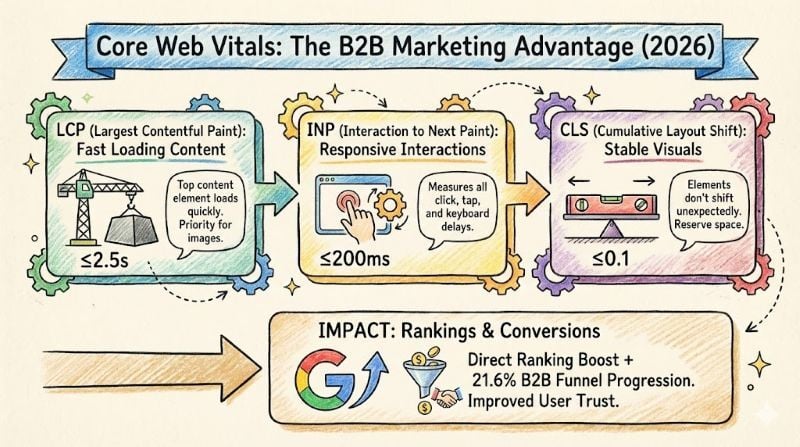
Current Core Web Vitals Thresholds for 2026
The current thresholds remain stable for 2026 with no announced changes. Google has not announced any new Core Web Vitals metrics for 2025 or beyond, though the Chrome User Experience Report (CrUX) added Round Trip Time (RTT) as a supplemental metric in September 2024.
| Metric | Good | Needs Improvement | Poor |
|---|---|---|---|
| LCP (Largest Contentful Paint) | ≤2.5 seconds | 2.5–4.0 seconds | >4.0 seconds |
| INP (Interaction to Next Paint) | ≤200 milliseconds | 200–500 milliseconds | >500 milliseconds |
| CLS (Cumulative Layout Shift) | ≤0.1 | 0.1–0.25 | >0.25 |
A page must achieve "good" ratings on all three metrics at the 75th percentile of visits to pass the Core Web Vitals assessment.
What Actually Affects Rankings vs What Doesn't
Here's where most marketing articles get it wrong. Google's documentation—last updated February 2025—makes a critical distinction that many marketers miss: only Core Web Vitals are directly used by ranking systems. Other page experience aspects like HTTPS, mobile-friendliness, and avoiding intrusive interstitials don't directly boost rankings. Instead, they represent baseline expectations that make sites "more satisfying to use."
This clarification matters enormously for resource allocation. HTTPS became a "very lightweight signal" when introduced in 2014 and now functions more as a baseline requirement. Its absence triggers browser warnings that harm user trust rather than providing competitive advantage. Mobile-friendliness similarly transitioned from bonus to expectation after Google completed 100% mobile-first indexing on 5 July 2024. All sites are now crawled exclusively by mobile Googlebot, making mobile optimisation non-negotiable rather than optional.
The practical takeaway: Don't waste budget chasing "page experience" improvements that won't move the needle. Focus your SEO investment on Core Web Vitals specifically—LCP, INP, and CLS—because these are the only page experience signals that directly influence rankings.
Google's official position places page experience between a tiebreaker signal and a lightweight ranking factor. Their documentation states that Google Search "always seeks to show the most relevant content, even if the page experience is sub-par." However, for many queries where lots of helpful content is available, "having a great page experience can contribute to success in Search."
Google also explicitly cautioned against over-optimisation, stating that "trying to get a perfect score just for SEO reasons may not be the best use of your time." The ranking priority remains: content relevance first, followed by quality and helpfulness, then page experience as a contributing factor when content is comparable.
Technical Priorities for Each Metric
LCP Optimisation: The Highest-Impact Opportunity
Largest Contentful Paint (LCP) focuses on ensuring the largest content element loads quickly—typically a hero image or main heading. Current data shows 40% of sites in Chrome UX Report fail the recommended LCP threshold, with 73% of mobile pages using an image as their LCP element. The most impactful fix involves adding fetchpriority="high" to LCP images, yet only 15% of eligible pages currently use this attribute.
Common LCP failures stem from images not being discoverable in the initial HTML. Approximately 35% of LCP images have source URLs hidden behind JavaScript or CSS that browsers can't prioritise immediately. Moving image sources to standard <img> tags or using <link rel="preload"> in the HTML head provides the most significant improvement.
CLS Optimisation: Reserve Space Before Content Loads
Cumulative Layout Shift (CLS) measures visual stability—how much elements move around unexpectedly during page load. Always specify width and height attributes on images and videos. Browsers use these to calculate aspect ratios and reserve space during loading. For ads and embeds, use CSS min-height based on the expected or largest possible size. Font-related shifts can be addressed with font-display: swap combined with preloading critical fonts.
INP Optimisation: Break Up Long JavaScript Tasks
INP optimisation requires breaking up long JavaScript tasks that block the main thread. The new scheduler.yield() API (Chrome 129+) allows developers to pause execution and let the browser respond to pending interactions. For event handlers, provide immediate visual feedback—spinners, state changes—even while processing continues.
Third-party scripts represent the most common INP offender. Regular audits of analytics, chat widgets, and advertising scripts frequently reveal unnecessary main thread blocking. This is particularly relevant for B2B sites using HubSpot tracking, live chat tools, and marketing automation scripts.
Field Data vs Lab Data: What Google Actually Measures
Google uses field data from real users (Chrome User Experience Report, or CrUX) for ranking signals, not lab data from tools like Lighthouse. This distinction matters because lab tests cannot measure INP—there's no user interaction in automated tests. Total Blocking Time (TBT) serves as a lab proxy for INP during development, but actual INP scores require real user monitoring.
The official measurement tools include PageSpeed Insights (combining CrUX field data with Lighthouse lab data), Chrome DevTools Performance panel for real-time debugging, Google Search Console's Core Web Vitals report grouping URLs by performance status, and the web-vitals JavaScript library (~2KB) for sending real user data to analytics platforms.
For third-party monitoring, tools like DebugBear, SpeedCurve, and Datadog RUM provide continuous real user monitoring with alerting capabilities. The Search Console report uses 28-day rolling windows, meaning improvements take approximately a month to fully reflect in reports—important for setting stakeholder expectations during technical SEO projects.
The B2B Business Case: Why This Actually Matters
The Google/Deloitte "Milliseconds Make Millions" study analysing 30+ million user sessions across 37 brands established quantifiable impact. A 0.1-second improvement in load time increased retail conversions by 8.4%, travel conversions by 10.1%, and—most relevantly for our clients—B2B lead generation funnel progression by 21.6%.
3×
conversion rate for 1-second vs 5-second sites
21.6%
B2B funnel progression from 0.1s improvement
48%
of mobile sites currently pass Core Web Vitals
Individual case studies demonstrate even larger returns. Vodafone Italy saw 8% higher sales after 31% LCP improvement. Redbus reported 80-100% increase in mobile conversion rates after eliminating layout shifts and halving time to interactive. For B2B specifically, Portent's research found sites loading in one second convert three times better than 5-second sites and five times better than 10-second sites.
Yet B2B website performance has remained essentially flat since 2019, with average performance scores at 65.9/100 and 40% of B2B websites having pages exceeding 4-second load times. This stagnation creates genuine competitive opportunity. According to BrightEdge research, only 13% of top B2B URLs currently receive the Core Web Vitals ranking boost—meaning the field is wide open.
Page Experience and AI Search Visibility
Research analysing 107,352 AI-visible pages found weak negative correlations between Core Web Vitals failures and AI visibility, suggesting that good performance doesn't create an advantage, but severe failure creates disadvantage. Pages with extreme CWV failures showed reduced engagement signals that indirectly affected AI inclusion likelihood.
Schema markup shows stronger correlation with AI visibility than page experience metrics. In March 2025, Google and Microsoft publicly confirmed using Schema Markup for their generative AI features. Industry studies found 73% higher selection rates for pages with properly implemented structured data, with FAQPage, HowTo, and Article schemas particularly effective for AI extraction.
Whitehat SEO's recommendation: Treat Core Web Vitals as table stakes for AI visibility—eliminate severe failures but don't over-invest in marginal improvements purely for AI purposes. Focus your SEO strategy on factors with stronger AI correlation: semantic content completeness, E-E-A-T signals through author credentials and citations, structured extractable content formats, and schema markup for entity clarity.
Implementation Priorities for B2B Websites
For sites updating from 2023 content or those just beginning their Core Web Vitals optimisation journey, here's where to focus your efforts:
Audit your LCP elements
LCP represents the highest-impact optimisation opportunity for most sites. Identify your LCP elements using PageSpeed Insights, then ensure images are properly sized, compressed, and prioritised.
Review third-party scripts for INP impact
INP requires JavaScript optimisation and third-party script audits that many B2B sites neglect. Analytics, chat widgets, and marketing automation scripts are common offenders.
Set up real user monitoring
Field data from real users—not lab scores—determines ranking impact. Use the web-vitals library or a RUM tool to understand actual user experience.
Don't chase perfect scores
Google explicitly advises against over-optimisation for SEO purposes alone. Get to "good" thresholds, then focus your remaining effort on content quality and other ranking factors.
Frequently Asked Questions
What are Core Web Vitals and why do they matter for B2B websites?
Core Web Vitals are three specific metrics—LCP, INP, and CLS—that Google uses to measure user experience on your website. They matter for B2B websites because they directly influence search rankings when content quality is comparable between competing pages. Sites meeting thresholds see conversion improvements of 8-92% depending on their baseline, with B2B lead generation funnel progression improving by 21.6% from just a 0.1-second improvement.
What replaced FID and when did the change happen?
Interaction to Next Paint (INP) replaced First Input Delay (FID) on 12 March 2024. Unlike FID, which only measured the delay before the first click could be processed, INP captures all interactions throughout a user's entire session. The threshold for "good" INP is 200 milliseconds or less at the 75th percentile of page visits.
How long does it take for Core Web Vitals improvements to affect rankings?
Google Search Console's Core Web Vitals report uses 28-day rolling windows, meaning improvements take approximately one month to fully reflect in reports. However, the ranking impact may take longer to materialise as Google re-crawls and re-evaluates your pages. Set stakeholder expectations for a 4-8 week timeline from implementation to measurable ranking changes.
Do Core Web Vitals affect AI search visibility?
Google states there are no additional requirements to appear in AI Overviews beyond standard SEO practices. However, research shows weak negative correlations between severe Core Web Vitals failures and AI visibility. Treat Core Web Vitals as table stakes—eliminate failures but don't over-invest purely for AI purposes. Schema markup shows stronger correlation with AI citation than page experience metrics.
Should I aim for perfect Core Web Vitals scores?
No. Google explicitly advises that "trying to get a perfect score just for SEO reasons may not be the best use of your time." Once you achieve "good" status across all three metrics at the 75th percentile, diminishing returns set in quickly. Focus remaining effort on content quality, which remains the primary ranking factor.
The Bottom Line for B2B Marketers
The page experience landscape in 2025 reflects a maturing ranking factor where basic compliance matters but diminishing returns set in quickly beyond "good" thresholds. The INP transition represents the most significant technical change since Core Web Vitals launched, requiring attention to JavaScript performance throughout user sessions rather than just initial page loads.
For B2B marketers, the combination of flat industry performance since 2019 and measurable conversion impacts from improvement creates genuine competitive advantage potential. With only 48% of mobile sites passing Core Web Vitals and just 13% of top B2B URLs receiving the ranking boost, the opportunity remains wide open.
The emerging AI search dimension suggests treating page experience as foundational hygiene rather than active optimisation target—eliminate failures rather than chase perfect scores, while focusing content optimisation efforts on the semantic completeness and structured formats that show stronger correlation with AI citation. If you're looking to improve your site's performance and drive more qualified leads, start with a Core Web Vitals audit and work systematically through LCP, INP, and CLS improvements.