
Marketing Attribution & Analytics SEO analytics metrics that matter explore our digital marketing FAQs
The old playbook—last-click attribution in GA4, MQL counting, campaign-level ROAS—is functionally broken for B2B companies with complex buying cycles. But attribution itself isn't dead. It has evolved into a multi-layered measurement discipline that requires different tools and thinking than most marketing teams currently employ.
Marketing ROI Tracking and Attribution for B2B in 2026
The definitive guide to measuring what actually drives B2B pipeline when traditional attribution captures less than a third of the buyer journey.
Traditional B2B attribution now captures at best 15–30% of the buyer journey, according to converging evidence from privacy restrictions, zero-click search, AI-driven discovery, and the dark funnel. The solution isn't abandoning attribution—it's building a layered measurement system that combines software-based tracking, self-reported data, incrementality testing, and AI visibility monitoring. This is how Whitehat SEO helps B2B companies prove marketing ROI in 2026.
The State of B2B Attribution: Dire But Improving
The numbers paint a stark picture. The RevSure 2025 State of B2B Marketing Attribution Report found that approximately 90% of B2B companies still use single-touch or basic multi-touch models, whilst only 18.2% measure attribution across integrated channels measuring SEO return on investment. Meanwhile, 86% of respondents struggle to connect multiple stakeholders to opportunities—a fundamental problem when 92% of B2B buying involves groups of three or more people.
The core tension in 2026 is between two camps. Chris Walker, CEO of Passetto, argues that multi-touch attribution tracks "probably 3% of the actual buyer journey"—only measurable digital touchpoints with your company, missing everything happening with competitors, peers, consultants, and board meetings. CaliberMind's 2025 State of Marketing Attribution report counters that attribution "is the only way to tie marketing efforts to revenue" and remains the primary framework for B2B revenue alignment.
Whitehat SEO's Hybrid Attribution Framework
The emerging consensus resolves this debate by treating attribution not as a single tool but as a measurement ecosystem with three layers:
- Self-reported attribution ("How did you hear about us?" as free-text on high-intent forms) to capture demand creation channels the dark funnel hides—podcasts, word-of-mouth, LinkedIn organic, communities
- Software-based multi-touch attribution to measure demand capture—which channels convert known intent into pipeline
- Triangulation using MTA for tactical optimisation, Marketing Mix Modelling for strategic allocation, and incrementality testing for causal validation
For the attribution model itself, Whitehat SEO recommends B2B companies start with W-shaped or position-based models and evolve toward data-driven/algorithmic as data maturity increases. W-shaped attribution allocates 30% credit each to first touch, lead creation, and opportunity creation, with 10% distributed among remaining touchpoints—mapping naturally to B2B pipeline stages.
What HubSpot Can and Cannot Do for Attribution
HubSpot offers nine attribution models—first interaction, last interaction, linear, U-shaped, W-shaped, J-shaped, inverse J-shaped, time-decay, and full path. This is a strong suite for rule-based attribution. However, three critical tier distinctions determine what clients can actually use.
Contact Create Attribution is available at Marketing Hub Professional (approximately £720/month). Deal Create and Revenue Attribution require Marketing Hub Enterprise (approximately £2,900/month), as does the Full Path model and Customer Journey Analytics. For any B2B client serious about attribution, Enterprise is effectively mandatory.
HubSpot Attribution Setup Recommendations
- Install tracking code on all pages including external domains and thank-you pages
- Use HubSpot's Tracking URL Builder rather than Google's Campaign URL Builder to ensure proper source categorisation
- Make every deal-contact association explicit—deals created without associated contacts break revenue attribution entirely
- Compare at least two models side-by-side (W-shaped for pipeline analysis, Full Path for revenue) in every QBR
- Note: As of 2026, email opens are excluded from attribution credit due to Apple Mail Privacy Protection
The platform has significant limitations that HubSpot Diamond Partners like Whitehat SEO must address proactively. HubSpot's Campaign object is a tag/organiser, not a true CRM object—it cannot have contacts or deals as "members" and offers no parent-child hierarchy. There is no native algorithmic or ML-based attribution model. Account-based attribution is absent; everything operates at the contact level.
For HubSpot-Salesforce environments, attribution reporting should live in HubSpot whilst sales reporting stays in Salesforce. A UTM governance document with controlled taxonomy is essential before launching any campaigns—this is something Whitehat SEO's inbound marketing services establish during onboarding.
GA4's Attribution Overhaul and Its B2B Blind Spots
GA4's Data-Driven Attribution uses a Shapley Value algorithm from cooperative game theory, analysing all user paths (converting and non-converting) to predict conversion probability and assign credit proportional to each touchpoint's marginal contribution. It examines up to 50 touchpoints per conversion path with a maximum 90-day lookback window.
For B2B, the 90-day lookback ceiling is the most damaging limitation. B2B SaaS deals average 84 days at the median, but enterprise cycles stretch to 6–18 months. Research from HockeyStack found B2B SaaS companies require an average of 266 touchpoints to close a deal, and Dreamdata data shows the average B2B customer journey spans 211 days with 76 touches.
| GA4 Configuration | Recommended Setting |
|---|---|
| Attribution Model | Data-Driven Attribution (DDA) |
| Credit Assignment | Paid AND organic channels |
| Lookback Window | 90 days (maximum) |
| Reporting Identity | Blended |
| Consent Mode | Advanced Consent Mode enabled |
GA4's DDA also operates as a black box—you cannot inspect how credit is specifically allocated. The minimum data threshold (400 conversions per key event plus 20,000 total conversions) means most B2B companies silently fall back to last-click without knowing it. For comprehensive attribution analysis beyond GA4's native limitations, Whitehat SEO recommends connecting BigQuery for custom analysis.
Organic CTR Has Collapsed—AI Overviews Accelerate the Decline
Position #1 organic CTR has fallen dramatically. The GrowthSRC 2025 study across 200,000+ keywords measured a 32% year-over-year decline for position #1 (from 28% to 19%) and a 39% decline for position #2, directly correlated with AI Overview expansion.
AI Overviews have become the primary driver of CTR erosion. Their prevalence grew from 6.49% of queries in January 2025 to 46.22% by Q2 2025. When present, they cause devastating CTR impacts: MailOnline data shows CTR dropping 56.1% on desktop and 48.2% on mobile. Critically, 88.1% of queries triggering AI Overviews are informational—exactly the content type B2B companies rely on for traffic.
Zero-click searches now represent 58–60% of all Google searches globally, with UK/EU organic CTR at 43.5% (down from 47.1% in March 2024). Gartner predicts traditional organic search traffic will decline 50% by 2028. This is why Whitehat SEO's Answer Engine Optimisation (AEO) services have become essential for B2B visibility.
An important counter-trend: positions 6–10 saw CTR increase by 30.63% in GrowthSRC's data, suggesting AI Overviews push some users to seek diverse perspectives further down the page. Featured snippets in position #1 achieve the highest CTR at 42.9%, whilst sitelinks boost position #1 to 46.9%—making structured data and snippet optimisation more valuable than ever.
Privacy Has Made 40–75% of the Customer Journey Invisible
The privacy landscape in 2026 is more complex than the simple "cookies are dying" narrative suggests. Google reversed its Chrome cookie deprecation in July 2024, and third-party cookies remain enabled by default in Chrome (approximately 67% global market share). However, Safari and Firefox already block all third-party cookies, meaning nearly 47% of the open internet is already unaddressable by traditional trackers.
In the UK and EU, the picture is worse. European cookie acceptance rates sit below 25% in strict-consent environments, meaning up to 75% of website visitor data may be lost for analytics and attribution. iOS App Tracking Transparency shows approximately 65% of users declining tracking when prompted. The combined effect: traditional client-side tracking achieves only 40–60% data coverage.
Server-side tracking is the primary countermeasure. It bypasses browser restrictions by collecting data on the server, achieving 80–95% data coverage. Meta's Conversions API implementation has delivered 9% CPA improvement, 13% CPC improvement, and 22% more recorded purchases in documented case studies. For B2B companies, server-side GTM with a custom subdomain, connected to HubSpot and GA4, is now a baseline infrastructure requirement rather than an advanced technique.
AI Search Is Creating a New Attribution Black Hole
AI platforms account for 0.15% of global internet traffic—small but growing 7x year-over-year. ChatGPT dominates at 77.97% of AI traffic share, followed by Perplexity at 15.10% and Gemini at 6.40%. The quality signal is compelling: AI-referred visitors spend 68% more time on websites than organic search visitors, convert 4.4x better, and carry 4.4x higher economic value.
The attribution challenge is severe. Perplexity reliably passes referrer data (showing as perplexity.ai / referral in GA4), but ChatGPT frequently strips referrer headers, causing traffic to appear as "direct" or "(not set)."
The disconnect between traditional SEO and AI visibility is striking. Only 12% of URLs cited by ChatGPT, Perplexity, and Copilot rank in Google's top 10 results. Some 80% of LLM citations don't rank in Google's top 100 for the original query. If a website ranks #1 on Google, there is only a 33% chance it appears in AI Overviews. This is why Whitehat SEO's approach combines traditional SEO services with Generative Engine Optimisation (GEO) as a distinct discipline.
The Metrics CFOs Actually Want in 2026
The industry has decisively shifted from lead-based to revenue-based metrics, though execution lags intent. Benchmarkit's 2025 report found the top three marketing metrics reported to boards are now Pipeline Generated (62%), Opportunities Generated (51%), and New ARR Bookings (36%). MQLs have become a "second-tier" metric.
| Metric | Benchmark | Context |
|---|---|---|
| Marketing Efficiency Ratio (MER) | 3.0–5.0 (SaaS) 4.0–8.0 (Services) |
Total revenue ÷ total marketing spend |
| New CAC Ratio | £2.00 S&M per £1.00 new ARR | Up 14% YoY; surged 222% over 8 years |
| LTV:CAC | 3:1 to 5:1 (healthy) | Below 3:1 unsustainable; above 5:1 signals underinvestment |
| CAC Payback | 12–15 months target | Median increased 12.5% since 2022 |
| Marketing-Sourced Pipeline | 25–60% of total pipeline | Enterprise: 20–40%; SMB/new territory: ~40% |
| B2B Customer Journey | 211 days, 76 touches | LinkedIn first impression to revenue: 320 days |
For CFO communication, frame everything in financial language. The critical insight: 64% of marketing leaders cannot track financial impact of their activities, and nearly 50% of CFOs say marketing budgets lack ROI justification. Closing this gap is the highest-value service an agency can offer—and it's central to Whitehat SEO's approach selecting an SEO agency that delivers measurable ROI to marketing attribution that works.
Choosing the Right Attribution Tools Beyond HubSpot
The attribution technology landscape for B2B has matured considerably. Whitehat SEO's recommendation depends on company size, sales cycle complexity, and budget.
Dreamdata is the strongest fit for mid-market B2B SaaS companies on HubSpot. Purpose-built for B2B revenue attribution with account-level journey mapping, it offers W-shaped, time-decay, and custom models, native HubSpot and Salesforce integration, and BigQuery data warehouse access. Pricing runs £500–£2,000/month.
Factors.ai offers the best value combination of attribution and ABM intelligence. At £330–£830/month, it provides seven-plus attribution models, account identification, LinkedIn and G2 intent signals, and no-code implementation.
Ruler Analytics, based in Liverpool, is the standout choice for UK professional services firms. Starting at £179/month, it combines visitor-level attribution with call tracking, form tracking, and live chat tracking—essential for businesses where phone conversations drive revenue.
Whitehat SEO's Recommended Tech Stack
For a mid-market B2B SaaS client on HubSpot:
HubSpot Enterprise + Dreamdata or Factors.ai + Looker Studio + Server-side GTM
Total attribution technology cost beyond HubSpot: approximately £1,200–£2,500/month
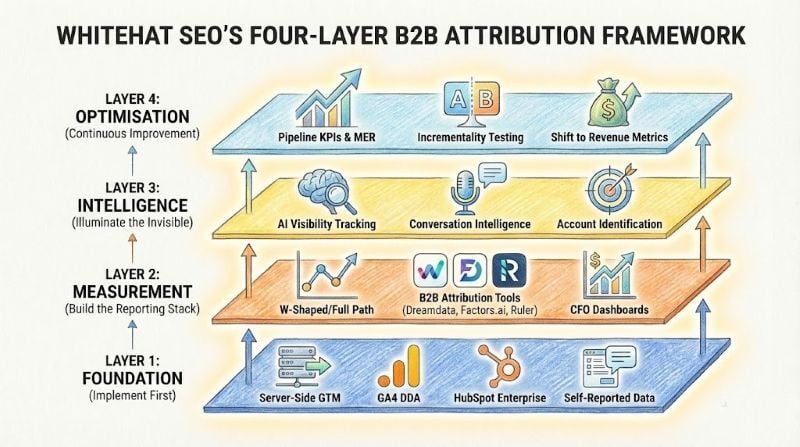
Whitehat SEO's Four-Layer Attribution Framework
The following framework translates this research into a practical methodology for B2B companies serious about ROI tracking.
Layer 1: Foundation (Implement First)
Establish UTM governance with controlled taxonomy before any campaigns launch. Deploy server-side GTM on a custom subdomain for 80–95% tracking coverage. Configure GA4 with DDA, 90-day lookback, Blended identity, and custom AI traffic channel groups. Ensure HubSpot Enterprise is in place with tracking code on all pages. Add self-reported attribution as a mandatory free-text field on demo request, pricing, and contact forms.
Layer 2: Measurement (Build the Reporting Stack)
Implement W-shaped attribution as the primary model for pipeline analysis and Full Path for revenue analysis in HubSpot. Deploy a purpose-built B2B attribution tool (Dreamdata, Factors.ai, or Ruler Analytics depending on client profile). Build CFO dashboards showing marketing-attributed revenue, CAC, LTV:CAC, CAC payback, pipeline velocity, and marketing cost per pipeline dollar. Compare at least two attribution models quarterly.
Layer 3: Intelligence (Illuminate the Invisible)
Monitor AI visibility across ChatGPT, Perplexity, and Google AI Overviews using GEO tracking tools. Implement conversation intelligence (Gong or similar) to capture dark funnel mentions in sales calls. Use visitor de-anonymisation (6sense, Demandbase, or HubSpot's Breeze Intelligence) for account identification. Correlate self-reported attribution themes with software attribution data monthly.
Layer 4: Optimisation (Continuous Improvement)
Match attribution lookback windows to actual sales cycle length. Shift KPIs from MQLs to pipeline generated, marketing CAC ratio, and cost per opportunity. Calculate MER quarterly using total revenue ÷ total marketing spend, benchmarked against 3.0–5.0 for SaaS and 4.0–8.0 for professional services. Run incrementality tests on high-spend channels quarterly.
The Goal Is Direction, Not Perfection
Attribution in 2026 operates in a fundamentally different environment than even two years ago. The convergence of privacy regulation (up to 75% of UK/EU visitor data invisible), AI-driven zero-click search (58–60% and rising), and increasingly complex B2B buying processes (211 days, 76 touches, 6+ stakeholders) means no single tool or model can deliver complete measurement.
The most important insight for B2B marketers is this: the goal is not perfect attribution but directionally accurate measurement that enables better decisions. A hybrid framework capturing 60–70% of the journey with acknowledged blind spots is infinitely more valuable than a last-click model that appears precise but misallocates 40% of credit.
Position attribution as a strategic storytelling tool for revenue alignment—not a surveillance system tracking every click—and both CFOs and marketing teams will find common ground. That's the approach Whitehat SEO takes with every HubSpot implementation and marketing engagement.
Frequently Asked Questions
What attribution model should B2B companies use in HubSpot?
Whitehat SEO recommends starting with W-shaped attribution for pipeline analysis and Full Path for revenue attribution. W-shaped allocates 30% credit each to first touch, lead creation, and opportunity creation—mapping naturally to B2B pipeline stages. Compare both models quarterly to identify blind spots and calibrate your understanding of what actually drives revenue.
Why is traditional B2B attribution broken in 2026?
Three converging forces have made traditional attribution unreliable: privacy regulations block 40–75% of visitor tracking in UK/EU markets, zero-click searches now represent 58–60% of Google queries, and AI-driven discovery creates a new dark funnel where brand impressions happen in ChatGPT and Perplexity but appear as "direct" traffic. The solution is layered measurement combining software attribution with self-reported data and AI visibility monitoring.
How much does B2B attribution technology cost beyond HubSpot?
A robust B2B attribution stack typically costs £1,200–£2,500/month beyond HubSpot Enterprise. This includes a purpose-built attribution tool like Dreamdata (£500–£2,000/month) or Factors.ai (£330–£830/month), plus server-side GTM implementation and dashboarding tools. The investment typically pays for itself through improved marketing efficiency and reduced wasted spend on underperforming channels.
What metrics should B2B marketers report to CFOs?
The top three metrics CFOs want are Pipeline Generated, Opportunities Generated, and New ARR Bookings—not MQLs. Frame everything in financial language: marketing-attributed revenue, CAC, LTV:CAC ratio, CAC payback period, and Marketing Efficiency Ratio (MER). Target MER of 3.0–5.0 for SaaS and 4.0–8.0 for professional services. Present P&L-style views of marketing impact with directional ROI trends.
How do I track AI search traffic in GA4?
Create a custom channel group in GA4 using regex pattern matching: chatgpt.com|openai.com|perplexity.ai|claude.ai|copilot.microsoft.com|gemini.google.com. Position it above "Referral" in channel ordering. Note that Perplexity reliably passes referrer data, but ChatGPT frequently strips headers—so significant AI-influenced traffic will still appear as "direct." Use self-reported attribution on high-intent forms to capture the full picture.
References & Further Reading
- RevSure: The State of B2B Marketing Attribution 2025 — Benchmark study of 60+ senior B2B marketing leaders on attribution maturity
- Gartner 2025 CMO Spend Survey — Marketing budget benchmarks and productivity trends
- Gartner Marketing Budget Benchmarks — Industry-specific budget allocation data
- HubSpot Revenue Attribution Documentation — Official guide to HubSpot's attribution reporting capabilities
- Google Analytics 4 Attribution Settings — GA4 data-driven attribution configuration guide
- Dreamdata B2B Revenue Attribution — Purpose-built B2B attribution for HubSpot users
- Ruler Analytics — UK-based visitor-level attribution with call tracking
Need Help Building Your Attribution Framework?
Whitehat SEO is a HubSpot Diamond Partner helping B2B companies build measurement systems that connect marketing activity to revenue. Let's talk about what attribution setup makes sense for your business. website audit view our pricing
Book a Strategy Call