
|
Gartner predicts traditional search volume will drop 25% by 2026 as AI chatbots capture market share. However, Google still controls 89-92% of traditional search traffic, and sites should not abandon Google optimisation. Whitehat's research shows that optimising for Google also benefits visibility in ChatGPT and Perplexity, which are built on similar indexing infrastructure.
SEO in 2025-2026: From AI Overviews to the End of the Click
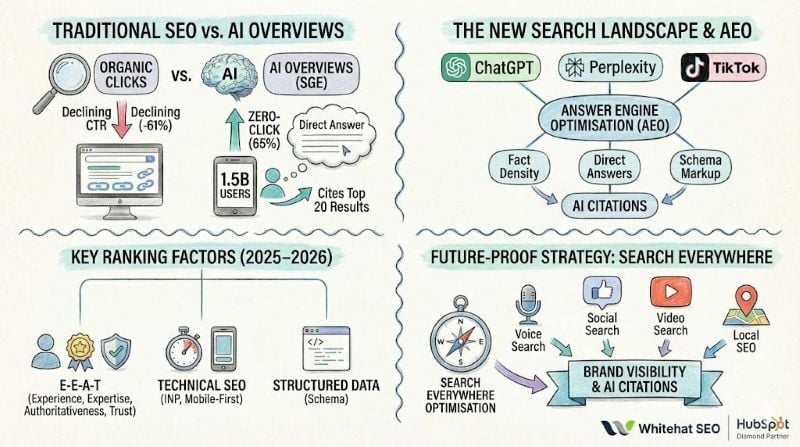
Zero-click searches now account for 65% of all Google queries, and organic click-through rates have plummeted 61% when AI Overviews appear. Whitehat SEO's analysis of 16 Google algorithm updates since August 2023 reveals that traditional SEO isn't dead—but the winners in 2025-2026 are those who combine E-E-A-T excellence with Generative Engine Optimisation strategies that earn AI citations.
Google Unleashed 16 Algorithm Updates Since August 2023
Between August 2023 and January 2025, Google released 8 core updates, 4 spam updates, and several policy changes that fundamentally reshaped the search landscape. Whitehat SEO has tracked every update, and the data tells a clear story: Google is aggressively targeting low-quality content whilst rewarding genuine expertise.
The most consequential was the March 2024 Core Update, which ran for 45 days—the longest ever—and achieved Google's goal of reducing low-quality, unoriginal content by 45% (exceeding their initial 40% target). This update permanently retired the Helpful Content Update as a standalone system, integrating it directly into core ranking.
For UK B2B companies working with professional SEO services, understanding these updates is critical. The September 2023 Helpful Content Update had already devastated independent publishers, with many seeing 40-95% traffic drops that never recovered. Google explicitly stated sites hit by this update "should not expect major recoveries" even after subsequent updates.
March 2024 Core Update: Key Statistics
- Duration: 45 days (longest ever)
- Low-quality content reduction: 45% (vs 40% target)
- New spam policies: Scaled Content Abuse, Expired Domain Abuse, Site Reputation Abuse
- December 2024 update: Completed in just 6 days (fastest on record)
Three new spam policies launched in March 2024 target modern manipulation tactics: Scaled Content Abuse (mass-produced AI or human content), Expired Domain Abuse, and Site Reputation Abuse (parasite SEO). The site reputation abuse policy, enforced from May 5, 2024, penalised major sites like Forbes Advisor for hosting third-party content designed to exploit domain authority.
Notable winners across these updates include Reddit and Quora, which saw unprecedented visibility gains until a January 2025 pullback. Reddit achieved a 1,328% increase in SEO visibility from July 2023 to April 2024, though this trend began reversing as spam concerns emerged.
AI Overviews Now Reach 1.5 Billion Users Monthly
AI Overviews (formerly Search Generative Experience) launched publicly on May 14, 2024, and expanded to 100+ countries by October 2024. The feature now appears in approximately 30% of U.S. desktop keywords as of September 2025—a 492% year-over-year increase according to seoClarity research across 500 million keywords.
The impact on click-through rates has been severe. Seer Interactive's September 2025 study of 3,119 queries found organic CTR dropped from 1.76% to 0.61% (61% decline) when AI Overviews appeared. Paid CTR crashed even harder, falling from 19.7% to 6.34% (68% decline).
| Metric | Without AI Overviews | With AI Overviews | Change |
|---|---|---|---|
| Organic CTR | 1.76% | 0.61% | -61% |
| Paid CTR | 19.7% | 6.34% | -68% |
| First organic result position | ~400px | 1,686px | Below fold |
Source: Seer Interactive, September 2025
However, here's the critical insight for businesses investing in Answer Engine Optimisation: what gets cited in AI Overviews correlates strongly with traditional rankings. Research from seoClarity shows 97% of AI Overviews cite at least one source from the top 20 organic results, with 99%+ sourcing from the top 10.
Ahrefs found the median ranking of cited URLs is position 3, with the top-cited URL typically ranking at position 2. This means traditional SEO remains essential—ranking well in organic results is the primary path to AI Overview visibility. Content structure also significantly affects citation likelihood: AI systems favour content that leads with direct answers in the first 40-60 words, maintains fact density with statistics every 150-200 words, and uses clear heading hierarchies.
ChatGPT and Perplexity Are Reshaping Search Competition
ChatGPT Search launched October 31, 2024, became available to logged-in users December 16, 2024, and rolled out globally without login requirements on February 5, 2025. The platform now serves 800 million weekly active users (doubled from 400 million in February 2025) and processes over 2 billion daily queries, capturing an estimated 4-12% of Google's search volume.
Perplexity AI has grown to 22 million active users processing 780 million monthly queries (up from 230 million in August 2024)—a 239% increase. The platform raised its valuation to $18-20 billion in 2025, with revenue growing from $20 million to over $100 million annually.
These platforms cite sources differently than Google. Profound's analysis of 680 million citations revealed that ChatGPT heavily favours Wikipedia (7.8% of total citations, 47.9% of top 10), whilst Perplexity draws 46.7% of citations from Reddit. Google AI Overviews distribute citations more evenly across multiple sources.
AI Search Platform Comparison
ChatGPT Search
800M weekly users • Wikipedia-heavy citations • Relies on Bing index
Perplexity
22M active users • 46.7% Reddit citations • Most diverse source selection
Google AI Overviews
1.5B monthly reach • Evenly distributed citations • 97% from top 20 organic
Answer Engine Optimisation Requires New Strategies
Generative Engine Optimisation (GEO), also known as Answer Engine Optimisation (AEO), represents the evolution of SEO for AI-first search. Princeton and Georgia Tech research found that GEO optimisation can increase AI visibility by 40%, with lower-ranked traditional SERP sites benefiting significantly more than already top-ranked pages.
Whitehat SEO's complete AEO guide for B2B marketers details the most effective content structures for AI citation. These include leading with direct answers ("The best X is Y" rather than hedged language), maintaining 40-60 word paragraphs for easy extraction, using question-based headers that mirror search queries, and including tables, lists, and bullet points that AI systems can easily parse.
AEO Content Optimisation Checklist
- Direct answer first: Lead with a 40-60 word answer block
- Question-based headers: Match natural language queries
- Fact density: Include statistics every 150-200 words
- Standalone sections: Each H2 should be comprehensible independently
- Schema markup: FAQPage, HowTo, and Article schema
- Brand embedding: Include your brand name in extractable sentences
Schema markup has become critical for AI search visibility. Priority implementations include FAQPage schema for Q&A pairs, HowTo schema for step-by-step content, and Article schema with complete author attribution and E-E-A-T signals. Schema App reported a 19.72% increase in AI Overview visibility after implementing entity linking, whilst InSinkErator saw a 69% increase in clicks for non-branded queries after schema optimisation.
The business case for AI optimisation is compelling: Ahrefs found that whilst only 0.5% of visitors came from AI search, they represented 12.1% of signups—a 23x higher conversion rate. Semrush reports AI search visitors are 4.4x more valuable than traditional organic traffic. For UK companies seeking AI consultancy services, this data demonstrates the commercial value of early AEO adoption.
Technical SEO Evolved with INP and Completed Mobile-First Indexing
Interaction to Next Paint (INP) officially replaced First Input Delay as a Core Web Vital on March 12, 2024. Where FID measured only the first interaction's input delay (93% of sites passed), INP measures responsiveness throughout the entire user session—only 65-75% of sites achieve "Good" scores on mobile.
The INP thresholds require pages to respond to interactions within 200ms for a "Good" score, with 200-500ms "Needs Improvement" and over 500ms rated "Poor." The metric captures the complete interaction lifecycle: input delay, processing time, and presentation delay until the next frame renders.
Core Web Vitals remain a ranking factor, though Google clarifies they act as a "tiebreaker" between pages with similar content quality rather than a primary signal. Google uses only field data from real users (via the Chrome User Experience Report) for ranking—Lighthouse lab scores do not affect SEO. Business impact remains significant: Vodafone reported a 31% LCP improvement led to an 8% increase in sales.
Mobile-first indexing reached 100% completion on July 5, 2024. Google's John Mueller confirmed that all sites are now crawled with mobile Googlebot, meaning content not accessible on mobile devices will not be indexed. However, this doesn't require mobile-responsive design—desktop interfaces that function on mobile phones remain indexable.
For businesses requiring a comprehensive website audit, crawl budget optimisation matters primarily for large sites (1 million+ pages with moderate update frequency) or medium sites (10,000+ pages with daily changes). Google's latest guidance emphasises using robots.txt to block pages from crawling (not noindex, which doesn't save crawl budget), consolidating duplicate content with canonical tags, and maintaining fast server response times.
E-E-A-T Requirements Intensified with AI Content Scrutiny
Google added "Experience" to create E-E-A-T in December 2022, emphasising that Trust remains "the most important member" of the framework—"untrustworthy pages have low E-E-A-T no matter how Experienced, Expert, or Authoritative they may seem."
Author authority signals have become increasingly important, though Google's Danny Sullivan clarified in January 2024 that "author bios on pages are not a direct ranking signal." However, author pages with detailed credentials, social media verification, and consistent cross-platform presence correlate strongly with content that performs well during algorithm updates. Sites with strong E-E-A-T signals weathered the March 2024 update significantly better than those without.
Google's stance on AI content remains nuanced: "Appropriate use of AI or automation is not against our guidelines" when content is "useful, helpful, original, and satisfies aspects of E-E-A-T." However, the January 2025 Quality Rater Guidelines update states that if "all or almost all of a page's main content is AI-generated (with little or no original content added), raters should apply the lowest rating."
⚠️ AI Content Caution
AI content in search results has grown from 7.43% post-March 2024 update to 17.31% by September 2025. However, of 1,446 websites receiving manual actions in March 2024, 100% had used AI content and 50% had 90-100% AI-generated posts.
For YMYL topics, AI content faces particular scrutiny. A Stanford study found GPT-4 with RAG produced responses where 30% of individual statements were unsupported, and AI hallucinates court holdings 75% of the time in legal contexts.
Whitehat's approach to content marketing services combines AI assistance with expert human oversight, ensuring content demonstrates genuine E-E-A-T whilst maintaining production efficiency. This hybrid approach satisfies both Google's quality requirements and modern content velocity demands.
Zero-Click Searches Hit 65% as Organic Results Get Pushed Down
Zero-click searches now account for 60-65% of all Google queries, with SparkToro finding that for every 1,000 U.S. searches, only 360 clicks reach the open web. Mobile drives this trend with a 77% zero-click rate compared to 46.5% on desktop.
AI Overviews dramatically accelerate this shift. When expanded, AI Overviews occupy 1,345 pixels on desktop, pushing the first organic result to 1,686 pixels below—beyond standard screen sizes. On mobile, AI Overviews can cover 75.7% of screen space. For informational queries, AI Overviews appear in over 88% of triggering searches.
Traditional SERP features are being displaced. Featured snippets declined from 15.41% to 5.53% of SERPs between January and June 2025—a 64% decline with a -0.90 correlation to AI Overview growth. Conversely, People Also Ask expanded to appear in 79% of SERPs (up from 74% in January), and sitelinks exploded from 8.44% to 84.95%—a 906% increase.
Despite declining CTR percentages, Google processes 9.1-13.6 billion searches daily (up from 8.5 billion in 2024). This volume growth means absolute click numbers may increase even as percentages fall. Organic search still drives 53% of all website traffic, and 91% of SEO professionals reported positive business impact in 2024.
The Local Pack continues evolving with algorithm updates emphasising consistent NAP data, review quality, and mobile user experience. Google's "diversity update" in August 2024 began linking local pack rankings to organic rankings, creating interdependencies between local SEO and traditional SEO strategies.
Expert Predictions Point to Search Everywhere Optimisation
Industry experts converge on several predictions for 2026. Lily Ray (Amsive) emphasises that "E-E-A-T still applies in 2026 with AI search. The more your brand is well-known and well-respected, the more likely LLMs will cite you as a trusted brand."
Eric Enge (Previsible) warns that "AI Overviews will cause significant traffic reductions for many sites—around 35%," whilst noting that "times of big change present opportunity to answer these questions before competition does."
Jono Alderson (Yoast) describes the emerging "Reasoning Web, where agents will read, decide, and act on our behalf. Visibility will depend on agentic readiness: clean structured data, stable identifiers, precise ontologies."
Skills SEOs Need to Develop for 2026
- AI and machine learning literacy: 59% of local agency marketers want to develop these skills
- Structured data implementation: Microsoft confirmed structured data supports LLM interpretation
- Multi-platform optimisation: Visibility across YouTube, TikTok, and Reddit
- Brand building: Digital PR and reputation management
The consensus: SEO no longer means just Google optimisation. "Search Everywhere Optimisation" or "Discovery Engine Optimisation" represents the new framework, requiring visibility across traditional search, AI platforms, social search, and voice interfaces simultaneously. Whitehat's HubSpot onboarding services help UK businesses implement this integrated approach with proper attribution tracking across all channels.
What This Means for Your SEO Strategy
The SEO landscape of 2025-2026 demands a fundamental strategic shift. Whilst Google maintains 89-92% of traditional search volume, the emergence of AI Overviews, ChatGPT Search, and social search platforms has fragmented user attention and compressed organic CTR. The critical insight: ranking well in traditional search remains the primary path to AI citation, with 97% of AI Overview sources coming from top-20 organic results.
Success requires three parallel strategies. First, maintain technical SEO excellence with INP optimisation, proper schema implementation, and mobile-first content architecture. Second, demonstrate genuine E-E-A-T through documented expertise, author attribution, and first-party research. Third, adopt Generative Engine Optimisation practices—structuring content for AI extraction with clear answers, fact density, and comprehensive topic coverage.
The shift from ranking-obsessed metrics to visibility-focused outcomes represents the largest conceptual change. Traffic may decline as zero-click searches approach 70%, but conversion quality from AI-referred visitors (23x higher than traditional organic) suggests the survivors will thrive. The winners will be brands that AI systems trust enough to cite—built through consistent expertise demonstration, reputation management across all platforms, and content that genuinely serves user intent rather than gaming algorithms.
Frequently Asked Questions
Is SEO dead in 2026?
No, SEO is not dead—it's evolving. Whilst zero-click searches have reached 65% and AI Overviews have reduced organic CTR by 61%, traditional SEO remains essential. Research shows 97% of AI Overview citations come from top-20 organic results, making strong rankings the foundation for AI visibility. The winners are those combining traditional SEO excellence with Answer Engine Optimisation strategies.
What is Answer Engine Optimisation (AEO)?
Answer Engine Optimisation is the practice of structuring content to be cited by AI systems like ChatGPT, Google AI Overviews, and Perplexity. Unlike traditional SEO focused on ranking in search results, AEO optimises for being quoted as an authoritative source when AI systems answer questions directly. Key techniques include leading with 40-60 word direct answers, implementing schema markup, and maintaining high fact density throughout content.
How do AI Overviews affect organic traffic?
AI Overviews significantly impact organic traffic by satisfying user queries without requiring clicks. Seer Interactive research shows organic CTR drops from 1.76% to 0.61% when AI Overviews appear—a 61% decline. However, sites cited within AI Overviews earn 35% more organic clicks than competitors, making it crucial to optimise content for AI citation rather than avoid AI Overviews entirely.
Should I still invest in traditional SEO?
Yes, traditional SEO remains the foundation of digital visibility. Google still controls 89-92% of search traffic, and strong organic rankings are the primary path to AI citation visibility. Whitehat SEO recommends a dual approach: maintain technical SEO excellence whilst adding AEO strategies. The businesses thriving in 2025-2026 are those treating traditional SEO and AEO as complementary rather than competing priorities.
What is the INP Core Web Vital?
Interaction to Next Paint (INP) replaced First Input Delay as a Core Web Vital in March 2024. INP measures page responsiveness throughout the entire user session, not just the first interaction. A "Good" score requires pages to respond within 200ms. Only 65-75% of sites currently achieve good mobile INP scores, compared to 93% that passed the previous FID threshold.
References & Sources
- SparkToro – 2024 Zero-Click Search Study
- seoClarity – AI Overviews Research Study
- Seer Interactive – AI Overviews CTR Analysis
- Ahrefs – AI Search Traffic and Conversion Data
- Google Developers – Core Web Vitals Documentation
- Semrush – AI Search Visibility Toolkit Research
- Gartner – Search Volume Predictions 2026
- Princeton/Georgia Tech – GEO Research Paper
Ready to Future-Proof Your SEO Strategy?
Whitehat SEO helps UK B2B companies navigate the shift from traditional SEO to Answer Engine Optimisation. As a HubSpot Diamond Partner running the world's largest HubSpot User Group, we combine SEO expertise with practical AEO implementation.
Explore SEO Services Learn About AEOAbout Whitehat SEO
Whitehat SEO is a London-based HubSpot Diamond Partner and full-service inbound marketing agency founded in 2011. We run the world's largest HubSpot User Group and specialise in helping UK B2B companies connect SEO, AEO, and HubSpot implementation to measurable revenue. Our ethical, white-hat approach has guided businesses through every major algorithm update since Google Panda. view our pricing