
Business Growth Guide explore our digital marketing FAQs
For UK SMEs with 20–500 employees, reputation management is no longer an optional marketing activity—it's a revenue-critical discipline that spans Google, Trustpilot, Reddit, TikTok, and the AI chatbots increasingly mediating purchase decisions.
Online Reputation Management for UK SMEs: The Complete 2026 Guide
AI answer engines, tighter UK regulation, and platform fragmentation have fundamentally reshaped how businesses earn and defend trust online. Here's what UK SMEs need to know—and do—right now.
Key Takeaways
- 97% of consumers now read reviews before choosing a business, with 68% requiring 4+ stars (BrightLocal 2026)
- ChatGPT usage for local recommendations jumped from 6% to 45% in one year—AI is now the third-largest referral channel
- UK's DMCCA now carries 10% global turnover fines for fake review violations—compliance isn't optional
- Consumers check an average of six review platforms before purchasing—Google alone won't cut it
- 74% only trust reviews from the last three months—continuous review generation is essential
Direct Answer
Online reputation management (ORM) for UK SMEs in 2026 requires a multi-platform approach spanning Google Business Profile, Trustpilot, Reddit, and AI answer engines like ChatGPT. Businesses need a minimum of 20 reviews with 4+ star ratings, responses within 24 hours, and content structured for AI citation. The CMA's new enforcement powers under the DMCCA mean fake review practices can now result in fines of up to 10% of global turnover.
The shift has been dramatic. In just twelve months, AI tools surged from 6% to 45% usage for local business recommendations, making them the third most popular discovery channel behind Google and Facebook. Meanwhile, UK regulators have gained unprecedented enforcement powers, with the Competition and Markets Authority (CMA) actively investigating businesses for fake review practices.
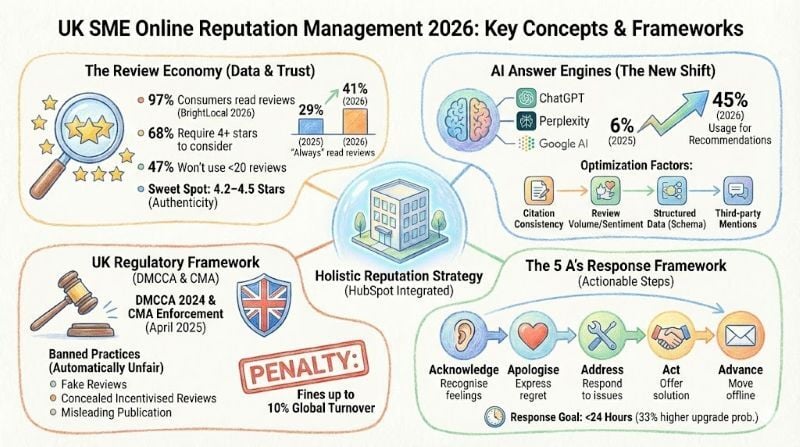
This guide covers everything UK business owners and marketing directors need to know: the evidence on review behaviour, the new regulatory landscape, how to optimise for AI answer engines, and practical frameworks for building and protecting your reputation across platforms.
The Review Economy in 2026: What the Data Shows
Consumer reliance on reviews has reached its highest point ever. BrightLocal's 2026 Local Consumer Review Survey found 97% of consumers read reviews for local businesses, with 41% reporting they "always" do so—up from 29% in 2025. Only 3% said they never read reviews.
UK-specific data from Trustpilot's February 2025 Growth Research reveals 84% of UK consumers rank independent review platforms as the single most important information source when making purchase decisions—above social circles (83%), professional endorsements (68%), and company websites (52%).
68%
require 4+ stars to consider a business
47%
won't use a business with fewer than 20 reviews
74%
only care about reviews from the last 3 months
The Sweet Spot: 4.2–4.5 Stars
Interestingly, perfect 5.0 ratings actually reduce trust because they signal inauthenticity. UK consumers are particularly sceptical: 52% have more faith in imperfect ratings as proof of authenticity, and 39% believe roughly half of reviews on seller websites are fake. The most trusted average rating range sits at 4.2–4.5 stars.
B2B Buying Follows Similar Patterns
If you're a B2B company thinking reviews don't apply to you, think again. G2's 2024 Buyer Behavior Report found public review sites are the most-consulted information source for software purchasing (31%), and 92% of B2B buyers are more likely to purchase after reading a trustworthy review.
The B2B review landscape is also consolidating: G2 announced its acquisition of Capterra, Software Advice, and GetApp from Gartner in late January 2026, creating a combined platform of 6 million reviews reaching 200 million software buyers annually.
AI Answer Engines: The Third-Largest Referral Channel
The most dramatic shift in reputation management is the explosive growth of AI as a business discovery channel. BrightLocal's 2026 data shows ChatGPT and AI tools surged to 45% usage for local business recommendations—up from just 6% in 2025, making AI the third most popular source behind Google and Facebook.
A Capgemini Research Institute study found 58% of consumers have replaced traditional search with generative AI for product and service recommendations. AI-referred website sessions jumped 527% between January and May 2025.
| Platform | Key Characteristics | Reputation Signals |
|---|---|---|
| ChatGPT | 800M+ weekly users; uses training data + real-time web search | Third-party brand mentions more influential than on-site optimisation |
| Perplexity | 153M monthly visits (up 192% YoY); real-time search with citations | Favours trustworthy, recent, multi-format content |
| Google AI Overviews | Appears in ~⅔ of local business queries; deep knowledge graph integration | Traditional SEO signals + review sentiment + structured data |
How AI Engines Assess Your Reputation
AI systems evaluate reputation through citation consistency, review volume and sentiment, structured data (LocalBusiness, FAQ, Review schemas), third-party mentions, brand mention frequency, and E-E-A-T signals. Businesses mentioned in AI answers capture disproportionate attention—creating a "winner-takes-most" dynamic.
Critically, over 60% of citations in Google AI Overviews come from non-Google sources including Yelp, TripAdvisor, Reddit, local blogs, and directories. Your Google Business Profile alone won't cut it—you need presence across multiple platforms.
Why This Matters for Your SEO Strategy
AI answer engines are fundamentally changing how people discover businesses. Traditional SEO services must now incorporate Answer Engine Optimisation (AEO) to ensure your brand appears when AI responds to buyer questions in your market.
Google Business Profile: Algorithm Changes and the Fake Review Crackdown
Whitespark's November 2025 Local Search Ranking Factors report confirmed GBP signals account for 32% of Local Pack ranking weight, with review signals comprising approximately 16%. Review recency was cited as the 11th most influential local pack factor—Whitespark calls it "the most underrated local ranking factor in 2025."
Google's Unprecedented Fake Review Purge
Google blocked or removed 240 million reviews for policy violations in 2024, up from 170 million in 2023 (a 41% increase). In 2025, review deletion rates increased by over 600% between January and July, driven by Google's Gemini-powered moderation system.
However, this aggressive approach has created collateral damage: 73.1% of deleted reviews in one December 2024 wave had 5-star ratings, and legitimate reviews are being caught in the crossfire.
⚠️ UK Regulatory Warning
The CMA–Google agreement of 24 January 2025 commits Google to enhanced fake review detection, warning alerts on profiles of UK businesses caught using fake reviews, and globally banning individuals who repeatedly post fake reviews for UK businesses. The CMA estimates £23 billion of UK consumer spending is influenced by online reviews annually.
The UK Regulatory Framework: DMCCA, CMA Enforcement, and GDPR
The UK now has one of the world's strongest regulatory frameworks for review integrity. The Digital Markets, Competition and Consumers Act 2024 (DMCCA) received Royal Assent in 2024, with consumer law enforcement provisions coming into force on 6 April 2025.
The Act explicitly bans publishing fake reviews, concealed incentivised reviews, and publishing reviews in a misleading way—all classified as automatically unfair banned practices. The CMA gained direct enforcement powers for the first time, enabling investigation and action without going through courts. Fines can reach 10% of global annual turnover.
CMA Enforcement Timeline
CMA published standalone statutory guidance on fake reviews (CMA208)
CMA secured formal undertakings from Amazon on fake review processes
CMA conducted online sweep of review platforms for compliance
CMA launched "major consumer protection drive"—investigating 8 businesses, issuing advisory letters to 100 firms
UK Review Platforms You Need to Know
The UK review ecosystem differs materially from the US market. Trustpilot dominates UK consumer awareness with 330 million reviews globally and 70 million monthly active users, having removed 4.5 million fake reviews in 2024 alone. Feefo (Hampshire-based) operates as a closed, invite-only platform where only verified customers can review—used by 6,500+ brands. Reviews.io has its largest market in the UK (41.57% of its 9,092 company clients).
All three are Google Seller Ratings partners, meaning reviews feed into Google Ads star ratings—a critical consideration for SMEs running paid campaigns.
Multi-Platform Reputation: Reddit, TikTok, LinkedIn, and Beyond
Reddit: The Internet's Trust Layer
Reddit's influence on purchase decisions has reached extraordinary levels. 88% of social media users say Reddit influences their purchasing decisions (Sprinklr 2025), and 71% of people who discover a brand research it on Reddit before buying.
Reddit's SEO visibility increased by 1,328% between July 2023 and April 2024 following a $60 million annual content licensing deal with Google. Reddit appears in 97.5% of product review queries on Google and is the number-one most-cited source for LLMs including Google AI Overviews.
TikTok: Reshaping UK Commerce
TikTok reached 24.8 million UK users aged 18+ in early 2025, with UK users spending an average of 49 hours 29 minutes per month on the platform—more than double Instagram. Over 200,000 UK small businesses now sell via TikTok Shop, doubled from 2024.
LinkedIn: The B2B Trust Gateway
The 2024 Edelman-LinkedIn B2B Thought Leadership Impact Report found 86% of decision-makers would invite a company to bid on a project if it consistently produces high-quality thought leadership. Employee LinkedIn posts deliver approximately 2x higher click-through rates than brand posts.
Responding to Negative Reviews: The Evidence-Based Framework
Research shows 45% of consumers remove or update negative reviews if the business acknowledges the issue, apologises, and offers a solution. Responding to a 1- or 2-star review within 24 hours has a 33% higher probability of the reviewer upgrading the rating by up to three stars.
The 5 A's Response Framework
Acknowledge
Recognise the customer's experience and feelings
Apologise
Express genuine regret for their negative experience
Address
Respond to the specific issues they raised
Act
Offer a concrete solution or next step
Advance
Move the conversation offline to resolve privately
Response timing expectations have accelerated: 19% of consumers now expect same-day responses (up from 6%), and 81% expect to hear back within a week. Despite this, only about 5% of businesses currently respond to online reviews.
The revenue impact is substantial: a single one-star increase in rating can produce a 5–9% increase in revenue (Harvard Business School), while a single negative review on page one reduced purchase likelihood by 42% in an INSEAD study of UK retailer data.
Proactive Reputation Building: Compliant Review Generation
Both Google and Trustpilot allow businesses to ask customers for reviews but prohibit incentives (discounts, gift cards, freebies) and review gating—the practice of pre-screening customers and only directing happy ones to review platforms.
Optimal Timing for Review Requests
- Services: Within 24 hours of service completion
- Physical products: 7–14 days after confirmed delivery
- B2B software: 30–60 days post-purchase
- Best send times: 10am–12pm, Tuesday to Thursday
Up to 80% of all reviews come from post-purchase emails (PowerReviews), and BrightLocal 2026 data shows 83% of people asked to leave a review actually did—a significant conversion rate when processes are systematic.
HubSpot-Powered ORM Workflows
For businesses using HubSpot, multiple integrations support reputation management: Birdeye syncs reviews and ratings directly into HubSpot; Podium pulls reputation data into HubSpot dashboards; NiceJob adds review requests to HubSpot workflows; Reviews.io generates support tickets for urgent reviews.
A recommended workflow architecture: deal closes or service ticket resolves → triggers workflow → appropriate delay → personalised review request email → follow-up if no response → track review in custom properties → segment promoters for case studies, route detractors to customer success.
ORM Tools and Technology: Pricing Comparison
| Tier | Budget | Recommended Tools |
|---|---|---|
| Budget | Under £150/month | Google Alerts (free), Brand24 (~£79/mo), NiceJob (~£75/mo), RightResponse AI (~£8/location) |
| Mid-tier | £150–400/month | Brand24 Team (~£200/mo), Podium (~£249/mo), Birdeye Starter (~£299/mo), Reviews.io (~£89/mo) |
| Enterprise | £400+/month | Birdeye Growth (£399–449/mo), Reputation.com (custom), Brandwatch/Meltwater |
For a typical UK SME, a practical stack combines Brand24 for social listening and brand monitoring, Birdeye or Reviews.io for review management (both integrate with HubSpot), and Trustpilot Business for UK consumer trust signals.
Optimising Content for AI Citation
To maximise citation by AI answer engines, content should follow specific structural principles. Begin each section with a direct answer in 40–70 words—matching the typical AI extraction length. Princeton and Georgia Tech research shows statistics addition boosts GEO visibility by 15–30%.
Content Architecture Checklist
- Each H2/H3 heading should represent a self-contained, extractable concept
- Use question-based headings that mirror natural-language queries
- Include bullet points and numbered lists (40–61% of AI Overviews contain these formats)
- Maintain statistics every 150–200 words for "fact density"
- Implement FAQPage, Article, and LocalBusiness schema markup
For ChatGPT and Perplexity citation specifically: optimise URL slugs descriptively, build consistent brand mentions across third-party sites, include expert quotes with named attributions, and maintain content freshness—most LLM citations occur within 2–3 days of publishing.
For Google AI Overviews: 92.36% of citations come from domains ranking in the top 10 organically, making traditional SEO the foundation for AI visibility. Learn more about keyword research strategies that work in 2026.
Five Trends That Will Define ORM Over the Next 12–18 Months
1. AI as a reputation channel will overtake traditional review browsing
The leap from 6% to 45% AI usage for local business research in a single year signals a paradigm shift. Businesses invisible to ChatGPT, Perplexity, and Google AI Overviews will lose an accelerating share of potential customers.
2. UK regulatory enforcement will intensify
The CMA's November 2025 consumer protection drive signals active enforcement under DMCCA powers. UK SMEs that commission, purchase, or fail to prevent fake reviews face fines of up to 10% of global turnover.
3. Review quality will matter more than quantity
With AI systems extracting specific phrases from reviews to populate summaries, businesses need reviews containing descriptive, keyword-rich language about services and outcomes—not just star ratings.
4. Multi-platform presence is non-negotiable
Consumers check six platforms on average. AI engines source from Reddit, YouTube, directories, and industry platforms. A Google-only strategy leaves businesses vulnerable on Trustpilot, Reddit, Glassdoor, and industry-specific platforms.
5. HubSpot-powered ORM workflows represent an untapped advantage
No existing content connects CRM-driven review automation, NPS-based segmentation, and multi-platform reputation management into a unified system—the precise capability gap UK SMEs can exploit with the right tools.
Frequently Asked Questions
What is online reputation management (ORM)?
Online reputation management is the practice of monitoring, influencing, and improving how your business appears across digital platforms. For UK SMEs in 2026, this includes Google Business Profile, review platforms like Trustpilot, social media, and increasingly, AI answer engines like ChatGPT and Perplexity that recommend businesses in response to user queries.
How many reviews does a UK business need?
According to BrightLocal's 2026 research, 47% of consumers won't use a business with fewer than 20 reviews. Additionally, 74% only trust reviews from the last three months. This means businesses need both sufficient volume (minimum 20) and ongoing freshness (continuous new reviews) to maintain trust.
What are the penalties for fake reviews in the UK?
Under the Digital Markets, Competition and Consumers Act 2024 (DMCCA), the CMA can now impose fines of up to 10% of global annual turnover for fake review violations. This includes publishing fake reviews, concealing incentivised reviews, and publishing reviews in misleading ways—all classified as automatically unfair banned practices.
How do AI answer engines affect business reputation?
AI tools like ChatGPT now account for 45% of local business recommendation searches—up from 6% in 2025. These systems assess reputation through review volume and sentiment, third-party brand mentions, structured data, and E-E-A-T signals. Businesses that appear in AI recommendations capture disproportionate attention in a "winner-takes-most" dynamic.
What's the best way to respond to a negative review?
Use the 5 A's framework: Acknowledge the experience, Apologise sincerely, Address the specific issues, Act with a concrete solution, and Advance the conversation offline. Research shows responding within 24 hours to negative reviews has a 33% higher probability of the reviewer upgrading their rating by up to three stars.
Ready to Take Control of Your Online Reputation?
As a HubSpot Diamond Partner, Whitehat SEO helps UK businesses build systematic reputation management processes that integrate with your CRM for full attribution and ROI tracking.
Explore Our SEO ServicesReferences
- BrightLocal Local Consumer Review Survey 2026
- Trustpilot UK Growth Research 2025
- Whitespark Local Search Ranking Factors 2025
- CMA Statutory Guidance on Fake Reviews (CMA208)
- Edelman-LinkedIn B2B Thought Leadership Impact Report 2024
- G2 Buyer Behavior Report 2024
- Harvard Business Review: Revenue Impact of Ratings
- Capgemini Research Institute: Consumer AI Usage Study
About Whitehat SEO
Whitehat SEO is a London-based HubSpot Diamond Solutions Partner specialising in SEO, AEO, and inbound marketing for B2B companies. Founded in 2011 by CEO Clwyd Probert, we run the world's largest HubSpot User Group (London HUG) and help businesses turn marketing investment into predictable pipeline. marketing services view our pricing