
Online reputation management (ORM) in 2026 is fundamentally different from even twelve months ago. The shift from "ten blue links" to AI-synthesised brand narratives means reputation is no longer about what ranks on page one—it's about what ChatGPT, Gemini, and Perplexity say when someone asks about your brand. For UK businesses, this creates both urgent risks and significant opportunities.
Key Takeaway
45% of consumers now use AI tools like ChatGPT for business recommendations—up from 6% in 2025
97% of consumers read online reviews, with 31% requiring 4.5+ stars before engaging
The UK's Digital Markets, Competition and Consumers Act now enables fines up to 10% of global turnover for fake reviews
85% of AI brand mentions come from third-party sources, not your own website
Crisis response windows have compressed to 15–30 minutes for initial acknowledgement
At Whitehat SEO, we've been tracking this shift closely. The data is unambiguous: with 45% of consumers now using AI tools for business recommendations (up from just 6% in 2025), review expectations nearly doubling, and UK regulators cracking down hard on fake reviews, every assumption about ORM strategy needs revisiting. This guide covers the full landscape for 2026—specific data points, platform updates, regulatory changes, and actionable strategies for UK businesses navigating this transformed environment.
Consumer Expectations Have Radically Changed
BrightLocal's Local Consumer Review Survey 2026 (published February 2026) reveals a consumer base that is more review-dependent, more demanding, and more platform-diverse than ever before. The numbers are striking:
97%
Read Online Reviews
41% say they 'always' read reviews—up from 29% in 2025
31%
Require 4.5+ Stars
Nearly doubled from 17% in 2025
19%
Expect Same-Day Reply
Up from 6%—response expectations have tripled
Review recency matters enormously. 22% of consumers only pay attention to reviews from the past two weeks, and 26% limit themselves to the past month. Generic, templated responses actively damage perception. Meanwhile, 94% of consumers say a negative review has convinced them to avoid a business, and 62% would stop buying from companies that censor reviews.
Why This Matters for UK Businesses
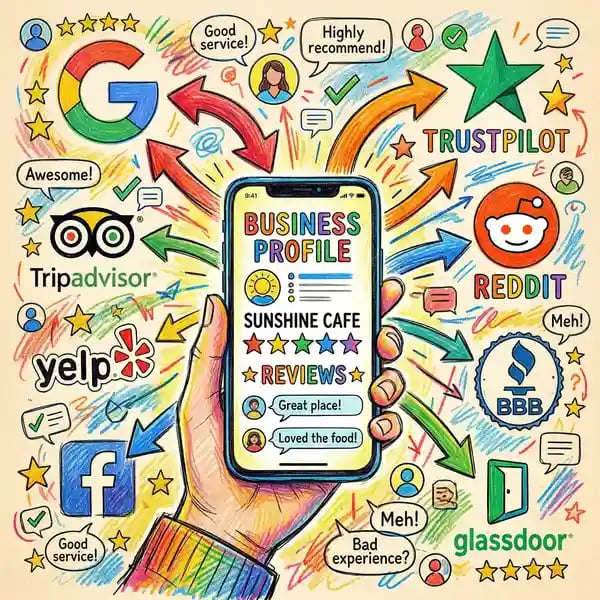
The economic context is driving this behaviour. Rising prices, declining product quality, and economic uncertainty mean consumers are doing more research before spending. Trust in advertising has collapsed—84% have stopped trusting ads—making reviews the primary trust signal. Consumers now use an average of six different review sites when evaluating businesses. Google's share as a review platform dropped from 83% to 71%—the most significant decline in years.
For businesses managing their SEO and online visibility strategy, this means reputation management can no longer be an afterthought—it's central to whether potential customers ever reach your website in the first place.

AI Answer Engines Are Reshaping Reputation Discovery
The most consequential shift in ORM for 2026 is the rise of AI as a primary discovery channel. According to BrightLocal, AI tools like ChatGPT have surged from 6% to 45% of consumers using them for local business recommendations in a single year, making AI the third most popular source behind Google and Facebook. ChatGPT alone processes approximately 1.1 billion queries daily with 800 million weekly active users. Perplexity has grown to 45 million active users with 780 million monthly queries. Google Gemini has nearly quadrupled its market share from 5.4% to 18.2%.
Warning
Only 30% of brands stay visible from one AI answer to the next, and 40–60% of cited domains change in just one month. 85% of brand mentions in AI answers originate from third-party pages rather than brand-owned domains, and 48% of citations come from community platforms like Reddit and YouTube.
The commercial implications are significant. AI search traffic converts at 14.2% compared to Google's 2.8%—roughly five times higher. AI-referred visitors spend 67.7% more time on sites and deliver 4.4x higher economic value than traditional organic traffic. Meanwhile, zero-click searches continue rising—58.5% of US searches and 59.7% of EU searches end without a click. Searches triggering Google's AI Overviews show an 83% zero-click rate. For ORM, your brand's reputation is increasingly mediated by AI summaries that users never click through to verify.
This is precisely why Whitehat has invested heavily in Answer Engine Optimisation (AEO)—ensuring our clients' brands are accurately represented when AI answers questions in their market.
Want to know how your brand appears in AI search results?
Get Your Free AI Visibility AuditAEO and GEO Are Now Mandatory ORM Disciplines
Two new disciplines have emerged that every ORM strategy must incorporate: Answer Engine Optimisation (AEO) focuses on optimising content for any platform providing direct answers—Google AI Overviews, Bing Copilot, voice assistants. Generative Engine Optimisation (GEO) specifically targets standalone AI platforms like ChatGPT, Claude, and Perplexity. Microsoft's official position: "SEO is how you won in search. AEO and GEO are how you win the recommendation in AI-powered discovery."
For reputation specifically, GEO strategies emphasise brand authority, getting mentioned in sources LLMs reference, and monitoring AI sentiment. Research shows 73% of AI-cited sources had a verified Google Business Profile or Wikipedia entry, making entity recognition a prerequisite for AI visibility.
Content Structures That Win AI Citations
Content structured for AI citation performs significantly better. This includes FAQ sections with 50–60 word answers, comprehensive schema markup (Organisation, Person, FAQPage, Review types in JSON-LD), and natural conversational language that mirrors how people actually ask AI questions.
At Whitehat, we build these considerations directly into our HubSpot implementations—ensuring content management, schema markup, and analytics work together to track both traditional and AI-mediated reputation signals.
The Fake Review Crisis Demands New Approaches
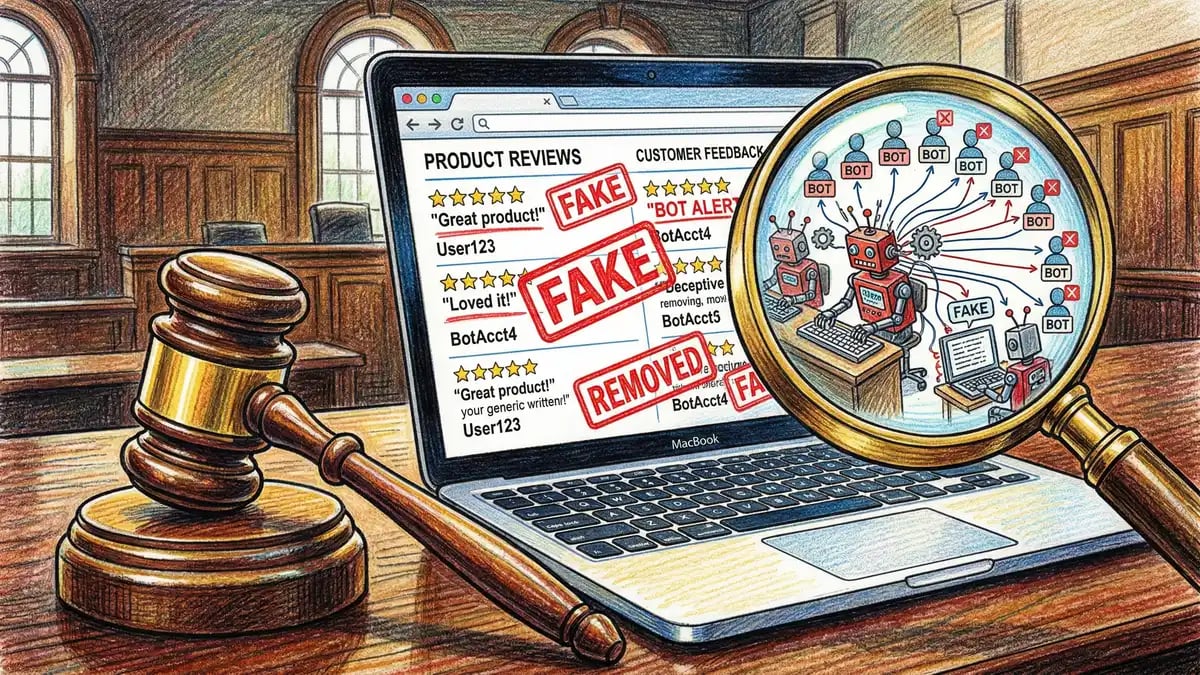
The scale of review fraud has reached crisis proportions. An estimated 30% of all online reviews are fake, costing consumers approximately £620 billion annually through misleading purchases. AI-generated fake reviews are growing 80% month-over-month since mid-2023. The fundamental challenge: humans operate at chance level in detecting AI-generated fake reviews, and LLMs perform no better.
| Platform | Annual Action | Detection Method |
|---|---|---|
| Amazon | 250M+ suspected fakes blocked; £400M+ spend | 8,000+ staff + AI models |
| 240M reviews removed for policy violations | ML classifiers + manual review | |
| Trustpilot | 4.5M fake reviews removed (90% auto-caught) | AI-first automated detection |
| Coalition for Trusted Reviews | Cross-platform fraud sharing | Amazon, Booking, Google, TripAdvisor + 3 more |
For legitimate businesses, this environment makes authentic review generation more important than ever. The gap between detection capability and generation capability continues to widen, meaning businesses that build genuine customer advocacy will increasingly stand out.
UK Regulatory Crackdown: What You Need to Know
The legal landscape for ORM has shifted decisively toward enforcement in 2025–2026. For UK businesses, compliance is now a board-level concern rather than a legal footnote.
What This Means
Effective 6 April 2025, the Digital Markets, Competition and Consumers Act explicitly bans fake reviews as an unfair commercial practice. The CMA gained direct enforcement powers including fines up to 10% of global annual turnover.
The CMA published fake reviews guidance (CMA208) in April 2025, secured commitments from Google and Amazon, and in November 2025 launched a 'major consumer protection drive' investigating 8 businesses and sending advisory letters to 100 firms.
The prohibition is widely defined: submitting or commissioning fake consumer reviews, reviews that conceal incentivisation, publishing fake reviews in a misleading way, and failing to take reasonable steps to prevent and remove banned reviews.
The Right to be Forgotten remains a powerful ORM tool in Europe, with coordinated EDPB enforcement in 2025 making it stronger. Success rates improve dramatically with proper submission strategy—approximately 80% of denied requests fail because applicants don't understand how to argue their case.
Platform-by-Platform: What Changed in 2025–26
Google Business Profile
Pseudonymous reviews introduced November 2025—nicknames instead of real names. Business owner responses now pre-reviewed by Google (10 min to 30 day delays). 'Review jail' temporarily freezes new reviews for flagged businesses.
Reddit: The Emerging ORM Battleground
Google cites Reddit 450% more often following data licensing deal. Appears in results for 97.5% of product review queries. 73% of businesses have Reddit threads ranking for their brand—63% carry negative sentiment.
LinkedIn and B2B Reputation
LinkedIn has become critical for B2B reputation with 1.3 billion members. Its algorithm now prioritises depth of relationship over engagement metrics, with dwell time as a major ranking signal. Employee-generated content gets 6x more reach than corporate page content.
| Platform | Key 2025–26 Change | ORM Impact |
|---|---|---|
| Pseudonymous reviews; response pre-screening | More reviews but harder authenticity verification | |
| 450% more Google citations; 40% of AI responses | Critical new front—73% have brand threads ranking | |
| Relationship depth > engagement; 6x employee reach | Executive branding now a company reputation asset | |
| G2 + Capterra | Acquisition creating 6M review mega-platform | Fewer B2B platforms but higher stakes per review |
| Trustpilot | 4.5M fakes removed; 90% auto-detection | UK/EU essential—strongest fraud prevention |
Crisis Response Windows Have Compressed to Minutes
The traditional 'golden hour' for crisis response is dead. Industry consensus now targets 15–30 minutes for initial acknowledgement. Companies with established crisis protocols recover 75% faster, yet only 49% of companies have a formal plan.
Caution
Deepfake content grew 550% between 2019–2024 and increased 900% in 2024 alone for video. Europol projects 90% of online content could be synthetically generated by 2026. Deepfake-enabled fraud attacks now occur every five minutes globally.
What UK Businesses Should Do Now
Based on the evidence, here are the practical priorities for the next 12–18 months:
Implement GEO Monitoring
Track how your brand appears across ChatGPT, Perplexity, Gemini, and Claude responses. Use tools like HubSpot's AI Search Grader.
Build Authentic Reddit Engagement
Genuine participation in relevant subreddits builds the signals AI systems use to evaluate brand trustworthiness.
Ensure Regulatory Compliance
Audit review collection practices, incentive programmes, and published reviews across UK DMCCA, EU DSA, and FTC rules.
Invest in Executive Personal Branding
49% of company reputation is linked to its CEO. LinkedIn thought leadership and speaking engagements compound over time.
Shift to 15-Minute Crisis Response
Implement AI-powered detection and pre-approved response templates for rapid initial acknowledgement.
Diversify Review Platform Presence
Consumers use 6 platforms on average. Prioritise Trustpilot (UK/EU critical), industry-specific platforms, and video reviews.
What 2026–2028 Looks Like: Analyst Predictions
Gartner projects traditional search engine volume will drop 25% by 2026 and organic search traffic will decline 50% or more by 2028. By 2028, 90% of B2B buying will be AI agent-intermediated. AI search platforms generated 1.13 billion referral visits in June 2025 (357% year-over-year increase).
The convergence of several trends will reshape ORM fundamentally: digital provenance will become essential for verifying content authenticity as deepfakes proliferate; AI commerce integration is accelerating with OpenAI announcing Shopify and Etsy partnerships; voice search produces single answers from 8.4 billion devices globally; and platform fragmentation will continue with consumers spreading across six or more review sites plus AI platforms.
The Bottom Line
Three shifts separate 2026 ORM from generic advice. First, AI is now a primary reputation channel—45% consumer adoption with 5x higher conversion demands immediate strategic investment. Second, regulation has moved from guidelines to enforcement—the CMA, FTC, and EU Commission are actively investigating. Third, reputation volatility has increased dramatically—only 30% of brands maintain visibility across consecutive AI responses.
The brands that adapt to AI-mediated reputation discovery now will hold an advantage that compounds over time—because the window to establish brand authority with LLMs before they calcify their training data is finite.
Frequently Asked Questions
What is the difference between AEO and GEO?
Answer Engine Optimisation (AEO) focuses on optimising content for any platform providing direct answers, including Google AI Overviews and voice assistants. Generative Engine Optimisation (GEO) specifically targets standalone AI platforms like ChatGPT, Claude, and Perplexity. Both are essential for UK businesses.
What are the UK penalties for fake reviews under the DMCCA?
Under the Digital Markets, Competition and Consumers Act 2024, effective April 2025, the CMA can impose fines up to 10% of global annual turnover for businesses that submit, commission, or publish fake reviews.
How quickly should businesses respond to a reputation crisis in 2026?
Industry consensus has shifted to a 15–30 minute window for initial acknowledgement. Companies with established crisis protocols recover 75% faster than those without.
Why is Reddit now important for online reputation management?
Google now cites Reddit 450% more often. Reddit appears in results for 97.5% of product review queries and is referenced in 40.1% of AI responses. 73% of businesses have Reddit threads ranking for their brand names.
What star rating do consumers expect in 2026?
31% of consumers will only use a business rated 4.5 stars or higher—nearly double the 17% from 2025. 68% require a minimum of 4 stars.
Sources: BrightLocal 2026 · CMA Guidance CMA208 · Gartner Predictions · DMCCA 2024 · Ashurst · Osborne Clarke
Clwyd Probert
Founder, Whitehat SEO
Clwyd Probert is the founder of Whitehat, a London-based SEO and inbound marketing agency and HubSpot Platinum Partner since 2016. He is a guest lecturer at UCL and runs the world's largest HubSpot User Group.
Concerned About Your Online Reputation?
Get a free AI visibility audit and reputation assessment from our team.