
The UK SEO market now requires fundamentally different investment levels than it did even two years ago. For small businesses targeting local markets, £500–£1,500 per month represents entry-level packages covering basic optimisation. Mid-tier SMEs competing regionally should budget £1,500–£3,000 monthly for comprehensive technical SEO, content creation, and authority building. Enterprise organisations typically invest £5,000–£15,000+ per month for multi-location, international, or highly competitive campaigns.
What SMEs Should Actually Budget
UK SMEs should budget between £1,500 and £5,000 per month for professional SEO services in 2025, with the exact investment depending on market competitiveness and geographic scope. The UK SEO and digital marketing consultancy sector has reached £22.3 billion in revenue, and the complexity of optimising for both Google and AI answer engines like ChatGPT has pushed quality SEO pricing upward. Whitehat SEO's analysis of the current market shows that businesses investing below £1,500 monthly typically receive templated approaches that fail to deliver sustainable results.
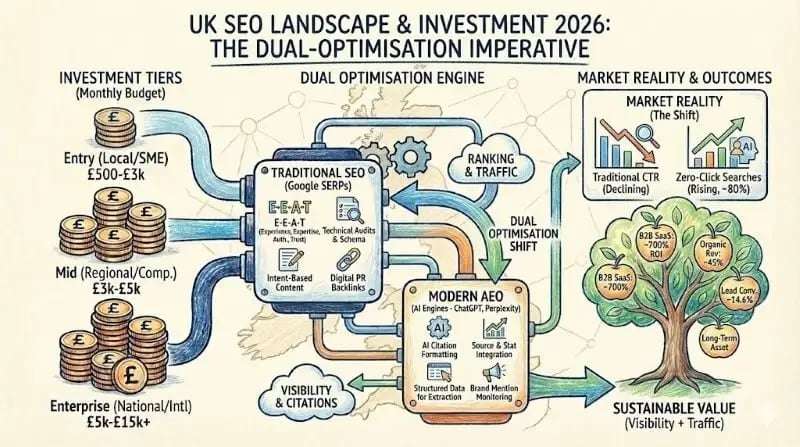
UK SEO Pricing Has Evolved With AI Complexity
Project-based work follows different pricing structures. Whitehat SEO's professional SEO audits typically cost between £500 and £2,500 for standard websites, whilst enterprise audits for complex multi-domain properties range from £5,000 to £10,000+. Hourly consultant rates span £50–£150 for mid-level professionals and £150–£300+ for senior strategists, with London agencies commanding premium rates.
| Service Type | Budget Tier | Standard | Premium | Enterprise |
|---|---|---|---|---|
| Monthly Retainer | £300–£700 | £700–£2,500 | £2,500–£5,000 | £5,000–£15,000+ |
| SEO Audit | £300–£750 | £750–£2,000 | £2,000–£5,000 | £5,000–£10,000+ |
| Hourly Rate | £25–£50 | £75–£150 | £150–£300 | £300+ |
The freelancer versus agency comparison reveals meaningful cost differences. Freelancers typically charge £300–£1,500 monthly for retainers and average £40–£75 per hour, whilst agencies command £700–£5,000+ monthly with hourly rates averaging £98–£150. Agencies charge approximately 138% more than freelancers on average—justified by broader service offerings, team expertise, and accountability structures that most B2B companies require.
Modern SEO Packages Now Optimise for AI Search Engines
The 2026 SEO landscape looks dramatically different from even two years ago. 71% of organisations now regularly use generative AI in business functions, and this extends directly into SEO service delivery. Modern agencies integrate tools like SurferSEO, Clearscope, and Frase.io for content optimisation, whilst tracking brand visibility across ChatGPT, Perplexity, and Google's AI Overviews using specialised monitoring platforms.
Core components that buyers should expect in any professional SEO package include technical SEO audits covering Core Web Vitals and mobile optimisation, keyword research focused on search intent rather than volume alone, on-page optimisation with proper schema markup, content strategy aligned with E-E-A-T principles, and quality-focused link building through digital PR rather than purchased links. Monthly reporting should tie directly to business outcomes—traffic, leads, and revenue—not just ranking positions.
Premium packages in 2026 add dedicated AEO (Answer Engine Optimisation) and GEO (Generative Engine Optimisation) services. Whitehat SEO's AEO methodology optimises content for AI-powered answer engines like ChatGPT and Perplexity, targeting citations and mentions in AI-generated responses rather than traditional SERP rankings. Research from Princeton University demonstrates that GEO strategies can increase AI visibility by 40% through techniques like adding statistics, citing sources, and structuring content for easy extraction.
The distinction matters commercially because Gartner predicts 25% of organic traffic will shift to AI chatbots by 2026, whilst 62% of marketers have already seen declining clicks from traditional search engines. Agencies that offer dual optimisation for both Google and AI platforms position clients for sustainable visibility across the fragmenting search landscape.
Google's AI Overviews Have Reshaped Strategy Fundamentals
AI Overviews now appear on approximately 16% of all Google queries as of late 2025, after reaching nearly 25% in mid-2025. The impact on click-through rates has been substantial: Seer Interactive's analysis of 25.1 million organic impressions found organic CTR dropped 61% for queries where AI Overviews appear, falling from 1.76% to just 0.61%. Even paid advertising suffered, with CTR declining 68% on affected queries.
When AI Overviews appear, zero-click searches reach 80–83%, meaning the vast majority of users never click through to any website. This represents an acceleration of an existing trend—60–65% of all Google searches now end without a click, rising to 77% on mobile devices. For SEO agencies like Whitehat SEO, this fundamentally shifts success metrics from raw traffic toward visibility, brand mentions, and citation presence.
The strategic response requires several adaptations. Content must be structured for featured snippet capture using FAQ schema and direct-answer formatting. 92% of AI Overviews cite sources from the top 20 organic results, so traditional ranking still matters—but being cited within the AI response delivers 35% more organic clicks than ranking alone without citation. E-E-A-T signals have become non-negotiable, with Google's updates explicitly targeting AI-generated material lacking genuine human expertise.
E-E-A-T and Content Quality Now Determine Rankings
Google's E-E-A-T framework—Experience, Expertise, Authoritativeness, and Trustworthiness—has moved from recommendation to requirement. The Search Quality Evaluator Guidelines emphasise that Trust remains the most critical pillar: "untrustworthy pages have low E-E-A-T no matter how Experienced, Expert, or Authoritative they may seem." First-hand experience now carries significant weight, distinguishing content from actual practitioners versus AI-generated summaries.
For SEO services, this means packages should include author bio optimisation with verifiable credentials, content strategies demonstrating topical authority through clusters rather than isolated posts, and digital PR campaigns building genuine backlinks from respected industry sources. Whitehat SEO's approach favours quality over quantity decisively—companies publishing 9+ blog posts monthly see 35.8% year-over-year traffic growth versus just 16.5% for those publishing 1-4 posts, but only when that content demonstrates genuine expertise.
YMYL (Your Money or Your Life) content—covering health, finance, legal, and safety topics—faces the highest E-E-A-T standards. Casual content in these sectors cannot compete against established authoritative sites, making expert-led content creation essential for businesses in regulated industries.
Evaluating SEO Agencies Requires Specific Questions
Before signing with any SEO provider, businesses should ask pointed questions that reveal operational quality. "What SEO areas will you focus on, and how will you develop a strategy specific to our business?" identifies whether the agency offers customised approaches or templated solutions. "Can you share case studies with measurable results—traffic growth, revenue increases, not just rankings?" separates evidence-based providers from those making vague claims.
Contract terms in the UK SEO industry typically require 6-month minimum commitments, reflecting the time needed for measurable results. Standard notice periods run 30 days, and payment models favour monthly retainers over project-based work for ongoing optimisation. However, Whitehat SEO operates on month-to-month agreements with no long-term lock-ins—we believe results should keep you, not contracts. View our transparent pricing for details.
Key contract elements to review include specific deliverables and timelines, ownership of created content, performance metrics and KPIs, and—critically—confirmation that no ranking guarantees are made.
Realistic SEO Timeline Expectations
- Months 1-2: Auditing and strategy development with no ranking changes expected
- Months 3-4: Implementation and early keyword movement, often with volatility
- Months 5-6: First measurable gains with long-tail keywords starting to rank
- Months 9-12: Significant results for competitive terms
- 12-24 Months: Meaningful traction in highly competitive industries
Red Flags That Signal Problematic Agencies
Despite industry maturation, the same warning signs that indicated poor agencies in 2023 remain relevant—with new AI-related red flags added. Guaranteed rankings remain the clearest danger signal: no agency controls Google's algorithm, which changes thousands of times annually. Google explicitly warns against providers claiming guaranteed #1 positions.
Suspiciously cheap pricing—offers of "£200/month full-service SEO"—typically relies on black hat techniques, offshore labour, or automated tactics that risk penalties. Quality SEO for competitive UK markets realistically costs £1,500–£5,000+ monthly minimum. Pre-packaged "one-size-fits-all" solutions prepared without analysing your specific website, competitors, or customer base indicate corner-cutting approaches that rarely deliver sustainable results.
⚠️ 2025 Red Flags to Watch
- Agencies using "AI buzzwords" without clear methodology explanations
- Pushing unproven tactics like llms.txt files without evidence of effectiveness
- Guaranteed ranking promises for specific positions
- Pricing significantly below market rates (under £1,000/month)
- No customisation based on your specific business situation
- Inability to explain how they measure AI visibility distinctly from traditional metrics
Legitimate SEO agencies like Whitehat SEO commit to transparent strategies, detailed monthly reporting, customised plans based on business needs, and honest assessments of competitive landscapes—including realistic timelines and acknowledgment of what SEO cannot guarantee.
UK Market Data Supports Strategic SEO Investment
The UK digital advertising market reached £35.53 billion in 2024, with search advertising accounting for £16.6 billion—47% of total digital spend. The broader UK SEO and internet marketing consultants industry totals approximately £22.3 billion, with five-year compound growth of 11.2% and projections reaching £25 billion by 2028.
ROI benchmarks strongly favour SEO over paid alternatives for long-term returns. B2B SaaS companies achieve 702% average SEO ROI with 7-month break-even periods, whilst financial services reach 1,031% and real estate tops the charts at 1,389% ROI. By comparison, the average UK Google Ads CPC reached £3.65 in 2024, up 10% year-over-year, with legal services CPCs hitting £5.53–£7.11 per click.
The conversion data makes the case compelling: SEO leads convert at 14.6% versus just 1.7% for outbound leads. For B2B companies, organic search generates 44.6% of all revenue and remains the largest single channel—making proper attribution through platforms like HubSpot essential for proving marketing ROI.
Local SEO carries particular weight for UK SMEs: 46% of all Google searches have local intent, and 76% of smartphone users who search locally visit a business within 24 hours. Yet 56% of local businesses haven't claimed their Google Business Profile, representing significant untapped opportunity. Businesses appearing in Google's local 3-Pack receive 126% more traffic and 93% more actions than those ranking below.
Measuring SEO ROI Requires the Right Framework
Calculating SEO return requires comprehensive cost accounting against attributed revenue. The formula—SEO ROI = [(SEO Revenue - SEO Cost) / SEO Cost] × 100—demands inclusion of all costs: agency fees, in-house staff time, tool subscriptions (Semrush, Ahrefs), content creation, and technical development resources.
For e-commerce businesses, Google Analytics 4 enables direct revenue tracking filtered by organic traffic source. Lead generation businesses should calculate lead value using the formula: Lead Value = Customer Lifetime Value × Lead Conversion Rate. If customer lifetime value is £20,000 and close rate is 15%, each organic lead carries £3,000 in attributed value.
Key performance indicators should span both leading and lagging metrics. Leading indicators include keyword rankings, impressions, and indexed pages—trackable monthly to confirm directional progress. Lagging indicators include organic traffic, conversions, and revenue—measured quarterly once enough data accumulates for meaningful analysis. ROI calculation before 6 months yields unreliable figures; the healthy benchmark target is 3-5x ROI over three years, with many campaigns breaking even around month 9 before compounding returns.
Frequently Asked Questions
How much should a UK SME budget for SEO in 2025?
UK SMEs should budget between £1,500 and £5,000 per month for professional SEO services in 2025. Local businesses targeting single geographic areas can start at £500–£1,500 monthly, whilst companies competing nationally or in competitive sectors should expect to invest £3,000–£5,000+ monthly. Whitehat SEO publishes transparent pricing on our website—retainers typically range from £2,000–£10,000 per month depending on scope.
What's the difference between SEO and AEO in 2025?
SEO optimises your website to rank in Google search results, whilst AEO (Answer Engine Optimisation) ensures your brand gets recommended by AI tools like ChatGPT, Perplexity, and Google's AI Overviews. With over 50% of B2B buyers now using AI to research purchases, businesses need both disciplines. Whitehat SEO's AEO methodology structures content for AI citation and tracks visibility in AI-generated responses.
How long does SEO take to show results?
Most businesses see measurable ranking improvements within 3–4 months, with significant traffic and lead growth by month 6. Competitive terms typically require 9–12 months for meaningful results. Whitehat SEO sets 90-day milestones so clients can track progress against clear benchmarks, not vague promises. The timeline hasn't shortened despite AI advances—agencies promising faster results warrant scepticism.
What ROI can I expect from SEO investment?
B2B SaaS companies achieve 702% average SEO ROI with 7-month break-even periods. SEO leads convert at 14.6% versus 1.7% for outbound leads, and organic search generates 44.6% of all B2B revenue. Whitehat SEO tracks marketing performance through to revenue—not just traffic or rankings—building dashboards that show pipeline contribution and marketing-sourced revenue your CFO will trust.
Should I choose a freelancer or an agency for SEO?
Agencies charge approximately 138% more than freelancers but provide broader service offerings, team expertise, and accountability structures. For B2B companies requiring attribution integration, multi-channel coordination, or HubSpot expertise, agencies typically deliver better value. Whitehat SEO operates as a HubSpot Diamond Partner—the top 3% of agencies globally—with specialist expertise across SEO, AEO, and marketing automation.
Making the Right SEO Investment Decision
The 2025 UK SEO landscape demands fundamentally different approaches than even two years ago. AI has created a dual-optimisation imperative—agencies must now deliver visibility across traditional Google search and emerging AI platforms simultaneously. Pricing has evolved accordingly, with comprehensive SME packages typically requiring £1,500–£3,000 monthly for competitive results, whilst enterprise organisations invest £5,000–£15,000+ for sophisticated multi-platform strategies.
Three insights stand out for businesses updating their SEO approach. First, zero-click searches and AI Overviews have made citation presence as valuable as ranking position—being referenced within AI responses delivers significantly more engagement than traditional SERP placement alone. Second, E-E-A-T compliance has shifted from recommendation to requirement, making author expertise, first-hand experience, and topical authority essential rather than optional. Third, the timeline for results remains 6–12 months for meaningful impact, regardless of technological advances—agencies promising faster results warrant scepticism.
For UK SMEs evaluating SEO investment, the market data supports the expenditure: organic search generates 44.6% of B2B revenue, delivers 702%+ average ROI across industries, and commands lead conversion rates 8.6× higher than outbound methods. The key lies in selecting agencies that combine traditional SEO fundamentals with emerging AI optimisation capabilities, transparent reporting tied to business outcomes, and realistic expectations aligned with competitive reality.
Ready to Discuss Your SEO Strategy?
Book a 30-minute discovery call with Whitehat SEO to discuss your goals and challenges. We'll give you honest advice on whether we're the right fit—no obligation, no hard sell.
Book Your Discovery CallReferences & Sources
- Seer Interactive: AIO Impact on Google CTR – September 2025 Update
- Semrush: AI Overviews Study – What 2025 SEO Data Tells Us
- Pew Research Center: Google Users Less Likely to Click When AI Summary Appears
- FirstPageSage: B2B Conversion Rates By Industry 2025
- Applabx: The State of SEO in the United Kingdom in 2025
- HubSpot: 2025 Marketing Statistics, Trends & Data
- Artios: SEO Agency Statistics 2024
- Search Engine Land: Google AI Overviews Drive 61% Drop in Organic CTR