
SEO Strategy
Google's December 2025 core update confirmed what experienced practitioners suspected: quality, clarity, and credibility matter more than ever. Sites demonstrating clear topic authority through deep content clusters gained an average of 23% in organic visibility, whilst those relying on thin, AI-generated content saw steep declines.
SEO Fundamentals Still Work in 2026—Here's What's Changed
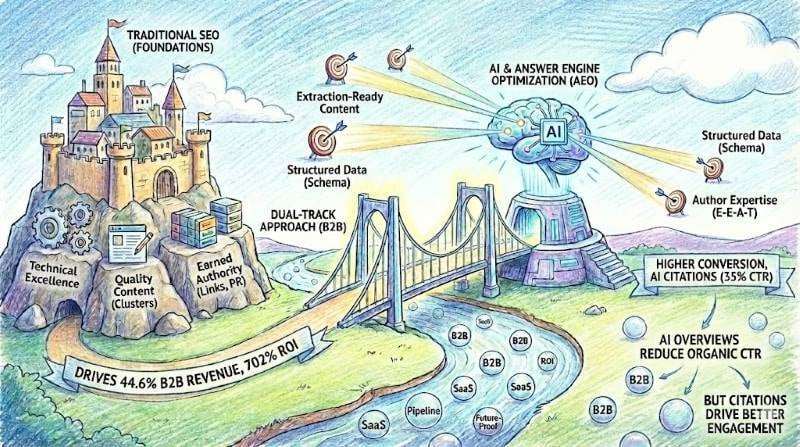
Traditional SEO delivers results. But with AI Overviews reaching 1.5 billion users and organic CTRs dropping 61% on AI-triggered queries, B2B companies need a dual-track approach.
The fundamentals of SEO—quality content, technical excellence, and earned authority—continue to drive B2B growth in 2026. Organic search generates 44.6% of all B2B revenue, delivering a 702% average ROI for SaaS companies. What's changed is the competitive environment: Google AI Overviews now appear for 30% of desktop queries, and brands cited within these AI responses earn 35% more organic clicks than those that aren't. Whitehat SEO's approach combines proven optimisation techniques with strategic AI visibility to help B2B companies capture both traditional rankings and emerging answer engine opportunities.
The fundamentals that continue delivering results
The algorithm now measures comprehensiveness differently. An 800-word post can outrank a 3,000-word competitor when it fully addresses user intent. Google's helpful content system distinguishes between articles that thoroughly answer questions versus those merely hitting word counts.
Core on-page practices remain unchanged: descriptive URLs with relevant keywords, unique title tags under 60 characters, meta descriptions that drive clicks, and heading structures that prioritise user readability. Internal linking continues to build topical authority, with content grouped into clusters driving approximately 30% more organic traffic than standalone pages.
Link building effectiveness persists. According to industry research, 92.3% of top-100 ranking websites have at least one backlink, and digital PR has emerged as the dominant white-hat strategy. The shift is toward relevance over raw authority—a link from a domain rating 30 niche publication often outperforms a generic DR 80 site.
Whitehat's approach to content clusters
At Whitehat SEO, we build topic clusters that demonstrate genuine expertise—not just keyword coverage. Our SEO services combine strategic content planning with technical optimisation to create authority signals that both Google and AI engines recognise.
Technical SEO requirements have intensified
Core Web Vitals remain critical, though current data suggests only 40-54% of websites meet all three thresholds. The benchmarks haven't changed—Largest Contentful Paint under 2.5 seconds, Interaction to Next Paint under 200 milliseconds, and Cumulative Layout Shift under 0.1—but their impact on competitive queries has grown, accounting for an estimated 10-15% of ranking signals.
| Metric | Good Threshold | Business Impact |
|---|---|---|
| LCP | ≤2.5 seconds | 53% of mobile users abandon sites taking >3 seconds |
| INP | ≤200 milliseconds | Replaced FID as the primary responsiveness metric |
| CLS | ≤0.1 | 4.42% conversion drop per additional load second |
Mobile optimisation is non-negotiable. Over 63% of Google's organic traffic originates from mobile devices, and Google judges all sites through a mobile lens first. The gap between mobile and desktop conversion rates (2.2% vs 4.3%) creates opportunity for sites that invest in mobile experience.
Google's John Mueller emphasised in late 2025 that consistency remains the most significant technical SEO factor. Links, canonicals, structured data, navigation, and content must all align. This guidance has remained constant for a decade because inconsistent websites remain one of the most common technical failures Whitehat identifies during website audits.
How AI Overviews have transformed the click equation
Google AI Overviews have created a two-tier search result system. Research from Seer Interactive analysing over 25 million impressions found that queries triggering AI Overviews show organic click-through rates of just 0.61%—down from 1.76% in mid-2024. That's a 61% decline.
But here's what matters for B2B marketers: being cited within an AI Overview yields 35% higher organic CTR than appearing below without a citation. The path to citation isn't mysterious—97% of AI Overview citations come from the top 20 organic results, with 82% pulled from deep, specialised pages rather than homepages.
The AI citation advantage
35%
Higher organic CTR when cited in AI Overviews
91%
Higher paid CTR for cited brands
97%
Of citations from top 20 organic results
Content structured for extraction—clear headings, bullet points, tables, and FAQ sections—appears more frequently in AI responses. Schema markup has become essential for AI visibility. Research shows GPT-4 accuracy improves dramatically when structured data is present, and Microsoft confirmed in early 2025 that their large language models use schema markup to understand web content.
The priority schema types for B2B: Article (for E-E-A-T signals), FAQPage (for direct Q&A pairs), HowTo (for step-by-step guidance), and Organisation/Person (for entity recognition).
Answer Engine Optimisation complements—not replaces—traditional SEO
The relationship between traditional SEO and Answer Engine Optimisation is symbiotic, not competitive. Whilst the foundational work of building authority, creating quality content, and establishing topical expertise feeds both systems, AI platforms have their own citation preferences.
AI referral traffic remains small—approximately 1% of overall web traffic—but it's growing rapidly (527% year-over-year) with significantly higher engagement. Visitors from AI platforms convert 4.4 times better than organic search visitors, spending 9-10 minutes per session on referred sites.
Whitehat's Answer Engine Optimisation services apply a framework that includes:
- Answer-first formatting: Lead with a 40-60 word direct answer, then expand with depth
- Conversational query targeting: AI queries average 23 words versus 4 for traditional search
- Entity consistency: Reinforce consistent facts and positioning across owned and earned media
- Structured data implementation: JSON-LD for Article, FAQ, HowTo, and Organisation schemas
- Fresh content signals: Pages updated within 30 days receive significantly more AI citations
Brands adopting comprehensive AEO frameworks have seen up to 40% higher visibility in generative AI search results. The key insight: you cannot optimise for AI without first being excellent at traditional SEO.
E-E-A-T requirements have tightened significantly
Google's 2025 algorithm updates made Experience, Expertise, Authoritativeness, and Trustworthiness requirements more stringent, particularly for YMYL (Your Money or Your Life) topics. Trust remains the foundational element—without it, according to Google's quality rater guidelines, the other components are worthless.
Demonstrating Experience now requires tangible evidence: original photos, case studies, "What We Tested" sections, and first-person accounts. Google can detect authentic real-world engagement and rewards it.
Expertise demands in-depth content written or reviewed by qualified authors with verifiable credentials. For B2B content, author authority signals have become critical—every piece should include visible bylines linked to dedicated author pages, professional profiles, and documentation of qualifications.
Authoritativeness comes through earned backlinks from reputable sources, topical depth, and consistent industry recognition. This is where community involvement—like Whitehat's leadership of the world's largest HubSpot User Group—provides genuine competitive advantage.
Expert insight
"Building strong personal brands, publishing true expertise, leveraging social platforms, and creating research that can't be copied are key ways to stand out."
— Lily Ray, MozCon 2025
The implication for B2B companies: invest in building genuine authority rather than superficial E-E-A-T signals. The December 2025 update specifically penalised sites lacking these authentic markers whilst rewarding demonstrated practitioner expertise.
Tactics that no longer work (and what to do instead)
Several practices from recent years have become counterproductive or trigger penalties:
| Obsolete Tactic | Why It Fails | Alternative Approach |
|---|---|---|
| Keyword density targeting | Google doesn't use it as a ranking factor | Topic comprehensiveness |
| Separate pages per keyword variation | Causes cannibalisation | One comprehensive page per topic |
| Mass AI content without oversight | Triggers scaled content abuse penalties | Human expertise with AI assistance |
| AMP pages | No longer required for search features | Responsive design with strong Core Web Vitals |
| Blocking author pages from indexing | Hurts E-E-A-T signals | Make author pages accessible and detailed |
| Parasite SEO on third-party domains | March 2024 update targeted this | Build authority on owned properties |
The March 2024 core update specifically targeted low-quality AI content, aiming to reduce unhelpful content by 40%. Sites publishing AI-generated content without substantive human oversight faced manual actions and algorithmic penalties. Best practice: treat AI as an assistant, not a replacement for expertise—research indicates 93% of successful SEO practitioners review AI content before publishing.
Content freshness has also risen in importance, now representing approximately 6% of ranking weight. Pages updated at least once per year gain an average of 4.6 positions versus stale content. But simply changing publish dates without substantive changes can lower trust scores.
B2B-specific considerations for 2026
B2B buyers conduct an average of 12 searches before engaging with a brand, with 27% of the buying journey spent independently researching online. The typical B2B buying cycle spans nearly a year with 10-11 stakeholders involved—making sustained SEO visibility essential.
The content that resonates differs from B2C: case studies are considered most valuable by 73% of B2B buyers, followed by video content. B2B buyers consume 3-7 pieces of content before speaking with a salesperson. Companies publishing 16+ blog posts monthly generate 3.5 times more traffic than those posting four or fewer.
The B2B SEO ROI case
702%
Average ROI for B2B SaaS SEO
44.6%
B2B revenue from organic search
7 months
Average break-even period
£147
Organic CPL vs £280 paid
For multi-location B2B businesses, local SEO remains powerful: 70% of online searches result in a visit when a business has a complete Google Business Profile. Each location requires a unique landing page with consistent NAP (Name, Address, Phone), embedded maps, LocalBusiness schema, and location-specific content—not duplicated boilerplate.
For companies using HubSpot, the platform includes robust built-in SEO capabilities: automatic SSL, global CDN, image compression, and real-time optimisation recommendations. Whitehat's HubSpot onboarding services help B2B companies leverage these features alongside strategic SEO planning to maximise organic visibility.
Your 90-day action plan
The path forward requires balancing continuity with adaptation. Fundamentals—technical excellence, quality content, topical authority, ethical link building—remain the foundation. Layer onto this: structured content for AI extraction, consistent entity information across platforms, and visibility metrics beyond traffic.
Days 1-30: Foundation fixes
- Audit and fix technical issues: canonical tags, security headers, mobile performance
- Implement schema markup on key pages (Article, Organisation, FAQPage)
- Optimise "striking distance" pages ranking positions 4-10
- Establish baseline tracking in Google Search Console and Analytics
Days 31-60: Content enhancement
- Add answer-first formatting to top 10 pages
- Create comprehensive FAQ sections with natural language queries
- Develop content clusters around core service areas
- Update author pages with credentials and expertise signals
Days 61-90: Authority building
- Launch digital PR campaign targeting relevant industry publications
- Audit and improve review presence on platforms AI engines trust
- Create original research or data that can't be replicated
- Track AI visibility: monitor brand mentions in ChatGPT, Perplexity, and Google AI Overviews
The bottom line
Traditional SEO isn't obsolete—it's foundational. The strategies that worked in 2015 still matter in 2026: helpful content, technical excellence, earned authority, and user-focused optimisation. What's changed is the competitive environment and measurement framework.
Success now requires visibility within AI-generated responses alongside traditional rankings, demanding content structured for extraction and brands with genuine expertise. For B2B companies, the economics remain compelling: organic search drives nearly half of revenue and delivers superior ROI compared to paid channels.
The agencies that help clients navigate both traditional SEO and emerging answer engine optimisation—without abandoning fundamentals for hype—will deliver the most value. The old school still works; it just requires new tactics to reach the same goals.
Ready to future-proof your SEO?
Whitehat combines proven SEO fundamentals with AI visibility strategies. Let's discuss how to build organic growth that lasts.
Explore our servicesFrequently asked questions
Is SEO still worth investing in with AI changing search?
SEO remains highly valuable for B2B companies in 2026. Organic search generates 44.6% of all B2B revenue and delivers a 702% average ROI for SaaS companies. Whilst AI Overviews have reduced click-through rates for some queries, brands that optimise for both traditional rankings and AI citations see significantly better results than those focusing on either approach alone.
How long does it take to see SEO results for a B2B company?
Most B2B companies see measurable ranking improvements within 3-4 months, with significant traffic and lead growth by month 6. The average break-even period for B2B SaaS SEO investment is 7 months. SEO is a compounding investment—early gains build momentum for larger results over time, with returns continuing to grow over a 3-year period.
What is Answer Engine Optimisation and do I need it?
Answer Engine Optimisation (AEO) is the practice of structuring content so AI platforms like ChatGPT, Perplexity, and Google AI Overviews can easily extract and cite your information. For B2B companies, AEO matters because AI referral traffic converts 4.4 times better than traditional organic search traffic. However, AEO builds on traditional SEO—you cannot optimise for AI without first having strong foundational SEO in place.
How do I get my content cited in Google AI Overviews?
To increase your chances of being cited in AI Overviews, focus on ranking in the top 20 organic results (97% of citations come from these positions), structure content with clear headings and extractable answers, implement schema markup, and keep content fresh—pages updated within 30 days receive significantly more AI citations. Quality and authority signals matter more than ever.
What SEO metrics should B2B companies track in 2026?
Beyond traditional metrics like rankings and organic traffic, B2B companies should track: AI visibility (brand mentions in ChatGPT, Perplexity, and AI Overviews), citation frequency, share of voice in AI responses, conversion rates from AI referral traffic, and branded search volume. Success metrics are shifting from clicks alone to overall visibility and brand presence across discovery channels.
References and sources
- Seer Interactive: AIO Impact on Google CTR – September 2025 Update
- Search Engine Land: Google AI Overviews drive 61% drop in organic CTR
- Ahrefs: 43 B2B SEO Statistics for 2025
- First Page Sage: 2025 B2B SEO Statistics
- seoClarity: Impact of Google's AI Overviews – SEO Research Study
- SeoProfy: 71 B2B SEO Statistics for 2025-2026
Whitehat SEO
HubSpot Diamond Partner | London
Whitehat is a London-based HubSpot Diamond Solutions Partner, running the world's largest HubSpot User Group. Founded in 2011, we help B2B companies build sustainable inbound marketing strategies that deliver measurable ROI. Our approach combines ethical SEO, HubSpot expertise, and emerging AI optimisation to create marketing engines that work. view our pricing