
SEO Strategy
Google officially introduced "Experience" to the E-A-T framework on 15 December 2022, announcing the change on the Search Central Blog. The updated guidelines now include what Google calls "Double-E-A-T" as part of how human quality raters evaluate content.
Google E-E-A-T: The Complete Framework for SEO Success
Google's E-E-A-T framework—Experience, Expertise, Authoritativeness, and Trustworthiness—determines whether your content ranks and whether AI search engines cite your brand. Pages demonstrating strong E-E-A-T signals have a 30% higher chance of ranking in the top three positions, according to Semrush's analysis of ranking factors. With Google's December 2025 core update extending stringent E-E-A-T standards to virtually all content categories, understanding this framework isn't optional—it's essential for any UK business serious about organic visibility.
When Google Added the Extra "E" and What Changed
The addition addressed a critical gap in content evaluation. Google recognised that some topics require content produced by someone with first-hand, lived experience—not just theoretical knowledge. Tax preparation illustrates this distinction well: you might want an accountant's expertise for filing returns, but when choosing tax software, hearing from actual users proves more valuable.
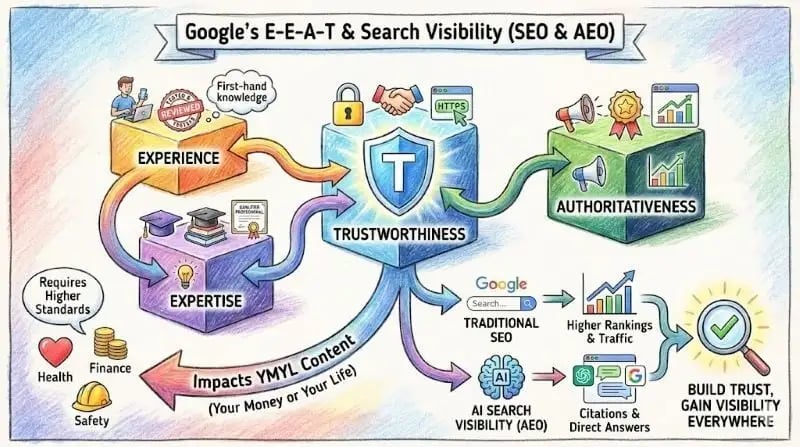
The current Quality Rater Guidelines (September 2025 edition) place Trust at the centre as the most important element. Google states explicitly that untrustworthy pages have low E-E-A-T regardless of how experienced, expert, or authoritative they might appear. The other components—Experience, Expertise, and Authoritativeness—all contribute to establishing this trust, though content doesn't necessarily need to demonstrate all of them to succeed.
The E-E-A-T Hierarchy
- Trust — The central element; without it, other signals don't matter
- Experience — First-hand involvement with the topic
- Expertise — Knowledge or skill for the topic
- Authoritativeness — Recognition as a go-to source
What Google's Quality Raters Actually Evaluate
The Quality Rater Guidelines provide specific definitions that content creators should understand thoroughly. Each component has distinct criteria that raters assess when evaluating pages.
Experience concerns the extent to which the content creator has necessary first-hand or life experience for the topic. Raters consider whether someone has actually used a product, visited a place, or lived through what they're describing.
Expertise evaluates whether the creator possesses necessary knowledge or skill, recognising that different topics demand different levels of expertise. The guidelines use electrical rewiring as an example—you'd trust a skilled electrician over an enthusiast with no wiring knowledge.
Authoritativeness examines whether a website or creator is known as a go-to source for the topic. Some topics have clear authoritative sources (government passport pages, for instance), whilst others benefit from established industry recognition.
For assessing these qualities, raters examine three main sources: what the website says about itself (About pages, author profiles), what others say about it (reviews, references, news articles), and what's visible on the page itself including content, reviews, and comments.
Important clarification: E-E-A-T is not a direct ranking factor. Google's Danny Sullivan stated in February 2024 that having an expert write content doesn't magically improve rankings. Instead, Google uses various signals as proxies to identify content that would demonstrate E-E-A-T if assessed by humans.
Why YMYL Content Faces Heightened Scrutiny
Your Money or Your Life (YMYL) topics receive considerably more rigorous E-E-A-T assessment. Google defines YMYL as topics that could significantly impact people's health, financial stability, safety, or the welfare of society.
The September 2025 Quality Rater Guidelines expanded YMYL categories to include elections, public institutions, and societal trust alongside traditional categories: health and safety, financial security, legal matters, and civic information. The guidelines identify specific harm types: content that could damage mental, physical, or emotional health; content threatening financial security; and content that could negatively impact groups of people or public institutions.
What makes YMYL assessment different is the standard applied. Google applies very high Page Quality rating standards because low-quality pages on such topics could potentially harm a person's health, financial stability, or safety.
However, personal experience still has a place in YMYL content. The guidelines note that pages sharing first-hand life experience on clear YMYL topics may be considered to have high E-E-A-T, provided the content is trustworthy, safe, and consistent with well-established expert consensus. A forum discussion about coping with cancer treatment can be valuable, even though treatment recommendations require medical expertise.
For UK businesses in regulated sectors—legal, financial services, healthcare—this means content must demonstrate both professional credentials and appropriate regulatory compliance. At Whitehat, we've helped professional services firms navigate these requirements through structured content programmes that satisfy both search algorithms and compliance teams.
How the March 2024 Core Update Reshaped Content Quality Standards
The March 2024 core update represented Google's most significant quality-focused change in years, rolling out over 45 days and achieving what Elizabeth Tucker, Director of Product at Google Search, described as a 45% reduction in low-quality, unoriginal content—exceeding the initially projected 40%.
Google announced this update as more complex than usual core updates, involving changes to multiple core systems. Most significantly, the update deprecated the standalone Helpful Content System, integrating it directly into core ranking systems. Google will no longer announce separate Helpful Content updates.
Three new spam policies accompanied this update:
- Scaled Content Abuse — Targets low-quality content production at scale, regardless of whether AI-generated or human-created. Google noted that scaled content creation methods have become more sophisticated, making the human vs. automation distinction less clear.
- Site Reputation Abuse (effective May 2024) — Addresses third-party content published to exploit a site's authority.
- Expired Domain Abuse — Tackles the practice of repurposing expired domains to manipulate rankings.
Throughout 2025, Google released three additional core updates (March, June, and December), each reinforcing quality signals. The December 2025 update particularly affected YMYL content, with industry analysis showing 67% of health/YMYL sites affected and 87% negative impact on mass-produced AI content without expert oversight.
Google's Position on AI-Generated Content
Google's February 2023 guidance remains the foundational statement on AI content: appropriate use of AI or automation is not against their guidelines. The key principle is quality, not origin—Google has always focused on the quality of content rather than how it's produced.
Google explicitly acknowledges that automation has long been used to generate helpful content, such as sports scores, weather forecasts, and transcripts. What matters is whether the content serves users well.
However, the January 2025 Quality Rater Guidelines update introduced stricter language: the Lowest rating applies if all or almost all of the main content on a page is copied, paraphrased, embedded, auto or AI-generated, or reposted from other sources with little effort, originality, or added value.
On disclosure, Google recommends transparency. AI or automation disclosures are useful where someone might reasonably ask "How was this created?" They advise against giving AI an author byline, as that doesn't align with their recommendation to make AI involvement clear to readers.
What the Research Shows About AI Content Performance
A Semrush study analysing 20,000 URLs found that 57% of AI content reached top 10 positions compared to 58% for human content—statistically similar performance. The differentiator isn't AI use but quality and oversight.
Sites with zero human oversight dropped an average of 8 positions and lost 17% of traffic, whilst sites with some human oversight dropped only 3 positions and lost just 6% of traffic.
The practical approach that works: use AI for research, drafting, and ideation; add personal experience and expert insights; fact-check all AI output; disclose AI use appropriately; and have human experts review content before publication. This is exactly the approach Whitehat recommends to clients—AI as an efficiency tool, not a replacement for expertise.
Demonstrating First-Hand Experience in Your Content
Experience, the newer addition to E-E-A-T, requires deliberate effort to showcase. Unlike expertise (which can be demonstrated through credentials), experience must be evidenced through the content itself.
First-person narratives that detail direct involvement with topics signal authentic experience. Describe what you actually did, observed, or learned—not what you read about or researched.
Original photographs and videos prove physical presence or actual product usage. Stock images don't demonstrate experience; your own images do.
Case studies documenting real-world problem-solving demonstrate practical application of knowledge. At Whitehat, we publish detailed implementation case studies specifically because they evidence what we've actually done, not just what we claim to know.
Before-and-after scenarios with measurable outcomes show tangible results from experience. Quantify wherever possible—"20 years coaching experience" carries more weight than vague claims.
Include timestamps and context for when experiences occurred. Document processes you've personally undertaken, and share challenges faced alongside lessons learned. For product reviews, demonstrate actual usage through original images, hands-on testing results, and comparisons based on personal use.
Building Author Authority Through Pages and Schema Markup
Author pages serve as cornerstone trust signals, particularly for YMYL content. These pages connect your content to real, credentialed individuals rather than anonymous sources.
Essential author page elements include:
- Author's name and professional headshot
- Job title and role within the organisation
- Credentials and certifications (particularly for YMYL topics)
- Years of experience in the relevant field
- Educational background
- Links to published works and speaking engagements
- Social media profiles, particularly LinkedIn
- Professional achievements and industry recognition
Google's documentation provides specific schema markup guidance. For articles, use the Person type with name, jobTitle, and URL linking to the author page. When multiple authors contribute, list each separately rather than combining names—this structure enables proper entity recognition.
Google expanded Profile page structured data in November 2023, enabling creators to include social handles, profile photos, follower counts, and content popularity metrics. This markup particularly benefits sites where creators share first-hand perspectives.
For implementation, consider tools like Yoast SEO, Rank Math, or Schema Pro for WordPress sites. HubSpot CMS includes built-in author management that can be extended with custom modules for comprehensive author pages.
Site-Wide Trust Signals That Support Your E-E-A-T Foundation
Trust extends beyond individual content pieces to encompass your entire website. These foundational elements signal legitimacy to both users and search engines.
Essential trust pages include:
- Comprehensive About page — Team profiles, company mission, and history
- Contact page — Multiple contact methods (phone, email, physical address with map)
- Privacy Policy — Clear data handling explanation (essential for UK GDPR compliance)
- Terms of Service — Legal clarity for users
- Editorial Policy — Content standards and fact-checking processes
- Corrections Policy — How you handle and acknowledge errors
Contact information best practices demand a phone number visible in the header or footer, branded domain email rather than free providers, physical address with map integration, and multiple contact methods accessible on mobile devices.
Technical trust signals include HTTPS encryption (non-negotiable in 2025), security badges from reputable providers, GDPR compliance indicators, fast page load times (under 3 seconds), and mobile responsiveness. These foundations should be addressed as part of any comprehensive SEO programme.
Social proof signals encompass third-party review platform integration (Trustpilot, G2, Clutch), customer testimonials with names and photos, client logos, case studies with measurable results, industry certifications, media mentions, and professional association memberships.
For UK B2B specifically, consider industry regulatory bodies relevant to your sector—FCA registration for financial content, SRA or Law Society connections for legal content, GMC or relevant professional body recognition for medical content.
E-E-A-T Signals Increasingly Determine AI Search Visibility
Answer Engine Optimisation (AEO) focuses on getting content cited by AI search tools including ChatGPT, Google AI Overviews, Perplexity, and Claude. Research from Ahrefs shows that 76.1% of pages cited in AI Overviews also rank in Google's top 10 results, suggesting traditional E-E-A-T signals directly influence AI citation likelihood.
Citation patterns across platforms reveal distinct preferences:
- ChatGPT draws heavily from Wikipedia (47.9%), Reddit (11.3%), and Forbes (6.8%)
- Perplexity favours Reddit (46.7%) and YouTube (13.9%)
- Google AI Overviews cites Reddit (21%), YouTube (18.8%), and Quora (14.3%)
The pattern is clear: user-generated content platforms dominate because they provide conversational, experience-rich content. This reinforces the importance of genuine Experience signals.
The Princeton GEO (Generative Engine Optimisation) study found that GEO methods can boost visibility by up to 40% in generative engine responses. The three most effective strategies achieving 30-40% improvement were citing sources, adding quotations from experts, and including statistics. Notably, keyword stuffing decreased visibility by 10%.
Brand search volume shows the strongest correlation (0.334) with LLM citations according to the Digital Bloom 2025 AI Visibility Report. Schema markup with proper structure showed 47% higher AI citation rates. Sites cited across four or more AI platforms were 2.8 times more likely to appear in ChatGPT responses.
Content freshness matters significantly—most LLM citations occur within 2-3 days of publishing. Adding the current year to titles increases citation likelihood. Listicle format dominates, representing 32% of all AI citations.
The Evidence: What the Research Actually Shows
The statistical picture requires careful interpretation, as E-E-A-T cannot be directly measured—only proxy signals correlate with rankings.
Backlinko's study of 11.8 million Google search results found that first-position results have 3.8 times more backlinks than positions 2-10, and Domain Rating (authority) correlates strongly with higher rankings. The average first-page result shows 2.5 minutes of time on site, suggesting engagement signals matter.
Algorithm update impact data tells a compelling story. The December 2025 core update affected 52% of e-commerce sites, 67% of health/YMYL sites, and 71% of affiliate sites. Sites with poor E-E-A-T signals experienced 45-80% visibility reduction.
For AI search specifically, the traffic picture is nuanced. Keywords triggering AI Overviews saw CTR declines averaging 15.49%, with non-branded keywords experiencing steeper drops at 19.98%. However, AI search traffic converts at higher rates—one study showed 3.76% LLM conversion versus 1.19% organic conversion. Users arrive more informed and ready to act.
Zero-click searches now represent 60% of all Google searches in 2024-2025, with Bain & Company finding that 80% of consumers rely on zero-click results for at least 40% of their searches. This makes AI citation presence increasingly important for brand visibility even without direct clicks.
What This Means for Your UK SEO Strategy
The evidence points to a clear strategic direction. E-E-A-T signals matter not as direct ranking factors but as the qualities Google's algorithms attempt to identify through various proxy signals.
Building genuine expertise, demonstrating real experience, establishing authority through quality and recognition, and maintaining trustworthy practices creates content that aligns with what both traditional and AI search engines reward.
AI content tools can accelerate content production, but the data shows that human oversight separates success from penalty. The most effective approach combines AI efficiency with human expertise, experience, and editorial judgment. Pure AI scale without quality control leads to demonstrable ranking losses.
For YMYL topics particularly relevant to professional services, finance, health, or legal sectors, the standards have never been higher. The September 2025 Quality Rater Guidelines expansion of YMYL categories signals Google's continued focus on content that could cause real-world harm.
The convergence of traditional SEO and Answer Engine Optimisation means E-E-A-T signals now influence visibility across both paradigms. Building authoritative, experience-rich content serves both purposes simultaneously.
Need Help Implementing E-E-A-T Best Practices?
Whitehat's SEO services include comprehensive E-E-A-T audits, author page development, and content strategies designed for both traditional search and AI visibility. As a HubSpot Diamond Partner, we integrate these signals directly into your CRM-powered content strategy.
Frequently Asked Questions
Is E-E-A-T a direct Google ranking factor?
No, E-E-A-T is not a direct ranking factor. Google's Danny Sullivan confirmed in February 2024 that having an expert write content doesn't automatically improve rankings. Instead, Google uses various signals as proxies to identify content that would demonstrate E-E-A-T qualities if assessed by human quality raters. Think of E-E-A-T as the outcome Google's algorithms try to reward, not a checkbox to tick.
Can AI-generated content rank well in Google?
Yes, AI content can rank well when properly implemented. Semrush's analysis of 20,000 URLs found 57% of AI content reached top 10 positions, compared to 58% for human content—statistically similar performance. The differentiator is quality and human oversight, not whether AI was involved. Sites using AI without human review lost significantly more traffic and positions than those with editorial oversight.
How do I demonstrate Experience for topics I haven't personally experienced?
You have several options: interview people with direct experience and include their quotes with attribution, commission first-person accounts from contributors, use case studies from clients (with permission), or partner with subject matter experts who can provide authentic perspectives. The key is ensuring genuine experience is represented, even if it comes from collaborators rather than the primary author.
What's the difference between E-E-A-T for SEO and for AI search visibility?
The same signals that help with traditional SEO largely help with AI search visibility—76.1% of pages cited in AI Overviews also rank in Google's top 10. However, AI engines particularly favour content with clear, extractable answers, statistics with source attribution, and presence on third-party platforms (reviews, Reddit, industry publications). Building E-E-A-T for traditional search also builds AI visibility.
How long does it take to improve E-E-A-T signals?
E-E-A-T improvement is a medium to long-term investment. Technical trust signals (HTTPS, contact information, policy pages) can be implemented within weeks. Author pages and credentials can be established within a month. However, building genuine authority through backlinks, mentions, and industry recognition typically takes 6-12 months of consistent effort. The good news: these investments compound over time and become increasingly difficult for competitors to replicate.
References and Further Reading
- Google Search Central: E-E-A-T Announcement (December 2022) — Official announcement of the Experience addition to E-A-T
- Google: Creating Helpful, Reliable, People-First Content — Google's guidance on content quality
- Google Search Central: AI-Generated Content Guidance (February 2023) — Google's official position on AI content
- Google Search Central: March 2024 Core Update Announcement — Details on the core update and new spam policies
- Google: Article Structured Data Documentation — Schema markup guidance for author and article data
- Backlinko: Search Engine Ranking Factors Study — Analysis of 11.8 million Google search results
- Semrush: AI Content Ranking Study — Research on AI content performance in search
- Princeton University: GEO Research Paper (arXiv) — Academic research on Generative Engine Optimisation
Note: This article distinguishes between Google's official statements and industry analysis. Rankings and citation patterns represent correlations; Google has not confirmed direct E-E-A-T scoring mechanisms.