
Content Strategy & SEO
The March 2024 core update represented the most significant algorithmic shift in years. Google merged the standalone Helpful Content System directly into the core ranking algorithm, meaning helpfulness is now evaluated through multiple systems working together rather than a single classifier. This update also introduced strict new spam policies targeting expired domain abuse, scaled content abuse, and site reputation abuse.
Mastering SEO and AI Citation Optimisation
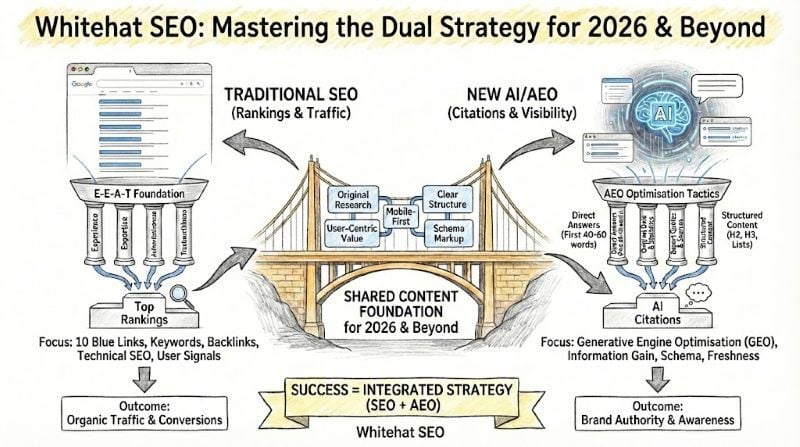
Content writing best practices have fundamentally shifted towards optimising for both traditional search rankings and AI citation by systems like ChatGPT, Perplexity, and Google AI Overviews. Google's March 2024 core update achieved a 45% reduction in low-quality content, whilst AI referral traffic has grown 357% year-over-year, with visitors from AI platforms converting at significantly higher rates than traditional organic search visitors. Whitehat SEO's analysis of 2025 research reveals that content creators must now master both E-E-A-T principles and Generative Engine Optimisation (GEO) to succeed.
E-E-A-T Remains the Foundation of Quality Content
Google's E-E-A-T framework—Experience, Expertise, Authoritativeness, and Trustworthiness—continues to define content quality standards in 2025 and 2026. According to Google's Search Quality Rater Guidelines, Trust is the most important factor among all E-E-A-T signals, with the other three elements contributing to overall trustworthiness.
Content demonstrating strong E-E-A-T signals now has a 30% higher chance of ranking in top 3 positions compared to content with weak signals.
For YMYL (Your Money Your Life) topics covering health, finance, and safety, author credentials have become essentially mandatory. Whitehat SEO recommends that content should be written or reviewed by credentialed professionals with clear "Reviewed by" statements and visible professional backgrounds.
The "Who, How, Why" Framework
Google's documentation provides clear guidance for demonstrating E-E-A-T through three key questions:
- Who created the content? This should be transparent through bylines and comprehensive author pages that include professional photos, detailed bios with credentials, years of experience, and verifiable social profiles.
- How was the content created? This should be disclosed, including any AI assistance used in the production process.
- Why was it created? The primary purpose should be to help users, not to manipulate search rankings.
Author pages have emerged as critical trust signals. Google's official guidance explicitly asks: "Is it self-evident to your visitors who authored your content? Do pages carry a byline, where one might be expected? Do bylines lead to further information about the author?"
Google Permits AI Content but Demands Human Oversight and Original Value
Google's official position, established in February 2023 and reaffirmed in subsequent updates, is unambiguous: "Appropriate use of AI or automation is not against our guidelines." The key distinction is that content must be created primarily to help users, regardless of production method. Using AI to generate content with the primary purpose of manipulating rankings violates spam policies, but thoughtful AI-assisted content creation is fully acceptable.
The January 2025 Search Quality Rater Guidelines update added explicit instructions for evaluating AI content: content where "all or almost all" of the main content is AI-generated and lacks effort, originality, and added value can receive the lowest rating. However, the guidelines clarify that "the use of Generative AI tools alone does not determine the level of effort or Page Quality rating."
Key Statistics on AI Content Performance
- AI content now appears in 17-19% of Google search results
- Human content still dominates 83% of top rankings
- 46% of marketers now use AI to help write copy
- 67% report that content quality improved with AI assistance
Information Gain: The Critical Differentiator
The most effective approach is using AI as an assistant rather than a replacement. AI excels at matching content to search intent—84% of marketers agree this is AI's strongest capability. The best use cases include ideation and brainstorming, creating outlines, research compilation, editing and refinement, and generating meta descriptions.
The critical differentiator for ranking success is "information gain"—how much new and unique information your content provides compared to existing sources. Google filed a patent for "Contextual Estimation of Link Information Gain" in 2018, which was approved in 2024. B2B SaaS websites conducting original research saw a 25.1% increase in top 10 rankings, whilst companies segmenting content by industry increased rankings by 43.4%.
Answer Engine Optimisation Transforms Content Strategy from Rankings to Citations
Generative Engine Optimisation (GEO), also called Answer Engine Optimisation (AEO), represents a fundamental paradigm shift in content marketing. The Princeton University study, presented at KDD 2024, defines GEO as "the first novel paradigm to aid content creators in improving their content visibility in generative engine responses." The core difference from traditional SEO: instead of competing for 10 blue links, content now competes to be among the 2-7 domains that AI systems cite per response.
Whitehat SEO's Answer Engine Optimisation services are built on this research, helping B2B companies get cited in AI-generated responses alongside traditional search rankings.
What the Princeton GEO Research Reveals
The Princeton research tested nine optimisation tactics and found dramatic differences in effectiveness:
| Optimisation Tactic | Visibility Improvement |
|---|---|
| Quotation addition | 27-40% |
| Statistics addition | 25-37% |
| Citing external sources | 24-30% |
| Keyword stuffing | -10% (worse than baseline) |
Critically, lower-ranked websites benefit disproportionately from GEO tactics. The "Cite Sources" method showed a 115.1% increase in visibility for rank-5 sites, whilst top-ranked sites actually saw visibility decrease by 30.3% when all sites optimised. The researchers described GEO as "a tool to democratize the digital space."
AI Search Traffic: The Opportunity
- AI referral traffic grew 357% year-over-year (Similarweb, 2025)
- ChatGPT now has 800-900 million weekly active users
- AI visitors spend 67.7% more time on sites than organic search visitors
- AI search traffic converts at 14.2% compared to Google's 2.8%—a 4.4x advantage
Content Patterns That Increase AI Citation
Based on Whitehat SEO's analysis of research from Princeton, Semrush, and Ahrefs, content patterns that increase AI citation include:
- Opening paragraphs that directly answer queries are cited 67% more often
- Pages with original data tables receive 4.1x more citations
- Content updated within 30 days gets 3.2x more citations
- Sites with clear H2→H3→bullet point structures are 40% more likely to be cited
Content Structure Should Prioritise Direct Answers and Scannable Formatting
The optimal content length debate has been definitively resolved: Google has confirmed that word count is not a direct ranking factor. Comprehensive topical coverage correlates with better rankings, but coverage matters more than length. Backlinko's 2024 study found the average top-ranking page is 1,447 words, whilst Surfer SEO's analysis of 1 million pages found that when 50%+ of suggested terms are used, text length becomes irrelevant.
For SEO-focused content strategies, Whitehat SEO recommends the following word count guidelines:
- SEO-focused blog posts: 1,500-2,500 words
- How-to guides: 1,000-4,000 words depending on complexity
- Service and product pages: 500-1,000 words
The Inverted Pyramid Method
The inverted pyramid method—placing the most essential information at the beginning—has become critical for both featured snippets and AI citations. Content should answer the primary question in the first 40-60 words, with keywords front-loaded within the first 100 words. Short paragraphs of 2-4 sentences maximum improve readability and AI extraction.
Header Structure Best Practices
Header structure significantly impacts both SEO and AEO performance. Best practices include:
- One H1 per page containing the primary keyword
- Typically 5-10 H2s for articles over 1,000 words defining main sections
- Logical H3 hierarchy under H2s
- Never skip hierarchy levels (e.g., H2 directly to H4)
Readability and User Engagement
Readability directly impacts user engagement metrics that influence rankings. Whitehat SEO recommends targeting a Flesch Reading Ease score of 60-70, average sentence length of 15-20 words, and paragraphs of 2-4 sentences maximum. Sites improving readability have seen session duration increases of 20% and user interaction improvements of 30%.
Technical SEO for Content Centres on Schema, Linking, and Mobile Performance
Schema markup in JSON-LD format remains critical for both traditional search and AI visibility. Content with proper schema shows 28-40% higher visibility in AI answers, yet only approximately 12.4% of websites currently implement Schema.org markup—representing a significant opportunity gap.
Essential schema types for content include Article for blog posts and editorial content, HowTo for step-by-step guides, BreadcrumbList for navigation hierarchy, and Organization and Person schemas for E-E-A-T signals.
Internal Linking Best Practices
Internal linking is one of the most controllable and impactful SEO factors. Whitehat SEO's website audit services consistently find that improving internal linking delivers measurable ranking improvements. Best practices include:
- 5-10 internal links per 2,000 words (approximately one link per 200-300 words)
- Keep every page within 3 clicks of the homepage
- A Zyppy SEO study found pages with 45-50 internal links saw optimal traffic
- Anchor text should be descriptive and keyword-rich, avoiding generic phrases like "click here"
Content Freshness and Mobile Performance
Content freshness signals have become more important as AI systems prefer content that is 25.7% fresher than content cited in traditional search. Fast-changing topics should be updated every 3-6 months, whilst evergreen content should be reviewed every 6-12 months. HubSpot reports that updating old blog posts can increase traffic by up to 106%.
Mobile-first optimisation is non-negotiable since Google exclusively uses the mobile version for indexing and ranking. Mobile now accounts for 59.6-63.3% of global web traffic.
Core Web Vitals Targets (2025-2026)
- LCP (Largest Contentful Paint): Under 2.5 seconds
- INP (Interaction to Next Paint): Under 200 milliseconds
- CLS (Cumulative Layout Shift): Under 0.1
Rakuten reported that optimising Core Web Vitals led to a 33% jump in conversion rates and 53% increase in revenue per visitor.
Original Research and Credible Sourcing Drive Both Rankings and Citations
The importance of original data has intensified as AI can easily synthesise existing information but cannot generate new research. Companies conducting original research see measurable ranking benefits—the 25.1% improvement for B2B SaaS sites with original research demonstrates this clearly. Original data tables get 4.1x more AI citations than content without proprietary data.
Effective sourcing strategies include linking to authoritative primary sources (government data, peer-reviewed studies, original research), referencing industry-specific experts with named quotes, and citing statistics with clear provenance and dates.
Expert Quotes and Interviews
Expert quotes and interviews provide unique value that AI cannot replicate. The quotation addition method showed the highest improvement in the Princeton study at 27-40% visibility increase. Quotes add authenticity through "authority by association" and provide specific perspectives not found in aggregated AI training data.
Fact-checking requirements have intensified as AI systems can produce "hallucinations"—fabricated statistics and inaccurate information. Content must be verified against primary sources, with particular scrutiny for statistics, dates, and technical claims.
User Engagement Metrics Increasingly Influence Both Rankings and AI Citations
Understanding search intent has become more nuanced as AI Overviews appear primarily for informational queries (88-99% of AI Overviews are informational) rather than transactional searches. This means informational content optimised for AI citation can build brand awareness and authority even if it doesn't directly drive transactions.
Whitehat SEO's inbound marketing services help B2B companies create content strategies that address all stages of the buyer journey.
Content for Each Buyer Journey Stage
- Awareness stage: Educational topics and problem identification, optimised for AI citation and featured snippets
- Consideration stage: Comparisons and detailed guides with original research and expert perspectives
- Decision stage: Trust signals, social proof, and clear calls to action
User Engagement Benchmarks for 2025-2026
- Median session duration: 2 minutes 38 seconds across all industries
- Long-form content (1,500+ words) generates 68% more time on page
- Median GA4 engagement rate: 56.21% across all industries
- Content with custom visuals increases time on page by 43%
- Video content increases engagement time by an average of 2 minutes 24 seconds
Zero-Click Searches and Brand Visibility
Zero-click searches have reached critical mass, with 58.5% of Google searches ending without a click in the US. This percentage jumps to 43% when AI Overviews are present and 93% in Google's AI Mode. The implication is that brand visibility and citation in AI responses increasingly matters even without direct traffic—being cited positions brands as authoritative sources in users' minds.
Key Statistics: The Scale of Transformation
88.2%
of businesses expect content marketing budgets to increase or stay the same in 2025
£7.65
average ROI per £1 spent on content marketing
748%
ROI from SEO for B2B companies when properly executed
300x
more traffic from Google than all AI platforms combined—traditional SEO remains essential
Frequently Asked Questions
What is the difference between SEO and AEO in 2025?
SEO (Search Engine Optimisation) focuses on ranking websites in traditional search results, whilst AEO (Answer Engine Optimisation) focuses on getting content cited and recommended by AI systems like ChatGPT, Perplexity, and Google AI Overviews. Both are essential—Google still sends 300x more traffic than AI platforms, but AI traffic converts at significantly higher rates. Whitehat SEO recommends optimising for both simultaneously.
How long should blog posts be in 2026?
Google has confirmed word count is not a direct ranking factor—comprehensive coverage matters more than length. For SEO-focused blog posts, 1,500-2,500 words typically performs well. The key is analysing top 10 SERP competitors for target keywords and matching or exceeding their usefulness rather than their word count. Focus on answering the primary question in the first 40-60 words for AI citation optimisation.
Is AI-generated content penalised by Google?
No—Google's official position is that AI-generated content is acceptable when created primarily to help users. The March 2024 core update targets content created to manipulate rankings, regardless of whether it's AI-generated or human-written. The key differentiator is adding original value, human oversight, and genuine expertise. Content that is purely AI-generated without editing, fact-checking, or added insight performs poorly.
How can I get my content cited by ChatGPT?
According to Princeton University's GEO research, the most effective tactics are adding statistics (25-37% visibility improvement), including quotations from experts (27-40% improvement), and citing external sources (24-30% improvement). Structure content with clear headers, answer questions directly in opening paragraphs, include original data, and ensure your content is indexed by Bing (which ChatGPT uses). Avoid keyword stuffing, which performs 10% worse than baseline.
How often should I update existing content?
AI systems prefer fresher content—content updated within 30 days gets 3.2x more AI citations. For fast-changing topics (technology, finance, health), update every 3-6 months. For evergreen content, review every 6-12 months. HubSpot reports that updating old blog posts can increase traffic by up to 106%. However, artificially changing publication dates without substantive updates is explicitly penalised by Google.
Conclusion: Success Requires Mastering Both Traditional SEO and AI Optimisation
The content landscape has bifurcated into two parallel optimisation tracks that must be mastered simultaneously. Traditional SEO fundamentals—E-E-A-T signals, technical optimisation, user engagement—remain the foundation for discoverability. But the emergence of AI as a primary information interface has created a new optimisation discipline where content structure, source citation, and information gain determine whether content gets synthesised and attributed in AI responses.
The most significant strategic insight is that AI citation and traditional rankings draw from overlapping but distinct source pools—80% of LLM citations don't rank in Google's top 100, whilst only 12% of URLs cited by AI systems rank in Google's top 10. This means content can succeed in one channel whilst failing in another, requiring explicit optimisation for both.
The competitive window for GEO adoption remains open: 47% of brands have no GEO strategy, and AI platforms cite only 2-7 domains per response versus 10 results on traditional SERPs. Early movers who structure content for AI extraction—with clear direct answers, cited statistics, expert quotes, and comprehensive coverage—can establish citation authority before competition intensifies.
Whitehat SEO helps B2B companies navigate this dual optimisation challenge through integrated SEO services and Answer Engine Optimisation. The content creators who thrive will be those who view AI not as a threat to be defended against but as a new distribution channel to be optimised alongside traditional search.
References & Sources
- Aggarwal, P. et al. (2024). "GEO: Generative Engine Optimization." KDD 2024 - Proceedings of the 30th ACM SIGKDD Conference on Knowledge Discovery and Data Mining. https://dl.acm.org/doi/10.1145/3637528.3671900
- Google Search Central (2024). "Google Search: New updates to address spam and low-quality results." https://blog.google/products/search/google-search-update-march-2024/
- Similarweb (2025). "AI Discovery Surges: 2025 Generative AI Report." https://ir.similarweb.com/
- TechCrunch (2025). "AI referrals to top websites were up 357% year-over-year in June." https://techcrunch.com/
- Search Engine Land (2024). "Google March 2024 core update rollout is now complete." https://searchengineland.com/
- Adobe Digital Insights (2025). "Q2 2025 insights: AI referrals surge across industries." https://business.adobe.com/
- Position Digital (2025). "100+ AI SEO Statistics for 2025." https://www.position.digital/
Ready to Optimise Your Content for Both Search and AI?
Whitehat SEO helps B2B companies get found in traditional search and cited by AI systems. As a HubSpot Diamond Partner, we integrate your organic performance directly into your CRM for closed-loop attribution. view our pricing
Speak with Our Team