
The Dual-Layer Problem: Why Smart Content Breaks AI Visibility
HubSpot smart content is powerful for personalisation — it delivers different messaging to different audience segments. But here's the problem: AI crawlers cannot see smart content. GPTBot, ClaudeBot, and PerplexityBot execute zero JavaScript. They only see the default HTML markup that loads on the server.
This creates a visibility paradox. While you optimise page layouts for different personas, AI search engines see only one version: the fallback content. If that default layer isn't optimised for AI Overviews, you're handing conversions to competitors who understand the dual-layer strategy.
The solution is architectural: treat default content as your AEO (Answer Engine Optimisation) foundation, and smart content as the personalisation layer on top. Like a house with a solid foundation and interior design that varies by room, the foundation must be structurally sound first.
Key Takeaway
Default content = AEO visibility for AI crawlers. Smart content = personalisation for humans. Build the AEO layer first, then layer personalisation on top. This dual-strategy approach improves both AI traffic and conversion rates.
The Data: AI Search Isn't a Niche Channel Anymore
AI-powered search is no longer an emerging trend. It's reshaping how B2B buyers discover information, and the volume is staggering. Here's what the latest research shows:
54%
B2B Keywords
Trigger AI Overviews
4.4×
Higher Conversion
From AI referral traffic vs organic
86%
Organic Growth Decline
Post-AI search rollout, UK market
14.2%
AI Search Conversion Rate
vs 2.8% from Google organic
Sources: Semrush 2025 AI Search Report, Vercel/MERJ Analysis, UK Market Data 2026
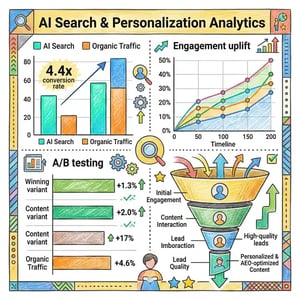
The numbers tell a compelling story. AI Overviews now dominate over half of B2B keyword searches. More importantly, AI referral traffic converts at 4.4× the rate of traditional organic traffic, and with a 14.2% conversion rate, it's already outperforming direct Google organic (2.8%). Yet 86% of UK organisations saw organic traffic decline post-AI rollout — because they optimised for Google's ranking algorithm, not AI crawlers' indexing requirements.
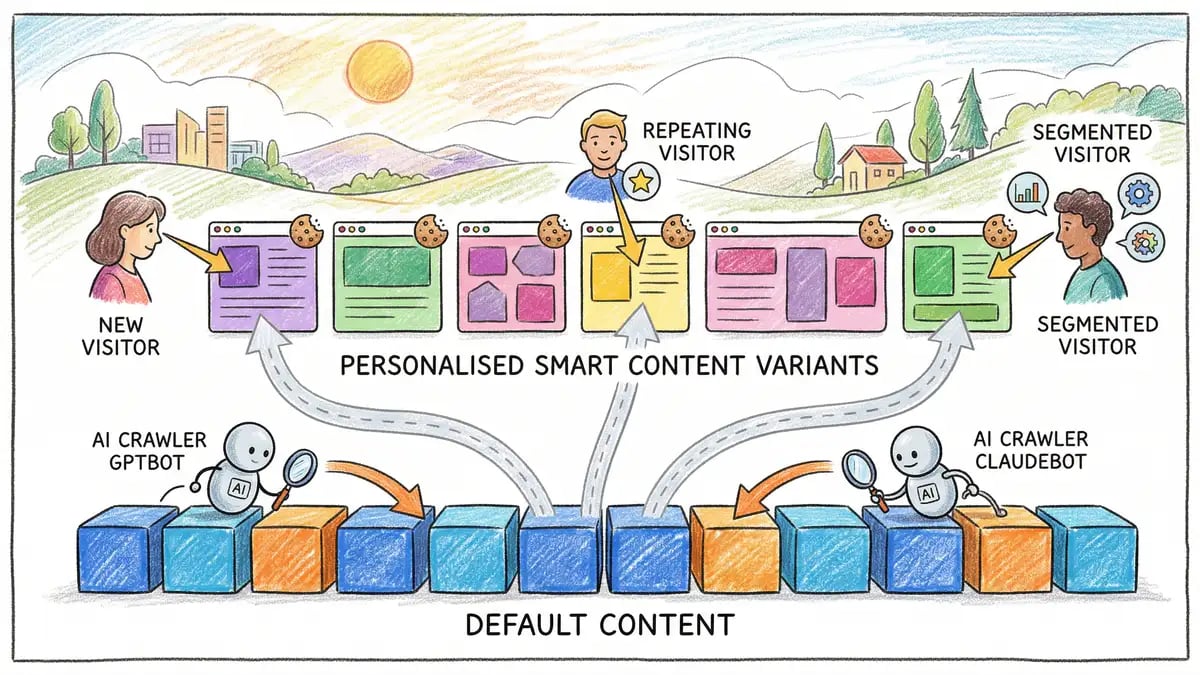
Why Smart Content Fails Without an AEO Layer
HubSpot smart content uses conditional logic — HubSpot render-time JavaScript — to show different content blocks based on contact properties, lifecycle stage, or custom segments. The problem: Vercel and MERJ analysed 500 million GPTBot fetches and found zero instances of JavaScript execution. AI crawlers simply don't wait for JavaScript. They parse raw HTML and move on.
When you rely solely on smart content:
AI Crawlers See Only Default Markup
Your personalised CTA, product recommendation, or case study callout is invisible to GPTBot, ClaudeBot, and PerplexityBot. They index the fallback content only.
Your Default Content Becomes Your AEO Liability
If the fallback content isn't optimised for AI Overviews — missing structured data, lacking direct answers, or vague on key statistics — AI systems won't rank you or cite you.
You Lose Dual-Channel Advantage
While competitors optimise both channels — AEO visibility AND personalisation — you're optimising one or the other, not both.
The solution is simple: make your default content your strongest AEO asset. Write it to rank in AI Overviews first. Then layer smart content on top for human visitors and known segments.
The Cost of Getting It Wrong
Common mistake: Assuming smart content personalisation alone will improve conversions and visibility.
The reality: Without AEO-optimised default content, you're invisible to AI crawlers and lose 54% of B2B search traffic. Personalisation only works when you're already discoverable.
HubSpot INBOUND 2025: New Tools for the Dual-Layer Strategy
HubSpot announced three game-changing features at INBOUND 2025 that enable the dual-layer approach at scale:
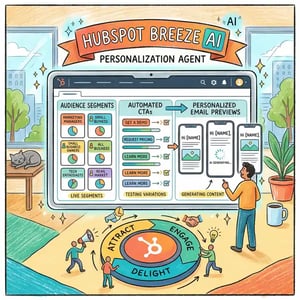
Breeze Personalisation Agent
AI-powered rules engine that automatically segments audiences and personalises content in real time. Build rules once, personalise across all channels without manual audience management.
AI-Powered Email & SMS
Breeze Email produces 82% higher conversion, 30% better open rates, and 50% higher click-through rates. Content is auto-optimised for each recipient based on engagement history.
Segments Replacing Lists
Dynamic, real-time audience segments replace static lists. Combine multiple properties, engagement signals, and lifecycle stage for hyper-targeted smart content without manual list updates.
Source: HubSpot INBOUND 2025 Feature Announcements
These tools don't replace AEO strategy — they amplify it. When you pair a strong AEO default with sophisticated smart content rules, you get both AI visibility AND high-converting personalisation.
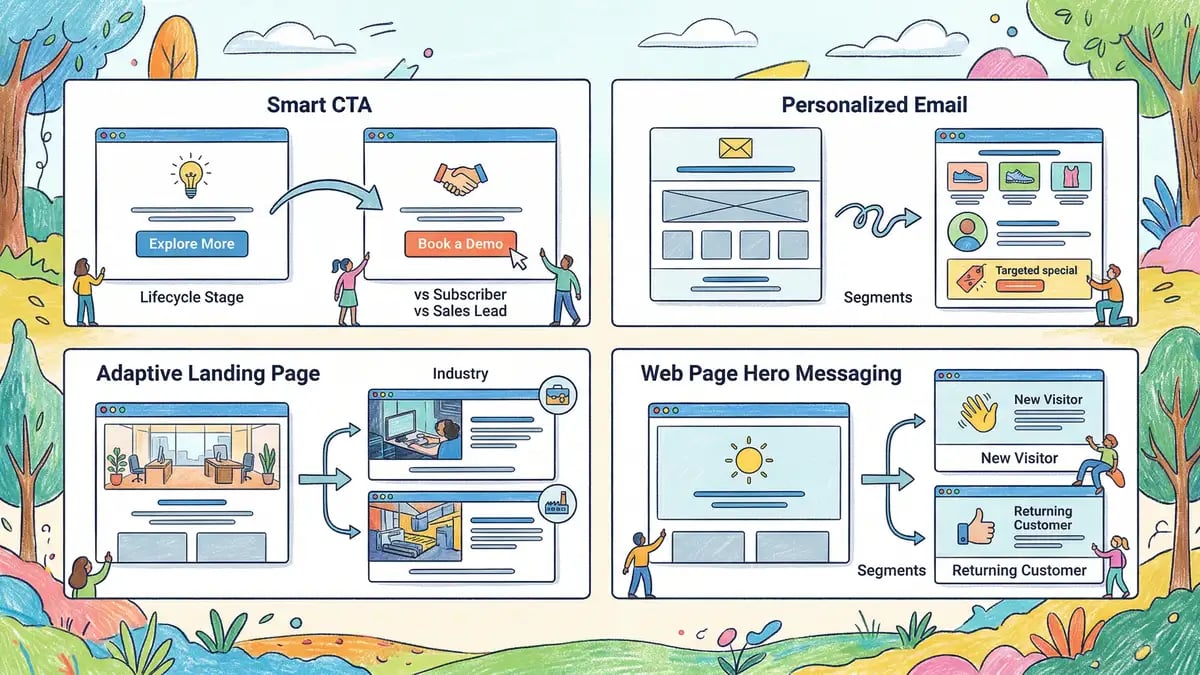
Implementing the Dual-Layer Strategy: Four Smart Content Types
Smart content is most powerful when applied strategically. Here are four proven smart content types that work within the AEO-first framework:
CTA Personalisation by Lifecycle Stage
Use the default CTA to answer the question or provide core value. Layer smart CTAs: leads see "Request a Demo", customers see "View Case Studies", prospects see "Download Guide". AI crawlers see the default; humans see what's relevant.
Email Personalisation by Engagement
Default email content answers the core question. Smart content branches: high-engagement contacts get expanded resources; low-engagement contacts get simplified next steps. Breeze AI optimises send times, subject lines, and messaging per segment.
Landing Page Personalisation by Traffic Source
Default headline answers the search intent. Smart content swaps hero imagery, subheadings, or social proof based on source: AI referral traffic sees "Recommended by [AI System]", organic sees traditional trust signals, direct traffic sees new-customer focused messaging.
Web Page Personalisation by Segment
Default content is AEO-optimised for AI crawlers. Smart blocks personalise the reading experience: B2B buyers see enterprise-focused language, SMBs see cost-effective solutions, returning visitors see advanced features they haven't explored.
Implementation rule: HubSpot smart content supports up to five conditional rules per block. Prioritise the highest-value personalisation first. Always keep the default content AEO-optimised — that's what AI crawlers and fallback visitors see.
Why Personalisation Without AEO Conversion Power Falls Short
McKinsey research shows that 40% more revenue comes from effective personalisation. But here's the catch: 86% of B2B companies use personalisation, yet only 8% execute it effectively. The difference? Effective programmes treat personalisation as a layer on top of a solid AEO and conversion foundation.
When you optimise default content for AI crawlers first, you gain visibility at the moment of search intent. When you then layer smart content for known segments, you convert those visitors at higher rates. It's not AEO vs personalisation — it's AEO and personalisation, sequenced.
Ready to build your AEO foundation? Explore our AEO strategy guide to learn how to optimise for AI crawlers while maintaining personalisation.
Start Your AEO StrategyFrequently Asked Questions
Can AI crawlers see HubSpot smart content at all?
No. AI crawlers (GPTBot, ClaudeBot, PerplexityBot) do not execute JavaScript. They fetch the raw HTML and parse it immediately. HubSpot smart content relies on client-side JavaScript to conditionally swap content blocks based on visitor properties. AI crawlers never see this logic — they only index the default HTML that loads on the server. This is why default content must be your AEO-optimised layer.
Should I choose personalisation or AEO optimisation?
Neither — choose both. The winning strategy is: (1) build a strong AEO-optimised default layer that ranks in AI Overviews, and (2) layer smart content personalisation on top for human visitors. This dual-layer approach gives you visibility in AI search plus higher conversion from personalisation. Personalisation is only valuable if you're discoverable first.
What's the difference between AEO and traditional SEO?
AEO (Answer Engine Optimisation): Optimise content for AI crawlers and large language models. Focus on direct answers, structured data, statistical claims, and Q&A coverage. Target AI Overviews in Claude, ChatGPT, Perplexity, and Google AI.
GEO (Google Engine Optimisation): Optimise for Google's ranking algorithm. Focus on keyword placement, backlinks, domain authority, and click-through rate signals. Target organic search results (the blue links below AI Overviews).
Both matter. AEO is the new priority because AI traffic converts 4.4× higher and now dominates 54% of B2B searches. But Google organic is still traffic — don't abandon it.
How do I measure the impact of smart content + AEO together?
Track these dual metrics:
AEO layer: AI Overviews appearances, AI crawler traffic (from Google Search Console and HubSpot analytics), cost-per-AI-lead, and AI conversion rate.
Personalisation layer: Conversion rate by segment, email open/click rates by segment (use HubSpot Breeze metrics), and revenue impact by lifecycle stage.
The dual-layer wins when you see AI traffic rising (AEO working) AND conversion rates rising within personalised segments (personalisation working). If AI traffic rises but segment conversion drops, your personalisation needs refinement.
Can I update smart content rules without breaking my AEO default?
Yes. Smart content rules only affect the personalisation layer — they don't change the default HTML that AI crawlers and fallback visitors see. Keep your default content stable and AEO-optimised. Update smart rules freely as you refine personalisation. Just test each rule's impact on segment conversion before rolling it out across the page.
Learn more in our Digital Marketing FAQs and Answer Engine Optimisation guide.
The Dual-Layer Future: AEO + Personalisation
The tension between HubSpot smart content personalisation and AI crawler visibility is real — but it's not a trade-off. It's an architecture choice. Build your default content to rank in AI Overviews and be discoverable by AI crawlers. Layer smart content on top to deliver the personalised, high-converting experience that converts known segments.
The winners in 2026 won't be companies choosing between AEO or personalisation. They'll be the ones who master both — treating default content as the AEO foundation and smart content as the personalisation layer that drives conversion uplift on top of new AI-sourced traffic.
Ready to Build Your AEO + Personalisation Strategy?
Whitehat SEO helps B2B companies optimise for both AI discovery and human conversion. From AEO architecture to HubSpot smart content implementation, we design systems that win on all channels.
Clwyd Probert
Head of SEO Strategy, Whitehat SEO
Clwyd specialises in AI search optimisation (AEO) and HubSpot CMS strategy for B2B SaaS companies. With 8+ years in technical SEO and marketing automation, he helps organisations bridge the gap between AI discovery and conversion. He writes frequently on answer engine optimisation and personalisation strategy.