
This means your website isn't just a brochure; it's your most important salesperson. And if prospects can't find you during their research phase, you've lost the deal before it started.
The Complete 2026 Guide to Attract Clients
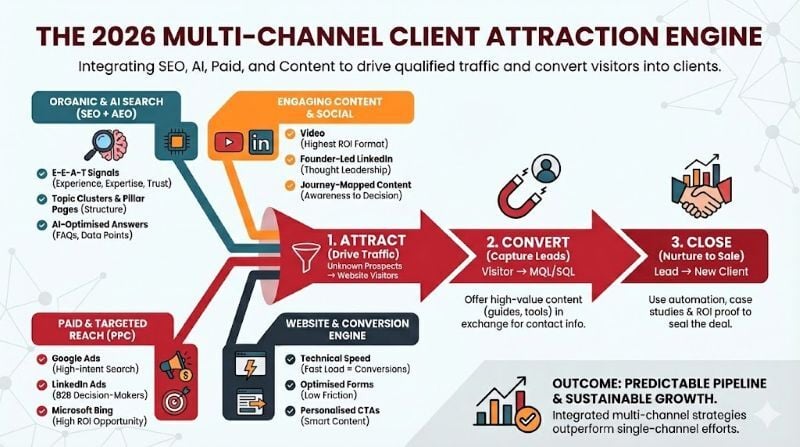
Attracting clients to your website in 2026 requires a multi-channel approach combining SEO, AI search optimisation, paid advertising, and conversion-focused content. According to HubSpot's 2025 State of Marketing Report, the top-performing B2B channels for ROI are website/blog/SEO efforts, paid social, and content marketing—with companies running active blogs generating 67% more monthly leads than those without. This guide from Whitehat, a HubSpot Diamond Partner, covers every strategy you need to drive qualified traffic and convert visitors into clients.
Why Traditional Marketing Alone No Longer Works
The way B2B buyers research and make decisions has fundamentally changed. According to research from Backlinko, 90% of B2B buyers consult 2-7 websites before contacting a single vendor. They're researching solutions, reading reviews, and asking AI chatbots for recommendations—all before you know they exist.
The good news? Businesses that invest in inbound marketing see dramatically better results. Content marketing costs 62% less than outbound methods while generating 3x more leads. HubSpot users experience up to a 107% increase in leads within six months of implementation.
Understanding Today's B2B Buyer Journey
Before diving into tactics, you need to understand how your ideal clients actually find and evaluate solutions. The modern buyer journey consists of three stages:
Awareness Stage
Prospects recognise they have a problem but don't yet know the solution. They're searching terms like "why is our website traffic declining" or asking AI chatbots "how do I generate more B2B leads." Your educational content—blog posts, guides, and videos—must answer these questions.
Consideration Stage
Now prospects understand the solution category and are comparing options. They're searching "best marketing automation platforms" or "HubSpot vs Salesforce for B2B." Your comparison content, case studies, and detailed service pages become critical here.
Decision Stage
Prospects are ready to choose a provider. They're searching "[agency name] reviews" or "HubSpot implementation cost UK." Your pricing pages, testimonials, and case studies with ROI metrics seal the deal.
To attract clients effectively, you need content optimised for each stage. Whitehat's approach to SEO services ensures your website appears throughout this journey—not just at the bottom of the funnel.
Organic Traffic: SEO That Works in 2026
Google commands 93.6% of the UK search market, and the UK SEO industry is now valued at £19.2 billion. But ranking in 2026 requires a different approach than five years ago. Here's what actually moves the needle.
E-E-A-T: What Google Now Demands
Google's Search Quality Rater Guidelines mention E-E-A-T (Experience, Expertise, Authoritativeness, Trustworthiness) 116 times. These signals now outweigh traditional metrics for many query types.
| Component | How to Demonstrate |
|---|---|
| Experience | Original case studies, hands-on tutorials, custom images showing actual work |
| Expertise | Author credentials, certifications, in-depth technical content |
| Authoritativeness | Backlinks from reputable sites, industry mentions, expert contributions |
| Trustworthiness | Clear contact info, privacy policies, accurate citations, customer reviews |
Topic Clusters and Pillar Pages
Businesses using a topic cluster strategy experience a 97% increase in organic search traffic. Pages with strong internal linking strategies have seen traffic increases of up to 570%.
The approach works like this: create comprehensive pillar pages (2,000-4,000+ words) on your core topics, then surround them with detailed cluster articles that link back. For example, a pillar page on "HubSpot Implementation" links to clusters covering onboarding, integrations, training, and migration.
Whitehat's website audit service identifies gaps in your topic cluster architecture and prioritises content that will drive the most traffic.
Technical SEO Fundamentals
Only 33% of websites meet Google's Core Web Vitals benchmarks. The businesses that do see measurable results: Vodafone improved their LCP (Largest Contentful Paint) by 31% and achieved an 8% increase in sales. A 0.1-second improvement in load speed correlates with an 8.4% conversion boost.
Your technical SEO checklist should include:
- LCP under 2.5 seconds
- INP (Interaction to Next Paint) under 200 milliseconds
- CLS (Cumulative Layout Shift) under 0.1
- Mobile-first responsive design (65.89% of organic searches are on mobile)
- Proper schema markup implementation
AI Search Optimisation: The New Frontier
Here's the statistic that should reshape your strategy: ChatGPT now has 800 million weekly active users. Gartner predicts that 25% of organic search traffic will shift to AI chatbots by 2026. AI-referred website sessions jumped 527% in the first five months of 2025 alone.
And the traffic quality is exceptional. AI search traffic converts at 14.2% compared to Google's 2.8%—because visitors arrive pre-qualified, having already received an AI endorsement of your solution.
This is why Answer Engine Optimisation (AEO) has become essential for forward-thinking businesses.
How AI Search Differs from Traditional Search
Traditional SEO aims to rank in Google's ten blue links so people click through. AEO aims to get your brand mentioned and recommended within AI responses. The user never clicks to your site initially—they receive a recommendation, then research your brand later.
When someone asks ChatGPT "What's the best HubSpot agency in the UK?", the AI synthesises information from multiple sources and provides a direct answer. If your content is structured correctly and your brand is mentioned across authoritative sources, you get recommended.
AEO Strategies That Work
Whitehat's research into AI citation patterns reveals several key optimisation strategies:
- Answer-first content structure: Lead with direct answers in the first 40-60 words. AI systems extract these for responses.
- Comprehensive FAQ sections: AI uses "query fan-out" to answer multiple related questions. Include 3-5 FAQs per page.
- Original statistics and data: Content with 19+ data points receives 5.4 citations versus 2.8 for content without.
- Structured data markup: Implement JSON-LD schema for Article, FAQ, and Organization to help AI parse your content.
- AI crawler access: Ensure GPTBot, Google-Extended, Claude-Web, and PerplexityBot are allowed in your robots.txt.
Platform-Specific Citation Patterns
Different AI platforms have different citation behaviours:
- ChatGPT averages 2.62 citations per response, favouring Wikipedia (47.9% of factual queries), LinkedIn, and G2.
- Perplexity provides 6.61 citations per response, prioritising Reddit, YouTube, and fresh content under 90 days old.
- Google AI Overviews appear in 13.14% of queries, with 46% of citations coming from pages already in the top 10 organic results.
The most-cited content types across all platforms are comparison articles (32.5%), listicles (25%), and Q&A/FAQ pages.
Paid Traffic Strategies for B2B
Organic traffic builds compounding value over time, but paid advertising delivers immediate results. The key is knowing where to allocate budget for maximum ROI.
Google Ads Benchmarks (2025)
According to WordStream's analysis of 16,000+ campaigns:
- Average click-through rate: 3.17%
- Average cost per click: $2.69 (£2.15) overall, $3.50-$7.00 (£2.80-£5.60) for B2B SaaS
- Average conversion rate: 6.69% for search ads
- Average cost per lead: $48.96 (£39)
Microsoft Bing Ads: The Overlooked Opportunity
Microsoft Bing Ads delivers the highest ROI of any major PPC platform at 253%. Average CPC is just $1.54 (£1.23)—42% lower than Google. The platform's unique LinkedIn Profile Targeting integration makes it particularly powerful for B2B, and its desktop-heavy audience aligns with B2B research behaviour.
LinkedIn Ads for High-Value Leads
LinkedIn's average CPC of $5.58 (£4.46) is higher than other platforms, but the lead quality justifies the investment:
- MQL-to-SQL conversion: 14-18% (versus Google's 7-12%)
- Average deal values 25-35% higher than leads from other platforms
- Thought Leader Ads deliver 1.7x higher CTR with 62% lower CPC
Recommended Budget Allocation
For B2B companies, Whitehat's PPC management typically recommends:
- Google Ads: 35-45%
- LinkedIn Ads: 25-35%
- Microsoft Bing: 15-20%
- Meta platforms: 5-10%
Social Media and Video Marketing
LinkedIn Dominates B2B
The statistics are unequivocal: 85% of B2B marketers say LinkedIn is their most valuable social platform. 80% of B2B leads from social media come through LinkedIn. And 89% of B2B marketers use LinkedIn for lead generation, with 62% seeing tangible results.
While organic reach has declined (down 50% year-over-year), engagement per post has increased 12%. Focus on quality over quantity—thought leadership content from company leaders consistently outperforms brand posts.
Video: The Highest-ROI Content Format
91% of businesses now use video as a marketing tool, according to Wyzowl's 2025 Video Marketing Statistics report. B2B marketers using video experience 49% faster revenue growth. Video content generates 1,200% more engagement than text and images combined, and website conversion rates increase from 2.9% to 4.8% when video is present—a 65% improvement.
Short-form video (under 60 seconds) delivers the highest ROI, followed by webinars and explainer videos. For B2B, focus on:
- Client testimonial videos
- Product/service explainers
- Expert interviews and thought leadership
- Tutorial and how-to content
Converting Visitors into Leads
Traffic without conversion is just vanity metrics. The median landing page conversion rate is 6.6% according to Unbounce's analysis of 41,000 pages. B2B landing pages specifically average 13.28%. Here's how to maximise your conversion rate.
Form Optimisation
Reducing form fields from 11 to 4 increases conversions by 120%. Only ask for information you genuinely need at this stage—you can progressive profile later. For top-of-funnel content offers, name and email are often sufficient.
Personalised Calls-to-Action
Personalised CTAs perform 202% better than generic versions. Use smart content to display different offers based on visitor behaviour, industry, or buyer journey stage. HubSpot's smart CTA functionality makes this straightforward to implement—part of why HubSpot onboarding is so valuable for growing businesses.
Landing Page Best Practices
- 36% of top landing pages feature testimonials—social proof significantly impacts conversion
- Companies with 40+ landing pages see a 500% boost in conversions
- Write at a 5th-7th grade reading level—this achieves 11.1% conversion versus 5.3% for university-level copy
- Match messaging between ads and landing pages—consistency builds trust
Speed Equals Conversions
A B2B site loading in 1 second has 3x higher conversion than one loading in 5 seconds. Speed isn't just an SEO factor—it directly impacts your bottom line. Prioritise image compression, caching, and CDN implementation.
Local SEO for Location-Based Businesses
If your business serves a local area or has physical locations, local SEO is non-negotiable. 76% of people who search for something nearby visit a business within 24 hours. 75.5% of consumers trust online reviews for purchasing decisions.
Essential local SEO optimisations include:
- Complete Google Business Profile optimisation with accurate categories
- Consistent NAP (Name, Address, Phone) across all citations
- Regular high-quality photo uploads
- Active review management—respond to all reviews, positive and negative
- Local schema markup (JSON-LD)
- Hyper-local content targeting specific cities and neighbourhoods
Putting It Together: The Inbound Methodology
All these tactics work best when integrated into a coherent inbound methodology. Rather than random acts of marketing, successful businesses follow a systematic approach:
- Attract: Draw qualified visitors through SEO, AEO, paid advertising, and social media—targeting the right personas with the right content at the right time.
- Convert: Turn visitors into leads through compelling offers, optimised landing pages, and frictionless forms.
- Close: Nurture leads through automated email sequences, lead scoring, and sales enablement content until they're ready to buy.
- Delight: Turn customers into promoters through exceptional service, continued education, and community building.
76% of B2B marketers use HubSpot for inbound marketing. HubSpot Marketing customers see a 134% increase in website traffic. This isn't coincidence—the platform provides the infrastructure to execute inbound at scale.
Frequently Asked Questions
How long does it take to see results from SEO?
Most businesses see measurable SEO results within 3-6 months, with significant impact typically appearing at 6-12 months. Quick wins like technical fixes and content optimisation can show improvements in weeks, while competitive keywords require sustained effort. Whitehat's SEO programmes typically deliver meaningful traffic increases within the first quarter.
What is Answer Engine Optimisation (AEO)?
Answer Engine Optimisation is the practice of optimising content to be cited and recommended by AI chatbots like ChatGPT, Claude, and Perplexity. Unlike traditional SEO where you aim for ranking positions, AEO focuses on structuring content so AI can extract and reference it in responses. This includes answer-first formatting, comprehensive FAQ sections, and building authority across third-party platforms.
How much should a B2B company spend on marketing?
B2B companies typically invest 6-12% of revenue in marketing, with growth-stage businesses at the higher end. HubSpot's 2025 data shows the average marketing budget is 7.7% of company revenue. The key is allocating budget across channels strategically—not just spending more, but spending smarter on proven ROI activities.
What's the best social media platform for B2B marketing?
LinkedIn is overwhelmingly the most effective social platform for B2B, with 85% of B2B marketers rating it their most valuable channel. It generates 80% of B2B social media leads. YouTube is the second priority for video content, followed by Twitter/X for real-time engagement. Focus your efforts where your audience actually spends their professional time.
Do I need HubSpot to implement inbound marketing?
You don't strictly need HubSpot, but it significantly accelerates results. Companies using HubSpot experience up to 107% more leads within six months and 134% more website traffic. The platform's all-in-one approach eliminates the complexity of managing multiple disconnected tools. As a HubSpot Diamond Partner, Whitehat helps businesses implement the platform efficiently.
Next Steps: Building Your Client Attraction Strategy
Attracting clients to your website in 2025 requires coordinated effort across SEO, AI search optimisation, paid advertising, and conversion optimisation. The businesses winning today aren't doing one thing well—they're executing across all channels with a unified strategy.
Start by auditing your current performance: Where does your traffic come from? What's your conversion rate? Are you appearing in AI search results for your target queries? The answers will reveal your biggest opportunities.
If you'd like help assessing your current situation and building a roadmap for growth, speak to Whitehat's team. As a HubSpot Diamond Partner running the world's largest HubSpot User Group, we've helped hundreds of B2B companies build predictable client acquisition engines.
Ready to attract more qualified clients to your website?
Book a Free ConsultationReferences and Further Reading
- HubSpot State of Marketing Report 2025 – Survey data from 1,700+ global marketers on top-performing channels and strategies.
- HubSpot Marketing Statistics – Comprehensive marketing benchmarks including conversion rates and channel performance.
- WordStream Google Ads Benchmarks 2025 – Analysis of 16,000+ campaigns with CTR, CPC, and conversion data.
- Unbounce Conversion Benchmark Report – Landing page conversion data from 41,000 pages across industries.
- Wyzowl Video Marketing Statistics 2025 – 12-year video marketing study with ROI and usage trends.
- Google Search Central: Core Web Vitals – Official documentation on LCP, INP, and CLS thresholds.
- Backlinko B2B SEO Guide – Complete B2B SEO strategy framework with buyer research statistics.