
ChatGPT and AI tools are fundamentally reshaping how SEO works in 2026. With AI search tools now handling millions of queries daily and Google AI Overviews appearing on up to 25% of searches, organic click-through rates have dropped by as much as 61% for affected queries. UK businesses interested in AI in marketing that rely on traditional ranking strategies alone risk losing visibility as search fragments across multiple AI platforms.
The shift does not mean SEO is dying — it means SEO is evolving. Whitehat SEO's analysis of 2025–2026 search data shows that companies combining traditional optimisation with Answer Engine Optimisation (AEO) are capturing visibility across both Google and AI search systems, building a durable competitive advantage that single-channel strategies cannot match.
Key Takeaway
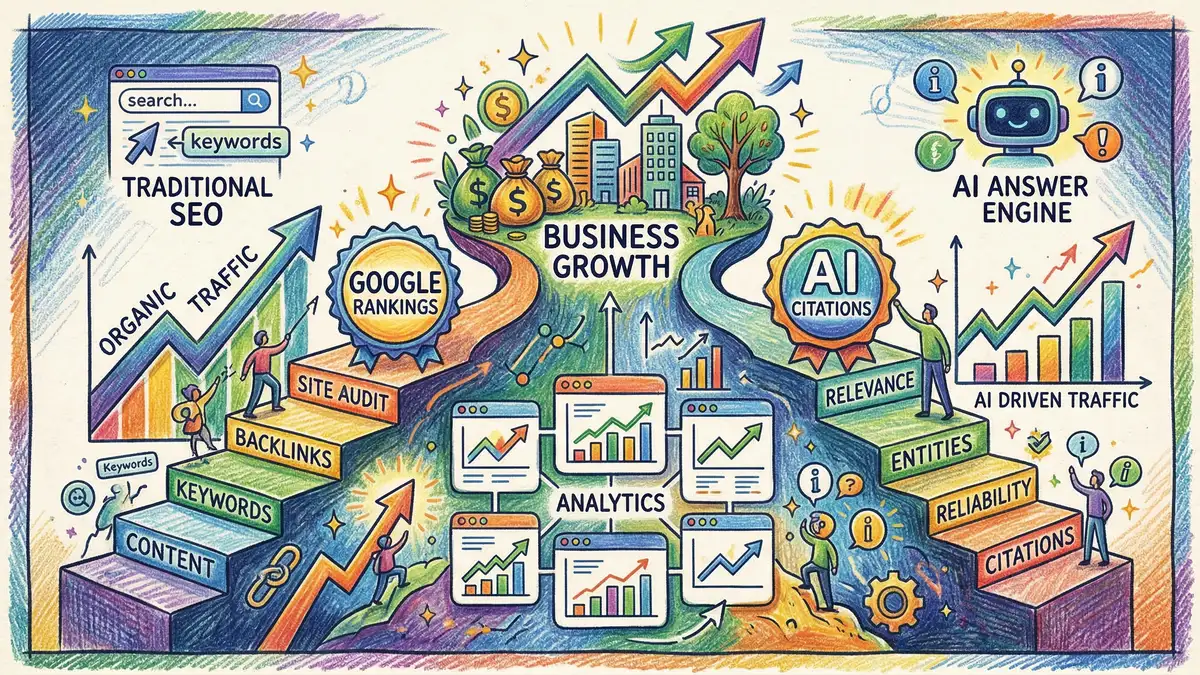
SEO in 2026 requires a dual-track strategy: traditional Google optimisation plus Answer Engine Optimisation for AI platforms. Companies cited in AI responses receive 35% more organic clicks than uncited competitors at the same ranking position. The winners are not those ranking highest — they are those being cited most.
45.3%
ChatGPT Market Share
Down from 69.1% in January 2025
80%+
Zero-Click Searches
Google searches ending without a click
61%
CTR Decline
For queries with AI Overviews since 2024
Sources: Fortune February 2026, Click-Vision Zero Click Statistics 2026, Seer Interactive September 2025
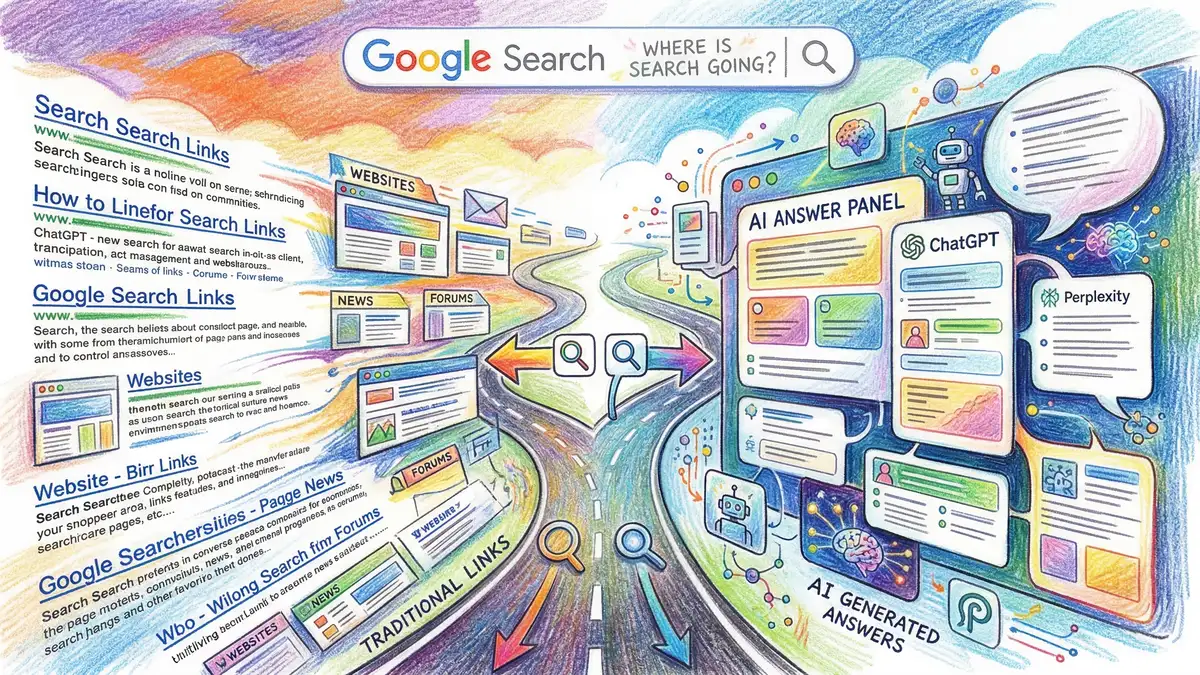
How AI Search Is Fragmenting the SEO Landscape
For two decades, search engine optimisation effectively meant Google optimisation. That era ended in 2025. The AI search market has fragmented into a multi-platform ecosystem where ChatGPT, Google Gemini, Perplexity, Claude, and Grok each serve distinct user needs and information-seeking behaviours. Our detailed comparison of AI engine citation behaviour maps these differences across all major platforms.
The data tells a clear story of market diversification. ChatGPT's share among AI chatbots fell from 69.1% in January 2025 to 45.3% by early 2026 — one of the steepest market share declines in consumer software history. Google Gemini surged to 25.2%, leveraging its integration with Gmail, Android, and Google Search. Grok captured 15.2% market share, up from 1.6% a year prior. Meanwhile, Perplexity processes over 435 million monthly search queries, having grown from 3,000 daily queries in 2022 to 30 million daily by 2025.
One in five AI tool users now employs multiple applications simultaneously, specialising their tool choices by use case. A procurement manager might use Perplexity for citation-rich vendor research, ChatGPT for quick queries, and Claude for synthesising complex decision documents. This fragmentation means there is no longer a single algorithm to optimise for — UK businesses must build visibility across a portfolio of competing AI systems, each with distinct content evaluation logic and citation preferences.
How Google AI Overviews Are Changing Click-Through Rates
Google's response to AI competition has been the aggressive rollout of AI Overviews — AI-synthesised answers displayed above organic search results. The deployment has been volatile: coverage surged from 6.5% of queries in January 2025 to nearly 25% by July 2025, then retreated to under 16% by November 2025 as Google apparently encountered quality or user satisfaction issues.
The impact on organic click-through rates has been severe. Research from Seer Interactive tracking data through September 2025 shows the scale of the challenge facing UK businesses:
| Scenario | Organic CTR | Year-on-Year Change |
|---|---|---|
| AI Overview present, site NOT cited | 0.52% | -65.2% |
| AI Overview present, site IS cited | 0.70% | -49.4% |
| No AI Overview | 1.45% | -46.2% |
Source: Seer Interactive AIO Impact on Google CTR, September 2025 Update
The critical insight is that being cited within an AI Overview partially protects your click-through rate. Websites cited in AI Overviews receive roughly 35% more clicks than uncited sites at the same ranking position. This makes citation strategy — not just ranking position — the primary metric for organic search success in 2026.
Google rolled out AI Overviews to UK and European markets from March 2025, forcing UK marketers to confront this feature at scale. Industries with high informational query volume — professional services, B2B SaaS, financial services, healthcare — face an acute challenge as their primary organic traffic sources are now systematically intercepted by AI-generated summaries.
What Is Answer Engine Optimisation and Why Does It Matter?
Answer Engine Optimisation (AEO) is the practice of structuring content so that AI systems — ChatGPT, Google AI Overviews, Perplexity, Claude — select it as a citation source when answering user queries. Unlike traditional SEO, where the goal is achieving the highest ranking position, AEO focuses on becoming the source that AI platforms quote and recommend.
This distinction matters because the rules have changed. An analysis of over 304,000 URLs cited by large language models found that content structure, clarity, and E-E-A-T signals predicted AI citation more strongly than content depth or research rigor alone. A well-structured 1,500-word article with clear headings, author credentials, and supporting data outperforms a 4,000-word piece that buries its conclusions deep in academic-style prose.
Several findings from 2025–2026 research reshape how Whitehat SEO approaches content strategy for our clients:
Schema markup is now critical. Pages with comprehensive JSON-LD markup are approximately three times more likely to appear in AI Overviews — our technical guide to schema markup for AI search covers implementation in detail. FAQ Schema, Article Schema, and Organisation Schema provide AI systems with machine-readable answer units they can extract with confidence.
Approximately 90% of ChatGPT citations come from outside the top 20 Google results. AI systems evaluate content independently of Google rankings. A mid-market UK company that cannot outrank Semrush or Moz for competitive keywords can still achieve disproportionate AI visibility through superior content structure, schema markup, and authority signals.
Third-party validation drives citations. AI systems heavily weight mentions from authoritative external sources. Being cited in industry publications, appearing on review platforms, and having a Wikipedia presence all increase the likelihood of AI citation — making PR strategy inseparable from AI visibility strategy.
Ready to build your AI visibility strategy? Discover how AEO works for your business.
Discuss Your AI SEO StrategyHow to Use ChatGPT for SEO Without Losing Rankings
Survey data shows 86% of SEO professionals now use AI tools daily, with the average practitioner saving approximately 12.5 hours per week through AI-assisted workflows. ChatGPT has become the dominant tool for keyword research, content planning, competitor analysis, and on-page optimisation. However, using AI effectively for SEO requires understanding both its capabilities and its limitations.
The most successful approach treats AI as a productivity multiplier for human expertise, not a content replacement. An Ahrefs study of 600,000 pages found that whilst Google does not penalise AI-generated content, the highest-ranking pages show almost no AI usage. Google's John Mueller stated in early 2026 that rewriting AI content with human editing will not improve rankings — websites must rethink the fundamental value they add to the web.
For UK businesses, Whitehat SEO recommends a structured approach content-led SEO strategy to integrating ChatGPT into SEO workflows:
Use AI for research and synthesis, not final copy. Feed competitor URLs, keyword data, and industry context into ChatGPT or Claude to generate analysis and outlines. Then apply human expertise, brand voice, and original insights to create content that demonstrates genuine Experience and Expertise — the first two pillars of Google's E-E-A-T framework.
Leverage AI for technical optimisation at scale. Use ChatGPT to audit meta descriptions, generate schema markup, identify internal linking opportunities, and analyse competitor content gaps. These tasks benefit from AI's speed without requiring the authentic human voice that distinguishes high-performing content.
Maintain editorial standards. Establish clear governance: which tasks are AI-first with human review, which are human-first with AI assistance, and which require purely human execution. Content quality and brand voice consistency must be maintained through human editorial oversight regardless of how the initial draft is produced.
The Cost of Getting It Wrong
Common mistake: Treating AI as a content replacement rather than a productivity tool. Companies that scale AI-generated content without human expertise and editorial oversight produce generic, thin content that neither Google nor AI answer engines will prioritise.
What the data shows: An Ahrefs study of 600,000 pages found the correlation between AI content percentage and Google ranking is just 0.011 — Google does not penalise AI usage. But the highest-ranking pages consistently show minimal AI content, suggesting quality and authenticity still differentiate the most valuable search results.
How UK Businesses Should Adapt Their SEO Strategy
The UK market has seen rapid but uneven AI adoption. According to the Lloyds Business Barometer, 66% of UK businesses have invested in AI, with 87% reporting increased productivity and 48% reporting higher profits. London leads adoption at 78%, whilst Scotland lags at 46% and Wales at 48%. This geographic disparity means competitive intensity for AI-optimised visibility varies significantly across regions and sectors.
Based on Whitehat SEO's analysis of 2025–2026 search data, UK businesses should implement these strategic priorities:
Establish AEO as a distinct discipline. Do not retrofit AI citation strategy onto existing SEO roles. Whitehat SEO recommends dedicating specific resource — either an in-house specialist or an agency partner with demonstrable AEO expertise — to own citation tracking, AI visibility analysis, and content structure optimisation for AI extraction.
Implement comprehensive schema markup immediately. Organisation, Article, FAQ, and Author Schema should be deployed across your highest-value pages. This is a one-time investment with compounding returns as AI systems increasingly rely on structured data to identify trustworthy, extractable content.
Restructure content to lead with findings. Audit your top-performing content and restructure opening paragraphs to place key claims within the first two sentences. Create extractable "answer nuggets" of 40–80 words beneath each section heading. AI systems evaluate individual passages independently — each section must be comprehensible in isolation.
Build a diversified citation strategy AI content strategy beyond your website. Invest in thought leadership on industry publications, build public LinkedIn profiles with verifiable credentials for senior team members, and maintain consistent presence on review platforms. AI systems evaluate authority across your entire digital footprint — not just your website.
Establish baseline AI visibility metrics now. Begin tracking brand citations across ChatGPT, Perplexity, Claude, and Google AI Overviews for your target query set — our AEO measurement framework provides the tools and KPIs to do this systematically. Measure share of voice — the percentage of AI responses citing your brand — and track this alongside traditional keyword rankings.
Frequently Asked Questions
Is SEO dead because of ChatGPT and AI?
SEO is not dead — it is evolving. Google still processes 14 billion queries daily compared to ChatGPT's 37.5 million, and organic search remains the largest source of website traffic for most UK businesses. However, click-through rates are declining as zero-click searches exceed 80%, meaning businesses must combine traditional SEO with Answer Engine Optimisation to maintain visibility across both channels.
How do I get my website cited in ChatGPT responses?
Focus on content structure, schema markup, and authority signals. Research shows that 90% of ChatGPT citations come from outside the top 20 Google results, meaning AI evaluates content independently of search rankings. Use clear headings, lead with direct answers, implement JSON-LD schema, and build third-party mentions through PR and industry publications. Whitehat SEO's AEO service helps UK businesses implement these citation strategies systematically.
Should I use ChatGPT to write my SEO content?
Use ChatGPT as a research and productivity tool, not a content replacement. An Ahrefs study of 600,000 pages found that whilst Google does not penalise AI content, the highest-ranking pages show minimal AI usage. The most effective approach uses AI for research, analysis, and drafting, then applies human expertise, brand voice, and original insights to create content demonstrating genuine experience and authority.
What is the difference between SEO and AEO?
Traditional SEO optimises content to rank highly in search engine results pages, driving clicks to your website. Answer Engine Optimisation (AEO) structures content so AI systems — ChatGPT, Google AI Overviews, Perplexity — cite your brand when answering user queries. Both are essential in 2026: SEO builds the ranking foundation that AI crawlers rely on, whilst AEO ensures your content is selected for citation within AI-generated responses.
How are Google AI Overviews affecting organic traffic?
Google AI Overviews reduce organic click-through rates significantly. When an AI Overview appears, organic CTR drops to 0.52% for uncited sites — a 65% year-on-year decline. However, sites cited within the AI Overview retain a CTR of 0.70%, receiving roughly 35% more clicks than uncited competitors. Being cited in AI Overviews has become more important than traditional ranking position for many informational queries.
Continue Your AI Search Learning Path
- Answer Engine Optimisation: The Complete Guide — Pillar overview of AEO strategy
- AEO vs SEO: What's the Difference — Understanding the shift from traditional SEO
- Google AI Overviews Guide — How to get cited in AI Overviews
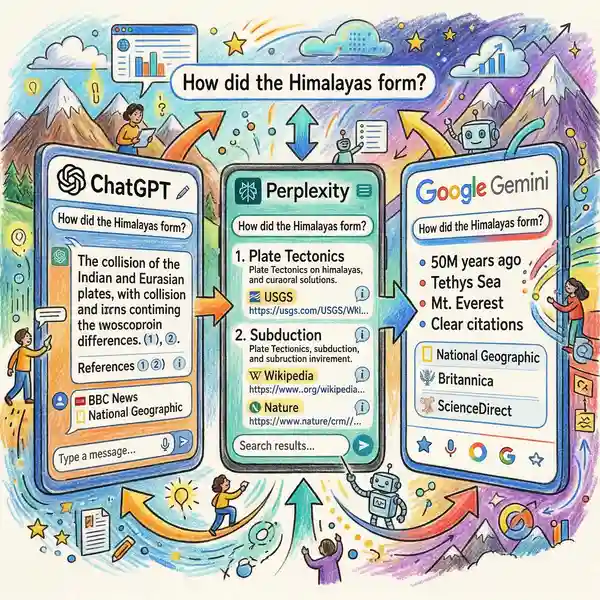
- AI Engine Citation Comparison — How Perplexity, ChatGPT, and Gemini cite differently
- Schema Markup for AI Search — Technical guide to schema that helps AI citation
- Measuring AI Search Visibility — Framework for tracking citations across platforms
- The History of Search Engine Optimisation — From PageRank to AI-powered search
Ready to dominate AI search visibility?
Whitehat SEO combines traditional SEO foundations with Answer Engine Optimisation to build sustainable visibility across both Google and AI platforms. Get cited more, rank higher, and capture traffic as search evolves.
Clwyd Probert
Managing Director, Whitehat SEO
Clwyd leads Whitehat's AI-native SEO practice, helping UK businesses navigate the shift from traditional search to AI-powered discovery. With over 15 years in digital marketing and as a HubSpot Diamond Solutions Partner, he specialises in building sustainable organic visibility through technical SEO foundations and Answer Engine Optimisation strategies.