
Published: 17 February 2026 | Last Updated: 17 February 2026 | By Clwyd Probert, CEO, Whitehat SEO Ltd
How Do B2B Companies Rank in ChatGPT? The Complete AEO Guide for 2026
To rank in ChatGPT, B2B companies must optimise for citation rather than clicks. This means structuring content with direct answers first, building brand mentions across sources AI trusts, submitting your sitemap to Bing, and ensuring every content section works as a standalone, citable passage. Whitehat SEO's AEO clients see AI-referred visitors convert at up to 15x the rate of traditional organic traffic.
Answer Engine Optimisation (AEO) is the fastest-emerging discipline in B2B marketing. As ChatGPT processes the equivalent of 12% of Google's search volume (Ahrefs, February 2026), and Google AI Overviews reaches 2 billion monthly users across 200+ countries, your brand's visibility in AI-generated responses has become as commercially important as your Google rankings.
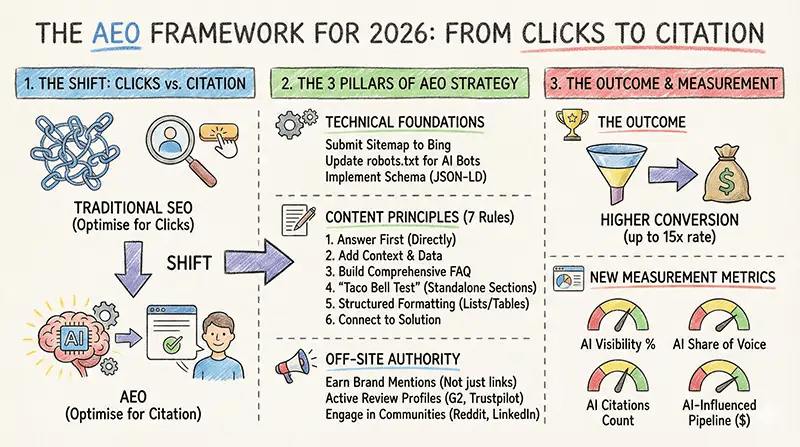
This guide covers the complete AEO framework for UK B2B marketers: how AI search engines select their sources, the seven content principles that drive citation, the technical foundations that most companies miss, and how to measure success honestly. It's written for B2B marketing and demand generation teams who want a practical, evidence-based strategy rather than speculation.
The Numbers Behind the Shift to AI Search
AI search has crossed from early-adopter curiosity into mainstream behaviour with remarkable speed. ChatGPT now has between 800 and 900 million weekly active users (Sam Altman, OpenAI Dev Day, October 2025). Google AI Overviews reaches 2 billion monthly users and appears in approximately 25% of searches globally. McKinsey's October 2025 AI Discovery Survey found that 50% of consumers intentionally seek AI search, with 44% naming it their primary information source.
The commercial stakes are significant. McKinsey projects that $750 billion in US revenue will flow through AI-powered search by 2028, and estimates that brands who fail to adapt risk a 20 to 50% decline in web traffic. In the UK, YouGov data (August 2025) shows 31% of UK SMEs are already using AI tools, with 45% applying them to marketing specifically.
Here is the nuance that separates a good AEO strategy from a rushed one. Despite ChatGPT processing 12% of Google's search volume, Ahrefs' February 2026 study of 76,000 websites found that Google still sends 190x more website traffic than ChatGPT. AI search matters enormously, but it does not replace traditional SEO. It adds a parallel visibility layer where the conversion economics are dramatically better: visitors referred by ChatGPT convert at 15.9% versus 1.76% for Google organic (Seer Interactive, June 2025). AI-referred visitors are 4.4x more valuable per session according to Semrush research.
The Conductor 2026 AEO/GEO Benchmarks Report, which analysed 13,770 domains and 3.3 billion sessions, found that AI referral traffic currently averages 1.08% of total traffic but is growing. ChatGPT accounts for 87.4% of all AI-referred traffic. Critically, 97% of digital leaders who have implemented AEO strategies report a positive impact on brand visibility.
Whitehat SEO's work with UK B2B companies consistently confirms these findings: the brands gaining disproportionate early advantage are those treating AEO as a structured investment, not an experiment. Learn more about the shift from traditional SEO to AI-led optimisation and what it means for your content strategy.
How ChatGPT Decides Which Brands to Recommend
ChatGPT does not simply retrieve one page and summarise it. It uses a process called query fan-out: it decomposes your question into multiple sub-questions, retrieves sources independently for each, then synthesises a unified response. Understanding this changes how you approach content architecture.
ChatGPT draws from three source layers. First, the Bing index (the most controllable and most important for B2B marketers). Second, OpenAI's proprietary OAI-SearchBot index. Third, real-time web fetching using the ChatGPT-User bot for live queries. Critically, only 31% of ChatGPT prompts trigger a live web search; the majority rely on Bing-indexed content and training data. This is why submitting your sitemap to Bing Webmaster Tools is one of the highest-impact, most-overlooked technical actions available.
What determines which brands are recommended? Ahrefs' Brand Radar study of 75,000 brands found that brand mentions across the web correlate with AI visibility at 0.664, compared to 0.218 for backlinks. Mentions matter roughly three times more than links for AI search visibility. Additionally, AirOps research (October 2025) found that brands cited through third-party sources (review sites, editorial coverage, community discussions) are 6.5x more likely to appear in AI responses than brands relying solely on their own domain.
Platform behaviour varies meaningfully. ChatGPT cites lower-ranking pages (position 21 and beyond) approximately 90% of the time (Semrush). Google AI Overviews draws from the top 10 organic results 76.1% of the time (Ahrefs). Perplexity provides exactly five links in 99% of responses and prioritises educational content. Understanding these differences allows you to tailor your AEO approach by platform rather than treating AI search as monolithic.
Whitehat SEO's AEO audit service identifies exactly where your brand appears across ChatGPT, Google AI Overviews, and Perplexity, and which competitors are claiming the visibility you should own.
The Seven Content Principles That Drive AI Citation
Princeton University, Georgia Tech, and the Allen Institute's 2024 GEO research (published at KDD 2024) provides the most rigorous academic foundation for AEO content strategy. Their key finding: structured optimisation methods can boost source visibility in generative engine responses by up to 40%. For lower-ranked content, the Cite Sources method produced a 115.1% visibility improvement. Keyword stuffing, by contrast, performed worse than an unmodified baseline.
Whitehat SEO's AEO methodology applies these seven principles across every piece of content we produce and optimise for clients:
1. Answer first, always
The opening paragraph must deliver a complete 40 to 60-word answer to the primary question before any context, background, or qualification. AI engines extract opening passages first. If your answer is buried after two paragraphs of scene-setting, your content will be skipped. The direct answer you see at the top of this article is an example of this principle applied.
2. Go a click deeper with supporting context
After the direct answer, follow immediately with 150 to 200 words of expansion: the mechanism behind the answer, the nuance that matters, and the context that transforms a correct answer into a useful one. AI engines reward depth after brevity.
3. Include original data and cited statistics
The Princeton GEO research found the Statistics Addition method produced the largest overall visibility improvement. Aim for 19 or more data points per article, each with source attribution and publication date. Original data from your own client work is especially powerful because no competitor can replicate it.
4. Build a comprehensive FAQ section
Because ChatGPT uses query fan-out, a question like "how to rank in ChatGPT" will generate sub-questions about cost, timelines, tools, measurement, and more. Each FAQ entry you provide is a potential citation opportunity for one of those sub-queries. Aim for five to eight questions with 30 to 50-word direct answers, supported by two to three sentences of additional detail.
5. Pass the Taco Bell Test
AI engines do not read articles sequentially. They extract and evaluate individual sections independently, a process called chunking. Every H2 section in your article must pass the Taco Bell Test: can someone understand this section without having read anything that came before? Avoid pronouns without clear antecedents ("this approach", "as mentioned above", "they typically"). Restate key terms in each section.
6. Use structured formatting AI can extract
Ahrefs data shows 78% of AI Overviews include lists. Format information using clear bullet points (five to eight items per list), comparison tables (maximum five rows by three columns for featured snippet capture), and bold text for key terms and statistics. Aim for sections of 120 to 180 words between H2 headings. This is optimal for AI chunking and citation.
7. Connect every section to your solution
This is the most commercially important principle and the one most often neglected. If your content educates the AI without mentioning your product or service, AI will learn from your content but recommend competitors who do make themselves visible. Every one to two sections must naturally reference your brand alongside the educational value you deliver. Whitehat SEO's content strategy service builds this brand embedding into every piece of content we produce within HubSpot Content Hub.
Building Authority Through Mentions, Not Just Backlinks
The single most actionable insight from recent AEO research is this: brand mentions across the web are three times more correlated with AI visibility than backlinks. This fundamentally changes how B2B companies should think about off-site authority building.
AI engines draw their recommendations from an ecosystem of third-party sources. G2 accounts for approximately 33% of ChatGPT's software review citations. Trustpilot is dominant for UK business trust signals. Reddit has grown 450% in AI Overview citations, reflecting AI's increasing reliance on community-validated opinion. YouTube accounts for 29.5% of AI Overview citations, making video content an underutilised AEO lever for B2B companies. Building your presence on these platforms is not optional if you want consistent AI visibility.
The B2B buyer journey context makes this even more important. 6sense's 2025 Buyer Experience Report (surveying nearly 4,000 B2B buyers) found that 61% of buyers are already well into their decision journey before they make first contact with a vendor, and that the vendor who is preferred on Day 1 wins 80% of deals. AI search is shaping that Day 1 preference at scale.
Whitehat SEO's four-step mention-building framework:
- Audit: Identify which AI platforms currently mention your brand and for which query categories, using tools including Semrush AI Visibility, Ahrefs Brand Radar, and HubSpot's free AEO Grader.
- Outreach: Target guest posts, expert commentary (via HARO and Qwoted), and industry publication coverage with substantive, citable insight rather than promotional content.
- Review platforms: Maintain complete, actively managed profiles on G2, Capterra, and Trustpilot. Request reviews from every satisfied client. Respond to every review professionally.
- Community presence: Participate genuinely in LinkedIn groups, relevant Reddit communities, and industry forums. Mention your solution only when directly relevant.
This is one of the areas where Whitehat SEO's AI consultancy and implementation service adds the most value: systematically building the off-site presence that your on-site AEO content needs to amplify. For a deeper introduction to optimising your brand for AI search, see our dedicated guide.
Technical Foundations Your Site Needs for AI Crawlers
Perfectly structured content earns zero citations if AI crawlers cannot access or index it. Technical AEO foundations are the most frequently neglected part of an AEO strategy, particularly for companies whose web teams are focused on Google optimisation rather than AI search.
The most impactful technical actions for AI search visibility, ranked by effort versus return:
| Action | Why It Matters | Priority |
|---|---|---|
| Submit sitemap to Bing Webmaster Tools | ChatGPT relies heavily on Bing's index. Not being indexed by Bing means being invisible to ChatGPT's primary source layer. | Critical |
| Update robots.txt to allow AI crawlers | Explicitly allow OAI-SearchBot, GPTBot, Google-Extended, PerplexityBot, and Claude-Web. Many WAF configurations block these by default. | Critical |
| Implement Article and FAQPage schema | JSON-LD schema markup helps AI understand content structure, author credentials (E-E-A-T), and content recency. | High |
| Server-side render all critical content | AI crawlers do not execute JavaScript. Content loaded by JS after page render is invisible to AI. Test with JS disabled. | High |
| Display and update content dates | AirOps research (2025) found 83% of AI citations come from pages updated within 12 months. Content updated within 3 months receives 67% more citations. | High |
| Core Web Vitals and page speed | Slow server response causes AI crawlers to abandon pages. Target under 200ms Time to First Byte. | Medium |
Whitehat SEO's comprehensive website audit now covers all technical AEO factors as standard, including AI crawler access, schema implementation, server-side rendering, and Core Web Vitals. For a broader view of how these technical components integrate, see our guide to key SEO components for 2026.
Measuring AEO Success When AI Recommendations Keep Changing
Honest measurement is where most AEO guides fail you. Here is the uncomfortable truth that underpins a credible AEO strategy: AI recommendations are highly inconsistent. SparkToro's January 2026 research across 2,961 prompts and 600 participants found there is less than a 1-in-100 chance that the same brand list will appear twice for the same query, and less than 1-in-1,000 that the same list will appear in the same order.
As Rand Fishkin, CEO and co-founder of SparkToro, wrote on the findings: "Ranking position in AI responses is essentially meaningless to track. Visibility percentage across dozens or hundreds of prompts might be a reasonable metric." This is the framework Whitehat SEO uses with clients: we measure how often a brand appears across a broad set of priority queries, not where it ranks in any single response.
There is a silver lining in the consistency data. SparkToro found that niche B2B categories show significantly higher consistency than broad consumer categories. If your company operates in a specific vertical such as life sciences marketing, HubSpot implementation, or multi-location retail operations, your AI visibility will be more stable and more measurable than a generalist competitor. Specificity is a structural advantage in AEO.
The four AEO metrics that actually matter:
- AI Visibility Percentage: How often your brand appears across your top 20 to 30 priority queries, tested monthly across ChatGPT, Google AI Overviews, and Perplexity.
- AI Share of Voice: Your visibility percentage versus named competitors for the same query set. Relative position matters more than absolute scores.
- AI Citations: The number of times AI engines link directly to your content. Track via Semrush AI Visibility or Ahrefs Brand Radar.
- AI-Influenced Pipeline: Revenue from leads whose first touchpoint was AI-referred traffic, tracked through post-purchase surveys, extended 30 to 60-day attribution windows, and HubSpot's multi-touch attribution reporting.
As a HubSpot Diamond Partner, Whitehat SEO configures HubSpot attribution reporting to track AI-referred visitors from first touch through to closed revenue. This transforms AEO from a brand-awareness exercise into a board-ready commercial metric. If your HubSpot portal is not yet configured for AI traffic attribution, our HubSpot onboarding programme can have you tracking this within a matter of weeks.
Your AEO Action Plan: Where to Start This Week
AEO is not a long-lead discipline. Initial visibility signals appear within two to four weeks for well-structured content on indexed domains. Meaningful business impact, in the form of attributable conversions and pipeline, typically builds over six to twelve months as authority compounds across platforms. The Conductor 2026 benchmarks found that 94% of enterprise marketing leaders plan to increase AEO investment in 2026. The window for early-mover advantage in UK B2B is narrowing.
Four actions you can take this week to begin building your AEO foundation:
- Submit your XML sitemap to Bing Webmaster Tools. Visit bing.com/webmasters, verify your domain, and submit your sitemap. This single action materially improves your ChatGPT indexing speed and costs nothing.
- Audit your top 10 pages against the seven-point content checklist above. Identify which pages lack a direct opening answer, have no FAQ section, or fail the Taco Bell Test. These are your highest-priority AEO optimisation targets.
- Test your priority queries in ChatGPT and Google AI Overviews today. Search for the questions your ideal customers ask. Document which brands appear and which are absent. This is your baseline measurement.
- Check your robots.txt file. Visit yourdomain.com/robots.txt and confirm GPTBot, Google-Extended, PerplexityBot, and Claude-Web are not blocked. If you use Cloudflare, check the security settings for "Block AI Bots" and disable it if active.
If you want a structured assessment of where your brand currently stands across AI search platforms, Whitehat SEO offers a free AEO audit that benchmarks your visibility against competitors and identifies the highest-impact content and technical improvements. Our work also integrates with your existing professional SEO programme because as Lily Ray, VP of SEO Strategy at Amsive Digital, summarises clearly: "AI systems rely on search, and there is no such thing as GEO or AEO without doing SEO fundamentals."
Frequently Asked Questions
What is AEO and how does it differ from SEO and GEO?
Answer Engine Optimisation (AEO) is the practice of structuring content and building brand authority so that AI engines like ChatGPT, Google AI Overviews, and Perplexity cite and recommend your brand in their responses. Generative Engine Optimisation (GEO) is the academic term for the same discipline, coined in Princeton's 2024 research. Both AEO and GEO extend traditional SEO rather than replacing it. Strong organic rankings, technical site health, and E-E-A-T signals remain the foundation on which AI visibility is built.
How long does AEO take to show results?
Initial AI visibility signals typically appear within two to four weeks for well-indexed domains that implement the technical and content foundations correctly. Measurable improvements on low-competition queries take two to three months. Significant business impact, including attributable pipeline from AI-referred visitors, typically requires six to twelve months as brand authority compounds across platforms and third-party sources. The technical quick-wins (Bing indexing, robots.txt, schema markup) can be completed in a single day.
Which AI search platforms should UK B2B companies prioritise?
Prioritise in this order: Google AI Overviews first (2 billion monthly users, 67% UK search market share, appears in 25% of searches), then ChatGPT (87.4% of AI referral traffic, highest B2B conversion rates at 15.9%), then Perplexity (growing rapidly among technical and senior buyers, 82% semantic similarity with ChatGPT). The good news is that content structured for AEO performs well across all three platforms simultaneously, because the underlying principles of direct answers, cited data, and standalone sections are universal.
Can smaller B2B companies compete against larger brands in AI search?
Yes, and often with a structural advantage. AI engines value specificity and genuine expertise over domain authority or company size. SparkToro's January 2026 consistency research found that niche B2B categories show significantly higher AI recommendation stability than broad categories. A specialist agency or software vendor with original client data, active review profiles, and properly structured content regularly outperforms generic content from larger, better-resourced competitors. The window of first-mover advantage in UK B2B AEO remains open for specialist brands willing to invest now.
How does HubSpot help with AEO implementation and measurement?
HubSpot supports AEO in several ways. HubSpot's free AEO Grader (launched at Inbound 2025) measures your brand's visibility across GPT-4o, Perplexity, and Gemini relative to competitors. Content Hub enables AEO-structured content production at scale with schema markup and proper semantic HTML. HubSpot's multi-touch attribution reporting, when configured correctly by a Diamond Partner, tracks AI-referred visitors through to closed revenue, making AEO a measurable commercial channel rather than a brand-awareness initiative. Whitehat SEO's HubSpot onboarding programme configures all three capabilities as part of a connected AEO and inbound strategy.
What is the difference between AEO and traditional featured snippet optimisation?
Featured snippets are single-source extractions from one page that answer a specific Google query. AEO is broader: AI engines synthesise multiple sources into a single response, citing several brands simultaneously. Featured snippet optimisation focuses on the opening paragraph and definition blocks. AEO requires the entire article to be structured for extraction, plus off-site mentions across third-party sources that AI trusts. The content principles overlap significantly, making AEO a natural evolution of featured snippet strategy rather than a replacement.
Find Out Where Your Brand Stands in AI Search
Whitehat SEO's free AEO audit benchmarks your brand's visibility across ChatGPT, Google AI Overviews, and Perplexity, compares you against your three closest competitors, and identifies the highest-impact improvements available to you right now.
Book Your Free AEO AuditReferences and Sources
- Ahrefs (February 2026). ChatGPT Has 12% of Google's Search Volume but Google Sends 190x More Traffic to Websites.
- Ahrefs (2025). An Analysis of AI Overview Brand Visibility Factors (75K Brands Studied).
- Conductor (November 2025). 2026 AEO/GEO Benchmarks Report.
- McKinsey (October 2025). New Front Door to the Internet: Winning in the Age of AI Search.
- Princeton University, Georgia Tech, Allen Institute (KDD 2024). GEO: Generative Engine Optimization.
- 6sense (November 2025). B2B Buyer Experience Report 2025.
- SparkToro / Gumshoe.ai (January 2026). New Research: AIs Are Highly Inconsistent When Recommending Brands or Products.
- SparkToro / Datos (2024). 2024 Zero-Click Search Study.
- Search Engine Land (July 2025). Zero-Click Searches Rise, Organic Clicks Dip.
- YouGov (August 2025). We Polled UK SME Leaders About AI Adoption.
- TechCrunch (July 2025). Google's AI Overviews Have 2B Monthly Users.
- Search Engine Land (2025). AI Recommendation Lists Repeat Less Than 1% of the Time: Study.