
The Google Ad Grant is a programme that provides registered charities with free Google Search advertising credits. Since launching in 2003 (created by Sheryl Sandberg), Google has awarded more than $10 billion in free advertising to over 115,000 nonprofits across 51 countries. Currently, more than 35,000 charities worldwide actively use the programme.
Google Ad Grants for UK Charities: The Complete 2026 Guide
Google Ad Grants provide eligible UK charities with $10,000 per month (approximately £7,500) in free Google Search advertising—equivalent to £90,000 annually. To qualify in 2025, your charity must be registered with the Charity Commission, OSCR, or NICC, maintain a 5% click-through rate, and implement conversion tracking through GA4. This guide covers everything from eligibility and application to the latest Performance Max features and compliance requirements.
What is the Google Ad Grant?
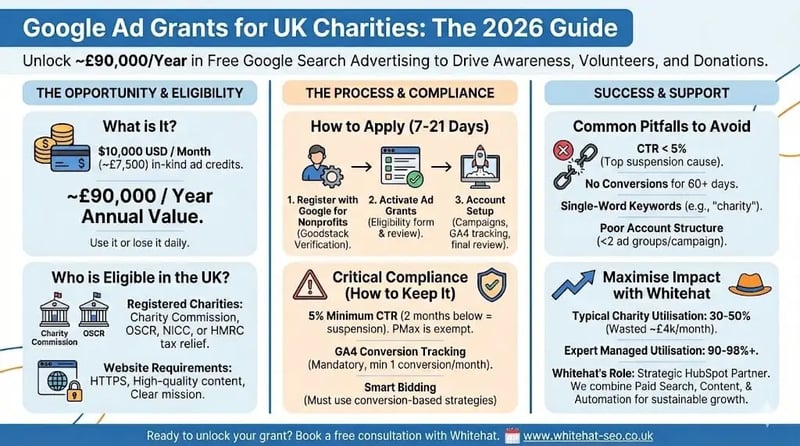
Unlike traditional paid advertising where organisations pay per click, Google Ad Grant recipients receive in-kind advertising credits that automatically renew monthly—provided compliance requirements are met. The grant covers text-based search ads that appear on Google Search results pages when users search for keywords related to your charity's mission.
For UK charities, this represents a significant opportunity. With Google commanding 87% of the UK search market, appearing prominently in search results can dramatically increase awareness, volunteer recruitment, and donations. Whitehat's inbound marketing approach for charities often incorporates Google Ad Grants as a foundational element of digital strategy.
How much is the Google Ad Grant worth?
The Google Ad Grant provides $10,000 USD per month in advertising credits. For UK charities, this translates to approximately £7,400–7,500 monthly depending on exchange rates—or roughly £90,000 annually in free advertising.
| Metric | Value |
|---|---|
| Monthly grant amount | $10,000 USD (~£7,500) |
| Daily spending limit | $329 USD (~£250) |
| Annual potential value | $120,000 USD (~£90,000) |
| Maximum CPC bid (manual) | $2.00 USD (~£1.50) |
| Smart Bidding CPC limit | Can exceed $2.00 |
Important: Unused funds do not roll over. The grant operates on a "use it or lose it" basis—if you don't spend your daily $329 allocation, that budget is lost. Well-managed accounts typically achieve 90–98% budget utilisation, while poorly optimised accounts often waste £4,000–5,500 monthly through under-utilisation.
UK charity eligibility requirements
To qualify for Google Ad Grants in the United Kingdom, your organisation must be registered with one of the recognised charity regulators and meet Google's website and content requirements.
Eligible organisations
Your charity must be registered with one of the following:
- Charity Commission for England and Wales
- Scottish Charity Regulator (OSCR)
- Charity Commission for Northern Ireland (NICC)
- HMRC as a charity for tax relief purposes
- Churches (covered as eligible nonprofits)
Organisations NOT eligible
- ✗ Community Interest Companies (CICs)
- ✗ Government entities and organisations
- ✗ Hospitals and healthcare organisations (exception: charitable arms/foundations)
- ✗ Schools, academic institutions, universities (exception: philanthropic arms)
- ✗ Political organisations
- ✗ Unregistered community groups
Website requirements
Your charity's website must meet these standards before applying:
- HTTPS secured (SSL certificate mandatory)
- Minimum 5 pages of original, substantive content
- Clear description of your organisation's mission and activities
- Up-to-date content with no broken links
- High-quality user experience (easy navigation, clear CTAs)
- Donation pages hosted by verified platforms
If your website needs improvement before applying, Whitehat's SEO services can help ensure your site meets Google's quality standards.
2026 compliance requirements
Google has significantly tightened compliance requirements since 2018. Failure to meet these standards results in account suspension—often without warning. Here's what UK charities must maintain in 2025.
Click-through rate (CTR) requirements
- Minimum 5% CTR required at account level
- Measured over a rolling 30-day period
- Two consecutive months below 5% = account suspension
- Performance Max campaigns are exempt from CTR requirements
- Recommended target: 7–8% CTR as a safety buffer
The nonprofit sector benchmark CTR is 4.41%—but Google Ad Grants require 5%. This means you must outperform the industry average to maintain compliance. Understanding how PPC advertising works is essential for managing this effectively.
Conversion tracking (mandatory)
Since January 2024, conversion tracking requirements have been strengthened:
- At least one meaningful conversion type must be configured
- Minimum 1 conversion per month required
- Accounts without conversions for 60+ days risk suspension
- Conversion rates above 15% are flagged as potentially inaccurate
Acceptable conversion types include:
- Donations
- Email newsletter signups
- Volunteer registrations
- Event signups
- Petition signatures
- Contact form completions
- Phone calls (30+ seconds)
Smart Bidding requirements
For accounts created after April 2019, Smart Bidding is mandatory:
- Must use conversion-based Smart Bidding for all campaigns
- Acceptable strategies: Maximise Conversions, Maximise Conversion Value, Target CPA, Target ROAS
- New accounts may start with Maximise Clicks to gather data
- Must switch to Smart Bidding after 15–30 conversions
Keyword restrictions
- No single-word keywords (exceptions: brand names, medical conditions, specific terms like "charity", "donate", "volunteer", "nonprofit")
- No overly generic terms ("free videos", "today's news", "things to do")
- Keywords with Quality Score 1 or 2 must be paused or removed
- Minimum acceptable Quality Score: 3 or higher
Account structure requirements
- Minimum 2 ad groups per campaign
- Minimum 2 sitelink ad assets account-wide
- Keywords must align with associated ads and landing pages
- Specific geographic targeting required (cannot target "all countries")
- Must log into account at least monthly
GA4 integration (mandatory)
Universal Analytics is fully retired—GA4 is now mandatory for all Google Ad Grants accounts.
Required setup steps:
- Link GA4 property to your Google Ads account
- Create key events/goals in GA4
- Import GA4 key events into Google Ads as conversions
- Set up Consent Mode v2 (required for UK/EEA compliance)
- Test conversions before going live
Best practice: Create goals in GA4 and import them into Google Ads rather than creating conversions directly in Google Ads.
How to apply for a Google Ad Grant
The application process involves three phases and typically takes 7–21 business days from start to activation.
Phase 1: Google for Nonprofits registration
- Visit google.com/nonprofits
- Sign in with your organisational Google account
- Enter your charity registration number
- Submit for Goodstack verification (Google's verification partner as of 2024)
- Watch for emails from verifications@mail.goodstack.org
- Wait 3–14 business days for verification
Phase 2: Activate Google Ad Grants
- Log back into Google for Nonprofits
- Select "Get Started" under Google Ad Grants
- Complete the eligibility form
- Google reviews your website for compliance
Phase 3: Account setup
- Google creates your ready-made Ad Grant account
- Set up campaigns meeting minimum structure requirements
- Configure conversion tracking via GA4
- Submit for final review (3–10 business days)
Total timeline: 7–21 business days from initial registration to activation, depending on verification speed and website compliance.
Performance Max for Ad Grants (2025)
Google completed full rollout of Performance Max to all Ad Grants accounts in January 2025. This represents a significant expansion of advertising capabilities for charities.
What's included vs. paid Performance Max
| Feature | Paid PMax | Ad Grants PMax |
|---|---|---|
| Google Search | ✓ | ✓ |
| Google Maps | ✓ | ✓ |
| Display Network | ✓ | ✗ |
| YouTube | ✓ | ✗ |
| Gmail | ✓ | ✗ |
Key benefits for charities
- Exempt from 5% CTR requirement—major advantage for struggling accounts
- Uses AI-driven audience signals instead of keywords
- Helps accounts with low search volume keywords
- Requires less hands-on management
- Google Maps integration increases local visibility
For charities struggling to maintain the 5% CTR requirement, Performance Max offers a compliance-friendly alternative. However, standard search campaigns often deliver more control and transparency. Whitehat's PPC agency services can help determine the right mix of campaign types for your charity.
Common mistakes that get accounts suspended
Understanding why charities lose their Google Ad Grants helps you avoid the same fate. Here are the most common pitfalls.
Critical mistakes leading to suspension
- CTR below 5% for 2+ consecutive months—the most common cause of suspension
- Using single-word keywords—automatically flagged
- No conversion tracking or zero conversions monthly—accounts without conversions for 60 days risk suspension
- Targeting all countries—specific geographic targeting is mandatory
- Account inactivity—must log in at least monthly
Strategic mistakes that waste budget
- Using only Maximise Clicks bidding long-term—must transition to Smart Bidding
- Broad match keywords attracting unqualified traffic—damages CTR
- Irrelevant landing pages—pages must match ad promises
- Set-and-forget approach—requires weekly monitoring minimum
- Not using negative keywords—wastes budget on irrelevant clicks
Most charities waste £4,000–5,500 monthly through poor optimisation. Expert management requires approximately 10–15 hours per month to achieve full budget utilisation.
Success benchmarks and case studies
What does success look like with Google Ad Grants? Here are industry benchmarks and real charity results.
| Metric | Benchmark |
|---|---|
| CTR (nonprofit/advocacy) | 4.41% industry average (must achieve 5%+ for compliance) |
| Conversion rate (advocacy) | 1.96% |
| Budget utilisation (under-optimised) | 30–50% |
| Budget utilisation (well-managed) | 90–98% |
| Management time required | 10–15 hours/month |
UK success stories
- Arthritis Research UK: 25,000 new website users monthly, 30+ registrations and donations per month
- Direct Relief: $59,000 in online donations in one month—exceeding their previous annual total
- Animal shelters: 125% increase in monthly adoption applications
- Cat Care Society: 95% budget utilisation, 100+ adoption enquiries in 40 days
Frequently asked questions
How much is the Google Ad Grant worth for UK charities?
The Google Ad Grant provides $10,000 USD monthly, equivalent to approximately £7,400–7,500 depending on exchange rates. This totals roughly £90,000 in free advertising annually. The grant renews automatically each month provided your account remains compliant with Google's requirements.
Can Community Interest Companies (CICs) apply for Google Ad Grants?
No, Community Interest Companies are not eligible for Google Ad Grants. Only organisations registered with the Charity Commission for England and Wales, Scottish Charity Regulator (OSCR), Charity Commission for Northern Ireland (NICC), or HMRC as a charity qualify. CICs would need to establish a separate charitable entity to access the programme.
What happens if my charity's CTR falls below 5%?
If your account CTR drops below 5% for two consecutive months, Google will suspend your Ad Grant account. To reinstate it, you must identify and fix compliance issues, then request a review through Google Ad Grants Help or by calling 1-866-246-6453. Accounts using Performance Max campaigns are exempt from the CTR requirement.
How long does it take to get approved for Google Ad Grants?
The complete application process typically takes 7–21 business days. Goodstack verification requires 3–14 business days, followed by website compliance review and final account setup approval (3–10 business days). Ensure your website meets all requirements before applying to avoid delays.
Should my charity manage Google Ad Grants in-house or hire an agency?
Expert management requires 10–15 hours monthly to achieve 90%+ budget utilisation. If your charity lacks digital marketing expertise or staff capacity, an agency can maximise ROI while ensuring compliance. Most under-managed accounts waste £4,000–5,500 monthly. Whitehat's inbound marketing strategies include Google Ad Grants management for UK charities.
Do unused Google Ad Grant funds roll over to the next month?
No, Google Ad Grants operate on a "use it or lose it" basis. You receive up to $329 daily ($10,000 monthly), and any unspent budget disappears at the end of each day. Well-optimised accounts achieve 90–98% utilisation; poorly managed accounts often use less than 50%.
Ready to unlock £90,000 in free advertising?
The Google Ad Grant represents one of the most valuable resources available to UK charities—£90,000 annually in free advertising that automatically renews each month. But between compliance requirements, conversion tracking, and Smart Bidding strategies, many charities struggle to maximise the opportunity.
Whitehat helps charities across the UK implement effective inbound marketing strategies that include Google Ad Grants management. As a HubSpot Diamond Partner, we combine paid advertising expertise with content strategy and marketing automation to drive sustainable growth for nonprofits.
Want help maximising your Google Ad Grant?
Book a free consultation to discuss your charity's digital marketing needs.
Get in TouchReferences and sources
- Google for Nonprofits – Ad Grants – Official programme information and eligibility requirements
- Google Ad Grants Help Centre – Policy compliance, account management, and FAQs
- Google for Nonprofits UK Eligibility – UK-specific registration requirements
- Google Ad Grants Policy Compliance – CTR requirements, Quality Score rules, account structure
- Charity Digital – Google Ads Grants Guide – UK success stories and implementation advice
- Getting Attention – Google Ad Grants Comprehensive Guide – Programme history, $10 billion awarded statistics
- Donorbox – Beginner's Guide to Google Ad Grants (2025) – Application process and verification requirements
- Charity Excellence Framework – Google Ad Grants for UK Charities – UK-specific eligibility guidance