
Key Takeaways
GA4 now includes cross-channel budgeting and scenario planning with AI-powered Analytics Advisor. UK DUAA exempts analytics cookies from consent under specific conditions. Server-side tracking achieves 95% accuracy vs 60-80% client-side. 80% of B2B buyers use AI search tools. 90% attribution gap persists between software and actual revenue drivers.
2026 B2B Analytics: Four Critical Metrics
95%
Data Accuracy
Server-Side Tracking
vs 60-80% client-side
80%
B2B Buyers
Using AI Search
ChatGPT, Perplexity, Gemini
70%
Server-Side
Adoption by 2027
Growing from 20-25% now
2.9%
Median Conversion
All B2B Industries
UK 2025-2026 benchmark
The B2B Analytics Inflection Point: GA4 Evolves, Cookie Law Shifts, AI Search Dominates
The analytics landscape for B2B companies has undergone a fundamental transformation in early 2026. Google Analytics 4 has evolved from a reporting tool into a strategic planning platform with cross-channel budgeting, scenario planning, and AI-powered insights. Simultaneously, the UK's Data (Use and Access) Act now exempts analytics cookies from consent requirements under specific conditions, fundamentally shifting compliance obligations. And 80% of B2B buyers now use AI search tools—ChatGPT, Perplexity, Gemini—as their primary research channels, creating an entirely new measurement imperative.
Server-side tracking has emerged as the critical infrastructure layer, achieving 95% data accuracy versus the 60-80% ceiling of client-side implementations. Yet 51% of B2B organisations implementing predictive analytics fail to achieve expected outcomes due to poor data quality. The companies winning in 2026 aren't those with the most sophisticated tools—they're building on first-party data foundations, closing the 90% attribution gap between software measurements and actual revenue drivers, and measuring brand visibility across AI platforms.
This guide synthesises the most consequential developments for UK B2B marketing teams and revises best practice for measurement in 2026.
GA4's Strategic Pivot: From Reporting Tool to Planning Platform
On January 16, 2026, Google released three major beta features that signal a definitive strategic pivot for GA4. These aren't incremental UI improvements—they fundamentally reposition GA4 as a business planning tool alongside its reporting functions.
Three Platform Shifts (January 2026)
Cross-Channel Budgeting & Scenario Planning
Forecast conversions based on planned spend across channels. Test budget allocations within GA4 to answer "If we shift 20% of PPC budget to LinkedIn, what's the projected impact?" Data-driven budget decisions no longer require external modelling tools.
Conversion Attribution Analysis Reports
Visualise how different touchpoints contribute across customer journeys. Adjust attribution settings independently per conversion, eliminating the longstanding discrepancy between GA4 and Google Ads reporting. Surfaces assisted conversions that model-based attribution often misses.
Audience Templates + Analytics Advisor AI
Pre-built templates for high-value purchasers and disengaged users, exportable to Google Ads for lifecycle campaigns. Analytics Advisor answers plain-language data questions in seconds. Cost data import now covers Meta, TikTok, Pinterest, Snap, and Reddit.
Organisations linking GA4 with Google Ads report 23% increase in conversions and 10% reduction in cost per conversion. For B2B companies, this means cross-channel measurement—previously fragmented across GA4, Ads, HubSpot, LinkedIn, and podcast platforms—now consolidates within a single interface.
UK Cookie Law Changes Everything: DUAA Analytics Exemption
The Data (Use and Access) Act 2025 took effect on February 5, 2026, introducing the most significant change to UK analytics compliance since GDPR. Analytics cookies can now operate without prior consent under specific conditions: the sole purpose must be collecting aggregate statistics, users must receive clear information, and a simple free opt-out mechanism must be available.
This exemption creates an immediate divergence from the EU, where the ePrivacy Directive continues to require consent for analytics cookies. International B2B companies will likely need different consent mechanisms for UK versus EU visitors.
⚠️ PECR Penalties Now Aligned with GDPR: Up to £17.5 Million
PECR penalties increased from £500,000 to £17.5 million or 4% of global annual turnover. The ICO's £14 million fine to Capita in October 2025—its largest-ever penalty—signals enforcement intensity. Cookie compliance is no longer housekeeping.
Third-party cookies remain technically available in Chrome after Google ended Privacy Sandbox, but this masks reality: 34.9% of US browsers block third-party cookies by default, ad blocker usage surpasses 1 billion active users globally, and Safari's Intelligent Tracking Prevention caps first-party JavaScript cookies at 7 days. Consent Mode v2 is now mandatory for EEA and UK advertising. Early adopters report 33% increase in modelled conversions and 12% improvement in ad spend efficiency, with Google claiming recovery of up to 60% of lost conversions from users who decline cookies.
Server-Side Tracking: The 95% Accuracy Advantage
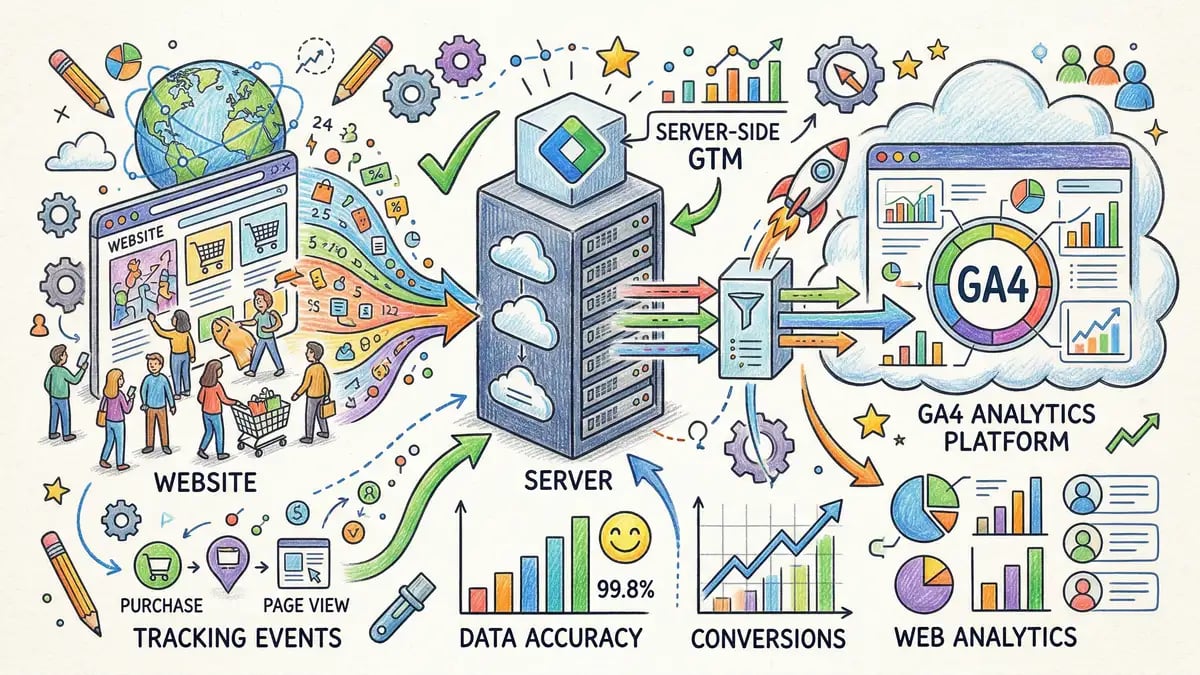
Server-side tracking has become the critical infrastructure layer separating best-in-class B2B measurement from legacy approaches. Currently adopted by 20-25% of SMBs with 70% adoption projected by 2027, server-side implementations achieve approximately 95% data accuracy versus the 60-80% ceiling for client-side tracking alone.
Real-world business impact demonstrates why this matters:
Square
46% increase in Google Ads conversion tracking after server-side implementation
Meta Conversions API
13% lower cost per result + 19% more attributed purchase events
For B2B companies spending £10,000+/month on paid media, improved data accuracy typically pays for implementation within the first quarter.
The Dark Traffic Crisis: 90% Attribution Gap
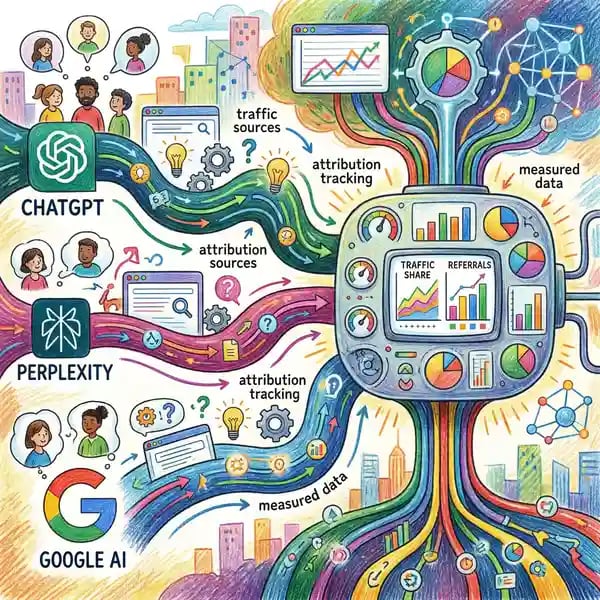
Approximately 18% of all web traffic—976 million users, projected to exceed 1.1 billion in 2026—is "dark traffic" invisible to analytics tools. An estimated 84% of online sharing happens through channels that analytics cannot see: Slack, Discord, WhatsApp, email, private messaging. For B2B specifically, buying committees of 11-14 stakeholders share vendor research in dark social channels.
Refine Labs research found a 90% gap between what software attributes and what self-reported attribution credits. Podcasts were credited with 53% of closed-won revenue (£11.4M) via self-reported attribution but 0% by software analytics. Yet 67% of B2B marketing teams still rely on last-touch attribution, blind to the 27+ touchpoints buyers engage with before purchase.
Recommended Hybrid Attribution Framework
Self-Reported Attribution
Add mandatory "How did you hear about us?" free-text field on high-intent forms. This reveals dark social exposure that software cannot detect.
W-Shaped Multi-Touch
Credit 30% to first touch, 30% to lead creation, 30% to opportunity creation, 10% across middle touches. Closes visibility gap for mid-funnel content influence.
Account-Level Engagement
Aggregate all touchpoints from the same company rather than tracking individual clicks. Reflects how B2B buying committees actually behave.
Ready to Close Your Attribution Gap?
Learn how to implement hybrid attribution frameworks that surface dark social, connect every touchpoint to revenue, and align marketing and sales on true buyer influence.
Explore Attribution SolutionsB2B Performance Benchmarks: 2025-2026 Data
| Metric | Benchmark Value | Context |
|---|---|---|
| Engagement rate | 55-75% (avg 63%) | Users with ≥1 event |
| Avg session duration | 2-2.8 minutes | Desktop higher; mobile lower |
| Conversion rate (all B2B) | 2.9% | Median; varies by industry |
| Legal services | 7.4% | Highest performing vertical |
| Professional services | 4-6% | Mid-range performance |
| SaaS | 1.1% | Long sales cycles |
| Mobile LCP (B2B sites) | 7.05 seconds | 2.8x above 2.5s threshold |
Sources: Ruler Analytics B2B Conversion Benchmarks 2026, Google CrUX January 2026 data
AI Visibility Tracking: Essential New Channel for B2B
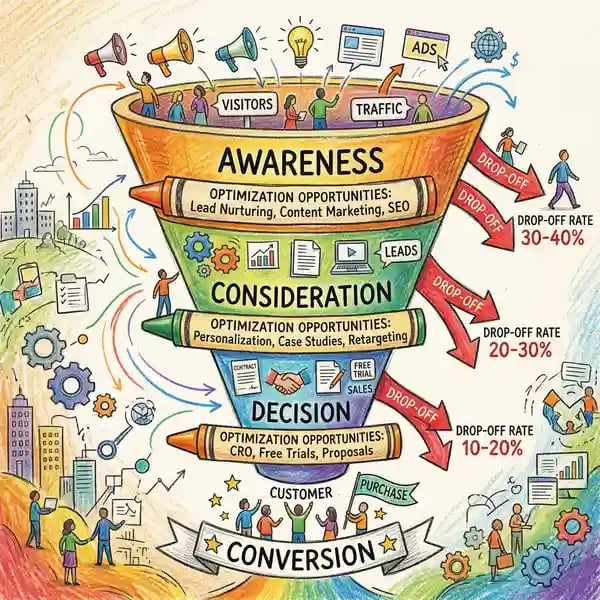
With 80% of B2B buyers now using AI search tools for vendor research, tracking brand visibility across AI platforms has become essential. Two platforms lead this space with complementary strengths:
Ahrefs Brand Radar
Tracks visibility across ChatGPT, Perplexity, Gemini, Copilot, and Google AI Overviews using 190+ million monthly prompts. Provides AI Share of Voice and competitive benchmarking.
From £199/month per index
Semrush AI Visibility
AI Visibility Score (0-100) aggregating mentions, citations, and share of voice. Found 15.69% of searches trigger AI Overviews with 61% CTR drop when present.
From £199/month
Five Priority Actions for B2B Analytics in 2026
Implement server-side tracking to achieve 95% data accuracy and improve Google Ads (46% lift) and Meta (19% more events) conversion reporting
Deploy AI visibility tracking via Ahrefs Brand Radar or Semrush AI Toolkit—measure the 80% of B2B buyers using ChatGPT, Perplexity, and Gemini
Adopt hybrid attribution framework combining self-reported data, W-shaped multi-touch, and account-level engagement to close the 90% measurement gap
Audit analytics cookies against UK DUAA exemption criteria—UK-only analytics may no longer require consent banners
Connect video platforms to CRM with attribution (91% video adoption vs 30% revenue attribution = your largest unmeasured opportunity)
Frequently Asked Questions
Do UK websites still need cookie consent banners in 2026?
Yes, but with important exceptions. Under the Data (Use and Access) Act 2025, analytics cookies used solely for aggregate statistics can operate without consent in the UK, provided you give clear information and an easy opt-out. Advertising and marketing cookies still require consent. If you target EU visitors, maintain consent mechanisms for them under the ePrivacy Directive.
What is the best attribution model for B2B companies?
Hybrid approach: W-shaped multi-touch (30% to first touch, lead creation, opportunity creation each; 10% to middle touches) combined with self-reported attribution via "How did you hear about us?" form field. This closes the 90% gap between software measurements and actual buyer influence.
How do I track AI search visibility for my B2B brand?
Start with Ahrefs Brand Radar (£199/month) or Semrush's AI Visibility Toolkit to monitor mentions across ChatGPT, Perplexity, Gemini, and Google AI Overviews. For GA4 tracking, create custom channel groups with regex matching for AI platform domains to measure referral traffic.
Should I use GA4 or HubSpot for B2B attribution?
Use both complementarily. GA4 excels at behavioural analysis, engagement patterns, and cross-channel cost data. HubSpot provides unlimited attribution lookback windows (critical for 6-12+ month B2B sales cycles where GA4's 90-day limit creates blind spots) and connects marketing activity directly to closed revenue.
What's the ROI of implementing server-side tracking?
Server-side tracking achieves 95% data accuracy versus 60-80% for client-side alone. Square reported 46% increase in Google Ads conversions after implementation. Meta's Conversions API delivers 13% lower cost per result and 19% more attributed events. For B2B companies spending £10,000+/month on paid media, improved accuracy typically pays for implementation within one quarter.
Need Help With Your Analytics Strategy?
Whitehat SEO audits your current analytics setup, implements server-side tracking and AI visibility monitoring, and builds HubSpot-integrated reporting that connects every touchpoint to revenue.
Clwyd Probert
Strategy Director, Whitehat SEO
Clwyd Probert is Strategy Director at Whitehat SEO, a HubSpot Platinum Partner since 2016. He specialises in B2B analytics infrastructure, marketing attribution, and inbound growth strategy. His work with 100+ HubSpot clients has shaped frameworks for closing attribution gaps in complex B2B buying journeys. Guest lecturer at UCL on digital marketing measurement.
Sources: Ruler Analytics B2B Conversion Benchmarks 2026, Google Analytics 4 Documentation, UK ICO Data (Use and Access) Act 2025 Guidance, Semrush AI Visibility Report, Refine Labs Attribution Study 2025, HubSpot Breeze AI Documentation, Square Case Study Server-Side Tracking Impact, Wistia Video Engagement Analysis 14M+ videos, Velocity Partners GA4 B2B Best Practice