
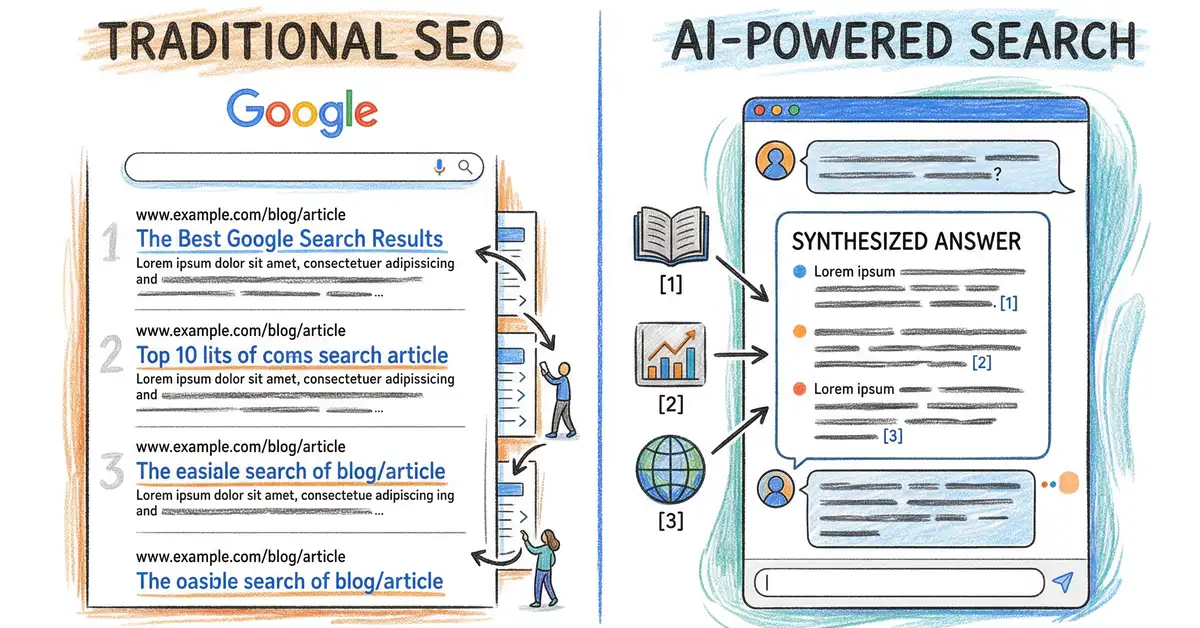
Generative Engine Optimisation (GEO) is the practice of structuring and distributing digital content to maximise its likelihood of being cited by AI systems — ChatGPT, Perplexity, Google AI Overviews, Claude, and Gemini — when they generate responses to user queries. Unlike traditional SEO, which optimises for rankings in blue-link results, GEO optimises for citation within AI-generated answers.
With AI-referred search sessions growing by 527% in the past twelve months and traditional search volume projected to decline 25% by 2026, GEO has moved from experimental curiosity to strategic imperative. This guide explains what GEO is, how it differs from SEO and AEO, which tactics are proven to increase AI visibility, and how UK businesses can build a practical GEO strategy from scratch.
527%
AI Search Growth
AI-referred sessions, Jan–May 2025
60%
Zero-Click Searches
Google searches with no click-through
47%
Brands Without GEO
No GEO strategy in place yet
32%
Leads from AI Search
Sales-qualified leads via AI for early adopters
Sources: Frase GEO Guide 2026, Geoptie GEO Definitive Guide 2026
Key Takeaway
GEO is not a replacement for SEO — it builds on traditional search foundations. Content that ranks poorly in organic search is unlikely to achieve AI citation either. Think of GEO as the next layer of optimisation that determines whether your already-strong content gets cited when AI systems generate answers.
What Is Generative Engine Optimisation?
The term "Generative Engine Optimisation" was formally introduced through academic research published in November 2023 by researchers from Princeton University, Georgia Tech, The Allen Institute for AI, and IIT Delhi. Their peer-reviewed study — titled "GEO: Generative Engine Optimization" — established the first comprehensive framework for understanding how content creators can improve visibility within AI-generated responses.
The researchers tested nine different optimisation methods across 10,000 queries and established quantifiable evidence that specific approaches significantly influence AI citation patterns. The three most impactful techniques were quotation addition (increasing visibility by up to 40%), source citation (improving visibility substantially), and statistical integration (providing concrete data anchors for AI systems to cite). Critically, the study found that traditional SEO tactics — such as keyword stuffing and density optimisation — perform poorly in generative contexts.
This distinction matters because it reveals something fundamental: GEO requires structural and qualitative shifts in how content is created, not incremental adjustments to existing SEO practices. Content optimised for AI citation must be extractable (self-contained paragraphs expressing complete ideas), attributable (citing credible sources within the text), and data-rich (incorporating specific statistics and quantifiable findings).
How AI Engines Choose What to Cite
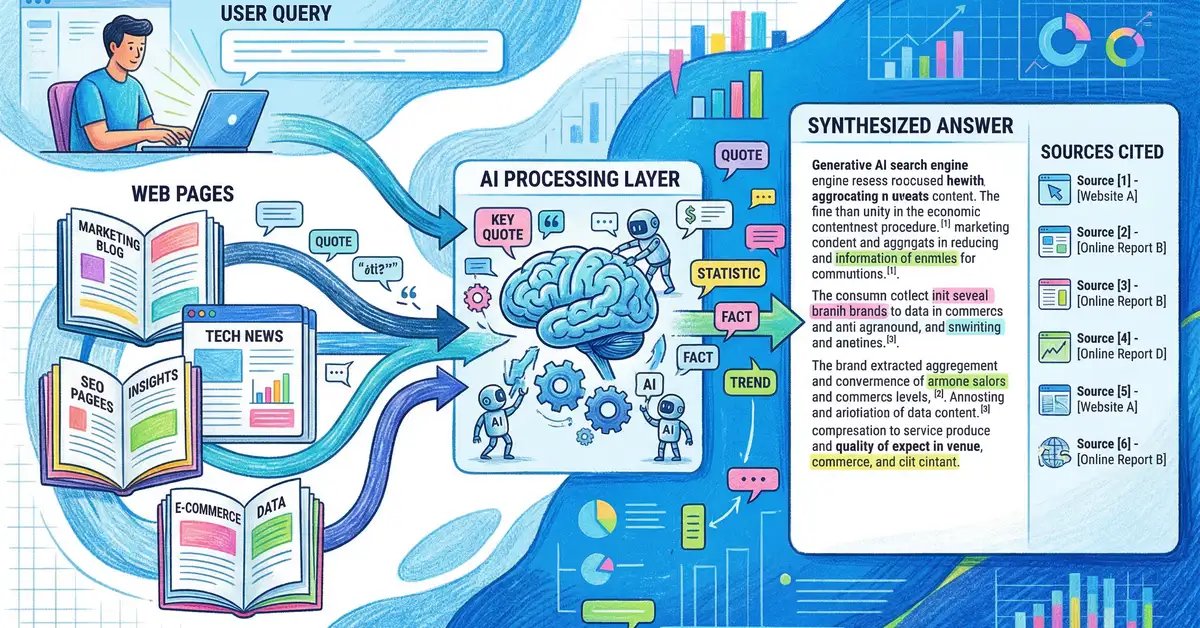
Generative AI systems do not function through simple ranking algorithms. Instead, they employ multi-stage retrieval and synthesis architectures that process content fundamentally differently depending on their underlying design. Understanding these mechanisms helps explain why some content gets cited repeatedly while equally well-written content remains invisible.
The two primary architectures are model-native synthesis (generating answers from patterns learned during training) and retrieval-augmented generation (RAG) (performing live web searches, retrieving relevant documents, then synthesising responses grounded in those results). Most modern AI engines use a combination, but the balance differs by platform.
Perplexity positions itself as a retrieval-first engine — every query triggers live search, synthesis, then citation. ChatGPT without browsing relies on training data, making it sensitive to what content existed when the model was trained; with search enabled, it retrieves and cites live sources. Google Gemini leverages Google's search index and Knowledge Graph directly, meaning content that ranks well in traditional Google search is preferentially considered for AI synthesis.
The extraction process follows a predictable sequence: the system converts your query into a semantic representation, searches for semantically similar documents, scores them on relevance, authority, recency, and structural quality, then generates a response synthesising the highest-scoring sources. This is why keyword-stuffed content loses to semantically clear content — RAG systems identify concepts, not keyword density.
GEO vs SEO vs AEO: What Is the Difference?
The proliferation of overlapping acronyms — GEO, AEO, LLMO, GSO — reflects the rapid evolution of AI-powered search. Understanding the distinctions helps you develop a coherent strategy rather than chasing every new buzzword.
The relationship between these disciplines is hierarchical and complementary, not competitive. GEO builds upon AEO tactics, and both build upon SEO foundations. Approximately 68% of digital marketers now integrate both GEO and AEO strategies to maintain visibility across all search platforms. Google's own position, stated by VP Robby Stein and John Mueller, is clear: "optimising for AI search is the same as optimising for traditional search — AI systems rely on search. There is no such thing as GEO or AEO without doing SEO fundamentals."
| Dimension | SEO | AEO | GEO |
|---|---|---|---|
| Goal | Rank in search results pages | Appear in featured snippets and knowledge panels | Be cited in AI-generated answers |
| Targets | Google, Bing (blue links) | Google featured snippets, knowledge panels | ChatGPT, Perplexity, Google AI Overviews, Claude, Gemini |
| Key Tactics | Keywords, links, technical optimisation, content depth | FAQ schema, concise answers, structured data | Quotations, statistics, source citation, entity clarity, answer-first structure |
| Measures | Rankings, organic traffic, CTR | Featured snippet acquisition | Brand mention frequency, citation rate, AI share of voice |
| Relationship | Foundation for all search visibility | Builds on SEO, targets answer formats | Builds on SEO + AEO, targets AI synthesis |
Sources: Search Engine Land GEO Guide, DigiDay GEO vs AEO Explainer
What This Means
You do not need to choose between SEO and GEO. The hierarchy is clear: strong SEO foundations remain essential (without them, your content will not be discovered by AI systems at all), but GEO-specific optimisation determines whether that content actually gets cited. Invest in both simultaneously.
The 7 Most Effective GEO Tactics
The Princeton/Georgia Tech research, combined with emerging industry case studies, has identified specific tactics that demonstrably improve AI visibility when executed consistently. These are ranked by research-evidenced impact.
Add Expert Quotations (+40% Visibility)
Include direct quotes from recognised experts, authoritative figures, or peer-reviewed sources. Quotations provide explicit attribution that AI systems can extract and verify, demonstrating that content engages with authoritative sources. This was the single most impactful tactic in the Princeton study.
Integrate Specific Statistics (+30–40% Visibility)
Replace vague claims with quantified data. "73% of content teams identified inconsistent workflows as their primary barrier" is substantially more citable than "many companies struggle with consistency." AI systems preferentially cite content with concrete, verifiable data anchors.
Cite Authoritative Sources Within Your Content (+30%)
Counter-intuitively, citing credible sources within your own content increases the likelihood your content gets cited by AI. Use natural language: "According to [Source], [finding]" rather than relying only on hyperlinks. AI systems assess how thoroughly researched content appears.
Use Answer-First Content Structure
Place key information in the first one to two sentences after each heading. AI systems give disproportionate weight to content appearing immediately after headings. Open with the answer, then elaborate — don't bury the key point in paragraph three.
Implement Entity Clarity and Schema Markup
Ensure your brand name is referenced consistently across all web properties. Implement JSON-LD schema markup (Organisation, Person, Article, FAQ) and use the sameAs property to link to Wikipedia, Wikidata, and LinkedIn. Entity clarity helps AI systems reliably identify and attribute your content.
Maintain Content Freshness
AI-cited content is 25.7% fresher than content ranking in organic Google results. ChatGPT shows the strongest preference for content updated within 10 months. Schedule quarterly reviews for time-sensitive content and add visible "last updated" dates — content maintenance now carries equivalent weight to initial quality.
Build Multi-Platform Brand Presence
AI systems cite sources where they encounter brand mentions across diverse platforms — industry publications, LinkedIn, YouTube, Reddit, podcasts, and press releases. A distributed content strategy that extends beyond your website builds the cumulative signal that your brand represents authority in its domain.
Want your content cited by ChatGPT, Perplexity, and Google AI Overviews? Explore our Answer Engine Optimisation services.
View AEO Services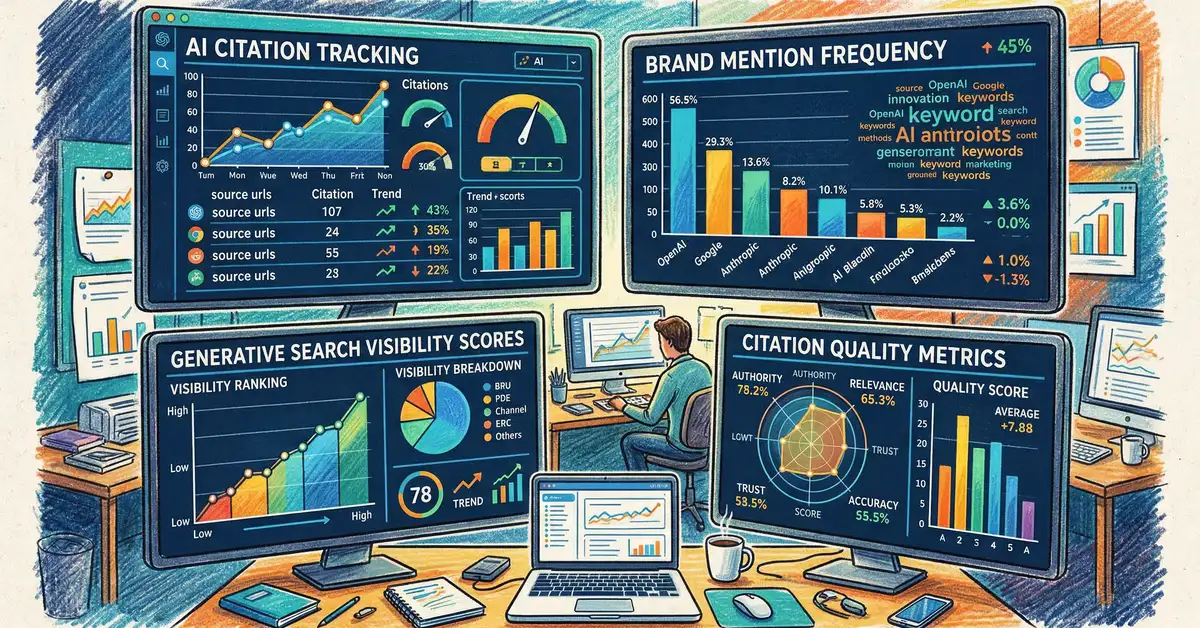
Measuring GEO Success: Metrics and Tools
GEO measurement differs fundamentally from traditional SEO metrics. Where SEO tracks rankings and traffic, GEO tracks whether your brand is being mentioned and cited when AI systems answer relevant queries — regardless of whether those mentions generate click-throughs.
The four primary GEO metrics are brand mention frequency (how often AI engines reference your brand), citation rate (what percentage of mentions include a clickable link), share of voice (your brand's percentage of AI-generated answers for target topics versus competitors), and citation velocity (how quickly new content achieves AI visibility after publication).
| Tool | UK Price/mo | What It Tracks | Best For |
|---|---|---|---|
| Ahrefs Brand Radar | Included | AI visibility across 327M monthly prompts, SOV, sentiment | Teams already using Ahrefs wanting integrated GEO data |
| Geoptie | From £41 | Multi-platform visibility, content audit, GEO scoring | Mid-market teams wanting an all-in-one GEO platform |
| Peec AI | From £75 | Visibility and sentiment across 6 AI engines, GDPR-compliant | UK/EU teams requiring European data residency |
| Google Search Console | Free | AI Overviews impressions (limited — only when expanded) | Baseline AI Overviews tracking at zero cost |
Sources: Ahrefs Brand Radar, Geoptie Best GEO Tools 2026, Platform pricing pages March 2026
For attribution, ChatGPT includes utm_source=chatgpt.com parameters on cited URLs, enabling precise tracking in GA4. Setting up a GEO-specific tracking protocol — with consistent UTM parameters and GEO-specific conversion events — enables rigorous measurement of how AI search contributes to business outcomes.
Building Your GEO Strategy: A Practical Roadmap
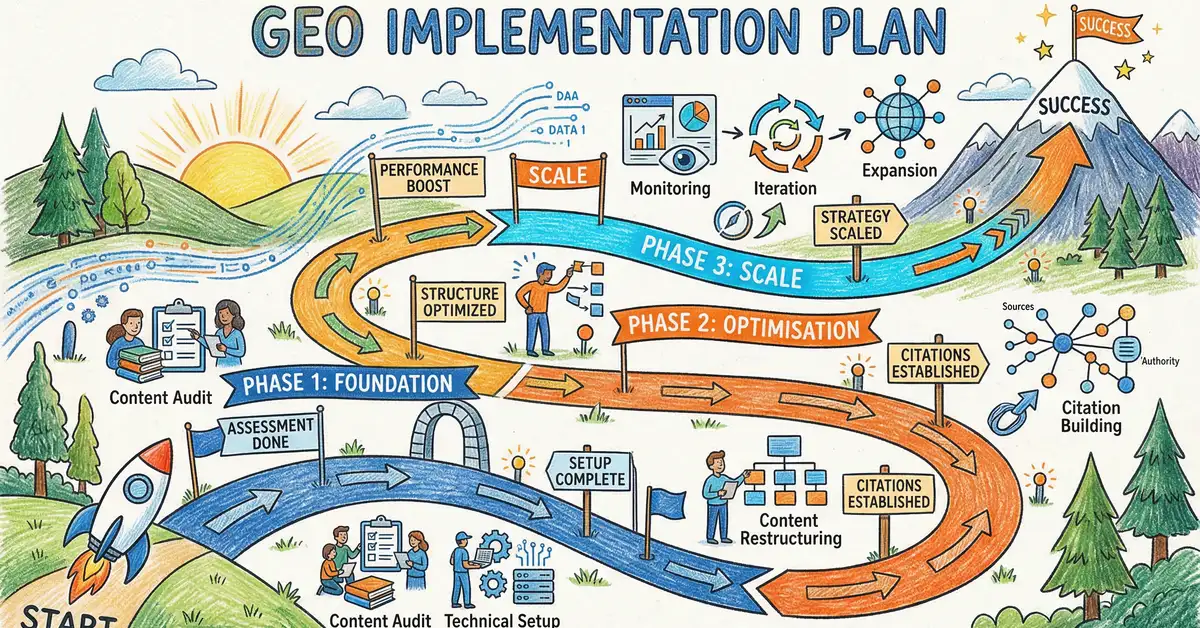
Converting GEO principles into operational reality requires a phased approach. Research suggests that organisations implementing structured GEO strategies see measurable improvements within 2–3 months, with mature citation patterns establishing by month 4–6.
Phase 1 (Months 1–2): Foundation. Conduct a content audit identifying which existing pages could benefit from GEO optimisation. Benchmark current AI visibility using a GEO measurement tool. Implement schema markup across key pages (Organisation, Article, FAQ). Configure GA4 tracking for AI referral traffic.
Phase 2 (Months 2–3): Acceleration. Prioritise high-value content addressing key buying-journey questions. Refresh content with proven GEO tactics: quotation addition, statistical integration, source citation, answer-first structures, and question-based headings. Create new content following GEO-optimised templates from the start. Expected: 10–20% improvement in share of model.
Phase 3 (Months 4–6): Maturity. Content library optimisation reaches completion. Consistent citation patterns stabilise. External media strategy drives brand mentions in industry publications and professional communities. Expected: 30–40% improvement in share of model, trackable referral traffic from AI platforms, and measurable leads originating from AI referrals.
The Competitive Window Is Closing
47% of brands currently lack any GEO strategy. This creates a significant competitive advantage for early adopters — organisations implementing GEO now are establishing authority and citation patterns while competitors remain invisible to AI systems.
This window is time-limited. As GEO becomes recognised as business-critical, the cost and effort required to compete will increase substantially. Organisations investing now are building citation momentum that becomes increasingly difficult for late entrants to displace.
Frequently Asked Questions
What is generative engine optimisation in simple terms?
Generative engine optimisation (GEO) is the practice of structuring your content so that AI systems — ChatGPT, Perplexity, Google AI Overviews, Claude, and Gemini — are more likely to cite it when generating answers to user queries. Instead of optimising for rankings in search results (traditional SEO), GEO optimises for being referenced as a trusted source within AI-generated responses.
Is GEO replacing SEO?
No. GEO builds on traditional SEO foundations — content that ranks poorly in organic search is unlikely to achieve AI citation either. Think of GEO as the next layer of optimisation. SEO ensures your content is discoverable; GEO ensures it gets cited when AI systems synthesise answers. Both work together, and approximately 68% of digital marketers now implement both strategies simultaneously.
How quickly can GEO produce results?
Organisations implementing structured GEO strategies typically see measurable improvements in AI visibility within 2–3 months, with mature citation patterns establishing by months 4–6. High-authority sites with clean technical infrastructure can achieve AI citation within hours or days of publishing new content; less authoritative sites may require weeks or months to build citation momentum.
What is the difference between GEO and AEO?
AEO (Answer Engine Optimisation) originally targeted featured snippets and knowledge panels within Google's traditional search results. GEO is broader — it targets citation across all AI-powered search platforms including ChatGPT, Perplexity, Google AI Overviews, Claude, and Gemini. GEO encompasses AEO tactics (FAQ schema, direct answer formatting) while adding AI-specific requirements like entity clarity, statistical anchoring, and multi-platform brand presence.
How do you measure GEO success?
The primary GEO metrics are brand mention frequency (how often AI engines reference your brand), citation rate (percentage of mentions with clickable links), share of voice (your percentage of AI answers vs competitors), and citation velocity (how quickly new content gets cited). Tools like Ahrefs Brand Radar, Geoptie, and Peec AI provide these measurements. Google Search Console offers limited AI Overviews tracking at no cost.
Which GEO tactics have the biggest impact?
According to peer-reviewed research from Princeton University and Georgia Tech, the three most impactful tactics are quotation addition (up to +40% visibility), statistical integration (+30–40%), and source citation within your content (+30%). These were tested across 10,000 queries. Traditional SEO tactics like keyword stuffing perform poorly in generative contexts — AI systems prioritise semantic clarity over keyword density.
Ready to Make Your Content Visible to AI Search?
We help UK businesses implement GEO strategies that get their content cited by ChatGPT, Perplexity, Google AI Overviews, and other AI platforms — driving brand visibility and qualified leads from the fastest-growing search channel.
Sources: Princeton/Georgia Tech GEO Research 2023, Frase GEO Guide 2026, Search Engine Land GEO Guide, Ahrefs Content Freshness Study, Geoptie GEO Guide 2026
Clwyd Probert
Managing Director, Whitehat SEO
Clwyd Probert is a digital marketing strategist with over 15 years of experience helping UK businesses grow through organic search, content strategy, and marketing technology. He specialises in HubSpot CMS implementation, AI search optimisation, and data-driven SEO strategies for B2B organisations.