
SEO & Digital Marketing SEO package prices
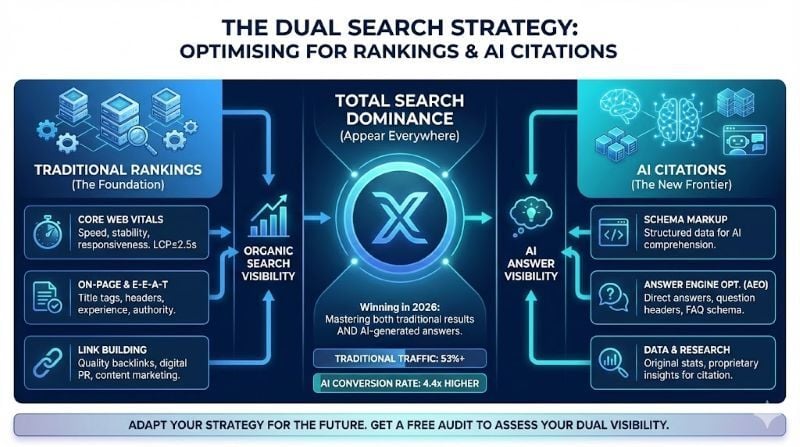
Whitehat SEO's approach helps UK businesses optimise for both traditional rankings AND AI citations simultaneously—because the winners in this new landscape will be those who appear everywhere their customers are searching.
SEO Best Practices for 2026: The Complete Guide to Search Visibility
Search engine optimisation in 2026 requires a dual strategy: mastering traditional ranking fundamentals whilst adapting to AI-powered search engines that now answer up to 60% of queries without delivering clicks. Google's AI Overviews appear on approximately 18% of global searches, ChatGPT processes over 2.5 billion queries daily, and Perplexity handles 780 million monthly searches. Yet organic search still drives 53% of all website traffic and delivers ROI as high as 748%.
Technical SEO foundations remain non-negotiable
Core Web Vitals continue as confirmed ranking signals, with Google evaluating sites at the 75th percentile of page loads. According to Whitehat SEO's analysis of UK business websites, only 47% currently meet all Core Web Vitals thresholds—leaving significant competitive opportunity for those who invest in technical excellence.
The current thresholds that separate high-performing sites from struggling ones:
| Metric | Good | Needs Work | Poor |
|---|---|---|---|
| LCP (Largest Contentful Paint) | ≤2.5s | 2.5-4s | >4s |
| INP (Interaction to Next Paint) | ≤200ms | 200-500ms | >500ms |
| CLS (Cumulative Layout Shift) | ≤0.1 | 0.1-0.25 | >0.25 |
INP officially replaced First Input Delay in March 2024. Case studies demonstrate the stakes: Pinterest saw a 15% SEO traffic increase after reducing perceived wait times by 40%, whilst Vodafone achieved an 8% sales increase following a 31% LCP improvement.
Mobile-first indexing reached 100% completion on 5 July 2024—every website now gets indexed via Googlebot Smartphone. With 63% of global web traffic originating from mobile devices, responsive design isn't optional. Google recommends minimum 48px × 48px tap targets, proper viewport configuration, and equivalent content across mobile and desktop versions.
Technical SEO checklist:
- Robots.txt configuration allowing AI crawlers (GPTBot, Google-Extended, Claude-Web)
- XML sitemap submitted through Search Console
- Proper canonical tag implementation
- HTTPS across all pages
- URL structure under 60 characters, using hyphens between words
Need help identifying technical issues holding your site back? Whitehat SEO's comprehensive website audit uncovers quick wins and prioritises improvements by impact.
On-page SEO has evolved but fundamentals persist
Title tags now get rewritten by Google approximately 76% of the time, yet they remain crucial ranking signals. Optimal display length sits at 50-60 characters (580-600 pixels), with primary keywords positioned early. Google reads the full tag for ranking purposes even when truncating the display.
Meta descriptions should target 155-160 characters for desktop and 120 characters for mobile. Whilst not direct ranking factors, they influence click-through rates and Google may bold matching terms from search queries.
Header hierarchy requires one H1 per page with logical H2→H3→H4 progression. Including relevant keywords naturally in headers helps Google understand page structure and content relationships.
Content optimisation in 2025 focuses on:
- Using primary keywords within the first 100-150 words
- Writing for users first, search engines second
- Matching search intent precisely (informational, navigational, transactional, commercial)
- Creating comprehensive coverage with unique value beyond existing content
- Optimising images with descriptive filenames and alt text under 120 characters
Internal linking distributes authority through descriptive anchor text (never "click here"), varied phrasing, and strategic connections to important pages. All critical content should be reachable within 3-4 clicks from the homepage. Whitehat SEO's SEO services include comprehensive on-page optimisation as part of our growth programmes.
E-E-A-T determines content quality judgements
Google's framework—Experience, Expertise, Authoritativeness, Trustworthiness—added the first "E" for Experience in December 2022. Trust remains most important, with the other signals contributing to trustworthiness assessments.
E-E-A-T isn't a direct ranking factor, but Google's systems give added weight to content demonstrating these qualities. Google's documentation emphasises evaluating who created content, how it was produced (including AI usage disclosure), and why it was created.
Experience
First-hand, real-world knowledge—personal insights, case studies, original research, and visual evidence of actual experience with topics.
Expertise
Real authors with credentials, comprehensive bio pages linking to LinkedIn profiles, and citing reputable sources. Essential for YMYL topics.
Authoritativeness
Earning quality backlinks, getting mentioned in industry publications, securing expert reviews, and developing topical authority through content clusters.
Trustworthiness
HTTPS (non-negotiable), clear contact information, privacy policies, accurate and current information, and transparent business practices.
YMYL (Your Money or Your Life) categories expanded in September 2025 to include election and voting information alongside traditional health, financial, and safety topics. Google applies stricter E-E-A-T standards to this content given potential real-world harm from inaccuracies.
Link building demands quality over quantity
The principle that one high-quality backlink outperforms dozens of low-quality links has never been more relevant. According to industry research, 91% of content fails to rank without quality backlinks, whilst 65% of marketers consider link building SEO's most difficult aspect.
Effective link-building strategies for 2025:
- Digital PR: Creating newsworthy original research and data studies
- Content marketing: Comprehensive guides, original research, shareable infographics
- Guest posting: Contributing to authoritative industry publications
- HARO/expert quotes: Responding to journalist queries
- Broken link building: Finding broken links and offering replacement content
⚠️ Red flags to avoid:
Link farms, Private Blog Networks, irrelevant placements, over-optimised exact-match anchor text, spammy directories, and rapid acquisition patterns signalling manipulation. These tactics risk Google penalties that can devastate organic visibility.
Quality indicators include relevance (from sites in your niche), authority (high domain authority, trusted sites), editorial placement (naturally chosen by content creators), and contextual positioning (within relevant content, not sidebars). Learn more about ethical approaches in our guide to white hat SEO.
Local SEO requires Google Business Profile excellence
For businesses serving geographic areas, Google Business Profile optimisation remains the cornerstone. Businesses with complete profiles are 70% more likely to attract visits, and 76% of local mobile searches result in store visits within 24 hours.
Essential GBP optimisation includes:
- 100% complete profile information with accurate NAP (Name, Address, Phone)
- Correct primary and secondary categories (Google offers ~4,000 options)
- Compelling business description with keywords in the first 250-300 characters
- High-quality photos and videos (businesses with photos get 42% more direction requests)
- Weekly posts signalling activity
- All services listed with descriptions
Google evaluates local results on three factors: relevance (how well you match the query), distance (proximity to searcher), and prominence (how well-known your business is online).
🇬🇧 UK-specific considerations:
- Create dedicated location pages for each county/city served
- Use UK directories (Yell, Thomson Local, Yelp UK)
- Target local long-tail keywords ("accountant in Manchester", "SEO agency London")
- Partner with local businesses for backlinks
NAP consistency across all platforms proves critical—80% of consumers don't trust businesses with inconsistent contact details. Local SEO improvements typically require 3-6 months to show significant results. Explore our detailed guide on mastering Google Business Profile.
Schema markup powers rich results and AI comprehension
Over 45 million web domains now use Schema.org markup, with properly implemented structured data delivering 20-30% higher click-through rates. Schema has become essential for AI-powered search understanding—Microsoft's Fabrice Canel stated in March 2025 that "Schema Markup helps Microsoft's LLMs understand content."
Priority schema types for 2026:
| Schema Type | Best For |
|---|---|
| Organisation | Brand recognition and business information |
| LocalBusiness | Physical locations (essential for local SEO) |
| Product | E-commerce (prices, availability, reviews) |
| Article | Blog posts and news content |
| FAQ | Question and answer content |
| Person | Author credentials (critical for E-E-A-T) |
| HowTo | Step-by-step instructions |
JSON-LD remains Google's recommended format. Validation through Google's Rich Results Test confirms proper implementation. Whitehat SEO implements comprehensive schema markup as part of our technical SEO services.
AI search optimisation demands new strategies
The shift from "10 blue links" to AI-generated answers represents the most significant change to search since mobile. Google AI Overviews now appear on approximately 18% of global searches (up to 30% for certain query types), whilst ChatGPT, Perplexity, and Claude collectively handle billions of queries monthly.
The zero-click reality
Zero-click searches rose from 56% to nearly 69% between May 2024 and May 2025, with AI Overviews occupying up to 75.7% of mobile screen real estate.
When AI Overviews appear, organic CTR drops 15-35%. However, visitors arriving from AI search convert at 4.4x higher rates than traditional organic visitors—making citation in AI responses highly valuable despite reduced traffic volumes.
How to optimise for AI citation (Answer Engine Optimisation):
- Answer-first content: Place direct answers (40-60 words) at the start of each section
- Question-style headers: Structure H2s around natural language queries
- Self-contained sections: Each section must make sense without surrounding context
- Original data and statistics: Include proprietary research AI can cite
- Brand embedding: Ensure your brand name appears in extractable passages
- Comprehensive FAQs: Capture related sub-questions searchers might ask
Building presence on platforms AI systems prioritise is equally important. Reddit, YouTube, and industry forums now influence AI recommendations significantly. According to Semrush research, Reddit appears in over 68% of Google's AI Mode results.
Whitehat SEO has developed comprehensive Answer Engine Optimisation (AEO) services specifically for businesses wanting to appear in ChatGPT, Perplexity, and Google AI Overviews. Learn more in our detailed guide on how to show up in ChatGPT search.
Statistics demonstrate SEO's continued importance
Despite AI disruption, organic search remains the largest traffic driver for most businesses:
53%
Website traffic from organic search
68%
Online activities starting with search
8.5×
Higher close rate vs outbound leads
39.8%
CTR for position #1 results
AI search adoption accelerates rapidly:
- ChatGPT: 400-800 million weekly active users, growing monthly
- AI referral traffic: 527% year-over-year growth
- Perplexity: 780 million monthly queries, up from 230M mid-2024
- AI search traffic converts at 14.2% versus Google's 2.8%
Voice search continues growing: 8.4 billion voice assistants in use worldwide, with 41% of UK adults using voice search daily. 76% of voice searches are local queries—reinforcing the importance of local SEO excellence.
Measuring SEO success requires evolved metrics
Traditional metrics remain important: total organic clicks (Backlinko calls this "the SEO north star"), organic traffic and sessions, keyword rankings and average position, impressions and click-through rate, and organic conversions and revenue.
New metrics for AI search:
- AI Overview mentions and citations
- Share of voice in AI responses
- LLM referral traffic
- Brand sentiment in AI answers
- Prompt visibility (which queries trigger your content)
SEO ROI calculation:
Average SEO conversion rate is 2.4%, but varies significantly: Legal services (7.5%), HVAC (3.3%), SaaS (2.1%). Wait at least 6 months before calculating ROI, as SEO benefits compound over time. Industry ROI benchmarks: Real Estate (1,389%), Financial Services (1,031%), B2B SaaS (702%).
Whitehat SEO's reporting includes both traditional ranking metrics and emerging AI visibility tracking—because understanding where your brand appears across all search channels is essential for strategic decision-making. Our HubSpot integration services can unify this data with your CRM for attribution clarity.
Actionable recommendations by priority
🚀 Immediate actions (Week 1-2)
- Audit Core Web Vitals through PageSpeed Insights and Search Console
- Test top content in ChatGPT, Perplexity, and Google AI Overviews
- Verify Google Business Profile completeness and NAP consistency
- Check index coverage in Search Console for crawl errors
📈 Short-term optimisations (Month 1-3)
- Restructure key pages with question-style H2/H3 headers
- Add direct answers (40-60 words) to top-performing content openings
- Implement FAQ, Article, and Organisation schema markup
- Ensure author bios display credentials linking to LinkedIn profiles
- Update content older than 12 months with current statistics
🎯 Medium-term strategy (Month 3-6)
- Build presence on Reddit and industry-specific platforms AI systems prioritise
- Develop original research or proprietary data assets for link earning
- Create comprehensive topic clusters demonstrating topical authority
- Implement AI search tracking tools to monitor citation frequency
🏆 Long-term investment (Month 6-12)
- Establish Wikipedia/Wikidata entity presence (if notable)
- Build systematic digital PR for authoritative backlinks
- Develop E-E-A-T signals across all digital properties
- Create measurement dashboards tracking both traditional rankings and AI citations
Frequently asked questions
How long does it take for SEO to show results?
Most businesses see meaningful SEO improvements within 3-6 months, with significant results typically appearing at 6-12 months. Quick wins like fixing technical issues and updating title tags can show improvements within weeks, whilst building authority and ranking for competitive terms requires sustained effort. Whitehat SEO's experience with UK businesses shows the fastest results come from combining technical fixes with content optimisation and consistent publication.
Is SEO still worth the investment with AI search growing?
Absolutely. Organic search still drives 53% of all website traffic and delivers ROI up to 748%. The key is adapting strategy to optimise for both traditional rankings AND AI citations. Visitors from AI search convert at 4.4× higher rates than traditional organic—making visibility in AI responses highly valuable. The businesses winning today are those investing in dual optimisation.
What is Answer Engine Optimisation (AEO)?
Answer Engine Optimisation (AEO) is the practice of optimising content to appear in AI-generated responses from platforms like ChatGPT, Google AI Overviews, Perplexity, and Claude. Unlike traditional SEO which focuses on ranking in search results, AEO focuses on structuring content so AI systems can easily extract and cite it when answering user queries. This includes answer-first formatting, self-contained sections, and embedded brand mentions.
How much should a UK business budget for SEO?
UK SEO budgets vary significantly based on competition, goals, and current website state. Small businesses typically invest £500-£2,000 monthly for local SEO, whilst mid-sized businesses competing nationally budget £2,000-£5,000 monthly. Enterprise-level campaigns for competitive industries often exceed £5,000-£15,000 monthly. The most important factor is ensuring investment matches business goals—a local tradesperson needs different SEO investment than a national B2B software company.
What's the difference between white hat and black hat SEO?
White hat SEO follows search engine guidelines and focuses on creating genuine value for users—quality content, ethical link building, and technical excellence. Black hat SEO attempts to manipulate rankings through tactics like link schemes, keyword stuffing, and cloaking. Whilst black hat tactics might show short-term gains, they risk severe penalties including complete removal from search results. Whitehat SEO (our company name reflects our philosophy) exclusively uses ethical, sustainable strategies that build long-term value.
Ready to improve your search visibility?
The SEO landscape of 2025/2026 rewards those who master dual optimisation: maintaining technical excellence and content quality for traditional rankings whilst structuring content for AI citation. Sites that appear in both traditional results AND AI-generated answers will capture disproportionate value as zero-click searches continue rising.
Whitehat SEO helps UK businesses navigate this evolving landscape. As a HubSpot Diamond Partner running the world's largest HubSpot User Group, we combine deep technical expertise with strategic marketing insight.
Get a Free Website Audit →References & further reading
- Google Search Central. "Core Web Vitals & Page Experience." developers.google.com/search/docs/appearance/core-web-vitals
- Semrush. "AI Overviews Statistics and Research 2025." semrush.com/blog/ai-overviews
- Search Engine Land. "Google AI Overviews: Complete Guide for SEOs." searchengineland.com/google-ai-overviews-seo-guide
- Ahrefs. "SEO Statistics for 2025." ahrefs.com/blog/seo-statistics
- Google Search Central. "Understanding E-E-A-T in Search Quality Rater Guidelines." developers.google.com/search/blog/2022/12/google-raters-guidelines-e-e-a-t
- BrightLocal. "Local Consumer Review Survey 2025." brightlocal.com/research/local-consumer-review-survey
- Schema.org. "Getting Started with Schema Markup." schema.org/docs/gs.html
- Exposure Ninja. "AI Search Statistics for 2025." exposureninja.com/blog/ai-search-statistics