
What Is HubSpot's Future in the AI Era? 2025-2026 Strategic Outlook
Published: January 2, 2026 | Updated: January 2, 2026 explore our digital marketing FAQs
Reading time: 11 minutes | Author: Whitehat SEO Marketing Team
HubSpot's future is positioned around AI-first transformation through its Breeze AI platform, continued market leadership in marketing automation (38% global share), and strong financial growth ($2.63B revenue, 21% year-on-year in 2024). For B2B companies, this means a CRM platform investing heavily in AI capabilities whilst maintaining its user-friendly approach for mid-market businesses.
If you're a B2B marketing director evaluating HubSpot—whether considering initial investment or renewal—you need confidence in the platform's long-term viability. This analysis examines HubSpot's 2024-2025 financial performance, AI strategy through Breeze, competitive positioning against Salesforce, and expert predictions for the next 18-24 months. As a HubSpot Diamond Partner running the world's largest HubSpot User Group, we provide independent analysis grounded in hands-on experience implementing HubSpot for UK B2B companies.
HubSpot's Financial Position Signals Long-Term Stability
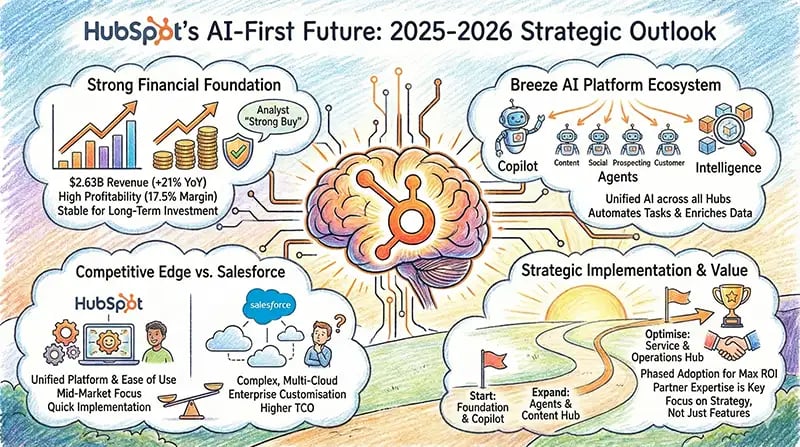
HubSpot's 2024 full-year results demonstrate robust financial health that should reassure B2B companies making multi-year platform commitments. The company reported total revenue of $2.63 billion, representing 21% year-over-year growth, with fourth quarter revenue reaching $703.2 million—beating analyst expectations of $673.65 million.
Customer acquisition continues at a healthy pace, with HubSpot serving 247,939 total customers as of December 31, 2024—a 21% increase from the prior year. This growth occurred across all customer segments, from small businesses adopting Marketing Hub Starter through to enterprise clients implementing the complete platform suite.
Key Financial Metrics FY2024
| Total Revenue | $2.63 billion (↑21% YoY) |
| Q4 Revenue | $703.2 million (↑21% YoY) |
| Total Customers | 247,939 (↑21% YoY) |
| Operating Margin (Non-GAAP) | 17.5% (↑200 basis points) |
| Free Cash Flow | $488 million (19% of revenue) |
| 2025 Revenue Guidance | $2.985-$2.995 billion (↑14%) |
Profitability improvements are particularly noteworthy. HubSpot achieved a non-GAAP operating margin of 17.5%, up 200 basis points from 2023, whilst generating $488 million in free cash flow. This combination of growth and profitability suggests HubSpot has moved beyond the "growth at all costs" SaaS model into sustainable expansion.
International expansion continues to drive results, with 47% of Q4 revenue originating outside North America. For UK companies, this geographical diversification reduces platform risk whilst ensuring HubSpot maintains strong EMEA market focus. Analyst consensus reflects confidence in these fundamentals: 29 analysts maintain a "Strong Buy" rating with an average 12-month price target of $630.38, representing 71% potential upside.
For B2B marketing directors evaluating professional HubSpot onboarding, these financial metrics matter. Platform stability enables multi-year strategic planning without concern about vendor viability, product discontinuation, or disruptive pivots that plague smaller competitors.
Breeze AI Transforms How Teams Use HubSpot
HubSpot's most significant strategic move in 2024 was the September launch of Breeze—a comprehensive AI platform integrated across Marketing, Sales, Service, Content, and Operations Hubs. Breeze represents more than feature additions; it's HubSpot's bet on AI-augmented work becoming the default operating model for B2B teams.
The Breeze ecosystem comprises three interconnected components. Breeze Copilot functions as an AI assistant with full CRM access, helping users draft emails, generate reports, and answer questions about customer data. By Q4 2024, Copilot had attracted 75,000+ weekly active users—a strong adoption signal considering this launched just months earlier.
Breeze AI Agents: The Four Specialists
- Content Agent: Generates blog posts, landing pages, and social content based on brand voice and historical performance data
- Social Media Agent: Monitors brand mentions, suggests responses, and schedules posts across platforms
- Prospecting Agent: Researches leads, enriches contact records, and identifies buying signals
- Customer Agent: Handles support tickets, resolves common issues, and escalates complex queries—already resolving 50%+ of tickets in early deployments
Breeze Intelligence, powered by HubSpot's $150 million acquisition of Clearbit in late 2023, provides the data foundation. It enriches contact records with firmographic information drawn from 200+ million buyer and company profiles, enabling more accurate lead scoring and personalisation. This intelligence layer differentiates HubSpot from competitors requiring separate data enrichment subscriptions.
Early adoption metrics suggest strong product-market fit. Content Hub—which heavily features Breeze AI capabilities—saw attachment rates surge from 13% to 54% during 2024. Service Hub Enterprise portal adoption increased 100% quarter-over-quarter in Q4, driven partly by Customer Agent capabilities that reduce support team workload whilst maintaining response quality.
HubSpot's internal deployment provides proof of concept. The company's own support organisation now resolves 35% of tickets through AI agents, targeting 50%+ resolution rates in 2025. This "eat your own dog food" approach validates that AI agents can handle real-world support complexity, not just demo scenarios.
For UK B2B companies, HubSpot coaching and training becomes particularly valuable for maximising Breeze AI adoption. The platform's potential is substantial, but realising value requires strategic configuration, prompt engineering, and workflow redesign—areas where Diamond Partner expertise accelerates time-to-value.
HubSpot CEO Yamini Rangan articulated the AI strategy during the February 2025 earnings call: "We will win for three key reasons. First, we unify structured and unstructured data. Second, we provide complete context across the entire customer journey. And three, we have the industry's most active AI agent ecosystem." This framing positions HubSpot not as an AI features company, but as an AI platform company—a meaningful distinction as enterprises evaluate vendor consolidation.
How HubSpot Compares to Salesforce and Competitors
Platform selection decisions often come down to HubSpot versus Salesforce, particularly for B2B companies in the 50-500 employee range. Market data and user reviews reveal distinct positioning: HubSpot leads in marketing automation (38% global market share) whilst Salesforce dominates CRM sales (21.8% share), but the story behind these numbers matters more than the percentages.
G2's 2024 rankings position HubSpot as the #1 Sales Product and #1 Marketing Product across their grids, based on 2,167 Gartner Peer Insights reviews averaging 4.4 stars. Salesforce Marketing Cloud scores 4.3 stars across 687 reviews—statistically similar, but HubSpot consistently outperforms on ease of use (8.7 vs. 8.0) and speed of deployment.
HubSpot vs. Salesforce: Key Differentiators
| Dimension | HubSpot | Salesforce |
|---|---|---|
| Sweet Spot | 20-500 employees, mid-market B2B | 500+ employees, enterprise |
| Ease of Use (G2) | 8.7 / 10 | 8.0 / 10 |
| Starting Price | £15/seat/month | £25/user/month |
| Implementation Time | 4-8 weeks typical | 3-6 months typical |
| Platform Philosophy | Unified, all-in-one | Best-of-breed integration |
| Customisation Depth | Good (improving with Custom Objects) | Excellent (apex code, full dev environment) |
HubSpot's architectural advantage lies in its unified platform approach. Marketing, Sales, and Service Hubs share a single database and interface, eliminating data synchronisation issues that plague Salesforce's multi-cloud architecture (Marketing Cloud, Sales Cloud, Service Cloud operating as separate systems requiring integration).
Salesforce retains advantages in specific scenarios: organisations requiring deep customisation through Apex code, companies with complex multi-entity structures, and enterprises with dedicated Salesforce development teams. The platform's maturity shows in its 5,246-strong AppExchange (versus HubSpot's 1,900+ integrations), though both ecosystems cover essential business software.
For B2B companies operating both platforms—a common enterprise configuration—HubSpot-Salesforce integration services address the "use HubSpot for marketing, Salesforce for sales" scenario. This hybrid approach leverages HubSpot's superior marketing automation whilst maintaining Salesforce investments, though it requires careful field mapping and governance.
Gartner's 2024 Magic Quadrant for B2B Marketing Automation Platforms positions HubSpot as a Leader for the fifth consecutive year, citing strengths in "ease of deployment, breadth of features, and partner ecosystem quality." This sustained recognition matters because many technology categories see leader churn every 2-3 years; HubSpot's consistency suggests durable competitive advantages rather than temporary market momentum.
The marketing automation market itself continues expanding at 19.5% compound annual growth rate, projected to reach $13.51 billion by 2033 according to Straits Research. HubSpot's 38% share positions it to capture disproportionate value as mid-market B2B companies digitise customer acquisition and retention.
What Experts Predict for HubSpot Through 2026
HubSpot's leadership team has articulated a clear strategic vision centred on AI-augmented teams, unified customer data, and agent ecosystems. Understanding their perspective provides insight into roadmap priorities and product investment areas that will shape user experience through 2026.
CTO Dharmesh Shah, speaking at INBOUND 2024, framed HubSpot's AI philosophy: "In the future, teams will be hybrid—consisting of humans like you and AI agents. The next-generation customer platform needs three things: a Smart CRM, AI-powered engagement apps, and an agent ecosystem." This articulation positions HubSpot not as a software company but as an AI platform provider—a subtle but meaningful reframing.
Shah's perspective on AI limitations provides balance: "AI may be faster than us, AI may be smarter than us, but it can't be more human than us. It can't be, because it has not had human experiences." This human-AI complementarity philosophy differentiates HubSpot from pure automation plays, suggesting the platform will emphasise AI augmentation over AI replacement.
Key Leadership Predictions
"SMBs do not have the appetite to go off and try and build and assemble all these pieces together."
— Dharmesh Shah, CTO
"It felt like we came out of the recession in Q3 of 2024. The universe slammed SaaS down at the beginning of 2020, then splashed it way up, then slammed it down again. Now it's flashing back up."
— Brian Halligan, Chairman
"We will win for three key reasons. First, we unify structured and unstructured data. Second, we provide complete context across the entire customer journey. And three, we have the industry's most active AI agent ecosystem."
— Yamini Rangan, CEO
Chairman Brian Halligan's market assessment suggests macro tailwinds returning: "It felt like we came out of the recession in Q3 of 2024." For B2B software, this timing matters—enterprise buying committees that froze discretionary spending in 2022-2023 began releasing budgets in late 2024, creating favourable conditions for HubSpot's growth targets.
Analyst projections support management optimism. Truist and Stifel forecast HubSpot achieving 20-22% operating margins by 2027, with long-term potential for 25% margins. RBC Capital maintains an "Outperform" rating with an $800 price target, citing HubSpot's "hybrid monetisation model as a key differentiator" that allows pricing flexibility as AI features mature.
The broader AI adoption context reinforces HubSpot's strategic timing. McKinsey's 2024 State of AI report found GenAI usage among business leaders increased from 37% (2023) to 73% (2024) on a weekly basis. Sagefrog's September 2024 research showed 52% of B2B marketers using AI for content generation—nearly doubling from 27% the prior year. HubSpot's Breeze launch captured this adoption curve at an inflection point.
For UK companies seeking to stay current with HubSpot developments, attending the London HubSpot User Group provides direct access to product updates, peer case studies, and implementation best practices. As organisers of the world's largest HUG, Whitehat maintains unique visibility into how UK B2B companies actually use HubSpot in production environments.
Looking specifically at 2025-2026, expect continued investment in three areas. First, agent capabilities will expand beyond the initial four agents, with specialisation by industry vertical and use case. Second, data intelligence will deepen as HubSpot digests the Clearbit acquisition and builds proprietary models on its corpus of B2B interaction data. Third, the platform will likely address the "HubSpot for enterprise" question through enhanced customisation options, particularly for organisations requiring complex data models or integration architectures.
Getting Maximum Value from HubSpot in 2025
Platform capabilities matter less than platform utilisation—a reality many B2B companies discover after purchasing HubSpot Professional or Enterprise tiers without achieving expected ROI. The difference between "we have HubSpot" and "HubSpot transformed our pipeline" typically comes down to strategic implementation rather than feature availability.
Breeze AI features unlock at Professional tier and above, but activation requires deliberate configuration. Companies should approach Breeze implementation in phases: start with Copilot for email drafting and reporting, add Content Agent for blog post generation, introduce Prospecting Agent for lead enrichment, and finally deploy Customer Agent for support automation. This sequencing allows teams to develop AI fluency before depending on agents for business-critical functions.
Content Hub represents one of 2024's most significant product investments, with attachment rates increasing from 13% to 54% during the year. The hub consolidates content creation, optimisation, and distribution in a single interface—addressing the common mid-market pain point of disconnected content tools. AI-powered features include topic cluster recommendations, SEO optimisation suggestions, and automatic internal linking—capabilities that previously required separate SEO platforms.
Service Hub's 2024 reinvention positions it as genuine customer success platform rather than basic ticketing system. The Customer Agent resolves 50%+ of incoming support tickets in early deployments, whilst Service Hub Enterprise portals saw 100% quarter-over-quarter adoption growth in Q4 2024. For B2B companies with complex products requiring ongoing customer support, Service Hub now competes directly with standalone platforms like Zendesk or Intercom.
Operations Hub (recently rebranded as Data Hub) addresses data quality—the foundation that determines whether marketing automation succeeds or frustrates. Features include data sync from external systems, deduplication rules, calculated properties, and data quality automation. Companies experiencing "HubSpot data quality issues" typically benefit more from Operations Hub configuration than from additional marketing automation features.
Recommended Implementation Sequence
- Months 1-2: Marketing Hub foundation (contacts, companies, deals, email campaigns) with proper data structure
- Months 2-3: Sales Hub deployment with pipeline stages, email sequences, and sales automation
- Months 3-4: Content Hub activation with blog migration, SEO setup, and content production workflows
- Months 4-5: Breeze AI features (Copilot, Content Agent, Prospecting Agent) with team training
- Months 5-6: Service Hub for customer success with Customer Agent for tier-1 support
- Ongoing: Operations Hub for data quality, reporting, and integrations
Pricing transparency matters for planning. HubSpot's credit-based AI model charges £0.01 per credit for most Breeze operations, with credits bundled into Professional and Enterprise subscriptions. Early adopters report reasonable consumption—a typical mid-market B2B company uses 50,000-150,000 credits monthly, well within standard allocations. This model contrasts favourably with competitors charging separate AI agent fees.
For companies beginning their HubSpot journey, starting with Marketing Hub onboarding establishes proper foundations before expanding into Sales and Service Hubs. The temptation to "buy everything upfront" typically results in underutilised features and confused teams. Sequential deployment with proper training delivers better outcomes.
Diamond Partners like Whitehat bring implementation patterns developed across hundreds of deployments—particularly valuable for avoiding common configuration mistakes that require expensive remediation. Issues like improper lifecycle stage setup, inadequate lead scoring models, or misaligned sales-marketing processes become visible only after months of operation. Strategic implementation prevents these problems rather than fixing them later.
Frequently Asked Questions About HubSpot's Future
Is HubSpot financially stable for long-term investment?
Yes. HubSpot reported $2.63 billion revenue with 21% year-over-year growth in 2024, achieving 17.5% non-GAAP operating margin whilst generating $488 million in free cash flow. The company serves 247,939 customers globally with strong retention metrics and analyst consensus "Strong Buy" rating. This combination of growth, profitability, and scale indicates a financially healthy platform suitable for multi-year enterprise commitments.
What AI features does HubSpot offer in 2025?
HubSpot's Breeze AI platform includes three components: Breeze Copilot (AI assistant with CRM access), four AI Agents (Content, Social Media, Prospecting, Customer), and Breeze Intelligence (data enrichment with 200M+ profiles). These features are available from Professional tier onwards, with enhanced capabilities at Enterprise level. The Customer Agent alone resolves 50%+ of support tickets in early deployments.
How does HubSpot compare to Salesforce for B2B companies?
HubSpot leads in ease of use (8.7 vs. 8.0 on G2), marketing automation market share (38% globally), and mid-market fit (20-500 employees). Salesforce excels at complex enterprise deployments requiring deep customisation through Apex code. HubSpot's unified platform architecture eliminates synchronisation issues common in Salesforce's multi-cloud setup, whilst Salesforce's mature AppExchange offers broader integration options (5,246 apps vs. HubSpot's 1,900+).
Will HubSpot's pricing increase with AI features?
HubSpot's current model includes AI capabilities in Professional and Enterprise tiers with credit-based consumption at £0.01 per credit. There's no separate AI agent fee for 2025. Typical mid-market companies consume 50,000-150,000 credits monthly, within standard allocations. Future pricing may evolve as AI capabilities expand, but HubSpot's stated approach avoids sudden premium pricing for features previously included in subscriptions.
What tier of HubSpot do I need for AI capabilities?
Breeze AI features unlock at Professional tier across Marketing, Sales, and Service Hubs. Enterprise tier provides additional advanced agent capabilities, higher credit allocations, and enhanced customisation options. For most mid-market B2B companies (50-250 employees), Professional tier provides sufficient AI functionality whilst Enterprise tier becomes valuable for organisations with complex workflows or higher-volume operations requiring premium support.
Is HubSpot suitable for growing B2B companies?
Yes. HubSpot serves 247,939 customers globally with strongest product-market fit for companies with 20-500 employees. The platform scales from Starter tier (small businesses) through Professional (mid-market) to Enterprise (complex organisations), allowing companies to upgrade as they grow rather than migrating platforms. Gartner's five consecutive years recognising HubSpot as a Magic Quadrant Leader validates sustained platform maturity and enterprise readiness.
How do I get started with HubSpot's AI features?
Subscribe to Professional or Enterprise tier, then activate Breeze through Settings → AI → Breeze Configuration. Start with Copilot for email assistance and report generation before deploying agents. Consider working with a Diamond Partner for optimal configuration—proper setup of data structure, lifecycle stages, and scoring models determines AI effectiveness. Training teams on prompt engineering and agent supervision maximises value from the platform.
What do analysts predict for HubSpot's stock performance?
Twenty-nine analysts maintain "Strong Buy" consensus with average 12-month price target of $630.38, representing 71% upside potential from current levels. Truist and Stifel forecast 20-22% operating margins by 2027 with 25% long-term potential. RBC Capital rates HubSpot "Outperform" with $800 target, citing hybrid monetisation as competitive differentiator. These projections assume continued AI adoption and maintenance of marketing automation market leadership.
The Strategic Verdict for B2B Companies
HubSpot enters 2025-2026 with momentum across multiple dimensions: strong financial performance, aggressive AI product investment through Breeze, sustained competitive positioning against Salesforce, and leadership confidence in market timing. For B2B marketing directors evaluating platform decisions, this analysis suggests HubSpot represents a safe, strategic bet rather than a risky or unproven choice.
The platform's future trajectory appears clear: deeper AI integration, continued mid-market focus with enterprise capability expansion, and unified platform architecture as competitive advantage against fragmented competitor offerings. Companies making HubSpot investments today can expect multi-year platform stability with regular feature enhancement rather than disruptive pivots.
For UK B2B companies specifically, HubSpot's international revenue growth (47% of total) and strong EMEA presence reduces regional platform risk. The company's consistent Gartner Magic Quadrant Leader status, combined with analyst "Strong Buy" consensus, provides external validation beyond vendor marketing claims.
The key implementation insight: platform capabilities matter less than strategic deployment. Working with experienced Diamond Partners who understand B2B use cases, proper data architecture, and change management dramatically improves HubSpot ROI compared to self-implementation approaches that underutilise available features.
Ready to Maximise Your HubSpot Investment?
As a HubSpot Diamond Partner running the world's largest HubSpot User Group, Whitehat brings hands-on expertise helping UK B2B companies achieve measurable ROI from HubSpot implementations.
Book a Consultation View HubSpot ServicesReferences & Citations
- HubSpot Investor Relations. (2025, February 12). HubSpot Reports Q4 and Full Year 2024 Results. Retrieved from ir.hubspot.com
- HubSpot. (2025, April). Spring 2025 Spotlight: Product Updates and New Features. Retrieved from hubspot.com
- HubSpot. (2024, September 18). HubSpot Launches New AI Breeze Plus Hundreds of Product Updates at INBOUND 2024. Business Wire. Retrieved from businesswire.com
- Gartner. (2024, September). Magic Quadrant for B2B Marketing Automation Platforms. Retrieved from gartner.com
- Straits Research. (2024). Marketing Automation Software Market Size, Share, Growth Forecast by 2033. Retrieved from straitsresearch.com
- Investing.com. (2025, February 12). Earnings Call Transcript: HubSpot Q4 2024 Beats Forecasts, Stock Rises. Retrieved from investing.com
- Stock Analysis. (2025, December). HubSpot (HUBS) Stock Forecast & Analyst Price Targets. Retrieved from stockanalysis.com
- Ainvest. (2025, January). HubSpot's 2025 Analyst Day: Strategic Pathways to Sustained Growth in SaaS. Retrieved from ainvest.com
- McKinsey & Company. (2025). The State of AI in 2025. Retrieved from mckinsey.com
- 1827 Marketing. (2025). AI in B2B Marketing: 2025 Statistics Every CMO Needs to Know. Retrieved from 1827marketing.com
- Diginomica. (2024). How to Win at AI? Here's the Three Point Plan, According to HubSpot CEO Yamini Rangan. Retrieved from diginomica.com
- SaaStr. (2024). HubSpot Co-Founder and Chairman Brian Halligan on AI and SaaS, Board Meetings, and The Incumbent Advantage. Retrieved from saastr.com