
Published: 17 January 2026 | Last Updated: 17 January 2026 | Reading time: 12 minutes
How to Build a Lead-Generating Chatbot That Converts in 2026
By Clwyd Probert, CEO & Founder, Whitehat SEO
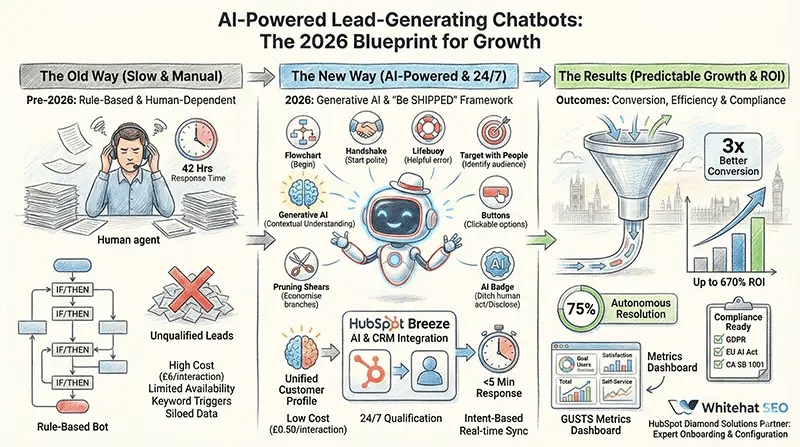
A lead-generating chatbot qualifies visitors 24/7, converts 3x better than forms, and costs £0.50 per interaction versus £6 for human agents. In 2026, AI-powered chatbots resolve 75% of inquiries autonomously, delivering up to 670% ROI when properly implemented with clear qualification logic, human handoff options, and CRM integration—capabilities that Whitehat SEO configures through HubSpot onboarding.
Lead Generation Chatbots in 2026: The Business Case
The chatbot landscape has transformed dramatically since 2020. Where rule-based systems once dominated with scripted responses and keyword triggers, generative AI chatbots now handle complex, multi-turn conversations with unprecedented accuracy. According to Tidio's October 2024 survey, 60% of B2B companies now use chatbots—significantly higher than the 42% adoption rate in B2C sectors.
The UK market reflects this global shift. Grand View Research values the UK chatbot market at £712.3 million in 2024, projected to reach £2.64 billion by 2030—a compound annual growth rate of 24.2%. For UK marketing directors seeking predictable pipeline growth, this represents both opportunity and competitive pressure.
Customer expectations have intensified since the original "Building a Lead Generating Chatbot" guide was published in 2020. Where 59% of marketing-stage prospects wanted immediate answers then, Tidio's 2024 research shows 82% would now use a chatbot rather than wait for a human agent. Only 18% are willing to wait even 15 minutes for human support.
Key 2026 Chatbot Statistics
| B2B adoption rate | 60% |
| Conversion vs forms | 3x better |
| Cost per interaction | £0.50 vs £6 |
| AI resolution rate | 75% |
| Proven ROI | 670% |
Sources: Tidio (Oct 2024), Dashly (2025), Fullview (2025), Gartner (2025), Forrester/Drift
Rule-Based vs AI-Powered Chatbots: What Changed Since 2020
The 2020 chatbot guide focused primarily on rule-based systems—decision trees with if/then branching logic. These systems worked well for structured conversations but struggled with anything unexpected. Today's generative AI chatbots, powered by large language models, understand context, remember entire conversations, and generate natural responses based on intent rather than keywords.
Gartner's 2025 research quantifies this evolution: AI-powered chatbots now resolve 75% of inquiries without human intervention, up from approximately 40% with previous rule-based systems. This improvement stems from natural language processing advances that enable semantic understanding of intent, real-time translation across 200+ languages, and affective AI that detects mood and adapts tone accordingly.
For B2B companies evaluating chatbot options, Whitehat SEO's AI consultancy services help navigate this complexity. The key decision factors include deployment timeline (rule-based systems deploy in 2-4 weeks versus 3-6 months for full AI implementations), total cost of ownership, and integration requirements with existing CRM and marketing automation platforms.
Master of Code's 2024-2025 research found that 87.2% of users rate chatbot experiences as neutral or positive—a dramatic improvement from the 47% who found chatbots had too many unhelpful responses in earlier surveys. The critical factor? Implementation quality, not technology choice.
The Business Case: ROI and Cost Savings
Forrester's commissioned study for Drift documented 670% ROI from conversational marketing implementations. This figure, while impressive, reflects best-practice deployments with proper CRM integration, lead qualification logic, and human handoff protocols—exactly the configuration Whitehat delivers through structured HubSpot onboarding programmes.
The economics are compelling. Fullview's 2025 analysis shows chatbot interactions cost approximately £0.50 compared to £6 for human agent interactions—a 12x cost differential. Tidio reports average ROI of 1,275% from support cost savings alone, while leading AI implementations achieve 148-200% ROI within 12-18 months.
Lead conversion improvements are equally significant. A Glassix study from February 2024 found AI chatbots increase conversion rates by 23% compared to no chatbot, while Dashly's 2025 research shows chatbots convert into sales 3x better than traditional website forms. For B2B companies with high customer acquisition costs, these improvements translate directly to pipeline value.
"Chatbots answer questions 80% faster than live agents, and businesses using personalisation technology including chatbots see 36% higher conversion rates."
— Adam Connell (2025) and Aberdeen/Qualified Research (April 2024)
Lead response time drives these results. Harvard Business Review research shows companies are 7x more likely to qualify leads when responding within one hour and 21x more likely to convert when responding within five minutes. The average B2B lead response time without chatbots? 42 hours. Chatbots eliminate this gap entirely.
HubSpot Chatbot Capabilities in 2026
HubSpot's chatbot builder has evolved significantly since 2020, now offering both rule-based chatflows and AI-powered capabilities through the Breeze ecosystem. The platform supports multi-channel deployment across website, Facebook Messenger, and WhatsApp, with native CRM integration that automatically populates contact records and triggers workflow enrolment.
Launched at INBOUND 2024, Breeze represents HubSpot's comprehensive AI suite with over 20 agents across marketing, sales, and service functions. Unlike generic AI chatbots, Breeze agents are trained on your CRM data and operate within HubSpot's workflow engine—meaning they take actions, not just provide suggestions. The Breeze Customer Agent resolves over 50% of support tickets automatically, with top-performing teams reaching 90% automatic resolution rates.
For UK B2B companies considering HubSpot implementation, understanding what HubSpot CRM offers is essential. As a HubSpot Diamond Solutions Partner, Whitehat SEO configures these capabilities properly from day one—ensuring chatbot conversations flow seamlessly into lead scoring, lifecycle stage updates, and sales team notifications.
HubSpot CEO Yamini Rangan noted in the Q4 2024 earnings call: "Our AI support bot now handles over 35% of support tickets while maintaining high customer satisfaction, and we're working to get this to over 50% in 2025. Similarly, our AI sales bot is resolving over 80% of website chat inquiries."
The "Be SHIPPED" Framework: 8 Best Practices for 2026
The original 2020 guide introduced the "Be SHIPPED" mnemonic for chatbot best practices. These principles remain foundational, though their application has evolved with AI capabilities. Here's how each element applies in 2026:
Begin by building a flowchart. Even with AI-powered chatbots, mapping conversation paths before implementation prevents scope creep and ensures alignment between marketing and sales teams. Document your qualification criteria, handoff triggers, and error recovery paths.
Start with a polite, helpful greeting. Research shows 64% of users trust AI more when it exhibits human-like traits including empathy and friendliness (Zendesk, 2025). Your opening message sets the tone—ask what brought them to your site rather than immediately requesting email addresses.
Have a helpful error message. When conversations go off-script, provide clear paths forward: a phone number, email address, or option to speak with a human. According to HubSpot's 2025 research, 86% of users believe an escalate-to-agent option is essential.
Identify your audience. Understanding which personas will interact with your chatbot—and on which pages—shapes everything from question sequence to qualification criteria. Sales and marketing alignment ensures chatbot-qualified leads meet sales team expectations.
Provide a clear failsafe. Let users control the conversation direction. Include options like "Start over," "Talk to someone," or "That's not what I meant" at decision points.
Provide clickable options. Even with AI's natural language capabilities, structured choices reduce friction and improve data quality. Button-based responses also work better on mobile devices.
Economise on branches. More complexity means more maintenance and more opportunities for errors. Focus on the 20% of use cases that represent 80% of interactions.
Ditch the human act. Transparency about AI identity isn't just ethical—it's increasingly required by law. California's SB 1001 and the EU AI Act both mandate clear disclosure when users interact with automated systems.
GDPR, Data Privacy, and UK Compliance
Chatbot compliance has become increasingly complex. California's SB 1001 (effective July 2019) requires "clear, conspicuous" disclosure of artificial identity for any bot that incentivises purchases. The newer SB 243, effective January 2026, introduces a private right of action with minimum £1,000 per violation damages—though this primarily targets companion/emotional AI rather than customer service bots.
The EU AI Act, with phased implementation from August 2024, places chatbots in the "Limited Risk" category requiring transparency. Users must be informed they're interacting with AI unless it's "obvious to a reasonably well-informed person." AI-generated content must also be marked as artificially produced.
For UK businesses, the regulatory landscape remains principles-based through existing regulators like the ICO. The Online Safety Act 2023 treats AI-generated content the same as human-generated content for harm assessment purposes. Key GDPR considerations for chatbots include establishing lawful basis (consent or legitimate interest), providing clear privacy notices before data collection, and enabling user rights including access, correction, and deletion.
Whitehat SEO's marketing services include compliance configuration as standard—ensuring your chatbot deployments meet both current requirements and anticipated regulatory evolution.
Measuring Chatbot Performance: The GUSTS Metrics
The 2020 guide introduced "GUSTS" as a framework for chatbot metrics. These five measurements remain essential for demonstrating ROI and identifying optimisation opportunities:
Goal Completion Rate measures how often chatbot interactions achieve their intended purpose—whether booking meetings, qualifying leads, or answering specific questions. This is your primary success metric and should be tracked daily during initial deployment.
User Interactions tracks total conversation volume over time. Rising interaction counts indicate growing adoption; declining counts may signal visibility issues or user frustration from previous experiences.
Satisfaction Rate captures user sentiment, typically through end-of-conversation ratings. HubSpot's chatbot builder supports NPS-style questions that feed directly into contact records for segmentation and follow-up.
Total Number of New Users measures reach—how many unique visitors engage with your chatbot. This metric helps justify investment and identifies traffic sources that generate the most chatbot engagement.
Self-Service Rate compares successful automated resolutions against requests for human assistance. Higher self-service rates indicate well-designed conversation flows and appropriate AI capabilities.
Advanced metrics for 2026 include MQL attribution (which chatbot conversations generated qualified leads), revenue influence (deals where chatbot interaction appeared in the customer journey), and AI accuracy (how often AI responses matched user intent). These require proper CRM integration and attribution modelling—exactly what Whitehat configures during HubSpot implementations.
Common Chatbot Mistakes (and How to Avoid Them)
Despite technological advances, chatbot failures in 2026 typically stem from implementation issues rather than capability limitations. The Conversation's January 2025 research found 71% of users still prefer human agents—not because chatbots can't help, but because poorly designed chatbots have conditioned users to expect frustration.
Mistake 1: Demanding email before providing value. The "anonymous example" from the original guide remains relevant. Chatbots that immediately request contact information before demonstrating helpfulness see dramatically higher abandonment rates. Provide value first; capture details after you've earned trust.
Mistake 2: No human handoff option. With 86% of users considering escalate-to-agent options essential, omitting this capability guarantees frustration. Ensure your chatbot includes clear paths to human assistance, with context passed through so users don't repeat themselves.
Mistake 3: Deploying without CRM integration. A chatbot that doesn't write to your CRM creates data silos. Every interaction should update contact records, trigger appropriate workflows, and provide sales teams with conversation context.
Mistake 4: Set-and-forget deployment. The 2020 guide emphasised daily monitoring during initial deployment. This remains true—chatbot conversations reveal customer questions, objections, and language patterns that should inform ongoing optimisation.
Mistake 5: Ignoring mobile experience. With over 60% of B2B research now happening on mobile devices, your chatbot must work flawlessly on smaller screens. Test button sizing, message length, and scroll behaviour across devices.
Frequently Asked Questions
What's the difference between rule-based and AI-powered chatbots?
Rule-based chatbots follow pre-programmed decision trees with if/then logic, responding only to anticipated inputs. AI-powered chatbots use natural language processing to understand intent, remember conversation context, and generate contextually appropriate responses. AI chatbots resolve 75% of queries versus approximately 40% for rule-based systems.
How much does it cost to implement a lead generation chatbot?
HubSpot's chatbot builder is included free with CRM, with advanced features in Professional (£890/month) and Enterprise (£3,600/month) tiers. Full AI capabilities through Breeze require Professional or Enterprise subscriptions. Implementation costs with a partner like Whitehat typically range from £5,000-£15,000 depending on complexity.
What ROI can I expect from a chatbot implementation?
Forrester's research documented 670% ROI for properly implemented conversational marketing. Individual results depend on traffic volume, current conversion rates, and implementation quality. Most B2B companies see positive ROI within 6-12 months through reduced support costs and increased lead conversion.
Do I need a developer to set up HubSpot chatbots?
No—HubSpot's chatbot builder is a no-code visual tool accessible to marketers. However, complex implementations benefiting from custom branching logic, CRM integrations, and advanced workflows typically achieve better results with partner support. HubSpot onboarding accelerates time-to-value by 20-40%.
How do chatbots comply with GDPR and UK data protection laws?
Chatbots must establish lawful basis for data collection (typically consent or legitimate interest), provide clear privacy notices before capturing personal data, honour data subject rights, and include human oversight for significant automated decisions. UK GDPR and PECR requirements apply to any chatbot collecting or processing personal data.
What metrics should I track for chatbot performance?
Track goal completion rate (primary success metric), user interactions (adoption), satisfaction rate (user sentiment), total new users (reach), and self-service rate (automation effectiveness). Advanced metrics include MQL attribution, revenue influence, and AI accuracy—all requiring proper CRM integration and attribution modelling.
How do I prevent chatbots from frustrating website visitors?
Provide value before requesting contact information, always include human handoff options, use clear and helpful error messages, offer clickable response options to reduce friction, and monitor conversations daily during initial deployment. The "Be SHIPPED" framework addresses each common frustration point systematically.
Can chatbots integrate with Salesforce and other CRMs?
Yes—HubSpot offers native bi-directional Salesforce integration, ensuring chatbot conversations sync with Salesforce records in real-time. For other CRMs, integrations via APIs or middleware platforms like Zapier enable similar functionality. Whitehat's HubSpot-Salesforce integration expertise ensures zero lead leakage between systems.
Getting Started: Your Chatbot Implementation Roadmap
Implementing a lead-generating chatbot that actually converts requires more than activating a widget. Based on Whitehat's experience across 100+ HubSpot implementations, here's a practical roadmap:
Week 1-2: Discovery and Planning. Map your buyer personas, identify high-intent pages for chatbot deployment, and document qualification criteria. Align sales and marketing on what constitutes a chatbot-qualified lead.
Week 3-4: Build and Configure. Create conversation flows following the "Be SHIPPED" framework. Configure CRM integration to capture all interaction data. Set up routing rules and handoff protocols.
Week 5-6: Test and Refine. Run internal testing across devices and scenarios. Identify edge cases and error conditions. Refine responses based on early feedback.
Week 7+: Launch and Optimise. Deploy to selected pages with daily monitoring. Review conversation transcripts for improvement opportunities. Expand deployment based on performance data.
Ready to Build a Chatbot That Actually Converts?
As a HubSpot Diamond Solutions Partner, Whitehat SEO configures chatbots that integrate seamlessly with your CRM, qualify leads automatically, and deliver measurable ROI. view our pricing
Explore HubSpot Onboarding ServicesSources and References
- Tidio Chatbot Statistics Report (October 2024)
- Grand View Research UK Chatbot Market Analysis (2024)
- Gartner Customer Service AI Predictions (2025)
- HubSpot Breeze AI Documentation (2025)
- Forrester Conversational Marketing ROI Study
- Master of Code Chatbot Statistics (2024-2025)
- Dashly Lead Generation Research (2025)
- Fullview B2B Chatbot Analysis (2025)
- Zendesk AI Trust Research (2025)
- Harvard Business Review Lead Response Research
Related Resources
- HubSpot Onboarding Services — Get your HubSpot implementation right from day one
- HubSpot CRM Guide for UK Businesses — Understanding what HubSpot offers
- Sales and Marketing Alignment — Essential for chatbot-qualified lead handoffs
- Answer Engine Optimisation (AEO) — Get your content cited by AI search engines