
Marketing Strategy
If you've studied marketing—or even glanced at a business textbook—you've encountered the 4Ps: Product, Price, Place, and Promotion. The framework is over sixty years old, and every marketing course still teaches it.
A Practical Guide for UK B2B this 2026
Move beyond textbook theory. Here's how to apply the marketing mix framework in complex B2B sales cycles—with AI-era adaptations that most guides ignore.
But here's what marketing courses don't teach: how to actually apply it when you're selling complex B2B solutions to multiple stakeholders over 6-18 month decision cycles. The textbook examples are always consumer brands—Apple, Nike, Starbucks—which is about as useful to a UK B2B marketer as a chocolate teapot.
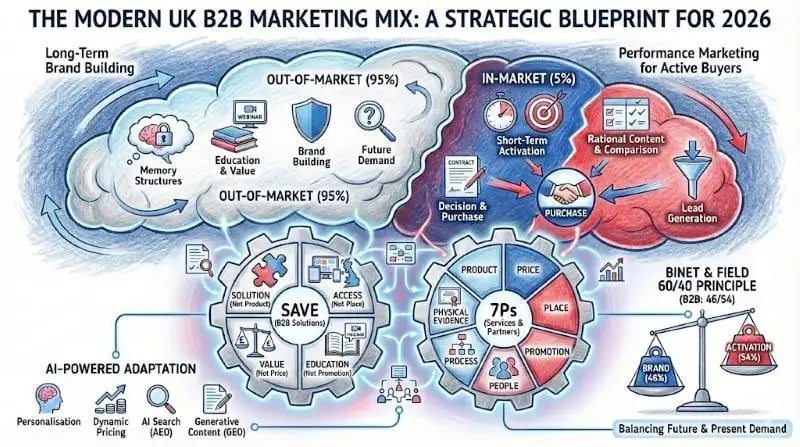
This guide fixes that gap. We'll cover what the 4Ps actually are (quickly, because you probably know this), where the academic debate currently stands (there's more disagreement than you'd think), and most importantly, how to apply the framework to UK B2B marketing in 2026—including the AI transformation that's reshaping every element of the mix.
What Are the 4Ps of Marketing?
The 4Ps of marketing—Product, Price, Place, and Promotion—represent the four fundamental elements that form a company's marketing mix. Originally developed by E. Jerome McCarthy in 1960 and popularised globally by Philip Kotler, these components work together to create a cohesive strategy for bringing offerings to market.
Here's the quick definition of each:
Product encompasses everything you offer to solve customer problems—features, quality, design, branding, packaging, and the entire customer experience surrounding it.
Price is what customers pay, but also includes payment terms, financing options, perceived value, and your positioning relative to alternatives.
Place covers how and where customers access your offering—distribution channels, sales teams, digital presence, and increasingly, visibility in AI answer engines.
Promotion includes all communication that creates awareness and demand—advertising, content marketing, PR, sales enablement, and the education that guides B2B buyers through complex decisions.
Simple enough. But the academic world can't agree on whether this framework still works—and that disagreement matters for how you apply it.
The Academic Battle Over Whether the 4Ps Still Work
Marketing thought leaders are genuinely divided here, and the debate is worth understanding because it shapes how you should think about strategy.
The Ehrenberg-Bass Institute (home to Byron Sharp, author of How Brands Grow) published a significant critique characterising the 4Ps and traditional segmentation models as lacking empirical grounding. Sharp's team argues that brands grow primarily through market penetration and mental availability—not through optimising a marketing mix.
Standing firmly in opposition is Mark Ritson, who calls attempts to reinvent the 4Ps "embarrassing" and uses a satirical "Four P Regenerator" to mock the proliferation of alternative frameworks. His position: the framework remains robust; only the constituent elements within each P evolve over time.
Even Philip Kotler himself has evolved his thinking. In recent work, he's advocated for a 7-component marketing mix that separates service from product, adds brand as a value-creator, and places value creation as the central organising concept—a significant departure from the framework he popularised.
For B2B specifically, the SAVE model offers perhaps the most useful reframing. Developed by Motorola Solutions' CMO and published in Harvard Business Review, it replaces the 4Ps with:
Solution (not Product) — Define offerings by the needs they address, not features they contain
Access (not Place) — Consider the entire purchase experience across channels and touchpoints
Value (not Price) — Articulate benefits relative to cost, including ROI and total cost of ownership
Education (not Promotion) — Guide buyers through complex decisions rather than pushing messages at them
This reframe directly addresses what HBR called the 4Ps' tendency to yield narrow, product-focused strategies that conflict with the imperative to deliver solutions. If you're selling B2B in the UK, the SAVE model is worth keeping in mind as you work through your marketing mix.
4Ps vs 7Ps: When to Use Each
The 7Ps extend the original framework with three additional elements: People, Process, and Physical Evidence. Developed by Booms and Bitner in 1981, this expanded model was designed specifically for services marketing.
For UK B2B services businesses—agencies, consultancies, professional services—the 7Ps often provide a more complete strategic lens. The quality of your people, the efficiency of your processes, and the evidence you provide (case studies, testimonials, certifications) directly influence buying decisions.
As a HubSpot Diamond Partner, we think about this constantly. Our "product" is inseparable from the people who deliver it and the processes that ensure consistent quality. The 7Ps framework captures this reality better than the original 4Ps.
That said, if you're selling a defined product—software, equipment, manufactured goods—the original 4Ps may provide sufficient structure. The key is choosing the framework that fits your business model, then applying it rigorously rather than picking a framework and forcing your business into it.
How AI Is Transforming Each P for UK B2B
The AI transformation of marketing isn't theoretical—78% of organisations now use AI in at least one marketing function, and the practical implications for each P are substantial.
Product: Mass Personalisation at Scale
B2B buyers increasingly expect B2C-level personalisation. Research shows 77% of B2B buyers now expect personalised experiences, and 76% express frustration when they don't receive them.
AI enables this at scale. Product-led growth strategies use AI to analyse user behaviour, identify conversion patterns, and predict churn. Custom configurations based on buyer personas have become standard for sophisticated SaaS companies. The "product" itself increasingly adapts to each customer's context.
Price: Dynamic and Value-Based
McKinsey research shows AI-powered pricing increases revenue by an average of 5%. BCG reports that companies using dynamic pricing are 70% more likely to achieve strategic goals.
For UK B2B, this translates to value-based pricing tied to ROI metrics, AI-powered competitive intelligence for positioning, and account-specific pricing optimisation for ABM programmes. The days of one-size-fits-all pricing are numbered.
Place: AI Intermediaries as Distribution Channels
This is where the biggest shift is happening. When recommendation engines, AI search results, and AI shopping assistants guide purchasing attention, these become the new retail shelves where brands must be visible.
Digital channels are projected to generate 56% of UK B2B revenue by 2025 (up from 33% in 2021). But it's not just about having a website anymore—product data must now be structured for machine readability as much as human consumption. If ChatGPT can't accurately describe what you do, you're invisible to a growing segment of buyers.
This is why Answer Engine Optimisation (AEO) has become essential alongside traditional SEO. The "place" where buyers discover you now includes AI-generated answers.
Promotion: From Broadcasting to Being Cited
The promotion P has seen the most visible AI impact. Research shows 84% of businesses report AI speeds up high-quality content delivery. Hyper-personalised, context-aware ABM interactions have replaced batch-and-blast approaches.
But the fundamental shift goes deeper: promotion strategies must now optimise for AI citation alongside traditional search rankings. Research from Princeton University and Georgia Tech demonstrates that proper Generative Engine Optimisation (GEO) techniques can boost AI visibility by up to 40%.
The tactics that improve AI citation are specific: adding statistics to content improves visibility by 30-40%, including expert quotations delivers 25-35% improvement, and citing authoritative sources increases visibility by over 30%. These aren't optional extras anymore—they're core to modern promotion strategy.
The 95:5 Rule and Why Your Marketing Mix Must Serve Two Audiences
Here's a fundamental insight that changes how you should think about the 4Ps: at any given time, only 5% of your potential B2B buyers are actually in-market.
This finding, from Professor John Dawes at the Ehrenberg-Bass Institute, has profound implications. It means 95% of the buyers you reach through your marketing mix are out-of-market and won't buy for months or even years. You cannot persuade them to buy sooner—they already have what you're selling or aren't ready to change.
The implication: your marketing mix must serve two distinct audiences simultaneously. The 5% in-market need rational, feature-focused content that helps them compare options and make decisions. The 95% out-of-market need brand-building that creates memory structures, so when they eventually enter the market, your brand comes to mind first.
Research by Les Binet and Peter Field quantifies this. Their work with the LinkedIn B2B Institute recommends a 46% brand building / 54% activation split for B2B—meaning nearly half your marketing investment should focus on the future, not immediate conversion.
When you're building your marketing mix, ask: does this serve only the 5% who are ready to buy today, or does it also build mental availability with the 95% who'll buy tomorrow?
Applying the 4Ps to UK B2B: A Practical Framework
Let's get specific about how to apply the marketing mix in a UK B2B context, with the adaptations that actually matter.
Product: Think Solutions, Not Features
In B2B, your "product" is rarely purchased in isolation. It's part of a broader solution to a business problem, evaluated by multiple stakeholders with different priorities.
The finance director cares about ROI and total cost of ownership. The IT director worries about integration and security. The end user wants ease of use and time savings. Your product positioning must address all of these—which means understanding buying committees, not just individual buyers.
Practical steps: map your offering against each stakeholder's priorities; create persona-specific messaging that speaks to different concerns; ensure your positioning leads with outcomes, not features.
Price: Value-Based, Not Cost-Plus
UK B2B pricing must account for complexity that B2C rarely faces: VAT implications, multi-year contracts, volume discounts, implementation costs, and ongoing support fees.
The shift toward value-based pricing is well-established but often poorly executed. True value-based pricing requires understanding the business impact of your solution—increased revenue, reduced costs, time saved, risk mitigated—and pricing accordingly.
Practical steps: quantify your value proposition in terms your buyers' CFOs will understand; create ROI calculators that demonstrate business impact; consider outcome-based pricing models where appropriate; be transparent about total cost of ownership, including implementation and training.
Place: Omnichannel Access
B2B buyers research extensively before contacting sales—research suggests 71% of B2B healthcare buyers have selected their preferred vendor before engaging sales teams. Your "place" strategy must account for this invisible research phase.
This means visibility across search (both traditional and AI-powered), presence in industry publications and communities, strong performance in partner marketplaces, and accessibility at every stage of the buying journey.
For UK businesses specifically, consider: local SEO for regional offices, compliance with UK data protection regulations in your digital channels, and presence in UK-specific industry events and publications. Our SEO services are built around this multi-channel access strategy.
Promotion: Education Over Persuasion
The SAVE model's replacement of Promotion with Education reflects B2B reality: complex purchases require guidance, not advertising.
Effective B2B promotion educates throughout the buying journey. Top-of-funnel content builds awareness and establishes expertise. Mid-funnel content helps buyers understand their options and build business cases. Bottom-of-funnel content addresses objections and facilitates decision-making.
UK-specific considerations: ASA advertising regulations, GDPR compliance in marketing communications, and the particular preferences of UK business audiences (we tend to prefer substance over hype, evidence over assertion).
The Marketing Mix in Action: How HubSpot Built a $2.5 Billion Revenue Engine
HubSpot provides perhaps the clearest B2B marketing mix case study, having grown from a startup to serving over 227,000 customers through disciplined application of marketing fundamentals.
Product: An integrated platform with freemium entry points attracting over 100,000 free users annually. Rather than selling isolated tools, they sell a connected system that grows with customers.
Price: Tiered models from £20 to £3,200 monthly, with clear value progression. Each tier addresses specific buyer needs and business stages, making the upgrade path obvious.
Place: 100% cloud-based with over 1,200 agency partners (including Whitehat as a Diamond Partner) extending reach into markets they couldn't serve directly.
Promotion: They pioneered inbound marketing methodology, generating 4.5 million monthly blog visitors and over 1.2 million HubSpot Academy course enrolments. They don't just promote—they educate, building trust with the 95% of buyers not yet ready to purchase.
The lesson: every element of their marketing mix reinforces the others. The freemium product creates promotion opportunities; the educational promotion attracts users to the product; the partner network extends place and provides services that enhance the product. It's a flywheel, not a funnel.
Integrating the 4Ps with Account-Based Marketing
For high-value B2B relationships, Account-Based Marketing (ABM) has become the dominant framework for applying marketing mix thinking. Research shows 92% of companies with mature ABM report it delivers more ROI than any other marketing tactic, with 58% experiencing larger deal sizes.
The 4Ps map directly to ABM:
Product becomes customised messaging for each target account, addressing their specific challenges and priorities.
Price becomes account-specific pricing and packaging, potentially including custom terms or pilot programmes.
Place becomes multi-channel engagement across email, social, web, and events—meeting target accounts wherever they spend their attention.
Promotion becomes hyper-personalised content that speaks directly to the account's situation, often involving one-to-one campaigns for top-tier targets.
If you're targeting enterprise accounts, ABM isn't optional—and your marketing mix should flex to support personalisation at the account level.
Common Mistakes When Applying the 4Ps to B2B
After years of helping UK B2B companies develop their marketing strategies, we've seen the same mistakes repeatedly:
Treating the 4Ps as separate activities. Product marketing, pricing, channel strategy, and promotion should work as an integrated system. When they're siloed across departments, inconsistencies creep in—your premium positioning undercut by discount-focused promotion, or your accessibility claims contradicted by a complex buying process.
Optimising only for the 5% in-market. It's tempting to focus entirely on conversion because it's measurable. But neglecting brand building for the 95% means your future pipeline depends entirely on expensive paid channels.
Copying B2C playbooks. The 4Ps framework is universal, but B2C tactics rarely translate directly. B2B requires longer consideration of buying committees, compliance requirements, and integration concerns that consumer marketing can ignore.
Ignoring AI visibility. Traditional SEO isn't enough anymore. If AI assistants can't accurately describe your offering, you're missing a growing segment of B2B research. Our guide to integrating SEO and AEO covers this in detail.
Static thinking. Your marketing mix should evolve continuously based on market feedback, competitive moves, and changing buyer behaviour. Set it and forget it doesn't work.
UK-Specific Considerations for Your Marketing Mix
Most marketing mix content is US-focused, which creates gaps for UK businesses. Here's what to consider:
VAT implications for pricing. B2B pricing in the UK typically quotes net figures, but you need clarity on VAT treatment—especially for services with mixed VAT status or international components.
Distribution and logistics post-Brexit. If physical products are part of your mix, supply chain considerations now include customs, regulatory alignment, and potential delays that affect your "place" strategy.
ASA advertising regulations. UK advertising standards are stricter than many markets. Claims must be substantiated, comparisons must be fair, and testimonials must be genuine. Factor this into your promotion strategy.
GDPR enforcement. The UK's version of GDPR affects email marketing, data capture, and personalisation strategies. Your promotion tactics must be compliant—aggressive data collection won't fly.
UK buyer preferences. British B2B buyers tend to value substance over style, prefer evidence to assertion, and are sceptical of hyperbole. Your promotion should reflect this—demonstrate rather than declare.
Building Your Marketing Mix: A 5-Step Process
Here's a practical process for developing or refining your B2B marketing mix:
1. Audit your current state. Document what you're actually doing across all four Ps. Where are the inconsistencies? What's working and what isn't? A comprehensive audit reveals gaps you might not see from inside the business.
2. Define your target accounts and personas. Who specifically are you trying to reach? What are their priorities, pain points, and decision processes? Your marketing mix should flex based on who you're targeting.
3. Map the buyer journey. How do your target buyers research, evaluate, and purchase? Where are the friction points? Your "place" and "promotion" strategies should address each stage.
4. Define measurable objectives. What does success look like? Set specific targets for awareness, consideration, conversion, and retention—and ensure your marketing mix activities connect to these outcomes.
5. Create an integrated plan. Don't plan each P in isolation. Build a unified strategy where product positioning, pricing, channel strategy, and promotion reinforce each other.
The Bottom Line: The 4Ps Are a Starting Point, Not a Destination
The 4Ps framework has endured for over sixty years because it addresses fundamental questions every business must answer: what are you selling, how is it priced, where can customers get it, and how will they know about it?
But the framework is a starting point, not a complete strategy. UK B2B marketers need to adapt it for complex buying committees, long decision cycles, and the AI transformation reshaping every element of the mix. The SAVE model, the 95:5 rule, and the 46:54 brand/activation split provide the additional nuance that makes the framework actionable.
Perhaps most importantly: no competitor currently owns the "UK B2B marketing mix" positioning. The content landscape is dominated by generic, US-focused, B2C-oriented material. There's an opportunity for UK B2B businesses to demonstrate real expertise here—through the quality of their marketing strategy, not just their marketing about marketing.
The question isn't whether the 4Ps are relevant. The question is whether you're applying them in ways that work for B2B, for the UK market, and for the AI-powered future that's already here.
References & Further Reading
- Binet, L. & Field, P. (2013). The Long and the Short of It: Balancing Short and Long-Term Marketing Strategies. IPA. WARC Interview with Les Binet
- Dawes, J. (2022). The 95:5 Rule: Advertising Effectiveness and the 95-5 Rule. Ehrenberg-Bass Institute. Ehrenberg-Bass Institute
- Ettenson, R., Conrado, E. & Knowles, J. (2013). Rethinking the 4 P's. Harvard Business Review. HBR Article
- Sharp, B. (2010). How Brands Grow: What Marketers Don't Know. Oxford University Press. Ehrenberg-Bass Institute
- The Drum (2019). An exclusive look at Binet and Field's new B2B marketing research. The Drum
- LinkedIn B2B Institute (2022). The 95-5 Rule. LinkedIn B2B Institute