
The AI SEO tools landscape has transformed beyond recognition. In 2026, the global SEO services market stands at approximately £60–65 billion, with AI-driven tools now accounting for 35–40 per cent of new platform investment. For UK marketing teams and agencies, this creates both opportunity and confusion — the traditional SEO stack is no longer sufficient, yet the proliferation of AI-native platforms, answer engine optimisation (AEO) tools, and AI-augmented legacy suites makes choosing the right combination genuinely difficult.
This guide compares the best AI SEO tools available to UK professionals in 2026, covering content optimisation platforms, all-in-one suites, technical SEO crawlers, specialist AEO trackers, and link building automation. Every tool is evaluated on capability, UK pricing, and practical fit for teams of different sizes — from solo freelancers to enterprise agencies.
£60–65B
Global SEO Market
2026 market size, 12% CAGR
35–40%
AI Tool Investment
Share of new SEO tool spending
58%
Zero-Click Searches
Queries answered without a click
1.5B
ChatGPT Monthly Users
AI Overviews active users 2026
Sources: Statista Market Outlook 2026, SparkToro Zero-Click Study
Key Takeaway
The single-platform model is dead. A modern AI SEO stack requires a primary all-in-one platform (Semrush, Ahrefs, or SE Ranking) supplemented by a specialist content optimisation tool and, increasingly, a dedicated AEO tracker. Budget 3–5 integrated tools rather than assuming one platform covers everything.
What Makes an SEO Tool "AI-Powered" in 2026?
Every major SEO platform now markets itself as "AI-powered," but there is a meaningful distinction between tools that have bolted AI features onto existing infrastructure and those built around AI from the ground up. Understanding this distinction helps you avoid paying premium prices for cosmetic AI additions.
AI-enhanced legacy platforms — such as Semrush, Ahrefs, and Moz — have added AI copilots, automated content recommendations, and keyword clustering powered by large language models. These features accelerate existing workflows but do not fundamentally change what the tool does. Semrush's Copilot AI Assistant, for instance, synthesises insights from your existing data and delivers prioritised daily action recommendations — essentially a junior analyst interpreting your dashboards.
AI-native platforms — such as Profound, Geoptie, and Atomic AGI — were designed specifically for problems that only emerged with AI search. They track brand citations across ChatGPT, Perplexity, Claude, and Gemini; measure AI share of voice; and recommend structural changes to increase citation probability. These tools address a category of work that traditional platforms simply were not built for.
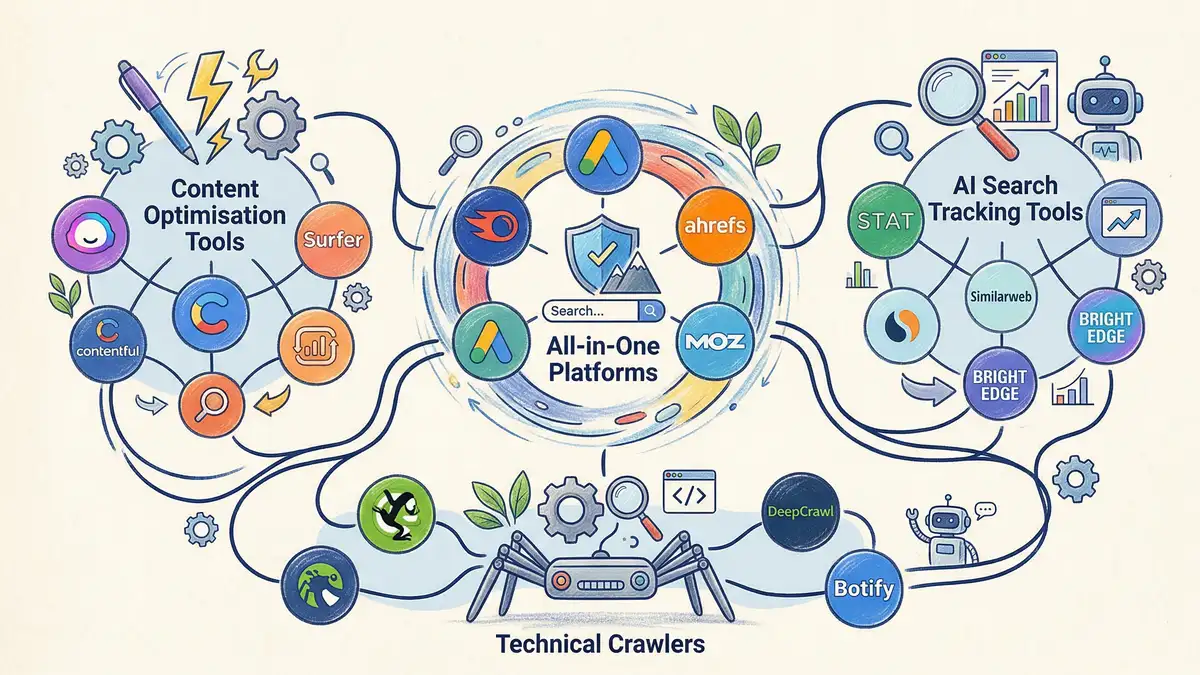
The third category is AI content optimisation tools — Surfer SEO, Clearscope, Frase, NeuronWriter, and MarketMuse — which use NLP models to analyse top-ranking content, extract semantic patterns, and score your content against competitive benchmarks. These tools have integrated generative AI for drafting, but their core value remains in the analysis layer rather than the writing output.
Content Optimisation Tools Compared
Content optimisation is where AI integration has matured fastest. These tools analyse SERP competitors, extract semantic signals, and score your content in real time — increasingly with the ability to generate or rewrite sections using generative AI. The table below compares the leading platforms available in the UK market.
| Platform | UK Price/mo | Core Strength | AI Features | Best For |
|---|---|---|---|---|
| Surfer SEO | From £99 | Real-time content scoring | SERP analysis, semantic recs, Google Docs integration | Writer-focused teams prioritising UX and rapid iteration |
| Clearscope | From £129 | NLP term precision, A++ grading | Industry-leading semantic analysis, quality gate scoring | Enterprise teams needing content governance and consistency |
| Frase | From £15 | Brief generation + AI writing | GSC integration, GEO content scoring, content decay detection | Mid-market teams wanting AEO readiness at affordable pricing |
| NeuronWriter | From £19 | Unlimited AI drafting | One-click AI article generation, NLP optimisation workflow | Freelancers and budget-conscious agencies seeking speed |
| MarketMuse | From £149 | Topical authority mapping | Content gap analysis, personalised difficulty scores, clustering | Large agencies pursuing aggressive topical authority strategies |
Sources: Platform websites, February–March 2026. Prices converted to GBP at mid-market rates.
For most UK agencies managing 10–30 clients, Frase offers the strongest value proposition — combining content brief generation, semantic scoring, AI writing, and AEO readiness at a fraction of the cost of premium alternatives. Teams with larger budgets and strict quality governance requirements should evaluate Clearscope as a quality-gate layer, potentially pairing it with a lower-cost drafting tool like NeuronWriter.

All-in-One SEO Platforms: Semrush vs Ahrefs vs SE Ranking
The all-in-one platform segment remains the largest category, accounting for approximately 45 per cent of paid SEO tool revenue. The three dominant players each serve different strategic priorities, and the right choice depends on your team's primary discipline focus and budget.
Semrush is the most comprehensive suite available, covering keyword research, site audits, rank tracking, backlink analysis, content optimisation, local SEO, PPC research, and social listening. Its Copilot AI delivers daily prioritised action recommendations. The Adobe acquisition in November 2025 for USD 1.9 billion signals enterprise maturation but raises questions about long-term platform independence. Pricing starts at approximately £140 per month (Pro plan).
Ahrefs is widely recognised as the gold standard for backlink analysis and competitor keyword research, with the most comprehensive backlink index in the industry (100+ billion backlinks indexed). Its recent Brand Radar AI feature surfaces keyword opportunities automatically. Pricing starts at approximately £129 per month (Lite plan), though the Standard plan at £249 is where most agencies operate.
SE Ranking has emerged as the compelling mid-market alternative, combining solid capabilities across all core disciplines at significantly lower cost. Its dedicated GEO/AEO tracking module (approximately £71 as an add-on) explicitly tracks brand visibility across ChatGPT, Google AI Overviews, Perplexity, and Claude — a forward-looking feature that larger platforms have been slower to match.
| Platform | Entry Price | Standout Strength | Relative Weakness | AEO Features | Best For |
|---|---|---|---|---|---|
| Semrush | £140/mo | Broadest feature set, AI Copilot | Pricing complexity, add-on costs | Integrated (post-Adobe) | Enterprise, multi-discipline |
| Ahrefs | £129/mo | Backlink index, keyword precision | Limited on-page, local SEO | Brand Radar (basic) | Link-heavy, competitor intel |
| SE Ranking | £103/mo | Value, dedicated GEO module | Smaller backlink index | Dedicated GEO add-on | Mid-market agencies |
| Mangools | £12/mo | Ease of use, AI Search Grader | Limited depth, no API | AI Search Grader + Watcher | Freelancers, beginners |
Sources: Platform pricing pages, February–March 2026. Prices converted to GBP at mid-market rates.
The Bottom Line
SE Ranking delivers 70–80% of the functionality of Semrush and Ahrefs at roughly half the cost, with the added advantage of a dedicated GEO/AEO tracking module. For UK mid-market agencies managing 10–50 client accounts, it is increasingly the most cost-effective primary platform choice.
Technical SEO Tools: Crawlers and Auditors
Technical SEO remains foundational — Core Web Vitals, indexation, crawlability, and site architecture are non-negotiable prerequisites for ranking competitively, regardless of how sophisticated your content strategy becomes. The technical tools category spans from affordable desktop crawlers to enterprise governance platforms.
Screaming Frog SEO Spider remains the technical SEO professional's gold standard. The free version crawls up to 500 URLs; the paid licence costs just £279 per year (approximately £23 monthly) and provides comprehensive crawl data covering internal links, redirect chains, meta tags, JavaScript rendering, canonical tags, and structured data. For the price of a single client invoice, it delivers more technical depth than many platforms costing ten times as much. The learning curve is significant, but any serious technical SEO professional should consider it essential.
Sitebulb (approximately £53 per month) differentiates through visual reporting and plain-English explanations of technical issues. Its interactive crawl maps transform raw crawl data into intuitive visual narratives — particularly valuable for communicating findings to non-technical stakeholders and clients. Where Screaming Frog excels at depth and control, Sitebulb excels at clarity and communication.
Lumar (formerly DeepCrawl, from £99–400+ monthly) serves enterprise-grade operations, auditing millions of pages at scale with direct CI/CD pipeline integration through its Protect module. Lumar's GEO/AEO-specific features — tracking how your site appears to AI crawlers like GPTBot and ClaudeBot — represent forward-looking capability. It is overkill for most mid-market agencies but essential for large in-house teams managing complex architectures.
Need help selecting and implementing the right SEO tools for your team? Explore our SEO services to see how we can help.
View SEO Services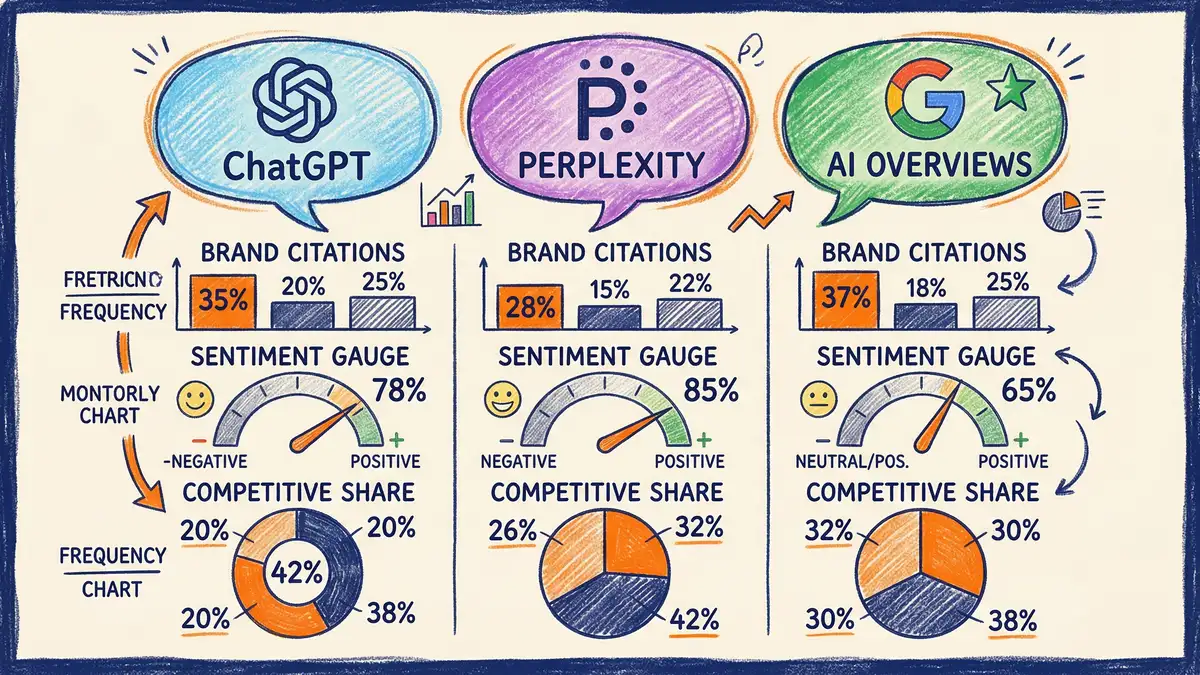
AEO and AI Search Tracking: The New Category
By March 2026, AI answer engines have captured mindshare previously reserved for Google organic search. ChatGPT processes 1.5 billion monthly active queries through AI Overviews, Perplexity handles 26 million queries daily, and Claude maintains strong enterprise adoption. The implication is stark: visibility in LLM-powered search now rivals traditional Google rankings as a traffic and brand awareness source in many niches.
This has spawned a distinct new tool category focused on tracking brand citations, sentiment, and competitive positioning across AI platforms. Adoption among UK agencies remains nascent — approximately 15–25 per cent of mid-market and enterprise agencies have implemented AEO monitoring, compared to over 90 per cent using traditional rank tracking.
Profound (£79–319/mo)
Enterprise-grade AI search analytics. Tracks citations, sentiment, and competitive share across ChatGPT, Perplexity, Claude, and Gemini using real-time LLM queries rather than API simulations. Best for large brands where AI perception directly affects revenue.
Peec AI (£75–421/mo)
Monitors brand mentions across six AI engines with emphasis on sentiment tracking and competitor benchmarking. Strong GDPR compliance and European data residency — servers located in Europe. 5/5 G2 rating as of December 2025.
Geoptie (£41–168/mo)
All-in-one GEO platform combining AI visibility tracking, competitor citation analysis, GEO audits, and a content studio. Offers seven free tools without registration. Aggressively priced at 85–90% below enterprise alternatives like Goodie.
SE Ranking GEO Add-on (£71/mo)
Bolt-on module for existing SE Ranking users. Tracks brand visibility across ChatGPT, Google AI Overviews, Perplexity, and Claude. Most cost-effective option for teams already committed to SE Ranking as their primary platform.
Even organisations not currently prioritising AI search visibility should implement baseline AEO monitoring — this is insurance against reputational surprises and informs long-term content strategy. At £41–75 monthly for entry-level monitoring, the cost is negligible relative to the risk of discovering your brand is being misrepresented across AI platforms without your knowledge.
Building Your AI SEO Stack: Budget Recommendations by Team Size
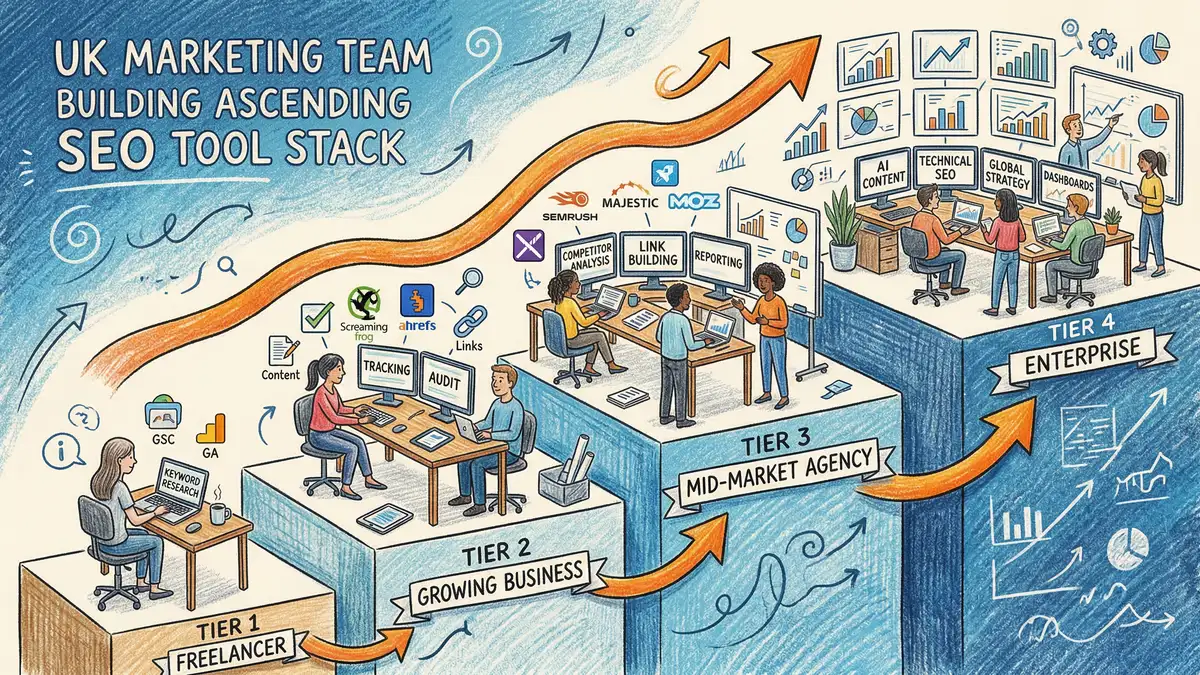
The right combination of tools depends entirely on your team size, client base, and budget. Based on our analysis of the current market, here are practical stack recommendations for UK teams at four budget levels.
Freelancers and Solo Practitioners — £30–80/month
Start with Google's free tools (Search Console, Analytics, Keyword Planner) plus Mangools (£12–29) or NeuronWriter (£19–23) and Screaming Frog free (500 URLs). This covers keyword research, rank tracking, basic audits, and content optimisation for approximately 70–75% of enterprise-level functionality. The trade-off is manual workflow stitching between platforms.
Small Agencies (5–15 staff, 10–30 clients) — £200–400/month
Adopt SE Ranking Core (£103) as the primary platform, supplemented by Screaming Frog paid (£23 annual), Frase or NeuronWriter (£59–69) for content workflows, and SE Ranking's built-in AEO tracking. This stack totals approximately £250–300 monthly and provides comprehensive coverage without sacrificing core functionality.
Mid-Market Agencies (15–50 staff, 30–100+ clients) — £400–800/month
Standardise on Semrush Pro/Guru (£140–250) or Ahrefs Standard (£249) as the intelligence layer, plus Screaming Frog or Sitebulb for technical SEO, a dedicated content tool (Frase, Surfer, or NeuronWriter at £59–199), and Peec AI or SE Ranking GEO (£71–168) for AEO monitoring. Total: £500–700 monthly with enterprise-grade data and white-label reporting.
Enterprise Teams (50+ staff, multi-market) — £1,000–3,000+/month
Deploy Semrush Business or enterprise licensing (£500–2,000+) with Ahrefs Enterprise for competitive intelligence, Clearscope or MarketMuse (£250–499) for content governance, Lumar (£300–1,000+) for technical SEO with CI/CD integration, and Profound or Goodie (£300–500) for enterprise AI search analytics. Total: £2,000–5,000+ monthly across the most comprehensive capability set available.
The AI Accuracy Problem: Why Human Oversight Still Matters
Enthusiasm for AI-powered SEO tooling must be tempered by awareness of significant limitations. The latest flagship language models have regressed 6–9 percentage points on standard SEO tasks relative to prior versions, according to Search Engine Land's 2025 benchmark. The regression stems from architectural choices — newer models prioritise agentic reasoning and safety guardrails at the expense of rapid, accurate technical SEO responses.
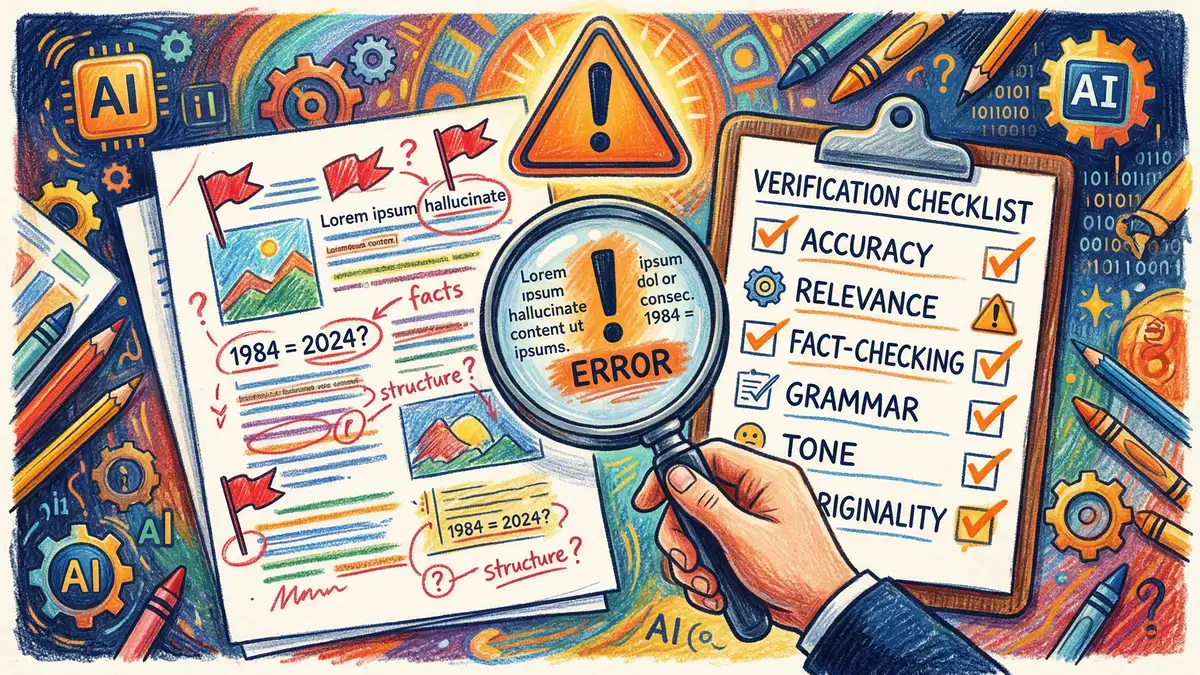
Meanwhile, Google's February 2026 core update explicitly targeted thin, low-effort AI-generated content, suggesting that algorithms can now distinguish between high-quality human-reviewed AI-assisted content and mass-produced, unreviewed output. AI content tools must be positioned as drafting assistance rather than autonomous content production — every AI-generated page requires human editorial review against factual accuracy, original insight, brand voice alignment, and E-E-A-T criteria.
The Cost of Trusting AI Without Verification
Common mistake: Teams deploy AI content generation tools without human review gates, assuming AI output is inherently accurate and optimised. AI platforms frequently hallucinate — recommending keyword targets with implausible search volumes, suggesting internal linking that creates silos, or confidently citing metrics that disagree with verified ground truth.
The reality: Sites that rely heavily on unreviewed, mass-produced AI content face algorithmic penalties under Google's 2026 core update. AI tools function most effectively as idea generators and analysis accelerators — surfacing hypotheses that human practitioners then validate and prioritise. Every AI recommendation should be spot-checked against external data sources before implementation, particularly for client-facing work.
Frequently Asked Questions
What is the best all-in-one AI SEO tool for UK agencies in 2026?
For mid-market UK agencies managing 10–50 client accounts, SE Ranking delivers the strongest value proposition — approximately 70–80 per cent of the functionality of Semrush and Ahrefs at roughly half the cost, with the added advantage of a dedicated GEO/AEO tracking module. Larger enterprises with budgets above £500 per month should evaluate Semrush for its unmatched breadth across keyword research, backlink analysis, PPC, and social listening.
How much should a UK agency budget for AI SEO tools?
Budget depends on team size and client volume. Solo freelancers can operate effectively on £30–80 per month using free Google tools plus one paid platform (Mangools or NeuronWriter). Small agencies (5–15 staff) typically spend £200–400 monthly across 3–4 tools. Mid-market agencies (15–50 staff) should budget £400–800 monthly, and enterprise teams (50+ staff) commonly invest £1,000–3,000+ monthly across 5–7 integrated platforms.
What are AEO tools and do UK businesses need them?
AEO (Answer Engine Optimisation) tools track how your brand appears in AI-powered search engines — ChatGPT, Perplexity, Claude, Google AI Overviews, and Gemini. With 58 per cent of searches now resulting in zero clicks, visibility in AI answer engines increasingly determines brand awareness and traffic. Even businesses not currently prioritising AI search should implement baseline AEO monitoring (from £41–75 monthly) as insurance against brand misrepresentation.
Is Semrush still worth the price after the Adobe acquisition?
Semrush remains the most comprehensive all-in-one SEO platform available. The Adobe acquisition in November 2025 for USD 1.9 billion signals enterprise maturation and has raised concerns about long-term feature independence. However, for teams already embedded in the Semrush ecosystem, the platform's breadth, data quality, and AI Copilot features justify the premium — particularly at the Guru tier (approximately £250/month) which unlocks content optimisation and competitive intelligence tools.
Can free AI tools replace paid SEO platforms?
Free tools — Google Search Console, Google Analytics, free Screaming Frog (500 URLs), and free-tier AI assistants (ChatGPT, Claude) — cover approximately 50–60 per cent of basic SEO needs. However, they lack keyword research databases, automated rank tracking, competitive intelligence, content scoring, and AEO monitoring that paid platforms provide. For professionals managing client work or operating in competitive niches, free tools alone are insufficient.
Which AI SEO tools are best for content optimisation specifically?
Frase (from £15/month) offers the best value for content-focused teams, combining brief generation, semantic scoring, AI writing, and AEO readiness scoring. Surfer SEO (from £99/month) provides superior real-time content scoring and Google Docs integration for writer-focused teams. Clearscope (from £129/month) delivers the most precise NLP term recommendations for enterprise quality governance. The right choice depends on whether you prioritise affordability (Frase), writer experience (Surfer), or content quality control (Clearscope).
Want Expert Help Choosing and Implementing Your SEO Stack?
Our team helps UK businesses select, configure, and integrate the right combination of AI SEO tools — then builds the content strategy to make them deliver results.
Sources: Statista SEO Market Outlook 2026, SparkToro Zero-Click Search Study, Search Engine Land AI SEO Benchmark 2025, Reuters Adobe-Semrush Acquisition Report, Platform pricing pages February–March 2026
Clwyd Probert
Managing Director, Whitehat SEO
Clwyd Probert is a digital marketing strategist with over 15 years of experience helping UK businesses grow through organic search, content strategy, and marketing technology. He specialises in HubSpot CMS implementation, AI search optimisation, and data-driven SEO strategies for B2B organisations.