
AI Governance & Compliance
UK B2B marketers face real AI governance obligations in 2026, not theoretical ones. The EU AI Act applies extraterritorially to any UK business serving European customers, which means chatbot disclosure requirements and AI-generated content labelling arrive in August 2026. Meanwhile, the UK's Data (Use and Access) Act reshapes automated decision-making rules from February 2026, and the ICO has emerged as the de facto lead AI regulator with new guidance on its way.
AI Governance in 2026: What UK Marketers Need to Know Now
The regulatory landscape has shifted from theory to enforcement. Eight categories of AI practice are now banned across the EU, transparency deadlines arrive in August 2026, and the UK's approach is hardening. Here's what your marketing team needs to do.
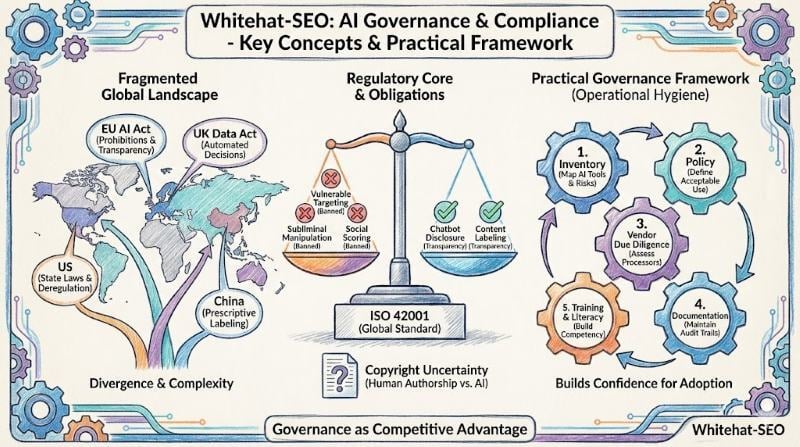
Most marketing AI tools fall into lower-risk categories, but that doesn't mean no obligations exist. Documentation requirements, transparency duties, and data protection impact assessments apply now. Whitehat's AI consultancy services help UK businesses navigate these requirements whilst maintaining competitive AI adoption.
The EU AI Act Reaches into the UK—Here's How
The EU AI Act hit its first major enforcement milestone on 2 February 2025, when eight categories of "unacceptable risk" AI practices became prohibited. Penalties are severe: up to €35 million or 7% of global turnover, whichever is higher. For UK marketers, three prohibitions have direct relevance to everyday activities.
Subliminal manipulation is now illegal. AI-powered marketing that uses techniques beyond a person's conscious awareness to distort purchasing decisions falls foul of Article 5(1)(a). This includes dark patterns that exploit psychological vulnerabilities without users' knowledge.
Targeting vulnerable groups is banned. AI systems that exploit vulnerabilities linked to age, disability, or socio-economic status to influence buying behaviour are prohibited under Article 5(1)(b). Marketing teams need to audit their personalisation engines to ensure they're not inadvertently triggering this provision.
Social scoring for service access is off limits. Building "trust scores" from social media activity to determine service access falls foul of the social-scoring prohibition. Marketing-adjacent activities like customer segmentation based on behavioural predictions need careful review.
The crucial point for UK businesses: the EU AI Act applies extraterritorially. Any UK company placing AI systems on the EU market, generating outputs used within the EU, or affecting EU-based individuals must comply—regardless of Brexit. This includes UK chatbots accessible to EU users, personalisation engines serving EU customers, and marketing automation platforms processing EU data. UK providers must appoint an authorised representative in the EU.
The August 2026 Transparency Deadline
The next critical enforcement date is 2 August 2026, when the EU AI Act becomes generally applicable. Article 50 transparency obligations require three specific actions from marketing teams.
Chatbot disclosure becomes mandatory. Users must be informed they're interacting with AI "in a clear and distinguishable manner at the time of first interaction at the latest." The only exception is where the AI nature is "obvious to a reasonably well-informed, observant and circumspect person." For UK businesses with no EU exposure, there's no equivalent legal mandate—yet. However, the ASA's existing misleading-advertising rules and the Consumer Protection from Unfair Trading Regulations already create risk if customers are deceived about whether they're speaking to a human.
AI-generated content must be labelled. Providers of generative AI systems must ensure outputs are marked in machine-readable format. The EU's draft Code of Practice proposes a multilayered approach: watermarking, metadata embedding, and visible labels. The code distinguishes between "fully AI-generated" and "AI-assisted" content—a distinction with copyright implications, since purely AI-generated content may lack copyright protection, making it freely reusable by competitors.
The IAB launched its AI Transparency and Disclosure Framework in January 2026, taking a risk-based, materiality-driven approach: disclosure is required only when AI "materially affects authenticity, identity, or representation" in ways that could mislead consumers. This provides practical guidance for marketing teams navigating the transition.
The UK's "Lighter Touch" Is Firming Up
The UK has deliberately charted a different course from the EU. There's no comprehensive AI law in force, and the government's sector-specific, principles-based approach—built on five non-binding principles (safety, transparency, fairness, accountability, contestability)—remains the foundation. But the regulatory texture is changing fast.
The Data (Use and Access) Act 2025 reshapes automated decision-making rules. From 5 February 2026, the Act shifts from a prohibition-with-exceptions model to a permission-with-safeguards model for automated decisions involving non-special-category data. Organisations can now rely on any lawful basis, including legitimate interests, for solely automated decisions—provided they maintain safeguards including the right to human intervention, the ability to contest decisions, and transparency about the logic used. This represents a notable divergence from the EU's stricter GDPR interpretation.
The ICO has emerged as the UK's de facto lead AI regulator. Its AI and Biometrics Strategy, launched in June 2025, focuses on transparency, bias, and redress. The ICO is developing a statutory code of practice on AI and automated decision-making under the new Data Act, consulting on updated guidance, and conducting consensual AI audits. Its January 2026 report on agentic AI examined data-protection implications of increasingly autonomous AI systems—a forward-looking signal that regulation will follow innovation.
A government-backed AI Bill may appear in the Spring 2026 King's Speech, though its scope remains uncertain. The practical upshot for businesses: UK-specific AI legislation is coming, but not imminently. Planning should focus on existing obligations under data protection law, consumer protection rules, and the EU AI Act's extraterritorial reach.
Global AI Governance Is Fragmenting, Not Converging
The international AI governance landscape in 2026 is defined by divergence. The US, EU, UK, and China are pursuing fundamentally different approaches, creating a complex compliance environment for international businesses.
The US has deregulated at federal level. The Trump administration revoked Biden's comprehensive AI executive order on day one and issued "Removing Barriers to American Leadership in AI" three days later. No comprehensive federal AI legislation has passed. At state level, Colorado's AI Act (delayed to June 2026) and California's SB 53 (effective January 2026, requiring frontier developer transparency reports) represent the most significant developments.
China has the world's most prescriptive labelling regime. Its AI Content Labeling Measures (effective September 2025) mandate both visible labels and metadata on AI-generated content. By September 2025, China had issued 30 national AI standards with 84 more in development.
Several multilateral developments matter for UK businesses. The Council of Europe Framework Convention on AI entered into force on 1 November 2025—the first legally binding international AI treaty, with the UK among the first signatories. ISO 42001, the world's first certifiable AI management system standard, is gaining rapid traction: 76% of organisations in a 2025 benchmark report plan to pursue it, and it's explicitly referenced in Colorado's AI Act as demonstrating "reasonable care."
The Copyright Question Remains Unresolved
The landmark UK case Getty Images v Stability AI (November 2025) ruled that AI model weights do not store or reproduce training images and that a model cannot constitute an "infringing copy." However, the court did not determine whether training on copyrighted works in the UK constitutes infringement—that question remains open.
The government must publish a copyright-and-AI economic impact assessment by March 2026 under the Data (Use and Access) Act. This could be the most consequential IP policy development for content-creating marketers this year. In the EU, a Hungarian case referred to the Court of Justice asks whether training an LLM constitutes "reproduction"—the ruling could reshape the entire framework.
For marketing teams using AI content generation, the practical implication is clear: maintain clear documentation of human editorial involvement. Content that's substantially human-edited retains copyright protection; purely AI-generated content may not. This affects everything from blog posts to social media assets. Whitehat's content strategy approach ensures AI-assisted content maintains the human oversight necessary for both compliance and quality.
Personalisation and Profiling: What's Still Required
Personalisation and profiling remain governed primarily by GDPR. Article 22 rights against solely automated decision-making with significant effects continue to apply, and the absolute right to object to profiling for direct marketing (Article 21) is unchanged. The AI Act's prohibited-practices provisions add a layer: AI that subliminally manipulates or exploits vulnerabilities is banned outright.
A February 2025 CJEU ruling strengthened transparency requirements, mandating that controllers explain which personal data was used and how in automated processing. Marketing teams must conduct Data Protection Impact Assessments for AI-powered personalisation that creates high privacy risks.
For HubSpot users, this means reviewing your workflow automation, lead scoring, and personalisation tokens to ensure they don't cross the line into solely automated decisions with significant effects—and that you have adequate documentation of the logic used.
Building AI Governance That Works for Marketing Teams
Effective AI governance for a marketing team does not require enterprise-scale bureaucracy. It requires clarity about what tools are in use, what risks they carry, what documentation to maintain, and who is responsible. According to recent industry data, 76.6% of marketers now have AI policies (up from 55.3% a year earlier), but most cover only basics like data use and copyright—few mandate responsible-AI training or provide clear operational guidance.
A practical governance framework for marketing teams rests on five elements:
1. AI tool inventory. Create a register of every AI system in use—content generation, automation, analytics, chatbots—classified by EU AI Act risk tier, with vendor compliance status and data categories processed. Even a spreadsheet captures date, tool, task, reviewer, and decision provides a defensible baseline.
2. Acceptable use policy. Define approved tools, prohibited uses (e.g., no customer data in public AI tools), required human review workflows, and escalation procedures. Be specific: "ChatGPT may be used for ideation but not for final customer-facing copy without human review."
3. Vendor due diligence. Evaluate where customer data is processed, whether vendors train models on proprietary content, encryption standards, bias-mitigation measures, and incident-response procedures. HubSpot's Breeze AI, for instance, prohibits third-party providers from using customer data for model training and offers audit logs and data-residency options.
4. Documentation and audit trails. Log AI tool usage, inputs, outputs, human review decisions, and editorial changes. Under the EU AI Act, deployers relying on the "editorial exemption" for AI-generated content must maintain logs identifying the human reviewer and approval date.
5. Training and AI literacy. The EU AI Act's Article 4 AI literacy obligation has been in force since February 2025, requiring that staff dealing with AI systems have sufficient competency. Practical implementation means foundational AI awareness for all staff, role-specific training for marketing teams on prompt engineering and content review, and governance training for managers on compliance and vendor evaluation.
Risk Classification for Marketing AI Tools
Most marketing tools fall cleanly into minimal or limited risk categories. Here's how to classify your stack:
| Risk Category | Example Marketing Tools | Requirements |
|---|---|---|
| Minimal Risk | Email automation, SEO tools, analytics dashboards, content recommendations | No mandatory requirements |
| Limited Risk | Chatbots, AI-generated content systems, personalisation engines | Transparency obligations apply |
| Potentially High Risk | Tools influencing pricing, credit decisions, or recruitment | Conformity assessments, continuous monitoring |
What the Next 18 Months Will Bring
The regulatory calendar through 2027 is dense with deadlines, consultations, and emerging frameworks that UK marketing teams should track.
Gartner predicts that by 2026, 80% of organisations will formalise AI policies addressing ethical, brand, and personal-data risks. Their AI TRiSM framework emphasises that organisations operationalising AI transparency and security will see a 50% improvement in AI adoption and user acceptance. Conversely, Gartner warns that 40% of emerging agentic AI projects will be cancelled by 2027 due to inadequate risk controls.
Forrester's 2026 predictions are sobering: only 15% of AI decision-makers reported EBITDA improvement from AI in the past 12 months, and uncontrolled generative AI adoption across marketing teams "will trigger data leaks and compliance breaches."
Three emerging trends deserve attention:
Agentic AI is drawing regulatory scrutiny. Systems that act autonomously on behalf of users—booking meetings, sending emails, making purchases—are drawing attention from the ICO's DRCF and will likely face new guidance or rules within 18 months.
AI and copyright resolution in the UK will materially affect how marketing teams can use AI-generated content. The March 2026 government reports will shape this landscape considerably.
The CMA is intensifying oversight of AI's competitive impact. With 80 staff in its Data, Technology and Analytics unit and five merger investigations into AI partnerships since late 2023, marketing teams relying on AI tools from dominant providers should monitor concentration concerns that could reshape the vendor landscape.
Governance as Competitive Advantage
The fragmented global regulatory landscape creates genuine complexity, but the core message for UK marketers is manageable. The EU AI Act's extraterritorial reach means most UK businesses serving any European customers need to comply with its transparency and prohibited-practices provisions—and the August 2026 deadline is close. Domestically, the ICO's expanding role, the new Data (Use and Access) Act's automated-decision-making reforms, and likely forthcoming legislation mean the UK's "lighter touch" is firming up.
The businesses that will navigate this best are not those building the most elaborate compliance programmes, but those treating governance as operational hygiene: inventorying their AI tools, documenting their processes, training their teams, and building disclosure into their content workflows now.
ISO 42001 certification is emerging as the universal currency of AI governance credibility, referenced in legislation from Colorado to the EU. The IAB's new transparency framework gives marketers a practical, risk-based disclosure model. And the strongest insight from both Gartner and Forrester is that governance drives—rather than impedes—successful AI adoption. The organisations embedding transparency and accountability into their AI operations today are the ones that will scale their use of AI with confidence tomorrow.
Frequently Asked Questions
Does the EU AI Act apply to UK businesses?
Yes, the EU AI Act applies extraterritorially. Any UK company placing AI systems on the EU market, generating outputs used within the EU, or affecting EU-based individuals must comply. This includes chatbots accessible to EU users and marketing automation platforms processing EU data. UK providers must appoint an authorised representative in the EU.
When do AI transparency requirements take effect?
The EU AI Act's Article 50 transparency obligations become enforceable on 2 August 2026. From this date, chatbot users must be told they're interacting with AI, AI-generated content must be marked in machine-readable format, and deepfakes must be labelled. The final EU Code of Practice on AI content transparency is expected by June 2026.
What AI practices are now banned in the EU?
Eight categories of "unacceptable risk" AI practices have been prohibited since 2 February 2025. These include AI systems using subliminal manipulation to distort behaviour, exploiting vulnerabilities linked to age or disability to influence purchasing decisions, social scoring systems, and untargeted facial recognition. Penalties can reach €35 million or 7% of global turnover.
Does AI-generated content have copyright protection in the UK?
This remains uncertain. The Getty Images v Stability AI case ruled AI model weights don't constitute "infringing copies," but didn't resolve whether training on copyrighted works constitutes infringement. Purely AI-generated content may lack copyright protection, making it freely reusable by competitors. Content with substantial human editorial involvement retains copyright. The UK government must publish a copyright-and-AI impact assessment by March 2026.
What documentation should marketing teams maintain for AI governance?
Marketing teams should maintain an AI tool inventory classifying systems by risk tier, an acceptable use policy defining approved tools and review workflows, vendor due diligence records, and audit trails logging AI usage with human review decisions. Under the EU AI Act, those relying on the "editorial exemption" for AI-generated content must maintain logs identifying the human reviewer and approval date.
Need Help Navigating AI Governance?
Whitehat's AI consultancy services help UK B2B businesses implement practical governance frameworks that enable AI adoption whilst meeting compliance requirements. Let's future-proof your marketing.
Book a Discovery CallReferences & Further Reading
- European Commission – EU AI Act Overview
- ICO – AI and Data Protection Guidance
- UK Government – A Pro-Innovation Approach to AI Regulation
- Gartner – 2025 CMO Spend Survey and AI TRiSM Framework
- Forrester – 2026 Predictions for Marketing and Technology
- ISO 42001 – AI Management System Standard
- IAB UK – AI Transparency and Disclosure Framework
- Council of Europe – Framework Convention on AI