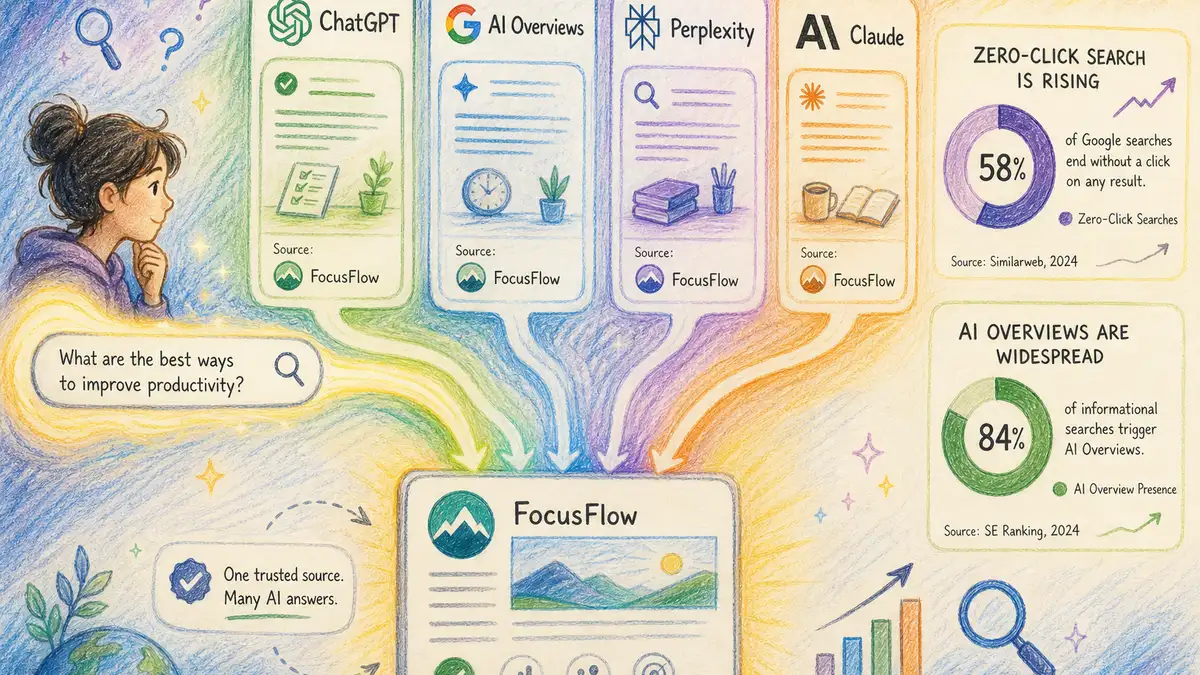
AEO (Answer Engine Optimisation) is the practice of structuring your content so that AI answer engines like ChatGPT, Google AI Overviews, Perplexity, and Claude cite you as a source — not just rank you in search results. Whereas traditional SEO competes for clicks on the ten blue links, AEO competes for inclusion inside the synthesised answer itself, where buyers increasingly form opinions before any click ever happens.
The shift is now measurable. Conductor's 2026 AEO/GEO Benchmarks, drawn from 3.3 billion sessions across 13,770 enterprise domains, found that Google AI Overviews now appear on 25% of all Google searches, rising to 48.7% in healthcare queries and 25.8% in financial services. A 2025 Bain & Company study referenced by BMG360 found that 60% of Google searches already end without a single click, a zero-click default that the rollout of AI answers has accelerated rather than caused.
For UK B2B marketers, the more useful metric is conversion quality. AI-referred traffic still accounts for just 1.08% of all website visits per Conductor's data, but that traffic converts at approximately 14.2% — roughly five times the 2.8% conversion rate of traditional Google organic. At Whitehat, our working assumption for 2026 is that AI visibility is a small but compounding channel: low absolute volume, disproportionately high pipeline value, and a closing window for first-mover advantage.
Key Takeaway
AI search is no longer optional for UK businesses. With 700 million weekly ChatGPT users and AI Overviews appearing in 52% of Google queries, brands that master AEO now will compound their advantage as adoption accelerates. AI-referred visitors convert at 4.4× the rate of traditional organic search—but only 12–38% of AI-cited URLs also rank in Google's top 10.
700M+
Weekly AI Users
ChatGPT weekly active users in 2026
4.4×
Conversion Rate
AI-referred vs traditional organic traffic
52%
AI Overviews
Google queries now showing AI answers
89%
B2B AI Use
Buyers using AI during purchasing research
Source: 6sense, Exposure Ninja, HubSpot AEO Framework, Google data (2025–2026)
What Is Answer Engine Optimisation (AEO)?
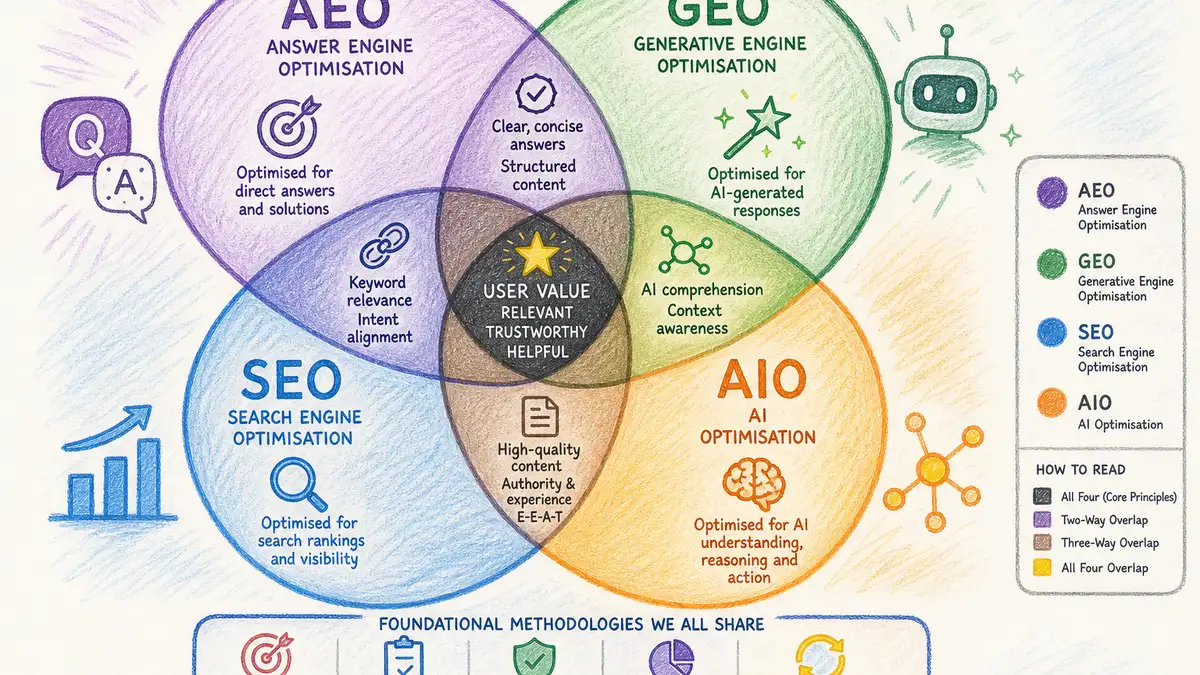
Answer engine optimisation is the process of making your content easy for AI systems to find, understand, extract, and cite. Where SEO optimises for search engine result pages, AEO optimises for inclusion in the synthesised answers that ChatGPT, Perplexity, Google AI Overviews, and Claude generate when users ask questions.
The terminology can be confusing. AEO (answer engine optimisation) focuses on getting cited in AI answers. GEO (generative engine optimisation) is the broader academic term from the Princeton–Georgia Tech research covering all generative AI optimisation. AIO (AI optimisation) is an umbrella term some practitioners use. In practice, these describe the same core discipline: structuring content so AI can extract and attribute it. As Mike King of iPullRank notes, AEO requires fundamentally different thinking from SEO because AI engines don't show ten blue links—they synthesise information from multiple sources into a single answer. For a deeper look at how search has evolved from early keyword matching to today's AI-powered landscape, see our history of search engine optimisation.
The critical difference is that AEO and SEO are complementary rather than competing strategies. Foundational SEO remains a prerequisite: without clean technical architecture, crawlable content, and topical authority, AEO efforts have nothing for AI systems to discover. Research from the Princeton GEO study found that AEO-specific techniques—adding citations, statistics, and structural improvements—boost AI visibility by up to 40% beyond what good SEO alone achieves. Whitehat SEO's approach treats them as layers of the same strategy: technical SEO as the foundation, content SEO for discoverability, and AEO refinements for AI extractability.
SEO vs AEO AEO vs SEO comparison
SEO optimises for search engine result pages (ten blue links). AEO optimises for inclusion in AI-generated answers. They are complementary layers: without SEO, AEO has nothing to build on. AEO-specific techniques boost AI visibility by up to 40% beyond good SEO alone.
The Terminology
AEO (answer engine optimisation), GEO (generative engine optimisation), and AIO (AI optimisation) describe the same core discipline. AEO is the most widely adopted term in the UK market for structuring content so AI can extract and attribute it.
What Does AEO Stand For? Definition, Vocabulary, and How It Differs from SEO
AEO stands for Answer Engine Optimisation. An "answer engine" is any AI-driven system that responds to a user query with a synthesised answer rather than a ranked list of links — Google AI Overviews, ChatGPT Search, Perplexity, Microsoft Copilot, and Anthropic's Claude are the canonical examples. The term emerged through 2024 and consolidated across the industry in 2025 as practitioners needed a label for the distinct discipline of being cited by these systems, rather than simply ranked by traditional crawlers. The word "engine" — rather than "search" — is used deliberately, because LLM-driven answer surfaces no longer perform a single retrieval step; they fan out, retrieve, summarise, and attribute, which is a different optimisation problem.
The vocabulary in this category is still settling. AEO sits alongside GEO (Generative Engine Optimisation), LLM SEO, and the umbrella term AIO (AI Optimisation). In practice the terms overlap heavily and are often used interchangeably. ATAK Interactive's 2026 framework positions AIO as the umbrella, with GEO focused on inclusion as evidence within generative answers and AEO focused on being the primary cited answer for a specific question. Aleyda Solis's comparative work draws a cleaner line: SEO optimises for rankings and clicks; GEO and AEO optimise for entity clarity, structured content, and citation in AI outputs.
The reason "AEO" matters more in 2026 than it did twelve months ago is straightforward: the surface area is larger. AI Overview prevalence has roughly doubled year-on-year, from 13.14% of Google queries in March 2025 to 25.11% in early 2026 according to Conductor. ChatGPT Search now processes an estimated 250-500 million search-intent queries per week, and Perplexity has grown past 100 million monthly active users. If you are a UK B2B brand and a quarter of your buyers' Google queries already trigger a synthesised answer, the question is no longer whether AEO matters — it is which queries you currently appear in and which you do not. Whitehat's AI SEO services are built around closing that visibility gap.
How Do AI Search Engines Choose What to Cite?
Understanding how AI platforms select sources is essential for any AEO strategy. The process differs fundamentally from how Google ranks websites, and each platform has distinct preferences.
Query Fan-Out and Chunking
When you ask an AI platform a question, it doesn't simply match keywords to pages. It breaks your question into sub-queries (a process called query fan-out), retrieves information from multiple sources for each sub-query, then synthesises a single answer. Google AI Overviews, for example, analyses content from across the top 20 organic results rather than just page one. This means building topical authority across content clusters matters more than optimising individual pages for isolated keywords.
AI systems also evaluate content through chunking—extracting and assessing individual passages independently. Each section of your content must stand alone as a complete, quotable unit. If a paragraph relies on context from three paragraphs above, AI will skip it in favour of a self-contained answer from a competitor. This is why at Whitehat SEO, we apply the "Taco Bell Test" to every section: can someone understand this passage without reading anything else on the page?
Platform-Specific Citation Patterns
Each AI platform has distinct source preferences and citation behaviours. Understanding these differences is essential for prioritising your AEO efforts. For a detailed comparison of how each platform selects and cites sources, see our AI engines comparison guide.
ChatGPT
Relies heavily on training data and brand familiarity. Wikipedia (47.9%), Reddit, and G2/Capterra are primary sources. Brand recognition compounds over time—early visibility creates lasting advantage.
Google AI Overviews
Uses query fan-out across the top 20 organic results. YouTube (29.5%) and Reddit (21%) are major sources. Recently updated content is 2.5× more likely to appear in AI Overviews.
Perplexity
Uses real-time web retrieval with exactly 5 cited links in 99% of responses. Reddit (46.7%) and YouTube (13.9%) dominate. Recency and community validation drive selection.
| Platform | Primary Sources | Key Behaviour |
|---|---|---|
| ChatGPT | Wikipedia (47.9%), Reddit, G2/Capterra | Relies heavily on training data; brand familiarity compounds over time |
| Google AI Overviews | Top 20 organic results, YouTube (29.5%), Reddit (21%) | Query fan-out across content clusters; recently updated content 2.5x more likely to appear |
| Perplexity | Reddit (46.7%), YouTube (13.9%), community platforms | Real-time web retrieval; exactly 5 cited links in 99% of responses |
| Claude | Capterra, authoritative long-form content | Favours longer, coherent passages; prefers recent, authoritative sources |
Brand Authority Trumps Backlinks
One of the most significant findings for AEO is that brand mentions correlate with AI visibility at approximately 0.65, whilst backlinks show neutral or weak impact. This represents a measurement inversion from traditional SEO, where backlinks have historically been the primary authority signal. Research from Ahrefs found that YouTube mentions show the strongest single correlation (0.737) with AI citation probability across all platforms. For UK B2B businesses, this means that building authentic brand presence across review platforms, community forums, and industry publications matters more than acquiring links. Domains with active profiles on G2, Capterra, and Trustpilot have three times higher chances of being cited by ChatGPT compared to those without.
Brand websites make up only approximately 10% of AI citations. The remaining 90% comes from third-party sources—review sites, Reddit discussions, Wikipedia, YouTube, and industry publications. This 90/10 split means AEO requires both on-site content optimisation and a deliberate off-site presence strategy.
The Authority Inversion
Brand mentions correlate 0.65 with AI visibility whilst backlinks show neutral impact—the opposite of traditional SEO. YouTube mentions show the strongest correlation (0.737). Brand websites account for only 10% of AI citations; the remaining 90% comes from third-party sources like review sites, Reddit, and industry publications.
What Does the AI Search Landscape Look Like in 2026?
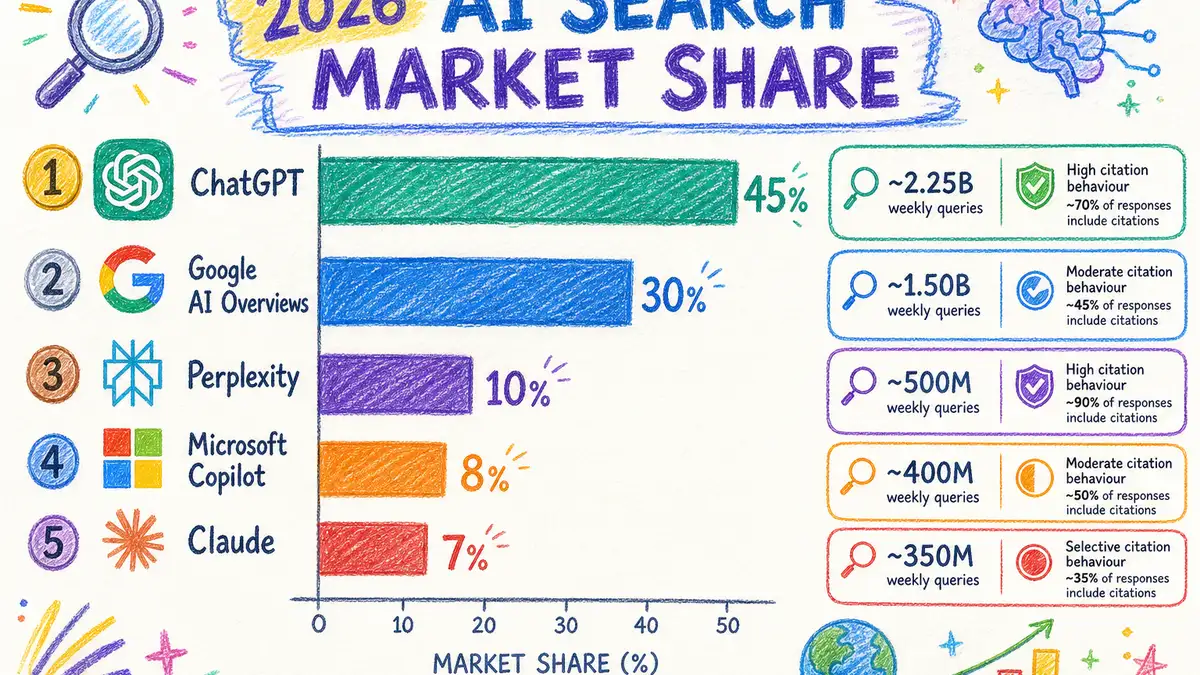
The AI search landscape in 2026 is no longer a single-channel story. Google still controls roughly 80% of global search, but AI-native answer surfaces now capture an estimated 15-20% of informational query volume according to Digital Applied's 2026 AI search engine market share analysis. Conductor's 2026 benchmarks confirm that AI Overviews now appear on 25% of all Google searches on average, with health queries seeing AI summaries 48.7% of the time and finance 25.8% — vertical variance that matters enormously when budgeting AEO investment by sector.
ChatGPT remains the dominant AI referrer by a wide margin. Conductor's analysis of 13,770 enterprise domains found that 87.4% of all AI referral traffic originates from ChatGPT, with Digital Applied estimating it handles 250-500 million search-intent queries per week. Similarweb data cited by Vertu shows ChatGPT's share of the AI chatbot market easing from 87.2% to 68% over twelve months as Google Gemini grew to around 18.2%, but in absolute terms the category is expanding so fast that share loss has not slowed query growth.
Perplexity now serves over 100 million monthly active users and processes around 50 million search-intent queries per week, with a heavy professional skew toward researchers, analysts, journalists and developers. Microsoft Copilot, integrated across Bing and Microsoft 365, handles an estimated 80-120 million weekly search-intent queries with roughly 64% of usage in workplace contexts — making it strategically important for UK B2B brands whose buyers live inside Microsoft's productivity stack. Anthropic's Claude continues to diversify across knowledge-work tasks; the company's March 2026 Economic Index reports that the top 10 tasks accounted for 19% of Claude traffic in February 2026, down from 24% in November 2025, indicating broadening adoption.
UK-specific data is still maturing, but the directional picture is clear. The UK Office for National Statistics reported around 25% of UK businesses using some form of AI by late 2025, with adoption concentrated in larger firms and in information, finance, and professional services. A March 2026 survey from the British Chambers of Commerce and Paragon Bank found UK SMEs lagging on systematic AI integration despite high awareness — meaning the UK market currently rewards brands that move on AEO ahead of their peers.
| Platform | Approx. Weekly Queries (2026) | Share of AI Referral Traffic | Primary Citation Behaviour |
|---|---|---|---|
| ChatGPT / ChatGPT Search | 250-500M | 87.4% | Authority domains; Wikipedia + institutional references |
| Google AI Overviews / AI Mode | ~25% of Google queries | Moderate | 59.8% brand sites; heavy YouTube and Reddit co-citation |
| Perplexity | ~50M | Minority, growing | Reddit 16.9%; balanced mention + link behaviour |
| Microsoft Copilot (Bing) | 80-120M | Limited published data | Public web + enterprise content blend |
| Claude (Anthropic) | Not disclosed | Emerging | Diversifying task usage; reference-grade sources |
Sources: Conductor 2026 AEO/GEO Benchmarks; Digital Applied 2026; Otterly AI Citations Report 2026; Anthropic Economic Index March 2026; Similarweb via Vertu 2026.
The traffic paradox sharpens this picture. AI referrals are still only 1.08% of website traffic in aggregate, but they convert at approximately 14.2% — roughly five times the 2.8% rate of traditional Google organic, per analysis published in Otterly's 2026 AI Citations Report and corroborated by Exposure Ninja's data. Conductor's 2026 research also found that 32% of CMOs now rank AEO and GEO as their top marketing priority for the year, and 94% are increasing or maintaining AI-search investment versus 2025. Our AI in Marketing 2026 research report covers the broader adoption signals driving this shift.
How Should UK Businesses Optimise for AEO?
Effective AEO spans three areas: on-site content structure, off-site presence, and technical infrastructure. Each reinforces the others, and neglecting any one area limits the impact of the others.
On-Site: Answer-First Content Structure
AI systems favour clearly structured, extractable content. Every page targeting AI citations should follow these principles:
Lead With a Direct Answer
The first 40–60 words of each section should completely answer the question in the heading. No preamble, no filler. AI extracts the opening passage first.
Use Question-Based H2 Headings
Mirror how people prompt AI platforms. "What should I look for when choosing an SEO agency?" rather than "SEO agency UK." AI maps questions to headings directly.
Keep Paragraphs to 2–4 Sentences
Each paragraph covers a single clear idea. AI models struggle with dense blocks and perform better with short, focused paragraphs that pass the "Taco Bell Test."
Include Data Tables and Citations
Tables are highly extractable and frequently cited. AI-cited content averages 8–12 external citations per 1,500 words versus 2–4 for typical SEO content.
Add 6–8 FAQ Entries
Concise 30–50 word answers capture query fan-out and create additional extraction targets. Each FAQ is an independent citation opportunity.
For an in-depth look at how AI is transforming content production workflows—and how to humanise AI content without losing efficiency—our dedicated guide covers the practical frameworks B2B teams are using.
Off-Site: Building Your Citation Ecosystem
Given the 90/10 third-party citation split, off-site presence is not optional. Priority actions for UK B2B businesses include:
- Review platforms: Maintain complete, detailed profiles on G2, Capterra, and Trustpilot. 100% of ChatGPT-recommended software has Capterra reviews.
- Community platforms: Participate genuinely on Reddit and Quora. Reddit citations from AI platforms surged 87% since mid-2024, though they have since declined approximately 50%—making authentic, high-quality contributions more important than volume.
- Original research: Publish proprietary data and analysis. When a study gets cited by three different publications, it creates three independent off-site citations from a single asset.
- YouTube: Video content strategy is now core to AI visibility. YouTube is the second-most-cited domain in Google AI Mode, ahead of Reddit and Facebook.
Technical: Ensuring AI Crawlers Can Access Your Content
Technical AEO focuses on removing barriers between your content and AI crawlers:
- Robots.txt: Allow GPTBot (ChatGPT), Google-Extended (AI Overviews), Claude-Web (Claude), and PerplexityBot (Perplexity). Block training-only bots like CCBot and GPTBot-training if you want to prevent training use without blocking search.
- WAF/Firewall: Cloudflare blocks AI crawlers by default since July 2025. Whitelist AI user agents or disable AI bot blocking in Security settings.
- Server-side rendering: AI crawlers cannot execute JavaScript. If your content only appears after JS runs, AI will miss it entirely. Test by viewing pages with JavaScript disabled.
- Performance: Target under 200ms TTFB and under 1MB total page weight. Slow response times cause AI crawlers to abandon pages before reading content.
- Schema markup: Implement attribute-rich Article, FAQPage, and Organization schema. Attribute-rich schema achieves a 61.7% AI citation rate versus 41.6% for generic schema. Critically, generic schema with minimal fields performs worse than having no schema at all.
For a detailed technical walkthrough, see our AEO audit guide. If you're running a full site health check, our SEO audit checklist covers 75+ checks including AI readiness.
Schema Warning
Generic schema with minimal fields performs worse than no schema at all. Attribute-rich schema achieves a 61.7% citation rate versus 41.6% for generic. Always populate pricing, ratings, specs, author credentials, dates, and word counts—every property relevant to the schema type.
How Do You Measure AEO Success?
Traditional SEO metrics—keyword rankings, CTR, organic sessions—don't fully capture AI visibility. AEO requires a new measurement framework built around Share of AI Voice: how frequently your brand appears in AI responses relative to competitors for your target queries.
Key Metrics Framework
| Metric Tier | What to Measure | Tools |
|---|---|---|
| Tier 1: Visibility | Citation presence in AI Overviews, attribution frequency across platforms, accuracy of brand descriptions | Manual prompt audits, Semrush AI Visibility, HubSpot AEO Grader |
| Tier 2: Quality | Citation trends over time, entity consistency across prompt variations, competitive share within topic clusters | Conductor, BrightEdge, Ahrefs AI References |
| Tier 3: Revenue | AI referral traffic, conversion rate from AI sources, attributed revenue from AI channels | GA4 custom channels, UTM parameters |
For practical tracking, start by setting up GA4 custom traffic segments for referral traffic from chatgpt.com, perplexity.ai, gemini.google.com, and claude.ai. Then run monthly manual audits of 10–20 target prompts across major platforms, documenting which brands appear and which sources are cited. The AEO tool market has exploded from 7 products to over 150 since March 2025, though Rand Fishkin of SparkToro cautions that tool selection requires critical evaluation of methodology and measurement transparency. For a deeper dive into AEO measurement and KPIs, see our dedicated guide.
What UK Regulations Affect AEO?
The UK regulatory environment creates both constraints and competitive advantages for businesses investing in AEO.
CMA Strategic Market Status. In October 2025, the UK Competition and Markets Authority designated several major AI platforms under its Strategic Market Status framework, giving it powers to investigate and intervene in AI search markets. This is significant because it creates potential regulatory constraints on how AI platforms source and display content.
Copyright framework. The UK government's proposed publisher opt-out mechanism (announced January 2026) would allow publishers to block AI training on their content. The March 2026 deadline for the copyright framework consultation means the rules are still evolving. UK businesses should monitor this closely, as it could affect which content AI platforms can access and cite.
GDPR as competitive advantage. The UK ICO released its initial analysis of regulatory challenges posed by agentic AI in January 2026, emphasising compliance with existing UK GDPR. For UK businesses, this creates opportunity: demonstrating GDPR compliance, data minimisation, and transparent AI use builds the kind of trust signals that both regulators and AI platforms value. UK-specific expertise in data protection and regulatory compliance is a genuine differentiator that global competitors cannot easily replicate.
British English content advantage. UK businesses writing in British English for British audiences have a natural AEO advantage for UK-focused queries. AI platforms distinguish between regional content, and locally relevant, locally authored content carries higher trust signals for geographically specific queries. This makes investing in high-quality, UK-specific content a strategic priority.
Frequently Asked Questions
What does AEO stand for?
AEO stands for Answer Engine Optimisation. It is the practice of structuring your content so that AI answer engines like ChatGPT, Google AI Overviews, Perplexity, and Claude cite your brand as a source when answering user queries. Whereas SEO focuses on ranking in traditional search results, AEO focuses on being cited inside the AI-generated answer itself. The two disciplines overlap heavily but require different content patterns — direct-answer paragraphs, structured schema markup, and brand authority signals matter more for AEO, which is why Whitehat treats it as a distinct layer of strategy.
Where can I find an AEO agency in the UK?
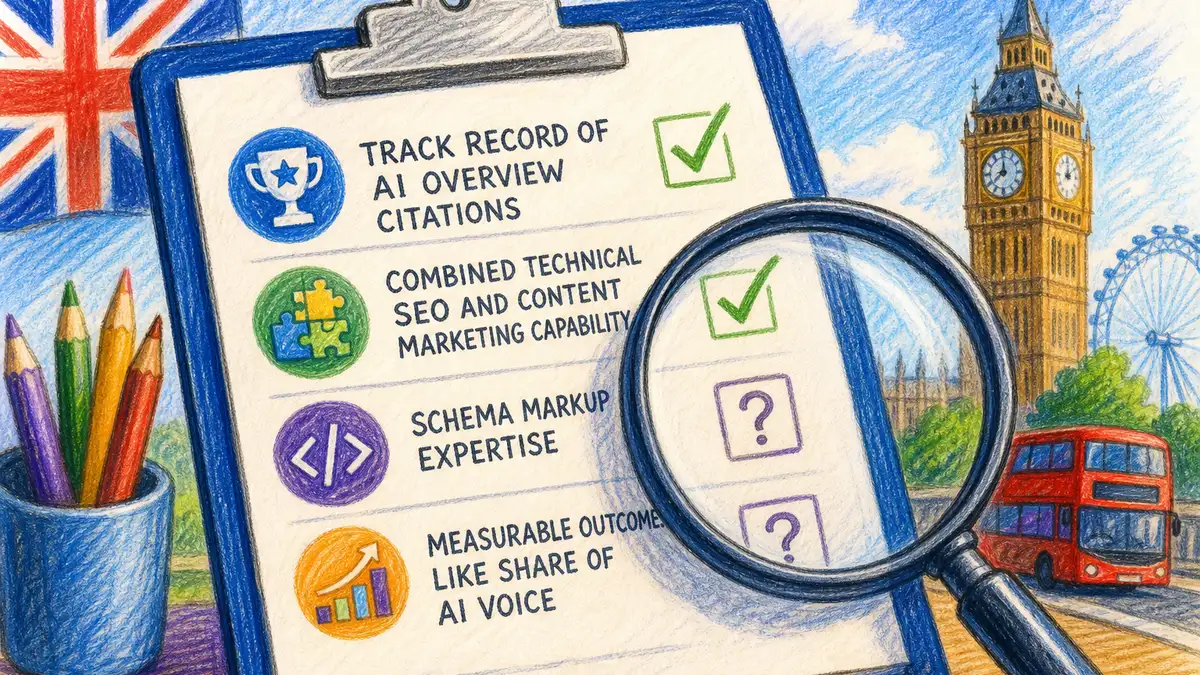
Choose a UK AEO agency on four criteria: a documented track record of earning AI Overview and ChatGPT citations for clients, combined technical SEO and content marketing capability under one roof, demonstrable schema markup expertise, and measurable outcomes reported as Share of AI Voice rather than vanity metrics. Whitehat's AI search optimisation services are built around exactly that combination, with monthly citation audits across ChatGPT, Perplexity, Claude, and Google AI Overviews.
What is the difference between AEO and SEO?
SEO optimises content for search engine result pages—the traditional ten blue links. AEO optimises content for inclusion in AI-generated answers from platforms like ChatGPT, Google AI Overviews, and Perplexity. They are complementary strategies: SEO provides the foundation of crawlable, authoritative content, while AEO adds structural refinements that make content easier for AI to extract and cite. Research shows AEO techniques boost AI visibility by up to 40% beyond good SEO alone.
How much does AEO cost for UK businesses?
AEO builds on existing SEO infrastructure, so marginal costs are modest for businesses with established content programmes. Key investments include content restructuring (question-based headings, direct answers, FAQ sections), schema markup implementation, and off-site presence building on review platforms and community sites. Most UK businesses can begin AEO within their existing SEO budgets by adjusting content creation processes. Whitehat SEO's AEO services integrate these techniques into comprehensive SEO programmes.
Which AI platforms should UK B2B businesses prioritise?
Google AI Overviews should be the primary focus as it appears in 52% of search queries and leverages existing organic rankings. ChatGPT is second priority with 700 million weekly users and growing B2B adoption. Perplexity matters for real-time information queries. Rather than optimising for one platform, build content that works across all—structured, cited, and authoritative content performs well everywhere.
How long does it take to see AEO results?
AI citation improvements can appear within 4–8 weeks of implementing structural changes, faster than traditional SEO ranking improvements. However, building sustainable AI visibility requires 3–6 months of consistent effort across on-site content, off-site presence, and technical infrastructure. Brand familiarity in AI training data compounds over time, creating first-mover advantages that become increasingly difficult for competitors to overcome.
Can small businesses compete with larger companies in AI search?
Yes—and this is one of AEO's most promising aspects. AI platforms prioritise content quality, specificity, and authority over domain size. A specialist UK business with deep expertise in a niche topic can outperform larger competitors in AI citations for that topic. The key is producing highly specific, data-backed, well-structured content with genuine expertise signals. Niche authority and authentic third-party validation matter more than brand size.
Is AEO relevant for businesses outside of technology?
Absolutely. While technology companies were early adopters, AI search impacts every sector where buyers research before purchasing. Professional services, healthcare (dental practices optimising for AI search), financial services, education, and manufacturing all see significant AI search activity. The 6sense data showing 94% of B2B buyers using AI spans all enterprise technology purchasing—and consumer adoption is following the same trajectory across all sectors. AI search optimisation services SEO audit services local SEO services link building services SEO pricing guide