
What Are Large Language Models? The 2026 Guide for UK Business Leaders
• By Clwyd Probert, CEO of Whitehat SEO
Large language models (LLMs) are AI systems trained on vast quantities of text data that generate human-like responses by predicting the most probable next word in a sequence. Models such as GPT-5, Claude 4.5, and Gemini 3 now power everything from customer service chatbots to marketing automation, code generation, and AI-powered search. The global LLM market reached $7.77 billion in 2025 and is projected to hit $35 billion by 2030, according to Precedence Research. For UK businesses, understanding how LLMs work is no longer optional: it is a competitive necessity.
Only 23% of UK businesses have adopted AI tools, according to the Office for National Statistics (September 2025), compared with 78% of organisations globally. That adoption gap represents both a challenge and an opportunity. This guide, developed by Whitehat SEO's AI consultancy and implementation team, explains what LLMs are, how they work, and what they mean for UK businesses in practical terms.
How Do Large Language Models Actually Work?
Large language models are built on a neural network architecture called the transformer, introduced in Google's 2017 paper "Attention Is All You Need." The transformer's key innovation is a mechanism called self-attention, which allows the model to consider how every word in a passage relates to every other word simultaneously. Think of it like a skilled editor who reads an entire paragraph at once, understanding that "bank" means a financial institution in one sentence and a riverbank in the next.
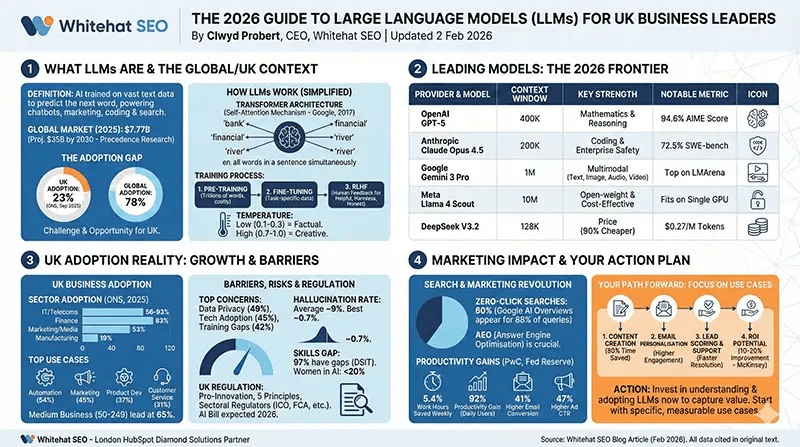
LLMs are trained in three stages. First, pre-training: the model reads trillions of words from books, websites, and documents, learning patterns by repeatedly predicting what word comes next. GPT-5's training data is estimated to have cost over $100 million to process. Second, fine-tuning: the model is refined on smaller, task-specific datasets to improve accuracy. Third, reinforcement learning from human feedback (RLHF): human evaluators rank the model's responses, teaching it to produce answers that are helpful, harmless, and honest.
When you type a prompt, the LLM calculates the probability of each potential next word from a vocabulary of over 50,000 options and selects the most likely continuation, one token at a time. A "temperature" setting controls creativity: low values (0.1 to 0.3) produce factual, consistent outputs, while high values (0.7 to 1.0) generate more varied and creative responses.
Which LLMs Are Leading the Market in 2026?
The LLM landscape has evolved rapidly. Six major providers now compete at the frontier, each with distinct strengths relevant to UK businesses.
| Provider | Model | Context Window | Key Strength |
|---|---|---|---|
| OpenAI | GPT-5.2 | 400K tokens | Mathematics, reasoning |
| Anthropic | Claude Opus 4.5 | 200K tokens | Coding, enterprise safety |
| Gemini 3 Pro | 1M tokens | Multimodal, research | |
| Meta | Llama 4 Scout | 10M tokens | Open-weight, cost |
| DeepSeek | V3.2 | 128K tokens | Price (90% cheaper) |
OpenAI's GPT-5, launched in August 2025, scored 94.6% on the AIME 2025 mathematics benchmark and now serves over 800 million weekly active users and one million business customers. OpenAI's annualised revenue reached $20 billion, a 233% increase from 2024.
Anthropic's Claude Opus 4.5, released in November 2025, focuses on enterprise safety through its Constitutional AI approach and scores 72.5% on the SWE-bench coding benchmark. Google's Gemini 3 (January 2026) claims the top position on LMArena benchmarks with native multimodal capabilities across text, image, audio, and video.
The open-source movement is equally significant. Meta's Llama 4 Scout offers a 10 million token context window (equivalent to approximately 7,500 novels) and fits on a single GPU. DeepSeek's V3.2 delivers frontier-level reasoning at $0.27 per million input tokens, roughly 90% cheaper than competitors. The Hugging Face platform now hosts over two million models, with the second million added in just 335 days.
How Are UK Businesses Adopting LLMs?
UK business adoption of AI is accelerating but remains behind global averages. The ONS reported in September 2025 that 23% of all UK businesses now use AI tools, up from just 9% in September 2023. For medium-sized enterprises (50 to 249 employees), adoption is significantly higher at 65%.
Sector-specific adoption varies considerably. IT and telecoms leads at 56 to 93%, followed by finance at 83% and marketing/media at 53%. Manufacturing trails at 19%. The primary use cases among UK adopters are task automation (54%), marketing and advertising (45%), product development (37%), and customer service (31%).
The UK's AI sector has grown 150 times faster than the broader economy since 2022, according to the Department for Science, Innovation and Technology (DSIT). Between 2022 and 2024, AI company revenue grew from £10.6 billion to £23.9 billion, a 125% increase. Employment in the sector rose 72% to 86,139 jobs. London accounts for 45% of UK AI companies, with Manchester named the most AI-ready city outside the capital.
Yet barriers persist. Nearly 49% of UK businesses cite data privacy and security as their top concern, followed by technology adoption struggles (45%) and training gaps (42%). Crucially, 59% of UK companies are not upskilling their workforce in generative AI despite the investment surge. Whitehat SEO's comprehensive guide to AI for marketers addresses these adoption challenges in detail.
What Does the UK Regulatory Landscape Look Like?
The UK has deliberately chosen a different path from the European Union's prescriptive AI Act. Instead of a single piece of comprehensive legislation, the UK government's 2023 white paper, "A Pro-Innovation Approach to AI Regulation," established five cross-sector principles: safety, transparency, fairness, accountability, and contestability. These principles are enforced by existing sectoral regulators: the ICO for data protection, the FCA for financial services, the CMA for competition, and Ofcom for communications.
The UK AI Security Institute (formerly the AI Safety Institute), established in November 2023 with £100 million annual funding, has tested over 30 of the world's most advanced AI models. Its December 2025 Frontier AI Trends Report found that AI models can now complete expert-level cybersecurity tasks requiring 10+ years of human experience, and autonomy success rates on hour-long software tasks improved from under 5% in late 2023 to over 40% in 2025.
For UK businesses deploying LLMs, the ICO's 2025 guidance requires a lawful basis for processing personal data through AI systems, mandatory Data Protection Impact Assessments for high-risk AI applications, and compliance with Article 22 of UK GDPR regarding automated decision-making. A comprehensive AI Bill is expected in 2026. This principles-based approach gives UK businesses more flexibility than their EU counterparts, who face stricter compliance requirements under the AI Act.
How Are LLMs Changing Marketing and Search?
LLMs are fundamentally reshaping how people find information and how businesses reach customers. ChatGPT now receives over 3.7 billion visits per month, with users sending more than one billion prompts daily. Google AI Overviews appear for 88% of informational search queries. Perplexity AI has grown to 22 million monthly active users and handles over 500 million queries per month.
The impact on traditional search is significant. According to Ahrefs, the click-through rate for the number one organic search result drops by 34.5% when an AI Overview is present. Seer Interactive reports a 61% decline in organic click-through rates for queries where AI Overviews appear. Sixty percent of all Google searches now end without any click at all. This shift is why Whitehat SEO developed its answer engine optimisation service: to help businesses maintain visibility in both traditional and AI-powered search.
For marketing teams specifically, LLMs are delivering measurable productivity gains. Workers using generative AI save an average of 5.4% of work hours weekly (approximately 2.2 hours per 40-hour week), according to the Federal Reserve Bank of St. Louis. PwC's November 2025 Global Workforce Survey found that daily AI users report 92% productivity improvements compared with 58% for infrequent users. AI-optimised marketing emails achieve 41% higher conversion rates, and AI-generated ad creatives produce a 47% increase in click-through rates.
Businesses that want to appear in AI-generated answers need to structure content for extraction rather than just ranking. This means leading with direct answers, including statistics with source attribution, and using schema markup that AI crawlers can parse. Learn more about how to rank in ChatGPT and other AI search engines in Whitehat SEO's dedicated guide.
What Are the Limitations and Risks of LLMs?
LLMs are not infallible, and UK businesses need to understand their limitations before deploying them. The most significant risk is hallucination: LLMs generate plausible-sounding text that is factually incorrect. The best-performing models achieve hallucination rates as low as 0.7% (Gemini 2.0 Flash, per the Vectara Leaderboard, December 2025), but average rates remain around 9%. OpenAI's own 2025 research showed that newer reasoning models can score even higher on certain hallucination benchmarks.
The business consequences are real. Deloitte (2025) found that 47% of enterprise AI users have made at least one major business decision based on hallucinated content. Microsoft reports that knowledge workers now spend 4.3 hours per week fact-checking AI outputs. Techniques such as Retrieval Augmented Generation (RAG), which grounds LLM responses in verified source documents, can reduce hallucinations by up to 71%.
The UK faces a specific challenge around AI skills. AI is now the most scarce technical skill in the UK, with 52% of tech leaders reporting AI skills shortages, a 114% increase year on year (Nash Squared, May 2025). DSIT's AI Labour Market Survey 2025 found that 97% of organisations identify at least one AI skills gap. Women represent just 20% of AI roles, down four percentage points since 2020. Addressing these gaps requires sustained investment in training and responsible implementation frameworks.
How Should UK Businesses Approach LLM Adoption?
Practical LLM adoption starts with identifying specific, measurable use cases rather than chasing the latest model release. McKinsey estimates that companies using AI in sales and marketing see a 10 to 20% improvement in ROI, with high performers generating £3.70 to £10.30 return for every pound invested in generative AI. IBM's October 2025 study confirmed that 66% of EMEA enterprises report significant productivity gains from AI implementation.
For marketing and sales teams, the most impactful starting points include content creation and optimisation (reducing production time by up to 80%), email personalisation, ad creative generation, lead scoring, and customer service automation. HubSpot's Breeze AI suite, for example, resolves over 50% of support tickets automatically and helps users close tickets 40% faster. Businesses already using HubSpot can explore these capabilities through Whitehat SEO's HubSpot onboarding programmes.
The Penn Wharton Budget Model (September 2025) projects that AI will increase productivity and GDP by 1.5% by 2035 and nearly 3% by 2055. The IMF estimates AI could add £470 billion to the UK economy by 2035. These are not distant possibilities: they are already materialising. The businesses that invest in understanding and adopting LLMs now will be best positioned to capture that value.
Frequently Asked Questions
What is the difference between an LLM and AI?
AI (artificial intelligence) is the broad field of creating machines that can perform tasks requiring human intelligence. An LLM is a specific type of AI: a neural network trained on text data that specialises in understanding and generating language. All LLMs are AI, but not all AI systems are LLMs.
How much does it cost to train a large language model?
Training costs vary enormously. GPT-4 reportedly cost over $100 million to train, while DeepSeek-R1 achieved comparable performance for approximately $6 million. Running pre-trained models is far cheaper: API costs start from $0.27 per million tokens. Most UK businesses use existing models rather than training their own.
Are LLMs safe for UK businesses to use?
LLMs are safe when deployed with proper governance. UK businesses must ensure compliance with UK GDPR, conduct Data Protection Impact Assessments for high-risk applications, and implement human oversight for automated decisions. The UK AI Security Institute provides guidance and evaluation frameworks.
What are hallucinations in AI?
AI hallucinations occur when an LLM generates confident, plausible-sounding text that is factually incorrect. The best models hallucinate as little as 0.7% of the time, but average rates remain around 9%. Businesses should always verify AI outputs for critical decisions and consider implementing RAG systems to reduce errors.
Which LLM is best for UK businesses?
There is no single best LLM. GPT-5 leads in general reasoning and mathematical tasks. Claude Opus 4.5 excels at coding and enterprise safety. Gemini 3 offers strong multimodal capabilities. The right choice depends on your specific use case, budget, data privacy requirements, and integration needs. Whitehat SEO's AI consultancy helps UK businesses evaluate and implement the right solution. HubSpot CRM view our pricing
References and Sources
- Precedence Research, "Large Language Model Market," January 2026
- Office for National Statistics, "Business AI Adoption," September 2025
- OpenAI, "Introducing GPT-5," August 2025
- Anthropic, "Claude Opus 4.5," November 2025
- Stanford HAI, "AI Index Report 2025"
- McKinsey & Company, "The State of AI," 2025
- DSIT, "AI Sector Study 2024," September 2025
- UK AI Security Institute, "Frontier AI Trends," December 2025
- Ahrefs, "AI Overviews CTR Study," 2025
- Federal Reserve Bank of St. Louis, "Generative AI and the Workforce," February 2025
- Vectara, "Hallucination Leaderboard," December 2025
- PwC, "Global Workforce Survey," November 2025