
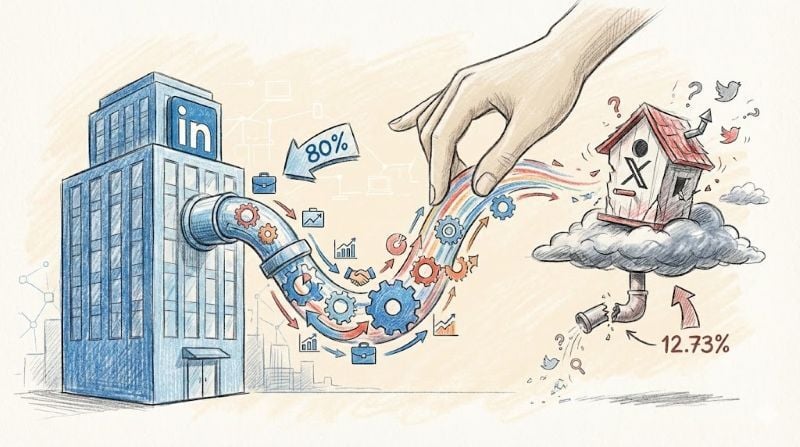
X (formerly Twitter) should receive 15–20% of your B2B social media resources in 2026, with LinkedIn commanding the remaining 65–70%. LinkedIn now generates 80% of all B2B social media leads compared to X's 12.73% — a dramatic fall from X's roughly 32% share in 2020. For UK businesses, X remains valuable for real-time engagement and thought leadership, but it should no longer function as a primary lead generation channel.
The platform's transformation since Elon Musk's 2022 acquisition has fundamentally reshaped its value proposition for B2B marketers. Declining organic reach, brand-safety concerns, monetised verification, and an algorithm that suppresses external links have changed how businesses should approach X strategically. This guide gives UK marketing teams the data-driven foundation to decide X's role in their social media marketing mix — whether you lead demand generation at a B2B SaaS firm, run professional-services marketing, or manage multi-channel campaigns through your HubSpot platform.
Key Takeaways
• LinkedIn dominates B2B lead generation: 80% of B2B social leads now come from LinkedIn versus 12.73% from X.
• X conversion rates have dropped: 0.69% visitor-to-lead versus LinkedIn's 2.74%.
• The algorithm penalises external links: posts with links can receive up to 94% less reach.
• X Premium is now near-mandatory: paying accounts receive roughly 10× more reach.
• The UK user base is declining: 22.9 million users, down from 25.6 million in early 2024.
80%
of B2B social leads
now come from LinkedIn, versus 12.73% from X
0.69%
X conversion rate
visitor-to-lead, versus LinkedIn's 2.74%
~10×
reach from X Premium
median reach advantage over free accounts (Buffer)
Is X (Twitter) still worth it for B2B in 2026?
Short answer: yes, but only in a specialised supporting role. X retains genuine value for real-time industry conversation, executive thought leadership, and customer service — 64% of UK business decision-makers say they discover new industry perspectives through X, versus 41% via LinkedIn articles. What has collapsed is X's usefulness as a primary lead-generation engine. The honest position for most UK B2B teams is to keep a deliberate, risk-aware presence on X while shifting the bulk of lead-generation effort to LinkedIn.
How X changed for B2B marketers after the Musk acquisition
The shift from Twitter to X was never cosmetic. Since Musk's roughly £35 billion acquisition in October 2022, three structural changes have redefined the platform for business marketing. First, algorithmic prioritisation moved away from external link clicks toward native engagement — likes, replies and reposts. Second, verification became monetised through X Premium. Third, distribution mechanics were rebuilt to favour native video over text and link-sharing.
The platform's workforce was reduced by roughly 80% after the acquisition, with downstream effects on content moderation, support responsiveness, and feature velocity. The July 2023 rebrand signalled Musk's pivot toward an "everything app" spanning payments, messaging and content — which also shifted the core user base away from the journalists, media professionals and cross-industry thought leaders who once made Twitter a strong B2B venue. For marketers whose audiences have thinned out or migrated to alternatives, that demographic drift matters as much as any algorithm tweak.
The monetisation of verification — and why it erodes B2B trust
Before the acquisition, the blue checkmark was earned and free, reserved for accounts notable enough to warrant the signal. X Premium restructured that entirely: in the UK, verification costs £8 per month per account. A large organisation maintaining verification across 50+ departmental, regional and executive accounts could spend around £4,800 a year on verification alone. The deeper cost is reputational — verification now signals willingness to pay rather than established authority. For UK B2B firms competing on trust, especially in regulated sectors such as financial services, law and consulting, that erosion of verification's signalling power is a real loss, and it sits awkwardly against value propositions built on earned reputation.
The numbers: a B2B landscape in transition
X claims roughly 557–611 million monthly active users globally across 2024–2025, though figures vary widely given the platform's private status. Daily active users hover around 200–251 million, with some late-2025 reports indicating a drop toward 132 million. The UK story is starker: British users total about 22.9 million, down from 25.6 million in early 2024 — an 8–10.7% annual decline, the steepest among major social platforms. Demographics skew 65.8% male, with 25–34s the largest segment at 33.8%, and 70% of British users still calling it "Twitter".
| Metric | X (Twitter) | |
|---|---|---|
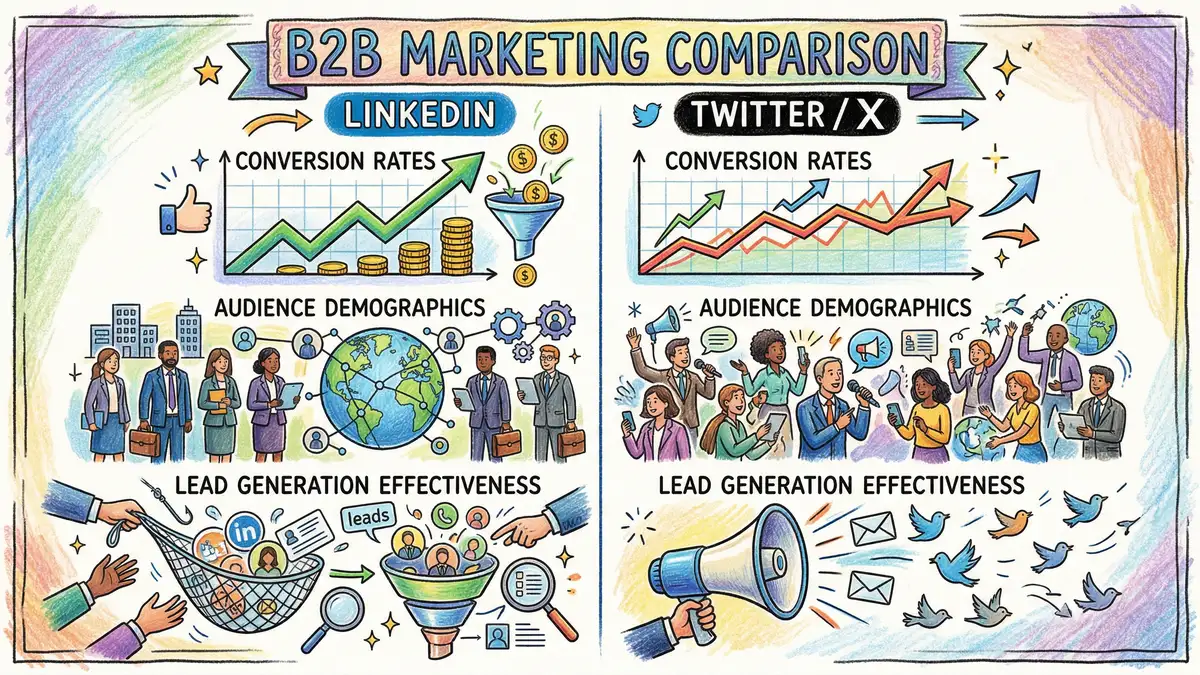
| B2B social leads share | 12.73% | 80% |
| Visitor-to-lead conversion | 0.69% | 2.74% |
| Organic reach (10k followers) | 2.3% | 5–8% |
| B2B marketer effectiveness rating | 12% | 76% |
One bright spot: 27% of X users have household incomes above £80,000, and the platform still surfaces genuine industry discovery. That intent gap — LinkedIn users arrive expecting professional content and active vendor evaluation, while X users arrive for news and commentary — explains the conversion differential more than any single metric.
Algorithm changes demand a different content strategy
X's open-source algorithm documentation reveals engagement weightings that should reshape B2B content. Replies that generate author engagement carry a 75× multiplier over likes; standard replies weight at 13.5×, and retweets at just 1×. Sparking conversation matters far more than accumulating passive engagement.
External links face severe suppression
Independent testing found posts with links received just 3,670 views against 133,000 for near-identical link-free posts — a potential 94% reach reduction. Musk effectively confirmed the throttling, advising users to "put the link in the reply." For B2B marketers used to driving traffic to landing pages, this is a fundamental shift toward delivering value within the platform itself. Your inbound marketing strategy must account for it when allocating X resources.
Content format performance: video earns ~9× more engagement than text-only and 6× more retweets than photos; GIFs give a ~6× engagement boost; images lift engagement ~3×; and threads earn ~3× more engagement than equivalent standalone posts.
X Premium provides significant reach advantages
Buffer's analysis of 18.8 million posts found the most consequential result: X Premium accounts receive roughly 10× more median reach than free accounts, and by March 2025 non-paying accounts showed median engagement of effectively 0% for link posts. Premium (£8/month) delivers a 4× in-network boost; Premium+ is stronger still. For any business maintaining a serious organic presence, subscription has become non-negotiable.
Recommended resource allocation for UK B2B
LinkedIn: 65–70% of social media resources — the primary lead-generation engine.
X (Twitter): 15–20% — thought leadership, real-time engagement, customer service.
Experimental channels: 10–15% — Threads, Bluesky and emerging platforms.
Industry performance varies: technology, SaaS, fintech and cybersecurity see ~58% of target audiences active on X — the strongest B2B category. Professional services sit at ~31%, while manufacturing has fallen sharpest at ~23%. Executive personal accounts achieve ~5× higher engagement than company pages, so weight effort toward named individuals.
Practical tactics that drive results on X
Video dominates, earning roughly 2× the organic reach of static images. Keep it to 15 seconds or less and use vertical 9:16 format, which shows ~14% lower CPMs for early adopters. For posting cadence and timing, the UK B2B pattern is consistent:
| Factor | Recommendation |
|---|---|
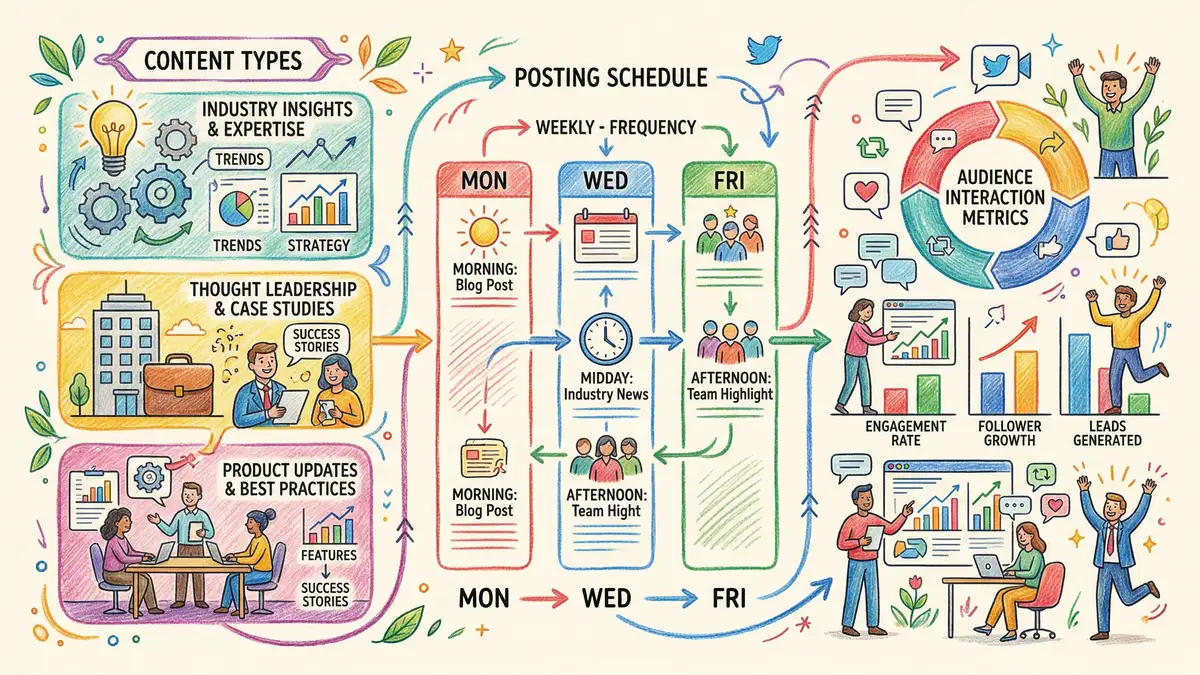
| Optimal frequency | 3–5 posts daily (~12/week average) |
| Best times (UK) | 8–10am and 1–3pm |
| Best days | Tuesday, Wednesday, Thursday |
| Avoid | Weekends, especially Sunday |
| Hashtags | Maximum 1–2, mid-tweet placement |
Never start a post with a hashtag — the algorithm penalises it. X Spaces remains underused for B2B: research links a 10% rise in Spaces conversations to a ~3% lift in sales volume, with product demos, expert AMAs and customer-feedback sessions the strongest use cases.
UK compliance and brand-safety realities
The Advertising Standards Authority requires paid or incentivised content to be "obviously identifiable as advertising" — "#ad" or "Ad" prominently at the start, not "#spon" or "#gifted". The Digital Markets, Competition and Consumers Act 2024 brought proactive enforcement from 6 July 2025, with fines up to 10% of global turnover. ICO requirements under UK GDPR/PECR mandate consent for direct marketing, and the Data (Use and Access) Bill aligns PECR fines with GDPR — up to £17.5 million or 4% of global turnover.
Brand-safety warning
Kantar's Media Reactions 2024 report ranks X the least-trusted major advertising platform, with 26% of marketers planning to cut ad spend. X withdrew from MRC brand-safety audits and lost TAG certification in March 2024. Treat brand-safety monitoring as a non-negotiable cost of any paid presence.
Alternative platforms worth serious B2B consideration
Threads has emerged as the leading X alternative with 300+ million monthly actives and Instagram integration for instant audience access. Bluesky reached 23–31 million users by late 2024, with publishers reporting ~3× higher traffic than Threads and 4.5× more subscriber conversions — its decentralised AT Protocol appeals to tech-savvy professionals and journalists. LinkedIn remains the undisputed B2B leader, reportedly generating 277% more leads than Facebook and X combined, with superior targeting by job title, company size and industry. Integrating LinkedIn cleanly with your HubSpot implementation should be a priority.
Strategic recalibration, not abandonment
The data points to X transitioning from a primary B2B channel to a specialised supporting role: keep it for real-time engagement, thought leadership and customer service, and reallocate lead-generation budget to LinkedIn. X Premium is essential for any serious organic presence — the 10× reach advantage justifies the modest cost. Prioritise short video, drop external links from primary posts, favour executive accounts over company pages, limit hashtags, and post Tuesday–Thursday mornings. Dismissing X entirely risks losing access to real-time industry conversation and decision-maker attention; a disciplined, risk-aware presence is the prudent path.
Need help with your social media strategy?
Whitehat SEO helps UK B2B companies build social strategies that generate pipeline — not vanity metrics — across LinkedIn, X and emerging channels.
Let's Have a ChatFrequently asked questions
Is X (Twitter) still worth it for B2B marketing in 2026?
Yes, but in a reduced capacity. Allocate 15–20% of social resources to X for thought leadership and real-time engagement, and 65–70% to LinkedIn for lead generation. X Premium is essential — without it, organic reach approaches zero for link-based content.
How much has X's B2B lead generation declined?
X's share of B2B social media leads fell from around 32% in 2020 to 12.73% in 2024–2025, while LinkedIn now generates 80%. Conversion rates have dropped to 0.69% on X against LinkedIn's 2.74% — nearly a four-fold gap.
Should I pay for X Premium for my business account?
If you maintain an active presence, yes. Premium accounts receive roughly 10× more reach than free accounts. At £8/month the subscription pays for itself in visibility, particularly because link posts from non-paying accounts now see near-zero engagement.
Why has X verification lost its value for B2B?
Verification is now a paid subscription rather than an earned signal, so the blue checkmark indicates willingness to pay rather than established authority. For trust-led sectors such as finance, law and consulting, that erodes the social proof verification once provided.
What should replace X for B2B lead generation?
LinkedIn, primarily — it generates 80% of B2B social leads with far better targeting and conversion. Threads and Bluesky are worth a 10–15% experimental allocation, but neither yet matches LinkedIn for B2B pipeline.
Ready to build a social strategy that generates pipeline?
Get a free review of your channel mix and a 90-day plan covering LinkedIn, X and emerging platforms.
Book a Free ConsultationAbout the author
Clwyd Probert is founder of Whitehat SEO and a HubSpot Diamond Partner, and runs the London HubSpot User Group. He helps UK and US B2B companies build social and content strategies that attract, convert and retain customers at scale. Updated June 2026 with current X/LinkedIn platform data and UK compliance requirements.
Sources: Buffer — social media benchmarks; Kantar Media Reactions 2024; Advertising Standards Authority; ICO — PECR & direct marketing. Figures reflect 2024–2026 data. Last updated June 2026.