

UK B2B companies can optimise their digital marketing budget by focusing spend on high-ROI channels—SEO delivers 748% ROI versus 36% for PPC—implementing marketing automation to generate 80% more leads at the same cost, centralising budget control for attribution clarity, and applying the 70/20/10 allocation model: 70% to proven tactics, 20% to emerging opportunities, and 10% to experimental approaches.
Key Takeaways
- Marketing budgets have fallen to 7.7% of revenue—among the lowest levels since 2019—while 64% of CMOs lack sufficient budget to execute their strategies
- The 70/20/10 framework balances proven tactics (70%), growth opportunities (20%), and experimental initiatives (10%) for sustainable budget allocation
- SEO delivers 748% ROI with compound returns; marketing automation generates 80% more leads at the same cost
- Channel ROI varies dramatically: email returns £36-42 per £1 spent, while PPC delivers only 36% ROI
- Centralising budget control and attribution clarity prevents overspend and drives revenue-focused optimisation
Marketing budgets in 2026 face unprecedented pressure. According to recent industry surveys, marketing budgets have fallen to just 7.7% of overall company revenue—among the lowest levels since 2019 and well below the pre-pandemic average of 11%. Even more concerning, 64% of CMOs report they lack sufficient budget to execute their 2026 strategy.
For UK B2B companies operating in this "era of less," budget optimisation isn't merely desirable—it's fundamental to survival. Spreading resources too thinly across too many channels, investing in vanity metrics rather than revenue, or failing to implement proper attribution creates a death spiral of diminishing returns. Every pound becomes exponentially less effective.
At Whitehat SEO, we've worked with hundreds of UK B2B companies facing these exact challenges. As a HubSpot Diamond Partner, we've helped our clients recover 200%+ ROI through systematic budget optimisation using frameworks proven in competitive B2B markets. This guide shares the exact methods we use with enterprise clients—tailored for UK B2B reality.
What UK B2B Companies Should Actually Spend on Marketing
Before optimising allocation, you need to understand whether your overall budget is appropriate. Industry benchmarks provide essential context:
2026 UK B2B Marketing Budget Benchmarks
| Benchmark | Allocation | Source |
|---|---|---|
| Overall average | 7.7% of company revenue | Gartner 2024 |
| B2B-specific benchmark | 8% of revenue | Forrester 2024 |
| High-growth B2B companies | 10-12% of revenue | Industry consensus |
| UK digital ad market | £35.53 billion (up 13% YoY) | IAB UK 2025 |
| Digital allocation of paid spend | 57.1% (up from 54.9% in 2023) | IAB UK 2025 |
These benchmarks matter because they provide negotiation leverage when advocating for appropriate budget and realistic target-setting. If your company falls below these thresholds and is targeting aggressive growth, you'll need a budget conversation.
However, raw percentage isn't the full picture. Company stage, growth objectives, and market competition all influence appropriate spend. The critical question isn't "What should we spend?" but rather "What return must we achieve from our current spend to fund growth?"
The 70/20/10 Framework: Smart Budget Allocation for B2B
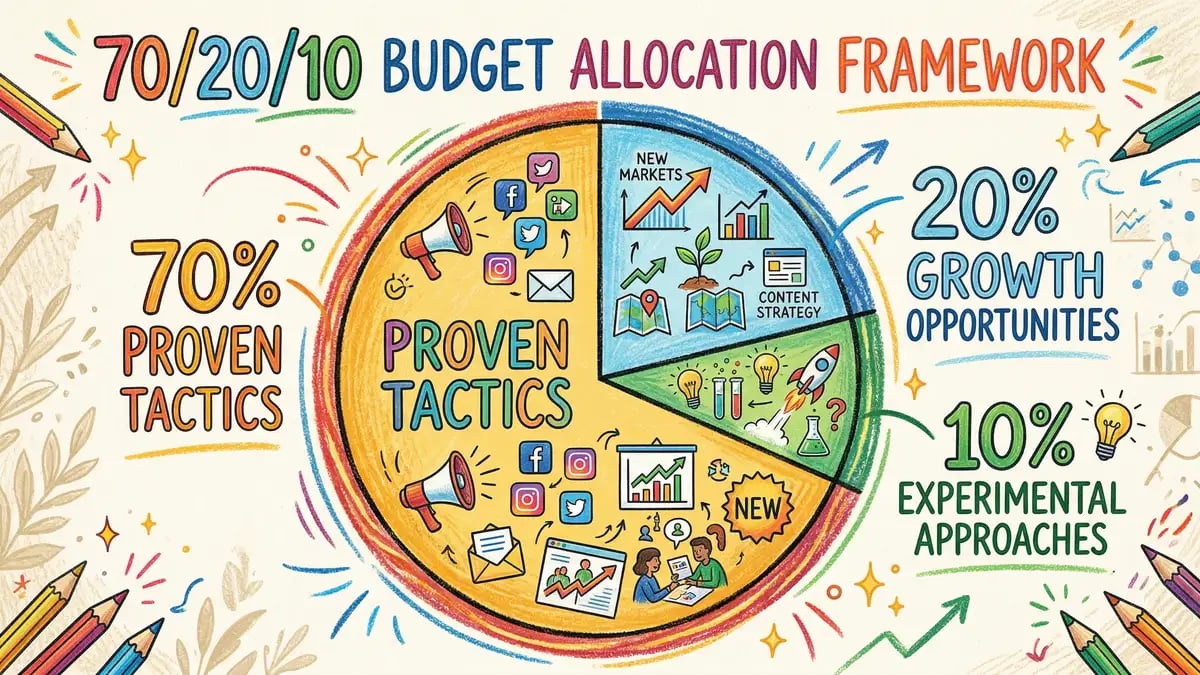
The most effective B2B marketing budgets aren't spread evenly across activities—they're strategically weighted. The 70/20/10 framework is the gold standard for sustainable growth:
Budget Allocation by Category
| Allocation | Category | Purpose & Examples |
|---|---|---|
| 70% | Proven Tactics | Activities delivering consistent ROI: established SEO, email nurturing, account-based campaigns, content production |
| 20% | Growth Opportunities | Scaling successful pilots: new content verticals, emerging channels, automation expansion, LinkedIn testing |
| 10% | Experimental | Testing new approaches: AI tools, emerging platforms, innovative content formats, new partnerships |
Why This Framework Works for B2B
The 70/20/10 split balances three critical business needs: predictability (70% on proven tactics ensures baseline performance), growth (20% on emerging opportunities drives improvement), and innovation (10% on experiments builds future capabilities).
Most B2B marketers fall into two extremes—either investing 95% in proven tactics with no innovation, creating long-term obsolescence, or spreading resources so thinly that nothing delivers measurable ROI. The 70/20/10 framework prevents both traps.
For UK B2B companies working with our strategic marketing services, this typically translates to: 70% on established SEO, content production, and email automation; 20% on scaling LinkedIn or testing new content verticals; 10% on emerging tools like advanced analytics platforms or AI-enhanced copywriting. The framework also provides clear decision criteria. When evaluating new opportunities, ask: "Is this replacing experimental budget or proven tactics?" If it's the latter, it probably shouldn't be funded.
Channel-by-Channel ROI: Where UK B2B Budgets Deliver Results
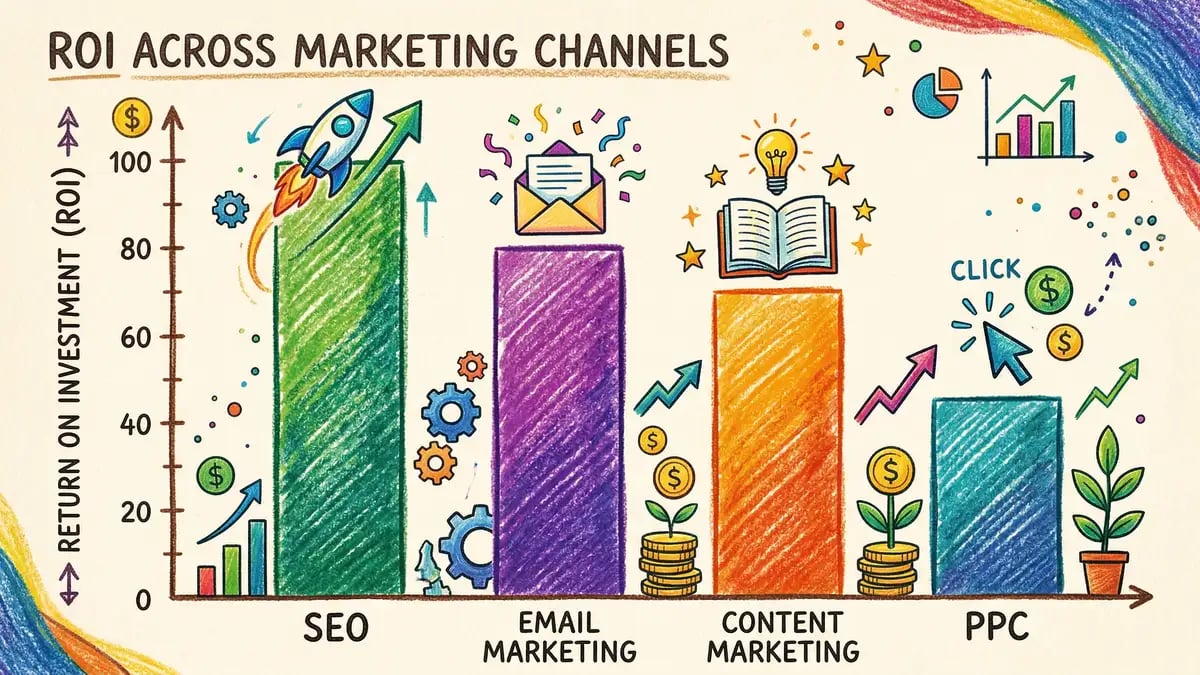
Not all marketing channels deliver equal returns. Understanding channel-specific ROI is fundamental to allocation decisions:
2026 B2B Marketing Channel ROI Rankings
| Channel | ROI | Source |
|---|---|---|
| SEO | 748% ROI | First Page Sage 2025 |
| Marketing Automation | 544% ROI | Nucleus Research 2024 |
| Email Marketing | £36-42 return per £1 spent | Industry consensus 2024 |
| Content Marketing | 3× more leads at 62% less cost | Demand Metric 2024 |
| LinkedIn Social | 76% rate as most effective | B2B marketing surveys 2024 |
| PPC (Google Ads) | 36% ROI | First Page Sage 2025 |
Understanding the SEO Advantage
The dramatic difference between SEO's 748% ROI and PPC's 36% isn't a measurement error—it reflects fundamental economics. SEO creates compound returns: content published today continues generating traffic and leads for years, while PPC spending stops the moment your budget ends.
This doesn't mean abandoning PPC entirely. For new product launches, immediate lead generation, or highly seasonal campaigns, PPC's speed provides value. But for sustainable growth, SEO should anchor your budget. Email marketing's exceptional £36-42 return per pound spent makes it indispensable for B2B nurturing. HubSpot's marketing automation capabilities report particularly strong email performance due to behavioural triggering and lead scoring.
Cost Per Lead Benchmarks: UK B2B 2026
| Channel | Cost Per Lead | Notes |
|---|---|---|
| Overall B2B average | £150-250 | Industry baseline |
| Referrals | £25 | Lowest-cost channel; requires existing network |
| Google Ads | £66-70 | Intent-driven; good for immediate leads |
| LinkedIn Ads | £75-150 | Higher quality; longer sales cycles |
| Trade shows | £840 | Highest cost; best for enterprise deals |
80%
More leads generated by marketing automation at the same cost
£36-42
Email marketing returns per £1 spent
748%
SEO ROI versus 36% for PPC
The Marketing Automation Multiplier: 80% More Leads, Same Budget
If any single investment consistently delivers budget optimisation impact, it's marketing automation. The statistics are compelling:
- Companies using marketing automation generate 80% more leads at the same cost (HubSpot State of Marketing, 2024)
- Marketing automation delivers 544% ROI on average (Nucleus Research, 2024)
- 76% of companies using marketing automation report ROI within the first year (LoudGrowth, 2024)
- 77% higher lead generation ROI compared to companies without automation
Why Marketing Automation Transforms Budget Efficiency
Marketing automation doesn't replace marketers—it multiplies their effectiveness by automating repetitive tasks and enabling sophisticated nurturing at scale:
- Lead scoring: Automatically prioritise sales-ready leads, eliminating waste on unqualified prospects
- Email sequences: Deploy triggered campaigns based on behaviour, ensuring timely, relevant messaging without manual intervention
- Lead nurturing: Maintain engagement with prospects throughout long B2B sales cycles without scaling headcount
- Attribution: Track which campaigns drive actual revenue, not just vanity metrics
- Cross-channel coordination: Deliver consistent messaging across email, landing pages, and social without duplicating effort
HubSpot's integrated platform combines email, lead management, analytics, and CRM in one system—eliminating the disconnection between marketing and sales that undermines ROI. When paired with proper SEO and content strategy, marketing automation can cut your cost per qualified lead by 40-60% within 12 months.
Why Attribution Clarity Is Your Most Important Budget Optimisation Tool
You can't optimise what you can't measure. Yet 68% of B2B companies still lack proper attribution across their marketing channels. Without knowing which activities drive revenue, you're allocating budget based on guess work.
The Three Attribution Models B2B Companies Actually Use
1. First-Touch Attribution
How it works: Credit 100% of the conversion to the first interaction a prospect had with your brand
Best for: Understanding which channels bring in new prospects
Example: Prospect discovers you through organic search, then converts 6 months later. All credit goes to SEO.
2. Last-Touch Attribution
How it works: Credit 100% of the conversion to the final interaction before purchase
Best for: Understanding which channel closes deals
Example: Same prospect, but they convert from a final email. Email receives all credit.
3. Multi-Touch Attribution
How it works: Distribute credit across all touchpoints in a customer journey
Best for: Understanding true channel contribution to revenue
Example: Same prospect interacted with SEO, then email, then a case study, then converted. Credit is distributed: 30% SEO, 40% email, 30% content. This requires sophisticated tracking and CRM integration.
HubSpot's integrated reporting makes multi-touch attribution feasible for mid-market companies. The key is centralising all customer interactions—web analytics, email, CRM, calls—in a single system so you can actually see the full journey. Once you implement proper attribution, budget allocation becomes obvious: you invest more in channels that demonstrably drive revenue.
Five Critical Budget Optimisation Mistakes (and How to Avoid Them)
We've reviewed hundreds of UK B2B marketing budgets. The same mistakes appear repeatedly. Avoid these five and you'll outpace 80% of your competitors:
Mistake 1: Spreading Budget Too Thinly Across Too Many Channels
The problem: Investing £5,000 in seven channels equals £714 per channel—below the minimum required to achieve any measurable results
The fix: Concentrate budget. Master two to three channels before expanding. In B2B, depth beats breadth every time.
Mistake 2: Optimising for Leads Instead of Revenue
The problem: 100 low-quality leads from untargeted campaigns look impressive on a dashboard but waste sales resources and produce zero revenue
The fix: Focus on cost per qualified lead, not total lead volume. Use lead scoring to eliminate prospects who won't convert. Measure sales cycle length and close rate, not just lead count.
Mistake 3: Stopping Investment When Early Results Appear
The problem: A new content campaign starts producing traffic in month 3. You cut budget to invest elsewhere. The campaign compounds in month 5-12, delivering 10× the initial return—which you've already abandoned
The fix: Set 12-month performance targets before launching. Commit to channels that have 3-6 month ramp times. Evaluate based on annual ROI, not monthly cycles.
Mistake 4: Relying on Agency Recommendations Without Internal Scrutiny
The problem: Agencies naturally recommend channels that justify their retainer, not channels that deliver the best ROI for your business
The fix: Require agencies to report on attribution and revenue, not just activity metrics. Ask: "What percentage of our leads come from this channel? What is our cost per qualified lead? What is our close rate for leads from this source?"
Mistake 5: Not Investing in Attribution Infrastructure
The problem: You spend £100,000 on marketing but allocate only £2,000 to tracking and analytics. You can't see which £80,000 is wasted
The fix: Invest 5-10% of marketing budget into proper CRM, analytics, and automation infrastructure. HubSpot, Salesforce, or similar integrated platforms pay for themselves within 12 months through waste elimination and optimisation clarity.
How to Build a Business Case for Marketing Budget Increases
If your current budget is below industry benchmarks, you'll eventually need to make a case for increases. Here's how to present data that CFOs actually listen to:
Step 1: Establish Current Performance Baseline
Document your current metrics: annual leads generated, cost per lead, sales cycle length, close rate, customer acquisition cost, lifetime value.
Step 2: Model Scenario Growth
Show conservative projections: "If we invest an additional £50,000 in SEO and marketing automation (industry-proven channels), we can expect to reduce cost per lead by 20% and generate 150 additional qualified leads annually."
Step 3: Calculate Revenue Impact
Multiply additional leads × average deal value × historical close rate = revenue impact. If your average deal is £25,000 and historical close rate is 20%, 150 additional leads = £750,000 in additional annual revenue.
Step 4: Calculate Payback Period
Additional investment (£50,000) ÷ additional annual profit (£750,000 × 30% gross margin = £225,000) = 2.7 month payback period. This is compelling to CFOs.
Most CFOs understand that marketing budgets below industry benchmarks limit growth. If you present conservative data showing positive ROI with a payback period under 12 months, you'll typically get approved.
Your 90-Day Budget Optimisation Implementation Plan
Ready to optimise your budget? Here's the exact sequence we use with clients:
Days 1-15: Audit and Baseline
- Document all current marketing spend by channel
- Extract 12 months of historical performance data (leads, cost per lead, sales cycle, close rate)
- Implement proper attribution tracking in your CRM
- Calculate current customer acquisition cost and lifetime value
Days 16-30: Identify Inefficiencies
- Identify underperforming channels (cost per lead 3× above average)
- Identify channels with longest sales cycles (often lower-quality leads)
- Review all paid campaigns—eliminate bottom 30% by performance
- Reallocate freed budget to top-performing channels
Days 31-60: Implement Automation
- Deploy lead scoring in your automation platform
- Set up email nurture sequences for different prospect segments
- Automate sales alerts for high-scoring leads
- Establish weekly performance reporting by channel
Days 61-90: Optimise and Scale
- Review attribution data; reallocate remaining budget based on revenue impact
- Increase investment in top two channels by 20-30%
- Allocate 10% of freed budget to experimental channels
- Establish quarterly budget review cycles with sales leadership
This 90-day sequence typically generates 15-30% reduction in cost per lead within 90 days, while maintaining or increasing total lead volume. Many clients see positive ROI on the optimisation investment within month 3.
Frequently Asked Questions: Digital Marketing Budget Optimisation
What's the ideal marketing budget for a B2B SaaS company with £2 million annual revenue?
Using the 8% B2B benchmark, you should allocate approximately £160,000 annually. For high-growth companies targeting 50%+ annual growth, increase to £200,000-240,000 (10-12%). If you're currently spending significantly below this, you're likely leaving growth on the table.
How do we choose between SEO and PPC if we have limited budget?
SEO wins for long-term compounding returns, but takes 3-6 months to produce measurable results. PPC delivers immediate leads but stops working the moment your budget ends. Optimal strategy: allocate 60% to SEO, 30% to PPC for immediate lead generation, 10% to testing. SEO compounds; PPC plugs the gap.
Can we do effective B2B marketing automation without a CRM?
Technically yes, but you'll lose 60% of the value. Automation tools like HubSpot, ActiveCampaign, or Marketo require CRM integration for proper lead scoring, sales prioritisation, and attribution tracking. Without CRM integration, you're just sending emails without understanding which leads matter.
How often should we rebalance our budget allocation?
Quarterly is ideal. Monthly is too reactive and causes whiplash. Annually is too infrequent in a fast-moving market. Quarterly reviews let you identify underperformers while giving new channels time to mature. Maintain your 70/20/10 framework as a guardrail—don't let any single channel drift above 30% of total spend.
What metrics should we present to leadership to prove marketing ROI?
Focus on revenue impact, not vanity metrics: customer acquisition cost (trend downward), customer lifetime value (trend upward), pipeline contribution (marketing should drive 40-60% of sales pipeline), and marketing-influenced revenue (revenue from deals touched by marketing at any stage). Avoid metrics like impressions, clicks, or total leads unless paired with revenue impact.
Ready to Transform Your Marketing Budget Into a Revenue Engine?
Budget optimisation doesn't require a complete overhaul. The frameworks, channel rankings, and implementation plan in this guide are battle-tested with UK B2B companies competing in every industry.
Whitehat SEO specialises in helping B2B companies extract maximum ROI from every marketing pound. We've helped our clients reduce cost per lead by an average of 35% while increasing revenue contribution by 150% through systematic budget optimisation, proper attribution, and marketing automation integration.
Ready to benchmark your budget against UK B2B benchmarks and identify quick wins? Schedule a free consultation with our strategy team. We'll audit your current budget allocation, identify 3-5 specific optimisation opportunities, and show you exactly how much revenue impact you're missing.
About the Author
Clwyd Probert is the founder of Whitehat SEO and a HubSpot Diamond Partner. Over the past 8 years, he's helped 200+ UK B2B companies scale their marketing from budget-constrained operations into strategic revenue engines. His approach combines data-driven channel optimisation, marketing automation, and proper attribution to transform how companies think about marketing ROI. When he's not helping B2B CMOs optimise their budgets, Clwyd speaks at industry conferences and contributes to HubSpot's marketing certification programme.
References & Citations
- Gartner CMO Spend Survey 2024
- Forrester B2B Marketing Budget Benchmarks 2024
- IAB UK Digital Market Report 2025
- First Page Sage SEO ROI Study 2025
- HubSpot State of Marketing Report 2024
- Nucleus Research Marketing Automation ROI 2024
- Demand Metric Content Marketing ROI Research 2024
- LoudGrowth Marketing Automation ROI Benchmarks 2024