
PPC & Paid Advertising · B2B Marketing · European Expansion ·
UK B2B companies should prioritise Facebook advertising in Germany, the Netherlands, and the Nordic countries for European expansion in 2026. Facebook delivers cost per lead 40–80% lower than LinkedIn across these markets, though lead quality trails — expect three to four Facebook leads to equal one LinkedIn conversion. Whitehat SEO recommends allocating 30–40% of European paid social budget to Facebook for awareness and retargeting, with 60–70% to LinkedIn for qualified pipeline generation.
If you're a UK B2B marketing director considering European expansion, Facebook advertising deserves serious evaluation — despite the platform's consumer-first reputation. With 3.07 billion monthly active users globally and advertising reach exceeding 269 million across Europe, Meta's flagship platform offers cost-efficient top-of-funnel reach that complements LinkedIn's precision targeting.
The strategic question isn't whether Facebook works for B2B — research shows 70% of B2B buyers use Facebook during purchase research, and decision-makers spend 74% more time on the platform than average users. The real question is where in Europe your budget will work hardest. This guide provides country-by-country analysis to help UK companies make smarter allocation decisions.
Whitehat SEO's professional PPC management services integrate Facebook advertising with HubSpot CRM, enabling the closed-loop attribution that B2B campaigns require for accurate ROI measurement.
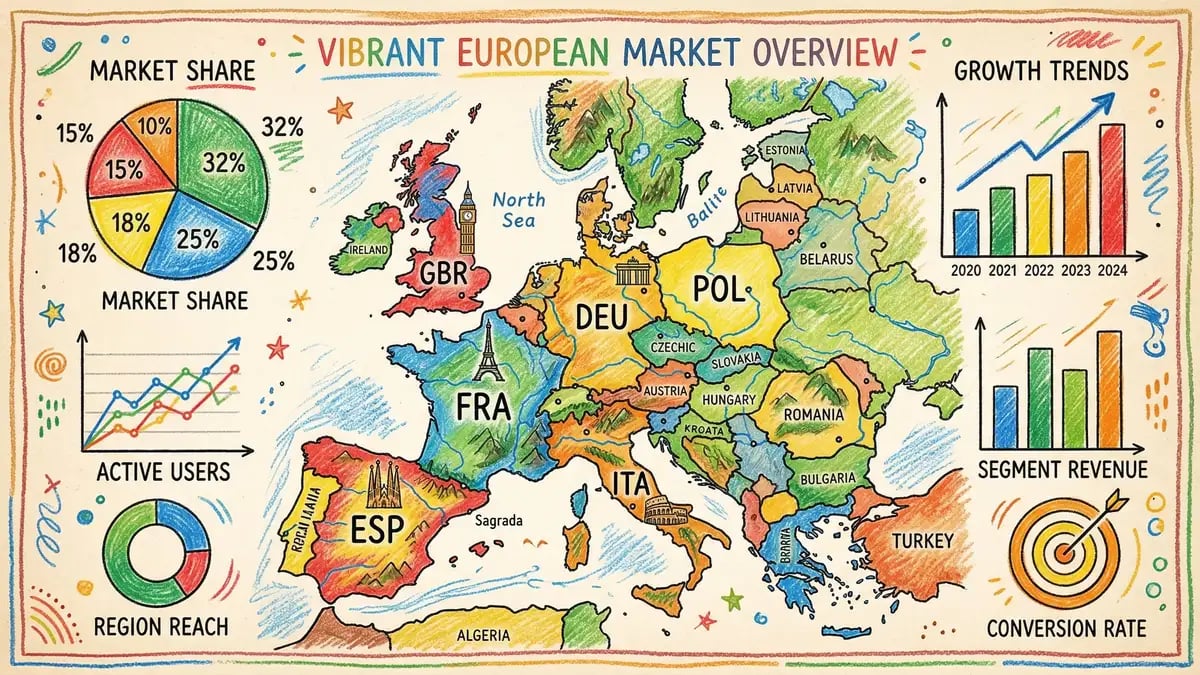
European Facebook Advertising Reach by Country
Facebook's advertising reach varies significantly across European markets. Meta's January 2025 data reveals Western Europe accounts for 77 million reachable users, Northern Europe 59.6 million, and Southern Europe 71.1 million. Understanding these regional differences is essential for budget allocation.
| Country | Ad Reach (millions) | Population % | YoY Trend | B2B Potential |
|---|---|---|---|---|
| United Kingdom | 38.3 | 55–80% | +3.2% ↑ | ★★★★★ |
| Germany | 23.9 | 29% | −2.4% ↓ | ★★★★ |
| France | 47.3 | 70.5% | Growing ↑ | ★★★★ |
| Netherlands | 8.05 | 44% | Stable → | ★★★★★ |
| Sweden | 5.65 | 88% | Stable → | ★★★★ |
| Norway | 3.15 | 87% | Stable → | ★★★★ |
| Denmark | 3.4 | 87.5% | Stable → | ★★★★★ |
| Finland | 2.3 | 67.5% | Growing ↑ | ★★★ |
| Poland | 24.1 | 64% | +2.5% ↑ | ★★★ |
Source: DataReportal/Meta Advertising Resources, January 2025. B2B potential rating based on professional audience concentration and LinkedIn penetration.
The 25–54 professional age bracket represents 50–60% of Facebook's European user base — significantly older than global averages. This demographic skew actually benefits B2B advertisers targeting established decision-makers rather than early-career professionals.
Facebook Advertising Costs Across European Markets
Facebook advertising costs cluster into three tiers across Europe. The UK and Germany command premium pricing, whilst Poland, France, and Italy offer significantly better value. For UK-based companies, understanding these differentials enables smarter budget allocation — achieving equivalent reach in Finland costs roughly 37% less than domestic campaigns.
| Country | CPM (USD) | CPC (USD) | Cost Index vs UK |
|---|---|---|---|
| UK (baseline) | $10.85–$23.79 | $2.04–$2.90 | 100 |
| Germany | $10.05 | $3.20 | 110 (highest CPC) |
| Netherlands | $9.49 | $2.35 | 81–87 |
| Denmark | $9.29 | $2.70 | 86–93 |
| Sweden | $9.51 | $2.60 | 88–90 |
| Finland | $6.87 | $2.50 | 63 (best CPM) |
| France | $8.05 | $2.40 | 74 |
| Poland | $9.41 | $1.80 | 62 (best CPC) |
B2B cost premium:
Expect SaaS and technology campaigns to run 48–150% higher than general benchmarks. B2B-specific targeting pushes average CPC to $2.52–$5.68 versus $0.70–$1.88 for consumer campaigns, with CPM reaching $30 for decision-maker audiences.
European advertising costs are decreasing overall (−13.6% year-over-year) whilst UK costs continue rising. This creates a window of opportunity for continental expansion campaigns. Whitehat's PPC management team monitors these cost fluctuations to optimise campaign timing and budget distribution.
Need help with European B2B paid media?
Our PPC team integrates Facebook and LinkedIn with HubSpot attribution for full-funnel ROI visibility.
Explore PPC Management Services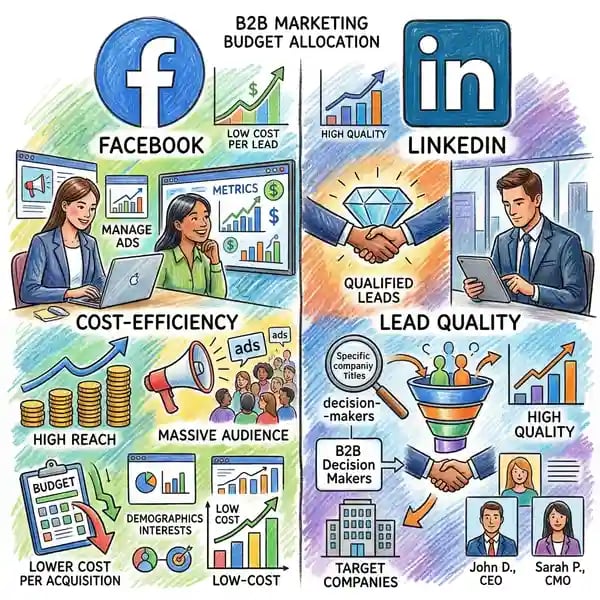
Facebook Versus LinkedIn for European B2B Campaigns
The central question for B2B budget allocation is whether Facebook can compete with LinkedIn for professional audiences. Research consistently shows Facebook excels at cost-efficient top-of-funnel reach whilst LinkedIn dominates qualified lead generation — making them complementary rather than competitive channels.
| Metric | Implication | ||
|---|---|---|---|
| Average CPC | €0.35–€1.80 | €5–€10 | LinkedIn 5–10× more expensive |
| Cost per lead (B2B) | €20–€50 | €100–€350 | Facebook 40–80% cheaper |
| Visitor-to-lead conversion | 0.77% | 2.74% | LinkedIn 3.5× better conversion |
| B2B decision-maker reach | ~1.3M globally | 65M+ decision-makers | LinkedIn 50× more precise |
LinkedIn accounts for 80% of all B2B social media leads according to Content Marketing Institute research. Yet 70% of B2B buyers do use Facebook for research, and decision-makers spend 74% more time on the platform than average users. The data supports a dual-platform strategy rather than an either/or choice.
💡 Whitehat's Recommended Budget Split for European B2B:
LinkedIn (60–70%): Qualified lead generation, account-based marketing, enterprise targeting
Facebook (30–40%): Brand awareness, content distribution, retargeting warm audiences
This allocation reflects the Ehrenberg-Bass 95-5 rule: only 5% of B2B buyers are in-market at any time. Facebook's cost-efficient reach builds mental availability with the 95% who'll buy later, whilst LinkedIn captures the active 5%. Learn more about integrating these channels in our complete B2B Facebook advertising guide.
Germany: The Largest European Market Requires Special Handling
Germany represents the largest European opportunity with a €4.54 billion social media advertising market projected to reach €7.70 billion by 2029. Yet significant challenges around privacy culture, regulatory enforcement, and platform preferences make it the most complex European market for UK B2B advertisers.
The GDPR factor: Germany's Bundeskartellamt ordered Meta to stop combining user data across platforms without genuine consent. A July 2023 CJEU ruling confirmed Meta cannot claim "legitimate interest" for personalised advertising. Custom Audiences from customer lists require explicit GDPR-compliant consent, and German data protection authorities actively investigate targeting practices.
Platform competition: XING maintains 22 million users in the DACH region with 47% holding manager/executive positions, competing directly with LinkedIn for B2B audiences. Many German professionals prefer XING for domestic networking whilst using LinkedIn for international connections — creating a potential three-platform strategy requirement.
Key Considerations for German Facebook Campaigns:
• Budget for robust consent management infrastructure before launching
• German-language creative is non-negotiable — English ads significantly underperform
• Expect 50%+ higher budget requirements versus UK-equivalent campaigns
• Germans expect thorough content: 2,000+ word articles, comprehensive case studies
• Include traditional PR alongside digital — Germans trust established media sources
Despite having 32+ million monthly active users, Facebook's advertising reach sits at just 28.7% of the German population — the lowest penetration among priority markets. This reflects Germans' exceptional privacy consciousness rather than platform weakness. Whitehat's HubSpot onboarding services include GDPR-compliant tracking setup essential for German market entry.
Nordic Countries: High-Quality B2B Audiences with Linguistic Nuance
The Nordic countries — Sweden, Norway, Denmark, and Finland — combine exceptionally high social media penetration (79.7–81.7%) with sophisticated digital audiences, creating attractive B2B advertising environments despite smaller absolute market sizes.
LinkedIn penetration is exceptional: Denmark has the highest LinkedIn penetration in Europe at 44.7% of population. LinkedIn describes Norwegian users as "among the most engaged in the world." For pure B2B lead generation in the Nordics, LinkedIn should comprise the majority of budget with Facebook serving awareness and retargeting functions.
Language strategy matters more than expected: Whilst 95% of young Nordics understand English and 59% primarily communicate in English with other Nordics, 8 out of 10 Nordic consumers prefer content in their native language. Testing shows localised ads achieve considerably better performance with bounce rates up to 10% lower and CPCs potentially half of English equivalents.
🇫🇮 Finland Requires Separate Treatment
Finnish is not mutually intelligible with Scandinavian languages — a "Scandimix" regional approach will fail. The Finnish market shows more formal communication preferences and a strong emphasis on research-driven decision-making. Budget for separate Finnish-language creative from day one.
For UK B2B companies, the Nordics offer an attractive combination: high-quality professional audiences, strong English acceptance for initial testing, competitive advertising costs (Finland offers the best CPM in Europe at $6.87), and tech-savvy early adopters receptive to SaaS solutions.
Strategic Budget Allocation Framework for 2026
Based on the data analysed, UK B2B companies should consider a tiered approach to European Facebook advertising investment. This framework balances market size, cost efficiency, and B2B audience quality.
| Priority Tier | Countries | Rationale | Budget Weighting |
|---|---|---|---|
| Tier 1: Primary | UK, Germany | Market size justifies premium costs | 50–60% |
| Tier 2: Strategic | Netherlands, Denmark | High LinkedIn penetration, English acceptance | 25–30% |
| Tier 3: Testing | Poland, Finland, Sweden | Cost-efficient for creative testing | 15–20% |
Critical 2026 trends to monitor: Meta's Conversions API (CAPI) now recovers 10–30% of conversions lost to cookie deprecation — implementation is critical rather than optional. Advantage+ automation reduces the effectiveness of manual micro-targeting, shifting value toward creative quality and conversion signal strength. The Digital Services Act bans profiling using sensitive data, whilst cumulative GDPR fines reached €5.88 billion by January 2025.
For UK B2B companies serious about European expansion, Facebook advertising represents a cost-efficient complement to LinkedIn — not a replacement. The platform's strength lies in building awareness with tomorrow's buyers at a fraction of LinkedIn's cost, then retargeting engaged prospects as they move through consideration stages.
Whitehat SEO's integrated marketing services help UK B2B companies navigate these complexities, combining Facebook and LinkedIn advertising with HubSpot attribution to prove which channels and campaigns actually generate pipeline — not just clicks.
Frequently Asked Questions
Is Facebook advertising effective for B2B companies in Europe?
Yes, but as a complementary channel rather than primary lead source. Facebook delivers cost per lead 40–80% lower than LinkedIn, but lead quality trails significantly. Research shows 70% of B2B buyers use Facebook during purchase research, and decision-makers spend 74% more time on the platform than average users. The optimal approach combines Facebook for awareness and retargeting with LinkedIn for qualified lead generation.
Which European countries offer the best Facebook advertising value for UK B2B companies?
Finland offers the best CPM at $6.87 (37% below UK), whilst Poland delivers the lowest CPC at $1.80. The Netherlands and Denmark combine competitive costs with exceptional LinkedIn penetration and English-language acceptance, making them ideal for initial European expansion. Germany, despite being the largest market, has the highest CPC at $3.20 and requires significant localisation investment.
How much budget should B2B companies allocate to Facebook versus LinkedIn in Europe?
Whitehat recommends allocating 60–70% of European B2B paid social budget to LinkedIn for qualified lead generation and account-based marketing, with 30–40% to Facebook for brand awareness, content distribution, and retargeting. This split reflects the 95-5 rule: Facebook cost-efficiently builds mental availability with future buyers, whilst LinkedIn captures the 5% actively in-market.
Do Nordic audiences accept English-language Facebook advertising?
Partially. Whilst 95% of young Nordics understand English, 8 out of 10 consumers prefer native-language content. Testing shows localised ads achieve up to 10% lower bounce rates and potentially half the CPC of English equivalents. English works for initial testing in Denmark and Sweden, but Finland requires Finnish-language creative from day one — Finnish isn't mutually intelligible with Scandinavian languages.
What technical requirements exist for B2B Facebook advertising in Germany?
German campaigns require robust GDPR-compliant consent management before launching. Custom Audiences from customer lists need explicit consent, and the Bundeskartellamt actively investigates targeting practices. Budget for consent infrastructure, German-language creative (English significantly underperforms), and expect 50%+ higher costs versus UK campaigns. Consider a three-platform strategy including XING, which has 22 million DACH users with 47% in manager/executive roles.
Ready to Expand Your B2B Advertising into Europe?
Whitehat SEO helps UK B2B companies build HubSpot-integrated paid media campaigns with attribution clarity that proves ROI — not just reach.
Book a Free PPC Strategy SessionLearn more about our PPC management services →
References & Citations
DataReportal (2025). Essential Facebook Stats. · Statista (2025). Most Popular Social Networks Worldwide. · Backlinko (2025). Facebook User & Growth Statistics. · DataReportal (2025). Digital 2025: The State of Social Media. · Content Marketing Institute (2024). B2B Content Marketing Research. · LinkedIn B2B Institute (2024). The 95-5 Rule.
Related Articles
- B2B Facebook Ads UK: The Complete Meta Advertising Guide 2026
Comprehensive guide to Facebook advertising for UK B2B companies, including cost benchmarks and HubSpot integration. - How to Set Up Google Ads for B2B Success in 2026
Step-by-step Google Ads setup for B2B, with UK benchmarks and HubSpot attribution integration. - Social Media Optimisation for B2B: Complete Guide
Platform-by-platform SMO tactics for UK B2B companies, including LinkedIn versus Facebook strategy.