
AI & Marketing Automation AI marketing automation explore our digital marketing FAQs
Here's the uncomfortable truth about AI automation in 2026: everyone's experimenting, almost nobody's mastering it. McKinsey's latest Global Survey found 88% of organisations now use AI in at least one function—up from 55% in 2023—while the US Census Bureau's more conservative production deployment measure puts adoption at 9.7% of firms. The reality sits somewhere in between, and the gap between adoption and impact defines this moment.
AI Automation in Business: The 2026 Reality Check
88% of organisations use AI, but only 12% of CEOs see real results. Here's what the data actually says—and what UK B2B businesses need to do differently.
PwC's January 2026 CEO Survey—their largest ever, covering 4,454 CEOs across 95 countries—revealed that 56% have seen neither revenue gains nor cost savings from AI. Only 12% report both. Meanwhile, global AI spending continues its remarkable climb, projected to reach £2.52 trillion by the end of 2026.
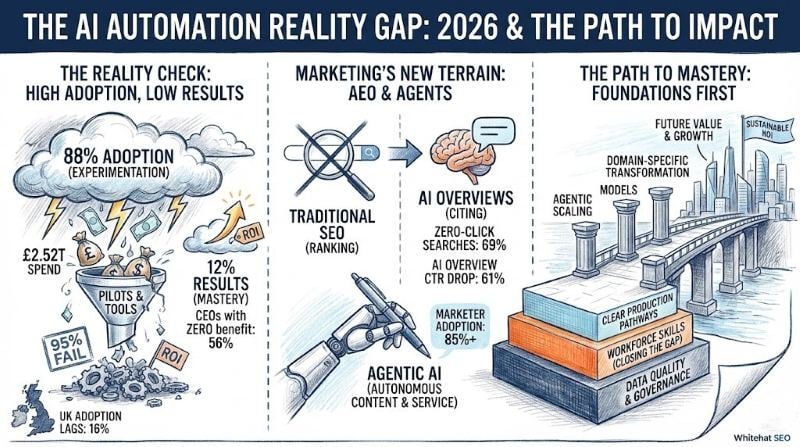
The organisations capturing value from AI aren't deploying the most tools. They're investing in data foundations, governance frameworks, workforce skills, and clear production pathways before scaling. This guide synthesises findings from McKinsey, Gartner, Deloitte, PwC, and HubSpot to map what actually works—and what UK B2B businesses need to prioritise now.
The maturity gap is the real story, not adoption rates
Strip away the headline adoption figures and the maturity data tells a sobering story. Only 1% of companies have reached full AI maturity with integrated, business-wide strategies. Just 6% qualify as McKinsey's "AI high performers" generating meaningful EBIT impact. Deloitte's 2026 State of AI report found only 25% of respondents have moved more than 40% of their AI pilots into production.
Budget commitments, however, tell a different story. Gartner projects AI infrastructure spending alone will exceed £1.37 trillion in 2026, with 91% of organisations planning to increase investment this year. The disconnect between escalating spend and elusive returns is prompting what Forrester calls "the end of the AI hype period"—they predict enterprises will defer 25% of planned AI spend into 2027 as ROI scrutiny intensifies.
AI ROI: The Polarised Picture
£3.70
Return per £1 invested
(top performers)
95%
Custom AI pilots that
fail to deliver P&L impact
42%
Companies that scrapped
most AI initiatives in 2025
Companies achieving results report 25–55% productivity improvements depending on function, with 74% of advanced implementations meeting or exceeding expectations. The Redwood Enterprise Automation Index found 36.6% of organisations reduced costs by at least 25% through automation. But these are the winners. S&P Global's 2025 survey revealed that 42% of companies abandoned most AI initiatives—up dramatically from 17% in 2024.
Agentic AI transforms the platform landscape
Agentic AI—autonomous systems that reason, plan, and execute tasks with minimal human oversight—has emerged as the dominant technology trend of 2025–2026. Gartner predicts 40% of enterprise applications will integrate task-specific AI agents by the end of 2026, up from less than 5% in 2025. The agentic AI market has grown to approximately £7.6 billion and is projected to surpass £10.9 billion in 2026.
The major automation platforms have undergone fundamental transformation from deterministic if-then connectors to intelligent, adaptive systems. Zapier now offers AI Agents that reason and decide across 8,000+ app integrations, supported by Model Context Protocol (MCP) connectivity. Make.com launched AI Agents in April 2025, built directly into its visual scenario builder with full transparency through execution logs. n8n, the open-source leader, has built LangChain-native AI agent capabilities with multi-agent orchestration.
Microsoft Power Automate has embedded Copilot across cloud flows, desktop flows, process mining, and its automation centre—IDC projects 1.3 billion AI agents in the Microsoft ecosystem by 2028.
For B2B marketers, HubSpot's Breeze AI suite has evolved into a comprehensive platform with 20+ agents and assistants spanning customer service, prospecting, content creation, and social media. Breeze Studio provides a centralised workspace for managing agents, upgraded to GPT-5 as the default model in January 2026. Early deployments report 50%+ support ticket resolution and 40% less time closing tickets.
The key differentiator in 2026 is no longer raw AI capability but trust, governance, and observability. Platforms that provide transparent, explainable agent operations are winning enterprise adoption—a critical consideration when evaluating how to use AI within your existing tech stack.
Why most AI projects still fail
The failure rate data is sobering and consistent across multiple sources. MIT's Project NANDA found that 95% of custom enterprise generative AI pilots fail to reach production with measurable impact. RAND Corporation puts the broader AI project failure rate at over 80%—roughly double that of non-AI technology projects. Gartner predicted at least 30% of generative AI projects would be abandoned after proof of concept by the end of 2025, and S&P Global's survey confirmed the trend was even worse: the average organisation scrapped 46% of AI proof-of-concepts before production.
Data quality remains the single largest barrier, cited by 43% of organisations in Informatica's CDO Insights 2025 survey, tied with lack of technical maturity. The MIT research revealed a significant build-versus-buy gap: vendor-purchased AI tools succeed roughly 67% of the time, while internally built solutions succeed only 33%. Pilot paralysis—launching proofs of concept without clear production pathways—consumes resources without generating value.
The skills crisis compounds every other challenge. 67% of employees have received zero AI training, according to JFF's survey. AI talent demand exceeds supply 3.2-to-1 globally, with 1.6 million open positions and only 518,000 qualified candidates. Pluralsight's 2025 report found that 65% of organisations abandoned AI projects specifically due to skills shortages.
Security risks are escalating in parallel with adoption. AI-related security and privacy incidents rose 56.4% from 2023 to 2024. Shadow AI—unauthorised use of AI tools—has become pervasive: IBM's Cost of Data Breach 2025 report found 20% of organisations suffered breaches from shadow AI, adding £200,000 to average breach costs. BlackFog's January 2026 survey found 86% of employees use AI tools weekly for work, with 34% using free versions lacking enterprise security controls.
UK adoption lags globally, but investment is accelerating
UK AI adoption significantly trails global averages. The most authoritative measure—DSIT's January 2026 research based on 3,500 business interviews—found just 16% of UK businesses currently use at least one AI technology, with 80% neither using nor planning to adopt. The British Chambers of Commerce paints a slightly more optimistic picture at 35% of SMEs actively using AI, up from 25% in 2024. Whichever figure is closer to reality, the UK lags the global enterprise average substantially.
The UK has deliberately chosen a principles-based, pro-innovation regulatory approach rather than comprehensive legislation. Five cross-sector principles—safety, transparency, fairness, accountability, and contestability—are implemented by existing sector regulators rather than enforced through standalone AI law. A comprehensive AI Bill is expected in the second half of 2026, but no binding AI-specific legislation exists today.
UK businesses trading with the EU face dual compliance challenges. The EU AI Act entered force in August 2024 with phased enforcement: prohibited practices were banned from February 2025, general-purpose AI model requirements became effective in August 2025, and full high-risk system obligations apply from August 2026. The Act's extraterritorial scope means any UK business placing AI systems on the EU market must comply. Estimated compliance costs for SMEs run to 1–3% of turnover.
UK AI Investment Snapshot
- → £28.2 billion in AI Growth Zone investment across five designated zones
- → £2 billion government commitment for AI compute expansion through 2030
- → 1 million+ AI upskilling courses delivered since June 2025
- → £2.4 billion in UK AI startup venture funding (H1 2025)
- → 38 of 50 planned AI Opportunities Action Plan actions delivered
AI governance in UK businesses remains notably immature. The Trustmarque AI Governance Index 2025 found only 7% of UK businesses have fully embedded AI governance frameworks, while 54% have minimal governance or none at all. Public expectations run ahead of the regulatory approach: 72% of the UK public say laws should regulate AI, and 91% believe it is important AI is developed fairly.
Marketing AI has transformed workflows but faces a visibility crisis
AI adoption among marketers outpaces nearly every other function. 85–88% of marketers now use AI tools in their daily work, with content creation as the leading use case at 55%. CoSchedule reports that AI saves marketers an average of 5+ hours per week, while 83% of AI-using marketers report increased productivity. Generative AI deployment in marketing surged 116% year-over-year, now spanning 15.1% of marketing activities.
AI-powered lead scoring has matured significantly, with approximately 75% of B2B businesses expected to use AI-driven scoring. Companies report 25% increases in conversions and 30% reductions in sales cycle length. Platforms like HubSpot, Salesforce Einstein, and 6sense now offer predictive scoring that continuously improves with new data, analysing hundreds of behavioural and firmographic signals to predict conversion likelihood.
AI-driven attribution and reporting is replacing traditional rule-based models. AI attribution processes millions of conversion paths simultaneously, identifying patterns invisible to human analysts. Performance marketers waste an estimated 30–40% of ad spend on misattributed channels with traditional models, while AI-driven campaigns deliver 22% higher ROI, 32% more conversions, and 29% lower acquisition costs.
The most consequential shift for marketing automation is the rise of Answer Engine Optimisation (AEO) and Generative Engine Optimisation (GEO). Zero-click searches rose from 56% in 2024 to 69% in May 2025. AI Overviews now appear for 30% of US desktop keywords, and where they appear, organic click-through rates have plummeted 61%. AI platforms generated 1.13 billion referral visits in June 2025—a 357% increase from June 2024.
The strategic imperative has shifted from "being ranked" to "being cited." Brands cited in AI Overviews see 35% higher organic CTR and 91% higher paid CTR versus non-cited brands. Crucially, AI search traffic converts at 14.2% compared to Google's 2.8%, making citation-optimised content dramatically more valuable per visitor. As Whitehat's AEO methodology demonstrates, marketing automation strategies must now incorporate structured content for AI extractability, consistent brand entity signals, and monitoring of AI visibility metrics alongside traditional analytics.
What the next 18 months hold for AI automation
The consensus across major analyst firms points to five key developments through 2027:
1. Agentic AI will scale but with significant casualties. Gartner predicts over 40% of agentic AI projects will be cancelled by the end of 2027 due to escalating costs or unclear value, even as 40% of enterprise applications integrate agents by the end of 2026.
2. ROI scrutiny will intensify. Forrester predicts the "AI hype period ends" in 2026, with enterprises deferring a quarter of planned AI spend and 60% of Fortune 100 companies appointing dedicated heads of AI governance.
3. The AI automation market will continue rapid expansion. Gartner forecasts £3.34 trillion in total AI spending by 2027, while the agentic AI segment alone could approach £25 billion by 2030 at current growth rates.
4. Workforce transformation accelerates. Gartner projects that starting 2028–2029, 32 million jobs annually will be "reconfigured or fused" with AI tools—roughly 150,000 people per day requiring upskilling. IDC predicts 70% of CEOs will pursue revenue growth without headcount expansion. Yet half of companies that cut jobs for AI will rehire by 2027, suggesting disruption is more about role redesign than elimination.
5. Domain-specific and multi-agent systems will replace general-purpose experimentation. Gartner forecasts 60% of enterprise AI models will leverage domain-specific language models by 2028, delivering superior accuracy in regulated industries. By 2028, Gartner expects 90% of B2B purchasing to be AI-agent intermediated, pushing more than £15 trillion through AI agent exchanges.
The path forward for UK B2B businesses
The defining tension of AI automation in 2026 is the gulf between investment and impact. Businesses are spending at unprecedented levels, platforms have evolved from simple connectors to sophisticated agent orchestrators, and marketing teams have fundamentally restructured their workflows around AI. Yet more than half of CEOs report no tangible financial benefit, 95% of custom pilots fail to deliver P&L impact, and governance frameworks lag dangerously behind deployment.
For UK businesses specifically, the combination of lower adoption rates, imminent dual regulatory compliance (UK principles plus EU AI Act), and a 97% AI skills gap rate makes the challenge acute—though £28.2 billion in Growth Zone investment and ambitious government upskilling programmes signal serious intent.
The organisations that will capture value from AI automation are not those deploying the most tools but those investing in data foundations, governance frameworks, workforce skills, and clear production pathways before scaling.
The winners in 2026–2027 will be defined not by whether they use AI, but by whether they've built the organisational infrastructure to make it work. For B2B companies already invested in integrated marketing automation, the opportunity is to leverage AI within proven frameworks—not to chase every new tool, but to systematically enhance the workflows that already drive results.
Frequently Asked Questions
What percentage of AI projects fail?
MIT's Project NANDA found that 95% of custom enterprise generative AI pilots fail to reach production with measurable impact. RAND Corporation puts the broader AI project failure rate at over 80%. The primary causes are data quality issues, skills shortages, and launching pilots without clear production pathways.
How does UK AI adoption compare to global averages?
UK AI adoption significantly trails global averages. DSIT's January 2026 research found just 16% of UK businesses currently use AI, compared to 88% globally. The British Chambers of Commerce reports 35% of UK SMEs actively use AI. The gap represents both a challenge and an opportunity for early adopters.
What is agentic AI and why does it matter for marketing?
Agentic AI refers to autonomous systems that reason, plan, and execute tasks with minimal human oversight. Gartner predicts 40% of enterprise applications will integrate AI agents by the end of 2026. For marketing, this means platforms like HubSpot Breeze can now automate content creation, lead prospecting, and customer service—early deployments report 50%+ support ticket resolution.
How is AI changing search and SEO?
Zero-click searches rose from 56% in 2024 to 69% in May 2025. AI Overviews now appear for 30% of desktop keywords, and where they appear, organic click-through rates drop 61%. The strategic imperative has shifted from "being ranked" to "being cited"—AI search traffic converts at 14.2% compared to Google's 2.8%, making Answer Engine Optimisation essential for B2B visibility.
What should UK B2B companies prioritise for AI success?
Focus on foundations before scaling: data quality (cited as the top barrier by 43% of organisations), governance frameworks (only 7% of UK businesses have them), workforce skills (67% of employees have received zero AI training), and clear production pathways rather than endless pilots. Vendor-purchased AI tools succeed 67% of the time versus 33% for internally built solutions—choose platforms wisely.
References & Sources
- McKinsey Global Survey: The State of AI in 2025 – Adoption rates and AI high-performer analysis
- PwC 28th Annual Global CEO Survey 2026 – CEO perspectives on AI ROI
- Gartner AI Research – Market forecasts and enterprise adoption predictions
- Deloitte State of AI in the Enterprise 2026 – Implementation maturity analysis
- DSIT: AI Adoption in UK Businesses 2026 – Official UK government research
- HubSpot State of Marketing 2026 – Marketing AI adoption trends
- Forrester Predictions 2026: Artificial Intelligence – End of AI hype period analysis
- British Chambers of Commerce: AI Adoption Survey 2025 – UK SME adoption data