
Technical SEO explore our digital marketing FAQs
Humans.txt is a plain text file placed in a website's root directory (alongside robots.txt) that lists the people who built the site. Think of it as digital film credits—a way to acknowledge developers, designers, copywriters, and other contributors.
Humans.txt in 2026: Does It Help SEO or AI Visibility?
The well-meaning web standard that time forgot—and why your efforts are better spent elsewhere.
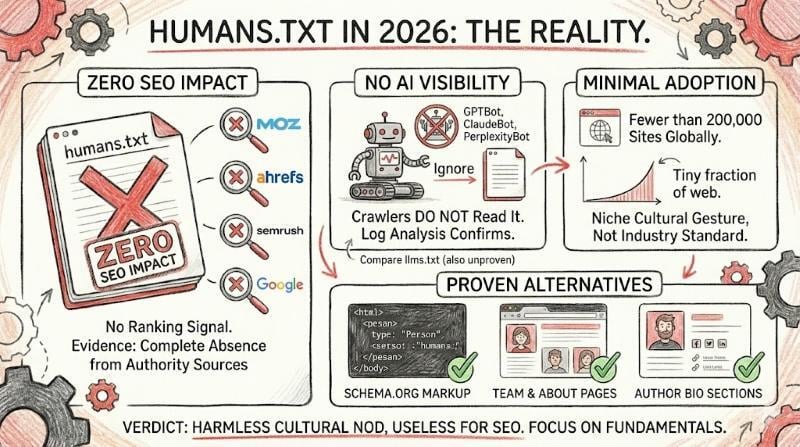
Humans.txt provides zero confirmed SEO value and has no documented influence on AI systems. Whitehat SEO's analysis of the evidence is unambiguous: if you're considering implementing humans.txt for search engine optimisation or answer engine optimisation, you're wasting your time. The file—created in 2011 to credit website contributors—remains a niche transparency gesture used by fewer than 200,000 websites worldwide, with no technical benefit to justify the effort.
What is humans.txt and why was it created?
The initiative launched in 2011 with the tagline "We Are People, Not Machines." The humanstxt.org website describes it as "an initiative for knowing the people behind a website." The specification recommends a simple format using UTF-8 encoding with sections for /* TEAM */, /* THANKS */, and /* SITE */.
The concept was charming and well-intentioned. The problem? It never gained meaningful traction, and the initiative has shown no signs of activity since approximately 2012.
How many major websites actually use humans.txt?
Adoption has always been modest. A Dataprovider.com analysis found just under 200,000 websites globally with a humans.txt file—a minuscule fraction of the hundreds of millions of active sites online. A 2019 crawl of the Alexa top 25,000 domains found humans.txt on only 1.96% of sites, dropping from 16% among the top 100.
Among major technology companies, the picture is sparse:
| Website | Humans.txt Status |
|---|---|
| ✓ Present (recruitment message) | |
| Netflix | ✓ Present (ASCII art + credits) |
| GitHub | ✓ Present (historical) |
| Twitter/X | ✗ Returns 404 |
| Microsoft, Apple, Amazon | ✗ Not implemented |
| Facebook, LinkedIn, Reddit | ✗ Not implemented |
The file exists primarily on business websites (48% of adopters) and content-related sites (27%). Notable users beyond the tech giants include Discord, Slack, Medium, Stripe, Wired, The New Yorker, and The Guardian—but these represent exceptions rather than industry standard practice.
Does humans.txt improve search rankings?
No. The evidence is categorical on this point.
The strongest indicator that humans.txt has no SEO value is the complete absence of coverage from authoritative SEO sources. Moz, Ahrefs, Semrush, and Search Engine Journal—organisations that exhaustively catalogue every known and suspected ranking factor—have never published content identifying humans.txt as a search signal. Backlinko's comprehensive list of 200+ Google ranking factors doesn't mention it.
Google has never identified humans.txt as a ranking signal in any documentation, Search Central article, or official communication. The 2024 Google Search API leak, which exposed over 14,000 ranking signals including previously denied factors like site authority and click data, contained no reference to humans.txt.
"If you have a humans.txt file for team recognition, keep it. If you're creating one for SEO benefit, you're wasting your time."
— Whitehat SEO analysis
Some lower-quality SEO content has speculated that humans.txt supports Google's E-E-A-T framework. This claim doesn't withstand scrutiny. Google representatives Danny Sullivan, Gary Illyes, and John Mueller have explicitly confirmed that E-E-A-T is not a ranking factor—it's a quality evaluation framework used to train human quality raters. There is no "E-E-A-T score" in Google's algorithm that a text file could influence.
Do AI systems read humans.txt files?
No. There's no evidence that any AI answer engine considers humans.txt when generating responses.
No AI company—OpenAI, Anthropic, Google, or Perplexity—has publicly indicated they read or consider humans.txt files. AI crawlers like GPTBot, ClaudeBot, Google-Extended, and PerplexityBot focus on robots.txt for access control and conventional web crawling for content; humans.txt simply isn't part of their workflow.
For comparison, consider the llms.txt standard—a file proposed in September 2024 specifically designed for AI consumption. Despite being purpose-built for large language models and adopted by approximately 844,000 sites (according to BuiltWith data), even llms.txt has no confirmed support from major AI providers. A Semrush analysis found that from mid-August to late October 2025, zero AI crawlers visited llms.txt pages. An SE Ranking study of 300,000 domains found no correlation between llms.txt and AI citations.
If a purpose-built AI file cannot demonstrate measurable impact, a 15-year-old attribution file designed for human readers certainly cannot. As we detail in our SEO best practices guide, focusing on fundamentals delivers better results than chasing unproven tactics.
What should you use instead?
If you want to credit contributors in a way that actually delivers value, focus on these proven alternatives:
Schema.org Author Markup
This is the gold standard for establishing authorship. Google actively parses Person and Organization structured data, which can generate rich snippets and establish authorship signals that search engines actually consume. Unlike humans.txt, Schema.org markup is documented in Google's Search Central guidelines and has demonstrable impact on how content is displayed in search results.
Comprehensive Team and About Pages
HTML team pages are crawlable, linkable, and provide richer context than plain text files. They support internal linking strategies, can be optimised for relevant keywords, and give visitors genuine insight into who they're working with. For agencies like Whitehat, our About Us page does far more for credibility than any root directory text file could.
Author Bio Sections on Content
Including author information directly on articles—name, credentials, photo, and links to social profiles—builds E-E-A-T signals where they matter: on the content itself. This is particularly important for YMYL (Your Money or Your Life) topics where expertise matters.
The Whitehat verdict
Humans.txt occupies a peculiar space in web culture: universally harmless, occasionally charming, and technically meaningless. If you already have one for cultural reasons—as a nod to the humans behind your work—there's no reason to remove it. The five minutes spent creating one are genuinely inconsequential.
But any time spent optimising a humans.txt file, promoting it as an SEO tactic, or expecting AI systems to notice it is misdirected effort. As we outline in our guide to SEO costs and budgeting, marketing resources are finite. Direct them toward strategies with proven impact: Schema.org structured data, comprehensive team pages, and—if you're forward-looking about AI—monitoring the evolving answer engine optimisation landscape.
Humans.txt can sit alongside these efforts as a quiet footnote, exactly as it was always intended to be.
Frequently Asked Questions
Should I add humans.txt to my website?
Only if you want to credit contributors for cultural or transparency reasons. There's no SEO, ranking, or AI visibility benefit to implementing humans.txt. If you do create one, spend no more than five minutes on it.
Does Google read humans.txt?
Google has never indicated that it reads or considers humans.txt for ranking purposes. The file was designed for human readers, not search engine crawlers, and no evidence suggests it functions as a ranking signal.
Is humans.txt the same as llms.txt?
No. Humans.txt (2011) credits website contributors and was designed for human visitors. Llms.txt (2024) was created specifically to help AI language models understand website content. Neither has confirmed support from major AI providers, but they serve fundamentally different purposes.
What's the best way to show authorship for SEO?
Use Schema.org Person markup in your page's structured data, create comprehensive author bio pages, and include author information directly on content. These methods are documented by Google and have demonstrable impact on search visibility.
Will removing humans.txt hurt my rankings?
No. Since humans.txt has no documented ranking impact, removing it will have no effect on your search performance. Focus your efforts on proven optimisation techniques instead.
References and Further Reading
- Humanstxt.org – The original humans.txt initiative website
- Schema.org Person Type – Structured data documentation for author markup
- Google Search Central: Article Structured Data – Google's guidelines for author markup
- Semrush: What Is LLMs.txt & Should You Use It? – Analysis of llms.txt adoption and AI crawler behaviour
- SE Ranking: LLMs.txt Research – Study of 300,000 domains examining AI citation correlation
- Drupal Humans.txt Module – CMS implementation showing continued niche interest
- Perishable Press: Humans.txt Guide – Long-standing developer resource on implementation
Focus on what actually works
Want to understand which SEO and AEO strategies will move the needle for your business? Our technical audits separate proven tactics from wishful thinking.
Get Your SEO Audit