
SEO Strategy explore our digital marketing FAQs AI-driven changes to SEO
Google shipped three confirmed core updates in 2025 plus a spam update and its first-ever Discover-specific core update in February 2026. Each reinforced the same direction: genuine expertise beats content volume, and mediocre content faces increasingly harsh penalties.
On-Page SEO in 2026: What's Changed and What Actually Matters Now
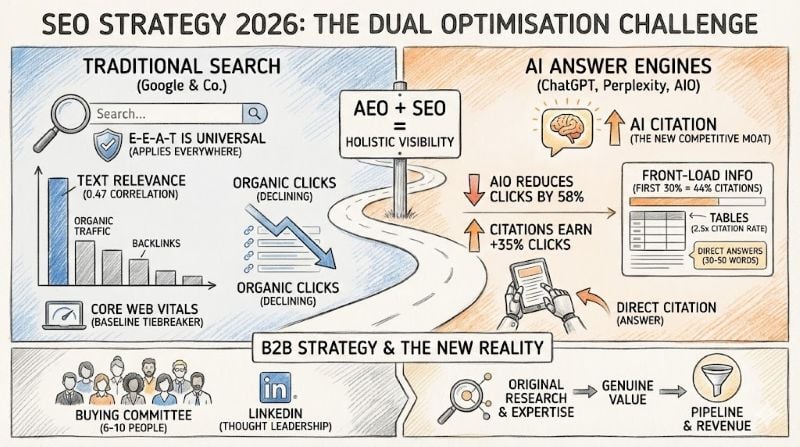
Google's December 2025 core update broadened E-E-A-T requirements beyond YMYL topics to all competitive categories. AI Overviews now reduce organic clicks by 58% and appear on roughly 30% of US desktop queries. The traditional playbook still works as a foundation, but the rise of AI answer engines has created a parallel optimisation challenge: getting cited by ChatGPT, Perplexity, and Google's AI features matters as much as ranking in position one.
Google's 2025 Algorithm Updates: Depth Over Volume
The December 2025 core update (December 11–29) was the year's most impactful. Analysis from SISTRIX found Wikipedia lost over 435 visibility points—making it the biggest single loser—whilst e-commerce and retail domains dominated the winners. SE Ranking data showed roughly 15% of pages previously in the top 10 disappeared entirely from the top 100.
Several patterns emerged from the December update that Whitehat's SEO services team observed across client accounts:
- Content depth trumped content length: 800-word posts outranked 3,000-word posts when addressing intent completely
- E-E-A-T applied universally: No longer limited to health and finance—now required across product reviews, tutorials, buying guides, and SaaS content
- Content freshness mattered: Analysis showed winning pages averaged 393 days freshness versus 500 days for losers
- Brand trust threshold: Sites with domain authority above the high 30s paired with branded search demand fared best
The March 2025 core update (March 13–27) targeted thin and AI-spam content globally. The June 2025 core update (June 30–July 17) deepened integration of the Helpful Content System—which has been embedded in core ranking since March 2024 rather than operating as a standalone system.
In February 2026, Google launched its first-ever Discover-only core update, prioritising geographic locality, reducing clickbait, and rewarding demonstrated topic expertise. Despite the Discover-only framing, the SEO community observed widespread ranking volatility in standard search.
What Actually Correlates With Rankings in 2026
The most recent large-scale ranking factor study comes from Semrush (January 2024, analysing 300,000 positions across 16,298 keywords). Text relevance has the highest correlation with rankings at 0.47—far ahead of any other signal. Domain and URL organic traffic, star ratings, and domain authority scores followed.
No user engagement signal ranked in the top 20 by correlation, though leaked Google documents have confirmed behavioural signals play a role. This suggests engagement matters for maintaining rankings once achieved, but content relevance gets you there.
| Ranking Factor | Correlation | Practical Implication |
|---|---|---|
| Text Relevance | 0.47 | Match content precisely to searcher intent |
| URL Organic Traffic | 0.33 | Success begets success—focus on quick wins |
| Domain Organic Traffic | 0.28 | Site-wide authority matters |
| Domain Authority Score | 0.21 | Build quality backlinks consistently |
| Content Quality Score | 0.17 | Quality trumps word count |
Emerging concepts worth tracking include "information gain"—based on a June 2022 Google patent—which measures unique, new information a document provides versus what's already in the search index. This favours differentiated content over AI-generated summaries that repackage existing information.
Topical authority has also gained prominence. Google patents explicitly reference topical clusters when weighting internal links. Building comprehensive coverage of subject areas through 10–15 supporting articles per core topic now represents a baseline expectation for competitive rankings.
Core Web Vitals: Stable Thresholds, Evolved Tools
The three Core Web Vitals—LCP (≤2.5s good), INP (≤200ms good), and CLS (≤0.1 good)—remain unchanged heading into 2026. No thresholds have been tightened, and no new metrics have been formally added since INP replaced FID in March 2024.
Current pass rates show steady improvement. According to the 2025 Web Almanac data, 48% of mobile websites now pass all three Core Web Vitals, up from 44% in 2024 and 36% in 2023. Desktop pass rates reached 56%. LCP remains the hardest to pass at roughly 53% of origins rated good, whilst INP (76% good) and CLS (74% good) are more widely achieved.
The most significant 2025 development was cross-browser support. Through the Interop 2025 project, Firefox 144 (October 2025) added INP support, and Safari 26.2 (December 2025) added both LCP and INP measurement. As of December 2025, LCP and INP are "Baseline Newly Available" across all major browsers.
The bottom line: CWV's role as a ranking signal remains that of a tiebreaker and baseline requirement. Google's official position is unchanged: when two pages have similar relevance, the one with better CWV ranks higher. Expert consensus is that CWV amplifies other signals but won't overcome poor content on its own.
E-E-A-T Now Applies Everywhere
Google's Search Quality Rater Guidelines received two updates in 2025: a major January revision expanding from 170 to 181 pages that added the first explicit definition of generative AI (and cited AI-generated content as a scaled content abuse example), and a minor September update that added the first-ever criteria for rating AI Overviews.
The most notable February 2026 development: Google added a new "Authors" section to Search Central documentation, stating "We strongly encourage adding accurate authorship information, such as bylines to content where readers might expect it." Bylines should lead to further information about the author's background and expertise areas.
However, John Mueller clarified at Search Central Live NYC that E-E-A-T is not something SEOs can directly "add" to web pages—it's a framework for quality raters, not a checklist for ranking. Trust remains paramount. Google's official documentation states: "Of these aspects, trust is most important. The others contribute to trust, but content doesn't necessarily have to demonstrate all of them."
The critical insight for 2026 is that Experience—the first E—is what AI cannot replicate. Original photos, proprietary data, personal case studies with specific metrics, firsthand testing results, and practitioner-only insights are the strongest differentiators.
For practical implementation, the strongest E-E-A-T signals include:
- Verifiable author credentials and cross-web consistency
- Original research and proprietary data
- Editorial backlinks from authoritative domains
- Branded search volume
- Transparent editorial processes with "last updated" timestamps
- Topic clusters demonstrating comprehensive subject expertise (10–15 supporting articles per topic)
AI Answer Engines: A Parallel Optimisation Challenge
The AI search landscape is bifurcating in ways that matter for your content strategy. Google AI Overviews heavily favour sites already ranking in the top 10 (76.1% overlap per Ahrefs), essentially acting as an extraction layer on traditional results. ChatGPT, by contrast, shows only 8% overlap with Google's top 10—and cites lower-ranking pages (position 21+) roughly 90% of the time.
This means optimising for traditional search gets you most of the way to AI Overview visibility, but ChatGPT and Perplexity require fundamentally different authority signals. Whitehat's Answer Engine Optimisation services address both simultaneously.
| Platform | Citations/Answer | Top Source | Google Overlap |
|---|---|---|---|
| ChatGPT | 2.62 | Wikipedia (7.8%) | 8% |
| Perplexity | 6.61 | Reddit (6.6%) | 28% |
| Google AI Overviews | 13.3 | Top 10 organic | 76.1% |
The traffic impact is substantial. Research shows organic CTR dropped 61% for queries with AI Overviews. AI Overviews now reduce clicks by 58%, up from 34.5% in April 2025. However, brands cited within AI Overviews earn 35% more organic clicks and 91% more paid clicks versus non-cited brands—making citation the new competitive moat.
A critical finding: 44.2% of all LLM citations come from the first 30% of content. Front-loading key information is no longer optional—it's essential for AI visibility.
How to Structure Content for AI Citation
Content structure matters more than ever for AI citation. Peer-reviewed research found that combining fluency optimisation with statistics addition outperforms single strategies by 5.5%+ and delivers a 30–40% visibility boost overall.
The optimal content architecture for AI citation follows a clear pattern:
- Use question-format H2/H3 headers matching conversational search patterns
- Lead each section with a 30–50 word direct answer
- Support with lists, tables, or evidence (tables achieve 2.5x higher citation rates)
- Keep paragraphs to 25–40 words for extractability
- Include TL;DR sections and "last updated" timestamps
- Add authority markers in the first 100 words
Schema markup in JSON-LD remains Google's recommended format. Content with proper schema has a 2.5x higher chance of appearing in AI-generated answers. Google deprecated FAQ rich results (now restricted to government/health sites) and HowTo rich results, but these schema types still provide semantic value for AI systems even without triggering rich results.
Priority schema types for 2026: Organisation (cornerstone for Knowledge Graph), Article (with author attribution), Person (critical for E-E-A-T), Product, Review/Rating, BreadcrumbList, FAQPage, and LocalBusiness.
Off-site, brands are 6.5x more likely to be cited through third-party sources than their own domains. Entity presence on Wikidata, Wikipedia, and 4+ third-party platforms increases citation likelihood by 2.8x. Reddit, YouTube, and earned media coverage are disproportionately cited across all AI platforms.
Title Tags and Meta Descriptions: The New Reality
Google now rewrites 76% of title tags—up from 61.6% in 2022. Of changed titles, Google retains only 35% of original content and removes an average of 2.71 words. Titles between 51–55 characters have the lowest rewrite rate (~40%), whilst titles exceeding 70 characters are rewritten nearly 100% of the time.
The optimal ranges remain 50–60 characters (~600 pixels) for title tags and 150–160 characters (~920 pixels) for desktop meta descriptions, with the first 120 characters most critical for mobile visibility. Google rewrites meta descriptions even more aggressively—over 62% of the time—but custom meta descriptions still increase CTR by 5.8% versus auto-generated ones.
What's changed dramatically is what those clicks are worth. Research from 2025 found position #1 CTR dropped from 28% to 19% (a 32% decline) year-over-year. Positions 6–10 actually saw CTR increase by 30.6%, suggesting users scroll past AI Overviews and engage with more diverse results.
To minimise rewrites: match your H1 to your title tag, use parentheses instead of brackets (brackets trigger 77.6% rewrites), include the current year, write titles as flowing sentences rather than pipe-separated segments, and place brand names at the end. Crucially, Google uses the original HTML title tag for ranking regardless of what it displays—so an optimised title retains its SEO value even when rewritten.
UK Market: Unique Regulatory and Competitive Dynamics
Google holds 93.35% of UK search market share as of December 2025, down 1.1 percentage points from its August 2024 peak. The UK search industry is valued at £5.4 billion with 1,455 businesses. AI Overviews prevalence on UK desktop searches increased 536.6% year-over-year.
The Digital Markets, Competition and Consumers Act (in force January 2025) is the most significant UK-specific regulatory development. The CMA designated Google as having Strategic Market Status in search and search advertising in October 2025, and in January 2026 proposed conduct requirements including publisher controls over AI Overview usage, fair ranking transparency, and proper content attribution.
The Data (Use and Access) Act 2025 (law since June 2025) introduced a significant change for SEO analytics SEO analytics and reporting framework: basic aggregate analytics cookies can now be used without consent in the UK if their sole purpose is website improvement. Advertising and behavioural tracking still requires consent, but UK-only sites now have access to more complete traffic data.
For content marketing, the ASA banned ads for identifiable unhealthy foods in paid online advertising from 5 January 2026. CAP guidance (May 2025) confirmed existing advertising codes apply regardless of whether content is AI-generated. Greenwashing enforcement is intensifying from both the CMA and ASA.
Understanding these SEO cost dynamics in the UK market helps set appropriate budgets for 2026.
B2B Companies: Optimise for Committees, Not Individuals
B2B buyers now complete 67–80% of their purchasing journey before engaging sales, with typical buying groups involving 6–10 decision-makers each gathering 4–5 independent pieces of information. Research shows 94% of B2B buyers use LLMs during their buying process and 72% encountered AI Overviews during research.
SEO delivers 748% ROI for B2B companies, with organic search generating 44.6% of all B2B revenue—the largest single channel. SEO leads close at 14.6% versus 1.7% for outbound efforts. For companies targeting marketing directors, RevOps managers, and CMOs, thought leadership is the decisive factor: 58% of decision-makers choose vendors based on thought leadership content.
Content mapping must address the full buying committee. Operational leaders need case studies with metrics, CFOs need ROI calculators and financial impact data, and CMOs need strategic insights and competitive intelligence. Original research drives 29.7% higher organic traffic than content without it and earns 42.2% more backlinks.
LinkedIn generates 80% of all B2B social media leads. LinkedIn's algorithm pivoted to a "Depth Score" in 2025, prioritising dwell time over clicks, and organic reach dropped roughly 50% year-over-year. Founder-led thought leadership now significantly outperforms corporate page posts. LinkedIn content also contributes to GEO—AI engines like ChatGPT and Perplexity reference LinkedIn discussions when generating answers.
For more on building a keyword strategy that serves both traditional and AI search, see our guide to keyword research in 2026.
What This Means for Your SEO Strategy
The 2025–2026 SEO environment rewards a specific profile: brands with genuine expertise, demonstrated through original research and firsthand experience, publishing fresh content on focused topics with proper technical implementation and strong off-site authority signals.
Three developments stand out as genuinely new rather than incremental:
First, AI citation has become a parallel optimisation target with fundamentally different rules than traditional ranking. ChatGPT's 8% overlap with Google's top 10 means a separate strategy is needed. Front-loading key information (first 30% of content captures 44% of citations), using tables (2.5x citation rate), and building third-party authority are the highest-leverage tactics.
Second, E-E-A-T has become universal. The December 2025 update applied expertise requirements to every competitive content category—not just health and finance. Experience, the element AI cannot fabricate, is the critical differentiator. Author transparency, original data, and verifiable credentials are now baseline expectations.
Third, for UK-based B2B companies, the CMA's Strategic Market Status designation for Google could reshape the competitive landscape. Publisher controls over AI Overview usage and fair ranking requirements may create new opportunities for smaller, expert-led sites.
The pragmatic answer to whether "GEO" is genuinely new: the fundamentals haven't changed, but the distribution of where content gets surfaced has. Optimise for both traditional search and AI citation, measure both, and invest disproportionately in the signals that AI systems weight most: authority, freshness, structure, and genuine expertise.
Frequently Asked Questions
What is the most important ranking factor in 2026?
Text relevance has the highest correlation with rankings at 0.47—far ahead of any other signal. This means matching your content precisely to searcher intent matters more than word count, backlinks, or technical factors. Content that completely addresses the query outperforms longer content that only partially satisfies intent.
How do I optimise for AI answer engines like ChatGPT?
Front-load key information in the first 30% of your content, use tables (2.5x higher citation rate), structure content with question-based headers, and include 30–50 word direct answers at the start of each section. Build authority through third-party mentions on platforms AI engines trust—brands are 6.5x more likely to be cited via third-party sources.
Has E-E-A-T changed in 2026?
E-E-A-T now applies to all competitive content categories, not just YMYL topics like health and finance. The December 2025 core update made this explicit. The critical differentiator is Experience—the element AI cannot replicate. Original photos, proprietary data, firsthand testing results, and practitioner-only insights are now essential.
How much do AI Overviews reduce organic clicks?
AI Overviews reduce organic clicks by 58% when present, up from 34.5% in April 2025. However, brands cited within AI Overviews earn 35% more organic clicks than non-cited brands—making citation the new competitive moat. Position #1 CTR dropped from 28% to 19% year-over-year.
What Core Web Vitals thresholds should I target?
The thresholds remain unchanged: LCP ≤2.5 seconds (good), INP ≤200ms (good), and CLS ≤0.1 (good). Currently 48% of mobile websites pass all three metrics. CWV remains a tiebreaker signal—it won't overcome poor content but amplifies other ranking signals when two pages have similar relevance.
References & Further Reading
- Semrush Ranking Factors Study 2024 – Analysis of 300,000 positions across 16,298 keywords
- Google Search Central: Creating Helpful Content – Official Google documentation on content quality
- Web.dev Core Web Vitals – Official Google documentation on page experience metrics
- HTTP Archive Web Almanac – Annual state of the web report
- UK Government: Digital Markets, Competition and Consumers Act – Official regulatory guidance
- Ahrefs Blog – Source for AI Overviews overlap and click impact research
- SparkToro Blog – Research on AI recommendation consistency and zero-click searches