
This isn't simply a matter of purchasing services. Choosing the wrong agency wastes budget, damages results, and creates months of disruption. Choosing the right one compounds your marketing effectiveness in ways that internal teams—stretched thin and lacking specialist expertise—simply cannot match.
How to Choose a UK Digital Marketing Agency: The Complete 2026 Guide
Choosing the right UK digital marketing agency requires evaluating five critical factors: relevant industry experience, transparent pricing structures, proven results with verifiable case studies, clear communication processes, and alignment between the agency's capabilities and your specific business goals. With 8,509 digital marketing agencies competing in a £35.5 billion market, getting this decision right is increasingly critical—and increasingly difficult.
UK Digital Marketing at a Glance: 2025
£35.5bn
UK digital ad market
8,509
UK digital agencies
46%
UK firms outsource marketing
13%
YoY market growth
Nearly half of UK companies now outsource some element of marketing—a figure that rises to 50% for B2B organisations, according to Marketing Week's survey of 3,000+ marketers. The primary drivers are revealing: 37% cite inability to find qualified internal candidates, whilst 35% lack resources for in-house handling.
At Whitehat, we've worked with businesses across the UK, Europe, and the US as a HubSpot Diamond Partner for over a decade. This guide distils what we've learned about what makes agency relationships succeed—and fail—into a practical framework you can use today.
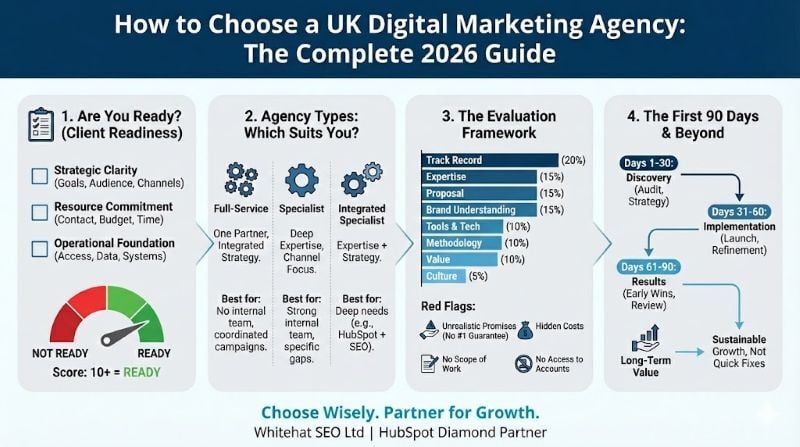
Are You Ready to Work with an Agency?
Before evaluating agencies, the more important question is whether your organisation is ready to work with one effectively. Whitehat's experience across hundreds of client engagements shows that client readiness is the single biggest predictor of agency relationship success—more than budget, more than choosing the "best" agency.
The Client Readiness Checklist
Answer honestly. Each "no" represents a potential point of friction in your agency relationship.
Strategic Clarity
- Do you have documented business goals for the next 12 months?
- Can you articulate what marketing success looks like in measurable terms?
- Do you know your target audience and their buying journey?
- Have you identified which channels matter most for your business?
Resource Commitment
- Do you have a dedicated internal contact with authority to approve work?
- Can that person commit 2-4 hours weekly to agency collaboration?
- Do you have budget confirmed for at least 6 months?
- Are stakeholders aligned on the decision to use an agency?
Operational Foundation
- Do you have access to your website, analytics, and advertising accounts?
- Is your brand positioning and messaging documented?
- Can you share historical performance data with a new agency?
- Are your sales and marketing systems (CRM, marketing automation) accessible?
Scoring: 10+ "yes" answers = ready to engage. 7-9 = address gaps first. Below 7 = foundational work needed before an agency can help effectively.
This isn't gatekeeping—it's protecting your investment. Agencies cannot compensate for missing foundations. If you score below 7, consider a marketing coaching engagement to build those foundations first.
Full-Service vs Specialist: Which Agency Type Suits You?
The UK market offers three primary agency structures, each suited to different business needs, budgets, and internal capabilities. The choice significantly impacts outcomes—there's no universally "best" option.
Full-Service Agencies
Full-service agencies provide end-to-end marketing support across multiple channels under one roof. These agencies typically employ 30-200+ staff including designers, developers, analysts, and channel specialists. They suit businesses needing integrated strategies across multiple channels, typically at budgets of £3,500+ per month for full service.
Advantages: Cohesive strategy across channels, simplified communication through a single account manager, scalability as your needs grow.
Disadvantages: Potential for "jack of all trades, master of none" expertise levels. Senior specialists may be spread across many accounts.
Best for: Businesses wanting one partner to handle everything, those lacking internal strategic capability, organisations requiring coordinated multi-channel campaigns.
Specialist/Boutique Agencies
Specialist agencies focus exclusively on one or two disciplines, offering deep expertise in areas like SEO, PPC, or social media. Teams typically range from 2-50 employees who stay at the forefront of their specific discipline.
Advantages: Deepest expertise in their specialism, often more innovative, tend to attract top talent in their field.
Disadvantages: Requires coordinating multiple agency relationships. Strategy integration becomes your responsibility.
Best for: Businesses with strong internal marketing leadership, those needing best-in-class execution in specific channels, organisations with clear channel-specific problems to solve.
Integrated Specialists (The Middle Ground)
Some agencies—including Whitehat—occupy a middle ground: deep specialism in complementary disciplines (such as inbound marketing, SEO, and HubSpot) that naturally work together, rather than attempting to cover everything.
Advantages: Deep expertise where disciplines genuinely overlap, coherent strategy without the coordination burden, specialists who understand how their work connects to business outcomes.
Disadvantages: Won't cover everything—you may still need additional partners for certain channels.
Best for: Businesses wanting specialist depth with strategic coherence, those whose primary needs align with the agency's integrated offering.
Quick Decision Framework
| Your Situation | Best Fit | Why |
|---|---|---|
| No internal marketing team | Full-service or integrated specialist | You need strategy and execution |
| Strong internal team, specific gap | Specialist | You can coordinate; need depth |
| Budget under £2,000/month | Specialist (one channel) | Focus limited resources |
| Complex tech stack (HubSpot + Salesforce) | Integrated specialist with platform expertise | Integration requires deep knowledge |
| Enterprise with £20k+/month budget | Full-service or specialist roster | Scale justifies dedicated resources |
UK Agency Pricing Benchmarks for 2026
UK agency pricing follows predictable patterns that should inform your expectations. These benchmarks are based on Whitehat's market analysis and industry research from sources including Adzooma, Expert Market, and Digital Marketing First. Note that rates increased approximately 62% compared to 2024 due to skills shortages and demand for AI/data expertise.
Monthly Retainer Ranges
| Service Level | Monthly Range | What's Typically Included |
|---|---|---|
| Core retainers (SMEs) | £1,250–£3,500/month | Single channel focus, monthly reporting, account management |
| Full-service retainers | £3,500–£16,750/month | Multi-channel strategy, content production, regular optimisation |
| Enterprise retainers | £16,750+/month | Dedicated team, strategic leadership, multiple campaigns |
| Average single-service | ~£960/month | One discipline, standard delivery |
Channel-Specific Pricing
| Channel | SME Range | Enterprise Range |
|---|---|---|
| SEO | £750–£2,000/month | Up to £10,000+/month |
| PPC Management | £500–£5,000/month + 10-20% of spend | £5,000–£15,000/month + % of spend |
| Social Media (Organic) | ~£1,120/month average | £2,500–£5,000/month |
| Social Media (Paid) | ~£587/month + 15% of spend | Management fee + % of spend |
| Content Marketing | £817–£1,050/month | £2,000–£8,000/month |
London premium: Agencies based in London typically charge 15-25% more than regional agencies. This doesn't always translate to better results—consider agencies outside London if you're working with constrained budgets. For transparent pricing examples, see Whitehat's digital services pricing.
Pricing Models Explained
Retainer (fixed monthly fee): Best for ongoing optimisation with predictable budgeting. Suits SEO, social media, and continuous campaign management.
Project-based (fixed fee for deliverables): Best for one-off campaigns, website builds, or testing agency relationships before committing to a retainer.
Performance-based (payment linked to outcomes): Aligns agency success with business results but requires robust tracking. Be cautious of agencies that only offer this—it can incentivise short-term tactics over sustainable growth.
Percentage of ad spend (10-20% of media budget): Common for paid media management but can become expensive at scale. Negotiate caps or fixed fees for larger budgets.
Watch for Hidden Costs
Setup/onboarding fees, third-party tool costs passed through, additional revisions beyond scope, emergency support charges, and media spend management fees separate from creative fees typically add 30-60% to the quoted retainer. Always ask for a complete cost breakdown before signing.
The Weighted Evaluation Framework
Moving beyond gut feel to structured evaluation dramatically improves selection outcomes. Whitehat recommends this weighted scorecard approach, synthesised from industry best practices and our experience of what actually predicts agency relationship success.
| Criterion | Weight | What to Evaluate |
|---|---|---|
| Track record and trustworthiness | 20% | Case studies, testimonials, awards, longevity in business |
| Industry experience and expertise | 15% | Sector knowledge, relevant results, market understanding |
| Quality of proposal | 15% | Strategic clarity, tailored solutions, goal alignment |
| Understanding of your brand | 15% | Discovery process depth, brand interpretation, communication style |
| Tools, technology and resources | 10% | Platforms used, proprietary tools, AI capabilities |
| Approach and methodology | 10% | Data-driven strategy, flexibility, review processes |
| Timeline and pricing value | 10% | Realistic timelines, transparent pricing, value alignment |
| Cultural fit | 5% | Working style, values, communication preferences |
Scoring guide: Rate each criterion 1-10. Multiply by weight. A total score of 80%+ indicates a reliable, knowledgeable agency aligned with your business needs. Below 70% warrants concern.
Certifications That Actually Matter
Agency certifications vary dramatically in rigour and meaning. Some indicate genuine capability; others are essentially purchased.
High-value certifications:
- Google Premier Partner: Requires being in the top 3% of participating companies within their country, with minimum £10,000 90-day ad spend, 70%+ optimisation scores, and staff certifications.
- HubSpot Diamond/Elite Partners: Specific accreditations (Advanced Implementation, CRM Implementation) demonstrate harder-to-achieve expertise beyond revenue thresholds. Whitehat is a HubSpot Diamond Partner.
- Meta Badged Partner: Requires $2.5 million+ ad spend or certified expertise with proven track record.
- CIM Chartered Marketer status: Represents the highest professional marketing recognition in the UK.
Moderate-value certifications: Standard Google Partner (achievable by smaller agencies meeting minimum thresholds), HubSpot Gold/Platinum (lower revenue thresholds), Meta Member level (entry-level).
Verification approach: Look for clickable dynamic badges linking to verification pages. Self-proclaimed expertise without verification links warrants scrutiny.
Red Flags and Warning Signs
Knowing what to avoid is as important as knowing what to seek. These warning signs, organised by category, should trigger serious reconsideration of any agency relationship.
🚩 Strategy and Promise Red Flags
- "We'll get you #1 on Google" — No one can guarantee search positions. Google's algorithm considers hundreds of factors, and rankings fluctuate constantly. Any agency making this promise is either lying or planning to use tactics that will eventually harm your site.
- "Results in 30 days" — SEO takes 3-6 months minimum. PPC needs optimisation time. Social media requires audience building. Instant results promises indicate either unrealistic expectations being set or a plan to use unsustainable tactics.
- Black-hat tactics mentioned casually — Buying links, purchasing followers, using scraped email lists. These violate platform terms, risk penalties, and produce worthless engagement. Ethical agencies—like those practising white hat SEO—build sustainable results.
- Focus on vanity metrics only — Impressions, followers, and traffic without connecting to business outcomes. Ask any agency: "How will this impact our pipeline?" Blank looks are disqualifying.
- One-size-fits-all approaches — Cookie-cutter proposals without discovery questions suggest templated execution that won't address your specific challenges.
🚩 Contract and Pricing Red Flags
- Vague or hidden pricing — Evasiveness about costs suggests upsell traps. Legitimate agencies can provide clear pricing structures upfront.
- Long lock-in contracts without cause — 12+ month contracts with no exit clauses trap you with underperforming agencies. Industry standard is 3-6 month initial terms with reasonable notice periods.
- Unrealistically cheap quotes — If it's dramatically below market rates, something is compromised: inexperienced staff, offshore execution without disclosure, or plans to upsell essential services.
- No clear scope of work — Undefined deliverables lead to disputes. Every agency should provide specific, documented scope before signing.
🚩 Communication and Process Red Flags
- Slow response times during sales — If they're unresponsive when trying to win your business, expect worse after signing.
- Won't provide account access — You should own your Google Ads, Analytics, and social media accounts. Agencies who insist on controlling these create hostage situations.
- No clear reporting schedule — Without defined reporting cadence and format, you'll struggle to track ROI or hold the agency accountable.
- Working on personal accounts — Ads should run through your Business Manager accounts, not the agency's. This protects your data and assets.
Essential Questions to Ask During Evaluation
These questions separate agencies with genuine capability from those with polished sales presentations. Use them systematically—vague answers should concern you.
Experience Questions
- What types of companies do you typically work with?
- Have you worked with businesses like ours in terms of size, industry, and challenges?
- Can you share relevant case studies with specific, verifiable results?
- Do you currently work with any of our competitors? (Conflict of interest check)
- What certifications does your team hold?
Process Questions
- What's your discovery and onboarding process?
- How do you develop strategy and what research do you conduct?
- What tools and technology platforms do you use?
- Will any work be outsourced to third parties?
- How do you integrate with existing marketing teams?
Team and Communication Questions
- Who will be my day-to-day contact?
- Can I meet the team who will actually work on my account?
- How often will we have meetings and in what format?
- What involvement do you need from our team?
- How do you handle staff turnover on accounts?
Reporting and Performance Questions
- How do you measure success and what KPIs do you track?
- How often will I receive reports and what format?
- Will I have access to analytics dashboards?
- How do you handle underperformance?
- Can you connect marketing metrics to business outcomes like revenue?
Commercial Questions
- How is pricing structured? What's included versus additional cost?
- What are contract terms and minimum commitment?
- What's your termination clause and notice period?
- Who owns the work product and data?
- Are there any setup fees, tool costs, or other charges beyond the quoted retainer?
Contract Terms and Negotiation
UK agency contract standards follow predictable patterns. Understanding these norms gives you negotiating power and protects against problematic terms.
Standard UK Contract Terms
- Notice periods: 30-60 days (2 months common for retained services)
- Initial minimum terms: 3-6 months
- After initial term: Auto-renewal monthly unless notice given
- Liability caps: Typically 1-2x fees paid
Essential Contract Elements
Ensure every agency contract includes:
- Detailed scope of services with exact deliverables expected
- Payment terms and schedule
- Duration and termination provisions
- Confidentiality provisions (NDA)
- Performance metrics for measuring success
- Intellectual property ownership clarity
- GDPR compliance requirements
- Data ownership and handover procedures
What to Negotiate
- Performance exit clauses: Right to terminate early if specific KPIs aren't met
- Shorter initial terms: Start with 3 months rather than 6 to test the relationship
- Fee caps: For percentage-of-spend models, negotiate maximum monthly fees
- Transition support: Written commitment to handover support if you end the relationship
- Key personnel clauses: Right to notification if your account lead changes
AI Capabilities and 2026 Readiness
AI has moved from experimentation to mainstream adoption in UK marketing. According to LOCALiQ's 2025 UK State of Digital Marketing report, 53% of UK businesses now use AI in their marketing strategy, whilst the UK Marketing Association reports 67% of UK marketers use AI tools to generate tailored content.
This creates a new evaluation dimension: agencies without coherent AI strategies will fall behind; agencies using AI carelessly create quality and compliance risks.
AI Capabilities to Assess
| Application | UK Adoption | What to Ask |
|---|---|---|
| Written content creation | 63% | How is AI content reviewed and edited by humans? |
| Marketing automation | 44% | Which workflows are AI-enhanced vs traditional? |
| Graphic design | 32% | What's AI-generated vs human-designed? |
| Campaign optimisation | 30% | How do you balance AI recommendations with human judgement? |
Questions for AI Readiness Assessment
- What's your AI usage policy and governance framework?
- How do you ensure AI-generated content maintains brand voice and accuracy?
- What human oversight exists for AI outputs?
- How are you preparing clients for Answer Engine Optimisation (AEO)?
- What's your approach to first-party data strategy as cookies phase out?
The Balance That Matters
Research shows AI-generated content is perceived as less engaging when AI replacement is disclosed—but these negative effects are attenuated when AI augments human work rather than substituting for it. The best agencies use AI to enhance human capabilities, not replace expertise. Ask specifically about their human-AI collaboration model.
The First 90 Days Framework
The initial three months determine whether an agency relationship will succeed. Understanding what to expect—and what to demand—sets appropriate benchmarks and surfaces problems early.
Days 1-30: Foundation and Discovery
What should happen:
- Comprehensive onboarding session covering business goals, brand, and history
- Account and analytics access established
- Audit of current state (technical, competitive, performance)
- Strategy document and roadmap presentation
- KPI baseline established and tracking implemented
Warning signs: No discovery call scheduled, vague strategy documents, requests to "just trust us" without explanation.
Days 31-60: Implementation and Optimisation
What should happen:
- Major technical/foundational issues addressed
- Campaign launches or content production begins
- First performance report delivered
- Regular communication rhythm established
- Initial learnings documented and strategy refined
Warning signs: No visible activity, reports without insights, defensive responses to questions.
Days 61-90: Results and Refinement
What should happen:
- Early results visible (especially for PPC, email, social)
- SEO showing progress indicators (even if not ranking changes yet)
- Strategic review meeting with learnings and recommendations
- Next quarter priorities agreed
- Relationship evaluation point—is this working?
Warning signs: Excuses without data, significant departure from agreed strategy without explanation, communication gone quiet.
Realistic Timeline Expectations by Channel
| Channel | Initial Results | Significant Results | Full Potential |
|---|---|---|---|
| SEO | 3-4 months | 5-6 months | 12+ months |
| PPC | Immediate | 2-4 weeks | 3-6 months |
| Social Media | 1-2 weeks | 1-3 months | 6+ months |
| Content Marketing | 3-6 months | 6-12 months | 12-24 months |
| Immediate | 1-3 months | Ongoing |
Frequently Asked Questions
How much should a small business spend on digital marketing in the UK?
UK SMEs typically invest £1,250-£3,500 per month on agency retainers for core digital marketing services. This usually covers one to two channels effectively. Businesses seeking full-service support across multiple channels should budget £3,500-£10,000 monthly. The critical factor isn't the absolute amount but ensuring budget aligns with realistic goals—underfunding creates false expectations and poor results.
Should I choose a London agency or a regional one?
Location matters less than capability and fit. London agencies charge 15-25% more but don't necessarily deliver better results. Remote working has made geography largely irrelevant for most agency work. Focus on expertise, cultural fit, and proven results rather than postcode. That said, if face-to-face meetings matter to you, proximity has value.
How long should an agency contract be?
Industry standard is 3-6 month initial terms with 30-60 day notice periods thereafter. Be cautious of 12+ month commitments without performance exit clauses. SEO genuinely requires 6+ months to show results, but shorter initial terms protect you whilst still giving agencies fair time to demonstrate value. At Whitehat, we recommend starting with a defined project or 3-month engagement to test the relationship.
What ROI should I expect from digital marketing?
ROI varies dramatically by channel and business model. SEO achieves 748% average ROI over time. Email marketing delivers approximately 4,200% ROI. PPC typically delivers 200-400% ROI when well-optimised. Content marketing takes longer but compounds significantly. The key is setting channel-appropriate expectations—demanding PPC-speed results from SEO is a recipe for disappointment.
How do I know if my agency is underperforming?
Key warning signs include: missed KPI targets without credible explanation, declining engagement in communications, rotating team members without notice, reports that present data without insights or recommendations, and defensive responses to questions. Compare performance against agreed benchmarks, not vague promises. Poor communication is often the first indicator—agencies struggling with results typically avoid conversations.
Can I work with multiple agencies simultaneously?
Yes, but coordination becomes your responsibility. Using specialists for different channels can deliver best-in-class execution, but requires strong internal marketing leadership to maintain strategic coherence. If you lack that capability, an integrated agency that handles complementary disciplines together—like combining SEO with HubSpot implementation—often produces better results with less management overhead.
Ready to Find Your Agency Partner?
Choosing a digital marketing agency is a significant decision. The frameworks in this guide will help you evaluate options systematically—but frameworks only take you so far. Ultimately, the right agency is one that genuinely understands your business, demonstrates relevant expertise, and feels like a true partner rather than a vendor.
At Whitehat, we've helped UK businesses navigate digital marketing for over a decade. As a HubSpot Diamond Partner running the world's largest HubSpot User Group, we bring both deep expertise and a genuine commitment to client success.
If you'd like to explore whether we're the right fit for your business, get in touch for a conversation—no obligation, no pressure. We'll be honest about whether we can help.
References and Sources
- IAB UK (2025). Digital Adspend 2024: UK's overall digital ad market hits £35.5bn. iabuk.com
- Advertising Association/WARC (2025). AA/WARC Expenditure Report: UK ad spend hit £42.6bn in 2024. iabuk.com
- Statista/Marketing Week (2024). Share of companies outsourcing elements of marketing in the United Kingdom as of March 2024. statista.com
- LOCALiQ (2025). 2025 UK State of Digital Marketing Report. localiq.co.uk
- UK Marketing Association (2024). AI Adoption in UK Marketing. cim.co.uk
- Google Partners (2025). Premier Partner Requirements. google.com/partners
- HubSpot (2025). Solutions Partner Program Tiers. hubspot.com/partners
About the Author
Whitehat SEO Ltd
Whitehat is a London-based HubSpot Diamond Partner and full-service inbound marketing agency, helping businesses grow through ethical SEO, content strategy, and marketing automation since 2011. We run the world's largest HubSpot User Group and are committed to delivering measurable results that connect marketing activity to business outcomes.