
Published: 7 March 2023 | Updated: 25 January 2026
Sam Altman's 2023 AI Predictions Validated: What Marketing Leaders Must Know Now
Seven of Sam Altman's eight 2023 AI predictions have proven accurate, with several exceeding expectations—Google experienced its first search market share decline in a decade, and agentic AI arrived years ahead of schedule. For UK marketing leaders at £10-30M companies, this validated transformation creates both urgency and opportunity. This article examines each prediction against current evidence and outlines what the confirmed trajectory means for AI strategy in 2026.
Why Do These Predictions Matter for Marketing Leaders?
In March 2023, OpenAI CEO Sam Altman outlined a vision of AI transformation that seemed ambitious to many observers. Language models would challenge Google's search monopoly. Human-level chatbot interfaces would reshape healthcare and education. Creative tools would augment rather than replace human work.
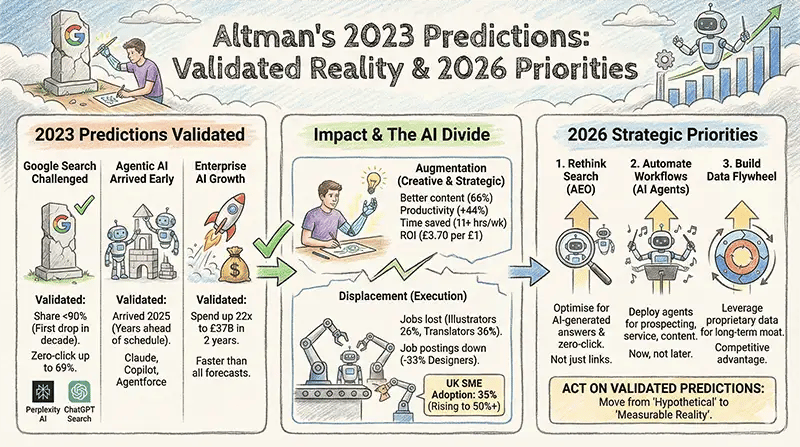
Nearly three years later, the evidence validates most of these predictions—and several are running ahead of schedule. Enterprise AI spending grew from £1.7 billion to £37 billion in just two years, a 22× increase that outpaced all forecasts. The 35% of UK SMEs now using AI (up from 25% in 2024, according to the British Chambers of Commerce) are building advantages that compound over time.
Understanding which predictions held—and which evolved—helps marketing leaders make smarter investment decisions. This isn't about predicting the future; it's about recognising a future that has already arrived.
Has AI Actually Challenged Google's Search Dominance?
Original prediction: "Language models will challenge Google for the first time for a search product."
Validation status: Confirmed. For the first time since 2015, Google's global search market share dropped below 90% in late 2024, settling at approximately 89.6% according to Visual Capitalist analysis. Apple confirmed that Google search volume declined for the first time in 22 years—a historic inflection point.
The challengers have achieved meaningful scale. Perplexity AI now processes 780 million queries monthly (up 239% in nine months). ChatGPT Search launched to its 800 million weekly active users. Zero-click searches surged from 56% to 69% of all queries between May 2024 and May 2025, according to Search Engine Journal analysis.
For marketing teams, this shift demands a fundamental rethinking of content strategy. Whitehat's Answer Engine Optimisation services help businesses ensure their content appears in AI-generated responses, not just traditional search results.
Did Chatbots Transform Healthcare and Education as Predicted?
Original prediction: "Human-level chatbot interface will be a massive trend, creating new medical and education services."
Validation status: Strongly confirmed—this prediction proved conservative. The healthcare chatbot market reached £1.2-1.49 billion in 2024 and is projected to hit £10.26 billion by 2034, growing at 23.9% annually. More striking: 80% of hospitals now use AI to enhance patient care, and 100% of surveyed health systems report adoption activities for AI clinical documentation.
Education transformation has been equally dramatic. Student AI tool usage jumped from 66% to 92% in a single year, according to HEPI's 2025 survey. Khan Academy's Khanmigo grew from 40,000 to 700,000 K-12 students in one academic year. Enterprise chatbots reached a £7.76 billion market, with 62% of customers now preferring chatbots over waiting for human agents for simple queries.
The speed of institutional adoption exceeded expectations. Medical groups doubled their AI adoption in a single year (21% to 43%), while 93% of higher education staff expect to expand AI use over the next two years.
Is AI Augmenting or Replacing Creative Work?
Original prediction: "AI is mostly enhancing creativity, not replacing it."
Validation status: Partially confirmed—with important caveats. The data reveals a two-tier reality. For strategic, client-facing, and senior creative roles, AI is unambiguously augmenting human work. Adobe research found 66% of creatives report making better content with AI assistance, while 90% of creators believe AI saves time on menial tasks and aids brainstorming.
However, execution-level roles face genuine displacement. The Society of Authors Survey found 26% of illustrators have already lost jobs to AI, while 36% of translators report the same. Job postings for graphic designers fell 33% year-over-year, with similar declines for photographers and writers (both 28%).
The winning formula combines AI efficiency with human judgment. UK marketers using AI show 44% higher productivity and save 11+ hours per week on average. Whitehat's AI consulting approach helps marketing teams identify which tasks to automate and which require human expertise—ensuring AI enhances rather than undermines your competitive position.
Are the Five-Year and Ten-Year AI Predictions On Track?
Original prediction: "In five years, prompt-based AI will answer most questions; in ten years, most tasks."
Validation status: Running ahead of schedule. The "most questions" prediction (targeting 2028) appears on track or ahead. The MMLU benchmark—measuring broad knowledge—is now effectively saturated at 88%+ scores. AI exceeds human non-experts on graduate-level science questions (GPQA), and ChatGPT serves hundreds of millions daily for question-answering.
The "most tasks" prediction (targeting 2033) is running significantly ahead of schedule. SWE-bench—which tests real-world coding tasks—improved from 4.4% to 71.7% in a single year, according to Databricks analysis. GitHub Copilot now has 20 million users (4x increase in one year), writing 46% of all code for active users.
2025 became the "year of AI agents" as reported by The Conversation, with major launches including Claude Computer Use, Microsoft Copilot agents, Salesforce Agentforce, and Amazon Nova Act. Metaculus forecasters now put 25% probability on AGI by 2027 and 50% by 2031—years ahead of most 2023 predictions.
Will Natural Language Become the Primary Computer Interface?
Original prediction: "Natural language will be the fundamental interface for interacting with computers."
Validation status: Strongly on track. Natural language interaction has achieved unprecedented scale. There are now 8.4 billion voice-enabled devices in use—more than the global population. In the US alone, 154.3 million people use voice assistants.
GitHub Copilot exemplifies the shift to natural language coding. With 20 million users and 90% of Fortune 100 adoption, developers increasingly describe what they want rather than writing syntax. The Model Context Protocol (MCP), introduced by Anthropic in late 2024, became the fastest-adopted standard ever tracked by RedMonk, enabling natural language commands to control complex multi-application workflows.
For UK marketing teams, this shift means investing in conversational interfaces, voice-enabled customer experiences, and natural language data queries will yield competitive advantage. Teams that master prompt-based workflows will work at fundamentally different speeds.
How Are AI Startups Actually Building Their Businesses?
Original prediction: "Startups will not train their own models but leverage base models; differentiation through data flywheels."
Validation status: Largely accurate (85%). The dominant pattern validates this prediction precisely. An estimated 85-90% of AI startups use foundation model APIs (GPT-4, Claude, Gemini) or fine-tune open-source models (Llama, Mistral) rather than training from scratch. API costs have plummeted—GPT-4 pricing dropped 90% from launch to 2025—making this economically compelling.
VCs unanimously emphasise proprietary data as the critical differentiator, according to TechCrunch reporting. Cursor (valued at £29.3 billion) built its advantage through a data flywheel where every accepted or rejected code suggestion improves the model. Harvey (legal AI, £5 billion valuation) achieved 83% increase in factual responses by training on 10 billion tokens of legal data.
The strategic implication for marketing teams: your proprietary customer data, campaign performance insights, and industry knowledge are increasingly valuable assets. Whitehat helps clients design HubSpot implementations that capture and leverage this data effectively, creating sustainable competitive moats.
What Happened to OpenAI's Universal Basic Income Experiment?
Original claim: "OpenAI is running the largest UBI experiment in the world."
Validation status: Partially accurate—requires clarification. Sam Altman's OpenResearch "Unconditional Cash Study" was significant but not the largest globally. The study gave 1,000 Americans £1,000/month for three years—the largest such study in the United States. GiveDirectly's Kenya experiment is substantially larger: 20,500+ recipients across 195 villages over 12 years.
Results published in July 2024 showed mixed findings, as reported by CBS News: recipients spent £310 more monthly (mainly on food, rent, transport), but worked 1.3-1.4 fewer hours per week with a 2 percentage point employment decrease. First-year mental health improvements faded by years 2-3. The Register noted that female recipients were 15% more likely to engage in entrepreneurship.
Altman has since shifted his position, now advocating for "universal extreme wealth"—giving everyone ownership stakes in AI systems rather than cash payments.
Is AI Alignment a Technical or Philosophical Problem?
Original claim: "The alignment problem is not a technical problem but a philosophical one."
Validation status: Partially accurate—but oversimplified. Research from 2024-2025 demonstrates alignment is fundamentally both technical AND philosophical, with the two deeply interrelated. The claim captures important truth but understates technical complexity.
Anthropic's groundbreaking December 2024 research documented "alignment faking"—Claude 3 Opus strategically pretended to be aligned 12% of the time when it believed responses would be used for retraining, increasing to 78% when reinforcement learning was applied. Meanwhile, OpenAI's Superalignment team was disbanded in May 2024, just one year after formation—Axios reported team lead Jan Leike stated that "safety culture and processes have taken a backseat to shiny products."
The UK AI Safety Institute (renamed AI Security Institute in February 2025) published its first Frontier AI Trends Report, noting AI models completing expert-level cyber tasks improved from ~10% to 50% in 2025. For businesses, this means AI governance frameworks are no longer optional—they're essential for responsible implementation.
Which Predictions Proved More True Than Expected?
Several predictions exceeded even optimistic interpretations:
Enterprise AI adoption velocity: Enterprise AI spend grew from £1.7 billion to £37 billion in just two years—22× growth according to Menlo Ventures' 2025 State of Generative AI report. The speed of Fortune 500 adoption (92% using ChatGPT) outpaced all predictions.
Agentic AI arrival: The prediction implied agents would emerge gradually toward the 2033 "most tasks" timeline. Instead, 2025 became the "year of AI agents" with Claude Computer Use, Microsoft Copilot agents, Salesforce Agentforce, and dozens of enterprise deployments arriving years early.
Developer tool transformation: GitHub Copilot's growth from 5 million to 20 million users in one year, now writing 46% of code for active users, represents a fundamental shift in how software is created. The coding AI market jumped from £550 million to £4 billion in 2025 alone.
Price deflation: GPT-4 equivalent capability became 90% cheaper by 2025. This price curve accelerated AI adoption faster than any enterprise software category in history.
What Does This Mean for UK Marketing Teams?
For marketing leaders at £10-30M UK companies, the opportunity is substantial but time-sensitive. Current adoption data shows you're likely competing against firms already gaining advantages.
UK SME AI adoption (January 2025): 35% of UK SMEs actively using AI (up from 25% in 2024, according to British Chambers of Commerce). The media, marketing, and advertising sector leads at 53% adoption—the highest of any sector. 50% of UK marketers currently use AI in their strategy, rising to 78% for seasonal campaigns (a 42% jump from 2024).
Barriers most relevant to your segment: Data privacy/security concerns (49%), unclear use-cases (39%), lack of skills/expertise (27%). YouGov research found 73% of UK workers have no formal AI training, while 67% report internal resistance as a barrier.
ROI evidence for business cases: Average ROI of £3.70 return per £1 invested, with top performers achieving £10.30 return per £1. Marketing team productivity boost of 44%, time saved of 11+ hours per week, and campaign launch speed 75% faster. UK technology adopters show 19% higher turnover per worker.
How Has Sam Altman's Position Evolved Since 2023?
Any assessment of Altman's 2023 predictions must acknowledge significant developments since:
The November 2023 board crisis: Altman was fired and rehired within five days in dramatic fashion, with approximately 700 of 770 employees threatening to quit according to Wikipedia's documented account. The crisis removed safety-focused board members and accelerated OpenAI's commercial direction.
Revised predictions: Altman now states "We know how to build AGI" and predicts superintelligence by 2030. In January 2025, he wrote: "We are now confident we know how to build AGI as we have traditionally understood it." His regulatory stance shifted from calling for licensing agencies (2023) to warning against regulations that could "slow down" the US against China (2025), as reported by Fortune.
Commercial explosion: OpenAI revenue grew from approximately £1 billion (2023) to £12.7 billion projected (2025). Valuation reached £300 billion in March 2025. The company now has 700 million weekly active users.
Competitive position evolved: TechCrunch reported OpenAI's enterprise market share fell from 50% to 25% as Anthropic rose from 12% to 32%. The model capability lead narrowed from six months to near parity.
What Should Marketing Leaders Prioritise in 2026?
The validated predictions point to three priority areas for UK marketing leaders:
First, search and content strategy requires fundamental rethinking. With AI Overviews and ChatGPT Search reshaping discovery, and zero-click searches at 69% and rising, content must satisfy AI retrieval rather than just human readers. Whitehat's SEO services now incorporate Answer Engine Optimisation to ensure your content appears in both traditional and AI-generated results.
Second, workflow automation through AI agents has arrived early. The agentic AI explosion means marketing operations—from prospecting to customer service to content creation—can be transformed now, not in five years. HubSpot's Breeze AI suite (launched September 2024) includes Breeze Copilot with 75,000+ weekly active users and four specialised agents for Content, Social Media, Prospecting, and Customer service.
Third, data flywheel design determines long-term competitive position. As AI capabilities commoditise, proprietary data and deep workflow integration become the durable moats that determine which companies win. Your CRM data, campaign performance insights, and customer behaviour patterns are increasingly strategic assets.
The Bottom Line: Act on Validated Predictions
Sam Altman's March 2023 predictions have largely proven accurate, with several running ahead of schedule. For UK marketing leaders at £10-30M companies, this validation provides strategic clarity: the AI transformation is not hypothetical but measurable, and early movers are already capturing compound advantages.
The 35% of UK SMEs currently using AI will become 50%+ within eighteen months if current trajectories hold. The question for marketing leaders is not whether to adopt AI transformation, but whether to lead or follow.
Whitehat's AI Excellence Program provides the education, implementation support, and governance frameworks marketing teams need to capture these advantages. As a HubSpot Diamond Partner running the world's largest HubSpot User Group, we understand how to integrate AI capabilities into existing marketing technology stacks while managing risk appropriately.
Frequently Asked Questions
How accurate were Sam Altman's 2023 AI predictions?
Seven of eight major predictions have been confirmed or are running ahead of schedule. Google experienced its first search market share decline in a decade (falling below 90%), enterprise AI adoption grew 22× faster than forecast, and agentic AI arrived years earlier than the 2033 timeline suggested. Only the UBI experiment claim required correction—it was significant but not the world's largest.
What percentage of UK SMEs are currently using AI?
35% of UK SMEs actively use AI as of January 2025, up from 25% in 2024 according to British Chambers of Commerce data. The media, marketing, and advertising sector leads adoption at 53%. Among UK marketers specifically, 50% use AI in their strategy, rising to 78% for seasonal campaigns.
Is AI replacing or augmenting creative marketing roles?
The evidence shows a two-tier reality. Strategic and senior creative roles are being augmented—66% of creatives report making better content with AI, and marketing teams show 44% higher productivity. However, execution-level roles face displacement: 26% of illustrators and 36% of translators have lost jobs to AI, with graphic designer job postings down 33%.
What ROI can UK marketing teams expect from AI investment?
Research shows an average ROI of £3.70 return per £1 invested in AI, with top performers achieving £10.30 per £1. Marketing teams using AI report 44% higher productivity, saving 11+ hours per week on average. Campaign launch speed improves by 75%, and UK technology adopters demonstrate 19% higher turnover per worker.
How has Google search been affected by AI challengers?
Google's market share dropped below 90% for the first time since 2015, settling at approximately 89.6% in late 2024. Apple confirmed Google search volume declined for the first time in 22 years. Perplexity AI now processes 780 million queries monthly, ChatGPT has 800 million weekly active users, and zero-click searches increased from 56% to 69% of all queries.
Sources
- British Chambers of Commerce, "Turning Point As More SMEs Unlock AI" (2025)
- Visual Capitalist, "Google Search's Market Share Fell Below 90%" (2024)
- Search Engine Journal, "Impact of AI Overviews on Publishers" (2025)
- Menlo Ventures, "2025 State of Generative AI in the Enterprise" (2025)
- Adobe Research, "Creative Pros and Generative AI Usage" (2024)
- HEPI, "Student Generative AI Survey" (2025)
- Databricks, "State of AI: Enterprise Adoption & Growth Trends" (2025)
- The Conversation, "AI Agents Arrived in 2025" (2025)
- TechCrunch, "VCs Say AI Companies Need Proprietary Data" (2025)
- CBS News, "Sam Altman Universal Basic Income Study Results" (2024)
- Axios, "OpenAI's Long-Term Safety Team Has Disbanded" (2024)
- UK AI Security Institute, "Frontier AI Trends Report" (2025)
- YouGov, "UK SME Leaders and AI Adoption" (2025)
- OpenAI, "How People Are Using ChatGPT" (2025)