
| Last Updated: 13 January 2026 explore our digital marketing FAQs
Inbound Sales Methodology: From the Flywheel to The Loop (2026 Guide)
By Clwyd Probert, CEO of Whitehat SEO
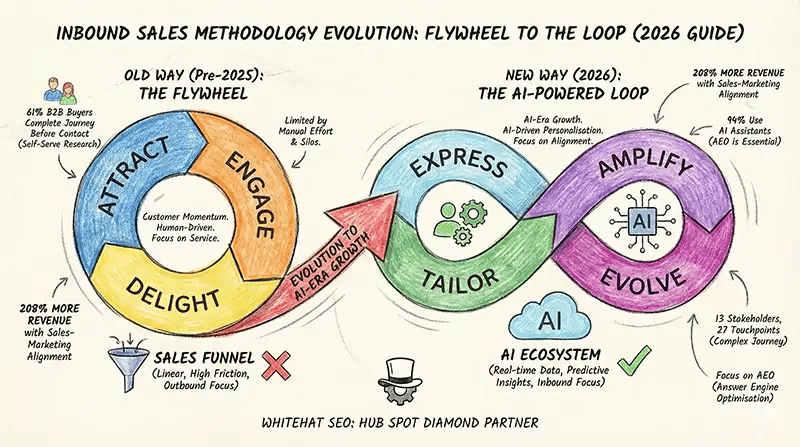
The inbound sales methodology is a customer-centric approach where sales teams attract, engage, and delight buyers through helpful content and personalised interactions rather than interruptive tactics. HubSpot's methodology has evolved from the 2018 flywheel model to The Loop—a four-stage AI-era framework (Express, Tailor, Amplify, Evolve) that helps B2B companies generate 208% more marketing revenue when sales and marketing teams achieve alignment.
When HubSpot introduced the flywheel at INBOUND 2018, it represented a fundamental shift in how businesses think about growth. The traditional sales funnel—with customers falling out the bottom as mere outputs—gave way to a circular model where delighted customers become the primary driver of new business.
Seven years later, the landscape has transformed again. 61% of B2B buyers now complete their purchase journey before contacting vendors, according to 6sense's 2025 Buyer Experience Report. AI-powered search has changed how prospects research solutions. And 60% of Google searches end without a click, according to SparkToro research.
At Whitehat SEO, we've helped hundreds of UK B2B companies implement these methodologies through our HubSpot onboarding services. This guide explains how the inbound sales methodology has evolved, what The Loop means for your business, and how to implement these frameworks to drive measurable pipeline growth.
What Is Inbound Sales and Why Does It Matter in 2026?
Inbound sales is a methodology that prioritises the buyer's needs over the seller's agenda. Rather than cold-calling prospects or pushing unwanted messages, inbound sales teams attract potential customers through valuable content, then guide them through personalised buying experiences.
The approach works because modern B2B buyers have fundamentally changed. Research from Gartner reveals that buyers spend only 17% of their purchase journey meeting with potential suppliers. When multiple vendors are being considered, that time drops to just 5-6% per supplier.
For UK B2B companies, the shift is even more pronounced. McKinsey research shows that fewer than 25% of UK buyers ever want to interact with sales representatives in person again. Instead, 96% prefer digital self-serve portals for purchases—even for high-value B2B transactions.
This transformation demands a new approach. Inbound sales aligns your sales process with how buyers actually purchase: researching independently, comparing options, and engaging with vendors only when they're ready to have meaningful conversations.
The Flywheel Model: HubSpot's Customer-Centric Revolution
HubSpot co-founder Brian Halligan introduced the flywheel at INBOUND 2018 as a replacement for the traditional sales funnel. The metaphor—borrowed from James Watt's industrial-era invention—captures how business momentum compounds when customers become growth drivers rather than endpoints.
The flywheel operates through three interconnected stages:
- Attract: Draw potential customers through content marketing, SEO, social media, and conversion optimisation
- Engage: Build relationships through personalised communication, live chat, nurturing workflows, and consultative selling
- Delight: Deliver exceptional experiences that transform customers into advocates who refer new business
As Halligan explained: "Customers are your best channel to market. It's not marketing. It's not sales. Your customers are the loudest voice in your potential customers' ears."
The flywheel's power comes from two forces: speed (how much energy you apply through marketing, sales, and service efforts) and friction reduction (eliminating obstacles that slow customer momentum). Research shows that 91% of B2B buyers are influenced by word-of-mouth recommendations—validating Halligan's customer-centric thesis.
Whitehat runs the world's largest HubSpot User Group in London, where we've seen hundreds of businesses implement flywheel principles. The companies that succeed share a common trait: they measure customer success as carefully as they measure acquisition.
The Loop: HubSpot's AI-Era Growth Framework for 2026
At INBOUND 2025, HubSpot CEO Yamini Rangan unveiled The Loop—a new playbook designed for growth in the AI era. The Loop doesn't replace inbound principles; it adapts them for a world where buyers use ChatGPT for research, get answers directly in AI Overviews, and discover solutions across fragmented channels.
As HubSpot CMO Kipp Bodnar explained: "The old funnel assumed customers would come to you. They visit your website, read your blog, and convert on your terms. But when 60% of searches never leave Google and AI is answering questions before prospects even click, that playbook is broken."
The Loop operates through four continuous stages:
| Stage | Focus | Key Activities |
|---|---|---|
| Express | Define brand identity and voice | Create AI-ready style guides, document ICP, establish differentiated positioning |
| Tailor | Personalise at scale | Use unified CRM data to craft contextual messages, build audience segments, enable AI personalisation |
| Amplify | Distribute across channels | Optimise for AI search (AEO), activate multi-channel distribution, build creator partnerships |
| Evolve | Iterate in real time | Monitor live performance, run rapid experiments, refine strategy continuously |
The critical difference between The Loop and earlier models is the explicit integration of AI throughout. HubSpot's Breeze AI ecosystem—including Copilot for day-to-day assistance, Agents for automated tasks, and Intelligence for data enrichment—powers each stage of The Loop.
Why Sales-Marketing Alignment Determines Inbound Success
Neither the flywheel nor The Loop can function without alignment between sales and marketing teams. Yet research consistently shows this alignment is rare: only 8% of companies achieve true sales-marketing alignment, according to ZoomInfo.
The business impact of alignment is substantial. Companies with aligned teams achieve:
- 208% more marketing-generated revenue (Marketo research)
- 38% higher sales win rates (SiriusDecisions)
- 36% better customer retention (ZoomInfo)
- 24% faster revenue growth over three years
Conversely, misalignment costs businesses dearly. An estimated £1 trillion is lost annually due to sales-marketing misalignment, and 60-70% of B2B content goes unused because sales teams don't know it exists or don't find it relevant.
For UK businesses implementing HubSpot, Whitehat's approach to sales and marketing alignment starts with shared definitions: What constitutes a Marketing Qualified Lead? When does a lead become Sales Qualified? What response times are acceptable? These agreements, documented in a Service Level Agreement (SLA), form the operational foundation for flywheel and Loop success.
How the B2B Buyer Journey Has Changed in 2026
Understanding modern buyer behaviour is essential for implementing inbound sales effectively. The 2025/2026 data reveals a buying process that would be unrecognisable to sales teams from a decade ago.
Key buyer behaviour statistics:
- 95% of B2B deals are won by vendors already on the buyer's "Day One shortlist" (6sense 2025)
- 81% of buyers have a preferred vendor before making first contact
- 94% of B2B buyers now use AI assistants (ChatGPT, Claude, Perplexity) during their research
- 13 stakeholders on average participate in B2B purchase decisions, spanning multiple departments
- 27 touchpoints occur before a typical B2B purchase decision
- 74.6% of B2B sales take four or more months; 46.4% take seven months or longer
For UK B2B companies specifically, the shift toward digital buying is accelerating. UK sales representatives spend only 28% of their time actually selling—down from 36% before the pandemic—while 80% are active on LinkedIn but only 21% have a documented social selling strategy.
These statistics underscore why inbound methodology matters: if buyers complete most of their journey before contacting you, your content, brand visibility, and digital presence determine whether you make the shortlist. Interruption-based outbound tactics cannot compete when buyers actively avoid vendor engagement until they're ready.
AI Integration in Modern Inbound Sales
Artificial intelligence has moved from experimental to essential in B2B sales. HubSpot's Breeze AI ecosystem exemplifies this shift, but the broader trend affects every organisation regardless of their technology stack.
Current AI adoption in sales:
- 56% of sales representatives now use AI daily (up from 24% in 2023)
- 81% of organisations have adopted AI in some form
- Sales teams using AI are 3.7× more likely to meet quota (Gartner 2024)
- 83% of AI-using sales teams reported revenue growth versus 66% of non-AI teams
- AI lead scoring reduces follow-up time by 60% and increases conversion by 50%
Gartner predicts that 95% of seller research workflows will begin with AI by 2027—up from less than 20% in 2024. This isn't a future trend; it's a current reality that inbound sales teams must address.
HubSpot's Breeze platform provides practical AI integration through Copilot (chat-based assistance), specialised Agents (content creation, prospecting, customer service), and Intelligence (data enrichment from 200+ million buyer profiles). For teams implementing modern B2B sales practices, AI isn't optional—it's the infrastructure that makes personalisation at scale achievable.
Implementing Inbound Sales Methodology in Your Organisation
Translating inbound sales principles into operational reality requires structured implementation. Whether you're adopting flywheel fundamentals or embracing The Loop's AI-era approach, success depends on systematic execution.
Phase 1: Foundation (Weeks 1-4)
- Document your ideal customer profile (ICP) with firmographic and behavioural criteria
- Define shared lead qualification standards (MQL, SQL, opportunity criteria)
- Establish Service Level Agreements between sales and marketing
- Configure CRM pipeline stages to match your actual buying journey
Phase 2: Content and Automation (Weeks 5-8)
- Audit existing content against buyer journey stages
- Create lead nurturing workflows for each persona segment
- Implement lead scoring based on fit and engagement signals
- Build sales enablement content library with usage tracking
Phase 3: Optimisation (Ongoing)
- Establish weekly alignment meetings between sales and marketing
- Review lead-to-customer conversion metrics monthly
- Gather sales feedback on lead quality and content effectiveness
- Iterate messaging based on closed-won/closed-lost analysis
Whitehat's HubSpot onboarding programmes follow this structured approach, typically achieving measurable pipeline impact within 45-60 days. The key is starting with clean data foundations and shared team definitions rather than rushing to tactics.
Measuring Inbound Sales Success: Key Metrics for 2026
Effective measurement distinguishes successful inbound implementations from failed experiments. Focus on metrics that connect marketing activity to revenue outcomes—not vanity metrics that inflate activity without demonstrating business impact.
Essential flywheel and Loop metrics:
- Speed-to-lead: Time from conversion to first sales contact (benchmark: under 1 hour)
- Lead-to-meeting rate: Percentage of inbound leads that become booked meetings
- Meeting-to-opportunity rate: Quality of meetings, not just quantity
- Customer acquisition cost (CAC): Total cost to acquire one customer (average B2B: £536)
- Customer lifetime value (LTV): Total revenue expected from a customer relationship
- Net Promoter Score (NPS): Customer likelihood to recommend (flywheel fuel)
CRM investment continues to deliver strong returns: organisations see £8.71 return for every £1 spent on CRM, according to Nucleus Research. But this return only materialises when teams actually use the system consistently and measure the right outcomes.
Frequently Asked Questions
What is the difference between the flywheel and The Loop?
The flywheel focuses on customer momentum through Attract, Engage, and Delight stages, emphasising how happy customers drive referrals. The Loop (Express, Tailor, Amplify, Evolve) adapts these principles for the AI era, explicitly integrating artificial intelligence for personalisation, multi-channel distribution including AI search optimisation, and real-time iteration. Both models share customer-centric foundations; The Loop adds AI-powered execution capabilities.
How long does inbound sales methodology take to show results?
Technical improvements and workflow optimisation typically show impact within 30-60 days. Content marketing and SEO compound over 3-6 months. HubSpot implementations configured by experienced partners like Whitehat demonstrate measurable lead generation improvement within 90 days. Full flywheel momentum—where customer referrals become a significant growth driver—typically requires 12-18 months of consistent execution.
Do we need HubSpot to implement inbound sales methodology?
No—inbound sales principles can be implemented with any CRM and marketing automation platform. However, HubSpot's integrated ecosystem makes execution significantly easier by unifying marketing, sales, and service data in one system. The Loop specifically leverages HubSpot's Breeze AI capabilities, though the underlying principles apply regardless of technology stack.
What percentage of B2B buyers complete their journey before contacting sales?
According to 6sense's 2025 Buyer Experience Report, 61% of B2B buyers complete their purchase journey before contacting vendors. Gartner research indicates that B2B buying groups spend only 17% of their time meeting with potential suppliers—and when evaluating multiple vendors, each supplier receives just 5-6% of that time. This underscores why inbound visibility and thought leadership matter.
How does sales-marketing alignment impact revenue?
Companies with strong sales-marketing alignment achieve 208% more marketing-generated revenue, 38% higher win rates, and 36% better customer retention. Only 8% of companies achieve true alignment, representing a significant competitive opportunity. Alignment requires shared definitions (MQL/SQL criteria), documented SLAs, unified reporting, and regular feedback loops between teams.
What is Answer Engine Optimisation (AEO) and why does it matter for inbound sales?
Answer Engine Optimisation ensures your content is discoverable and citable by AI assistants like ChatGPT, Claude, Perplexity, and Google AI Overviews. With 94% of B2B buyers now using AI during their research and 60% of Google searches ending without clicks, AEO has become essential for maintaining visibility during the buyer's independent research phase. Whitehat's AEO services help UK businesses optimise content structure, schema markup, and authority signals for AI citation.
Moving Forward: Implementing Inbound Sales in Your Business
The evolution from traditional funnels to the flywheel to The Loop reflects a fundamental truth: business growth increasingly depends on customer experience rather than sales pressure. When 95% of deals go to vendors on the buyer's Day One shortlist, your ability to build trust, demonstrate expertise, and maintain visibility throughout the research phase determines your success.
For UK B2B companies, the opportunity is significant. With only 8% of businesses achieving true sales-marketing alignment, implementing these frameworks systematically creates genuine competitive advantage. The methodology isn't complicated—it requires consistent execution, shared team definitions, and technology that connects marketing activity to revenue outcomes.
Whitehat SEO has helped hundreds of UK businesses implement inbound sales methodology through our HubSpot Diamond Partner programmes. Whether you're starting with flywheel fundamentals or ready to embrace The Loop's AI-era capabilities, the path forward begins with understanding your buyers, aligning your teams, and measuring what matters.
Ready to transform your sales approach? Book a discovery call to discuss how inbound sales methodology can drive measurable pipeline growth for your business.
References and Citations
- 6sense (2025). The B2B Buyer Experience Report for 2025. https://6sense.com/science-of-b2b/buyer-experience-report-2025/
- HubSpot (2025). HubSpot introduces the Loop: A new playbook for growth in the AI era. https://www.hubspot.com/company-news/loop
- Gartner (2024). The B2B Buying Journey: Key Stages and How to Optimize Them. https://www.gartner.com/en/sales/insights/b2b-buying-journey
- ZoomInfo (2024). 20 Sales and Marketing Alignment Statistics. https://pipeline.zoominfo.com/sales/sales-and-marketing-alignment-statistics
- HubSpot Blog (2025). Loop Marketing Strategy: A Framework for Stellar AI-Era Growth. https://blog.hubspot.com/marketing/loop-marketing-strategy
- SPOTIO (2026). 140+ Sales Statistics. https://spotio.com/blog/sales-statistics/
- GetAccept (2023). 32 UK B2B Sales Statistics. https://www.getaccept.com/blog/uk-b2b-sales-statistics
- HubSpot (2025). Breeze AI: HubSpot's Artificial Intelligence Tools. https://www.hubspot.com/products/artificial-intelligence
About the Author
Clwyd Probert is CEO of Whitehat SEO, a London-based HubSpot Diamond Partner specialising in inbound marketing and SEO for UK B2B companies. He leads the world's largest HubSpot User Group and lectures on digital marketing at UCL. Connect on LinkedIn. marketing services SEO services view our pricing