
Full disclosure: Whitehat SEO is a HubSpot Diamond Partner. We earn revenue from HubSpot implementations. This comparison is honest anyway — we identify six categories where Salesforce wins and tell you exactly when Salesforce is the better choice. Our credibility depends on giving you the right recommendation, not the easy one.
The Verdict: Which Is Better, and for Whom?
For most UK businesses under 200 employees, HubSpot is the better choice — it costs 30–60% less over three years, deploys in weeks rather than months, and 86% of teams run it without a dedicated admin. Choose Salesforce if you need an industry-specific vertical cloud (financial services, healthcare, manufacturing), extreme customisation via Apex, deep ERP integration, or enterprise-grade compliance such as Salesforce Shield. Both cost far more than their list prices once implementation, training, admin and add-ons are included.
Rule of thumb: under ~200 users and marketing-led → HubSpot; over ~200 users, regulated, or heavily customised → Salesforce. The total-cost crossover is around 75–100 users with a capable in-house admin.
Based on 2026 UK pricing, Gartner/Forrester analyst reports, G2 user reviews (127,000+), and total cost of ownership data from multiple UK agency studies.
HubSpot vs Salesforce at a Glance
Before diving into the detail, here is how HubSpot and Salesforce compare across the metrics that matter most to UK businesses evaluating CRM platforms in 2026.
| Metric | HubSpot | Salesforce |
|---|---|---|
| Global Customers | 288,000+ | 150,000+ (self-reported) |
| Annual Revenue | $3.13B (FY2025) | $37.9B (FY2025) — 13× larger |
| Revenue Growth | 19% YoY | 9% YoY |
| UK Entry Price (CRM) | Free (then ~£16/seat/mo) | £20/user/mo (Starter Suite) |
| Mid-Market CRM (per user/mo) | £85/seat (Sales Hub Pro) | £140/user (Enterprise) |
| 3-Year TCO (25 users) | £80,400–£168,600 | £265,000–£581,000 |
| G2 Ease of Use | 8.7/10 | 8.0/10 |
| G2 Ease of Setup | 8.4/10 | 7.2/10 |
| Typical Implementation | 4–8 weeks (£4K–£16K) | 3–6 months (£25K–£80K+) |
| Dedicated Admin Needed? | Usually no (86% self-manage) | Almost always yes (£55K–£80K/yr) |
| Gartner MQ: Sales Force Auto. | Niche Player | Leader (19th year) |
| Gartner MQ: Marketing Auto. | Leader (5th year) | Also recognised |
| Industry Vertical Clouds | None | 15+ (Financial, Health, Mfg, etc.) |
| App Marketplace | ~2,000 apps | ~5,600 apps (10M+ installs) |
Sources: HubSpot Q4 2025 earnings (11 Feb 2026), Salesforce Q3 FY2026 results, Gartner Magic Quadrant reports (July/Sept 2025), G2 user reviews, Avidly/Aptitude 8 TCO studies. All GBP prices confirmed from salesforce.com/uk and UK HubSpot partner sources.

What Does Each CRM Actually Cost in the UK?
Most comparison articles quote USD pricing. UK businesses pay in GBP and need to factor in VAT, different support tiers, and UK-specific add-ons. Here is what each platform actually costs when purchased from the UK in February 2026.
All prices below exclude VAT at 20%. Salesforce prices confirmed from salesforce.com/uk. HubSpot prices confirmed where marked ✅; others converted at ~£1 = $1.25 and marked 🔄.
Salesforce UK Pricing (Sales Cloud)
| Edition | GBP/User/Month | Key Inclusions |
|---|---|---|
| Free Suite | £0 | Max 2 users, basic CRM only |
| Starter Suite | £20 | Billed monthly or annually |
| Pro Suite | £80 | Annual billing. AppExchange access |
| Enterprise | £140 | Advanced pipeline, Agentforce add-on available |
| Unlimited | £280 | Premier Success Plan + full sandbox |
| Agentforce 1 Sales | £440 | Full AI suite, unlimited Agentforce, Tableau Next |
Service Cloud mirrors the same pricing tiers. Marketing Cloud (Account Engagement/Pardot) is custom-quoted, starting from approximately £1,000/month for Growth tier and rising to £3,200+ for Advanced. Salesforce increased Enterprise and Unlimited pricing by approximately 6% in August 2025.
HubSpot UK Pricing (Sales Hub)
| Tier | GBP/Seat/Month | Key Inclusions |
|---|---|---|
| Free CRM | £0 | Unlimited users (feature-limited). Contacts, deals, email tracking, forms, live chat |
| Starter | ~£16 🔄 | 1 seat included. Remove HubSpot branding, basic automation |
| Professional | £85 ✅ | 1 Sales seat included. Sequences, forecasting, custom reporting. Onboarding ~£1,200 |
| Enterprise | ~£120 🔄 | 1 Sales seat included. Custom objects (max 10), predictive lead scoring. Onboarding ~£2,800 |
HubSpot moved to seat-based pricing in March 2024. Core Seats provide full edit access; View-Only Seats are free. Marketing Hub Professional starts at £780/month (3 seats, 2,000 contacts). The bundled Customer Platform (all Hubs at Professional) costs £1,130/month for 5 seats.
For a deeper look at HubSpot's full pricing structure, tiers, and how to choose the right bundle for your business, see our complete HubSpot CRM guide for UK businesses.
Bundled Platform Pricing Compared
Most mid-market UK businesses need CRM, marketing automation, and service tools together. Here is what each vendor charges for the combined stack.
| What You Need | HubSpot (GBP/mo) | Salesforce (GBP/mo) |
|---|---|---|
| CRM only (10 users, mid-tier) | ~£850 | £1,400 |
| CRM + Marketing (10 users) | ~£1,630 | £2,400–£3,900 |
| Full platform bundle (5 seats) | £1,130 ✅ | £3,500–£5,000+ |
| Enterprise bundle (all features) | ~£3,440 🔄 | £7,000–£12,000+ |
Total Cost of Ownership: What UK Businesses Actually Spend
Licence fees are only part of the cost. Implementation, training, ongoing administration, and add-ons can double or triple the sticker price. These TCO figures are based on data from Avidly Agency (2026), Aptitude 8 (332 respondents), and multiple UK partner sources.
TCO sources include HubSpot partner agencies, so figures may have a slight pro-HubSpot bias. However, the directional cost differences are consistent across all independent sources we reviewed.
10 Users — Small Business
| Cost Component | HubSpot (Year 1) | Salesforce (Year 1) |
|---|---|---|
| Licences | £5,400–£10,200/yr | £9,600–£16,800/yr |
| Implementation | £3,000–£8,000 | £8,000–£25,000 |
| Training | £500–£2,000 | £2,000–£5,000 |
| Ongoing Admin | £0–£3,000/yr | £5,000–£15,000/yr |
| Year 1 Total | £10,100–£25,600 | £24,600–£61,800 |
| 3-Year TCO | £20,900–£52,000 | £53,800–£125,400 |
25 Users — Mid-Market
| Cost Component | HubSpot (Year 1) | Salesforce (Year 1) |
|---|---|---|
| Licences | £18,000–£35,000/yr | £42,000–£84,000/yr |
| Implementation | £8,000–£16,000 | £25,000–£80,000 |
| Ongoing Admin | £3,000–£8,000/yr | £25,000–£50,000/yr |
| Year 1 Total | £34,400–£72,600 | £105,000–£247,000 |
| 3-Year TCO | £80,400–£168,600 | £265,000–£581,000 |
50 Users — Larger Mid-Market
| Metric | HubSpot | Salesforce |
|---|---|---|
| Year 1 Total | £62,000–£130,000 | £199,000–£413,000 |
| 3-Year TCO | £152,000–£330,000 | £497,000–£1,019,000 |
Where Does the Cost Crossover?
HubSpot is cheaper for teams under approximately 200–500 users, with a typical TCO advantage of 30–60% over three years. The single largest hidden cost differentiator is the "admin tax" — a dedicated Salesforce admin in the UK costs £55,000–£80,000 per year, while 86% of HubSpot teams manage the platform with existing staff. Even at larger scale, Salesforce typically costs 2–3× more when admin costs are included.

Hidden Costs You Need to Know About
HubSpot Hidden Costs
- Marketing contact overages: ~£200/mo per 5,000 extra contacts
- Mandatory onboarding: £1,200–£5,600 per hub (waived via partner)
- Breeze Intelligence credits: ~£36/mo for 5,000 credits
- API call add-on: ~£400/mo for 160K calls/day
- ~5% annual renewal uplift now standard
- 5× pricing jump from Starter (~£16) to Professional (~£85)
Salesforce Hidden Costs
- Premier Support: 20–30% of net licence fees
- Dedicated admin salary: £45,000–£75,000/yr
- Data storage overages: ~£100/mo per 500MB
- AppExchange apps: £5–£50/user/month each
- Salesforce Shield: ~30% uplift on licence cost
- Sandbox: 25–30% of production licence cost
- 5–7% renewal uplift (after 30–40% Year 1 discounts expire)
- UK consultant rates: £600–£1,500/day
Feature-by-Feature: Who Wins Each Category?
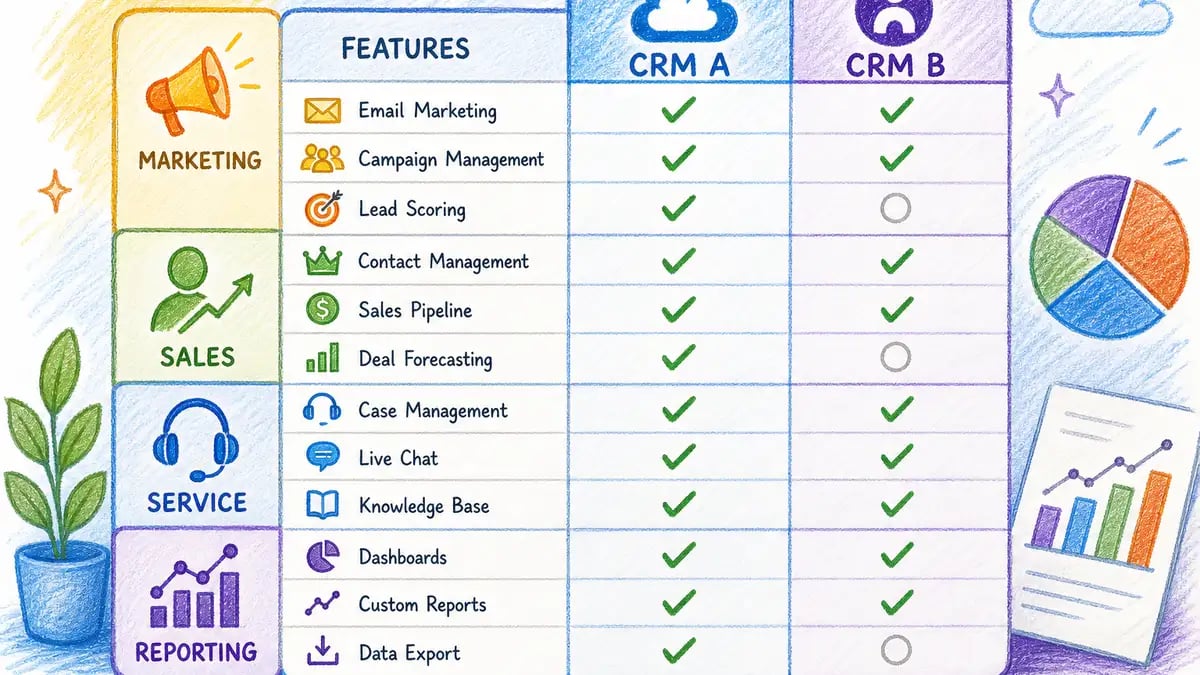
We compared HubSpot and Salesforce across 12 core CRM categories. The result is closer than most comparison articles admit: Salesforce wins 6 categories, HubSpot wins 2, and 3 are genuine ties (with HubSpot having a slight edge in 2 of those ties).
| Category | Winner | Why |
|---|---|---|
| Contact & Lead Management | Tie | HubSpot: simpler single contact record. Salesforce: deeper enterprise flexibility with separate Lead/Contact objects |
| Sales Pipeline & Deals | Tie | HubSpot: intuitive drag-and-drop (G2 Ease of Use 8.7). Salesforce: superior forecasting with Einstein, territory management |
| Marketing Automation | HubSpot | All-in-one: email, workflows, lead scoring, landing pages, blog, SEO, social, ad tracking — natively integrated. Gartner Leader 5th year |
| Reporting & Analytics | Salesforce | Tableau integration (industry-leading BI), cross-object reporting, complex joins, matrix reports |
| AI Capabilities | Tie | Salesforce (Agentforce) more mature and enterprise-grade. HubSpot (Breeze) more accessible and faster to deploy. Both investing heavily |
| Customer Service | Salesforce | Full contact centre: omnichannel routing, field service, workforce management. SelectHub: SF 96, HS 91 |
| Content Management (CMS) | HubSpot | Native CMS with blog, landing pages, SEO tools, A/B testing, smart content. Salesforce has no native CMS equivalent |
| E-commerce | Salesforce | Full B2B/B2C Commerce Cloud. HubSpot Commerce Hub is lightweight payment/invoicing tools, not a storefront |
| API & Integrations | Salesforce | AppExchange: ~5,600 apps, 10M+ installs, 91% of customers use ≥1 app. HubSpot: ~2,000 apps, more curated |
| Customisation Depth | Salesforce | Unlimited custom objects, Apex, Lightning Web Components, SOQL. HubSpot: custom objects limited to Enterprise (max 10) |
| Data Model Flexibility | Salesforce | Complex relationship types, industry-specific data models, record types. HubSpot improving but constrained |
| Mobile App | Salesforce (slight) | More feature depth, offline mode, customisable layouts. HubSpot cleaner but lacks key admin functions |
Summary: Salesforce wins on enterprise depth — reporting, customisation, integrations, service, e-commerce, and data modelling. HubSpot wins on marketing and content management. They tie on core CRM functions and AI (with different strengths). The right choice depends on which categories matter most to your specific business.
AI in 2026: HubSpot Breeze vs Salesforce Agentforce
Both platforms are making enormous AI investments. Salesforce committed $60 billion to its agentic enterprise vision. HubSpot expanded from 4 to 20+ AI agents in 12 months. Here is how they compare for UK businesses evaluating AI-powered CRM capabilities in 2026. For broader context on how AI is reshaping search and marketing, see our guide to answer engine optimisation.
| Dimension | HubSpot Breeze | Salesforce Agentforce |
|---|---|---|
| Launch | Late 2024 | Einstein since 2016; Agentforce 2024 |
| Agent Count | 20+ agents (expanded from 4 in 12 months) | SDR, Sales, Service, Coach, Commerce, Field Service, Marketing agents |
| Resolution Rate | Mid-60s% (Customer Agent) | 84% of 380,000+ interactions (only 2% needed human help) |
| Underlying AI | GPT-5 (migrated Jan 2026). LLM connectors for ChatGPT, Claude, Gemini | Atlas Reasoning Engine. Einstein Trust Layer for data security |
| Deployment Speed | 36-day average activation | Often requires admin/developer setup |
| Autonomous Capabilities | Growing. Customer Agent handles 50%+ of support interactions across 9 channels | More advanced. Atlas engine analyses, reasons, AND executes actions |
| Pricing | Credits-based: 500–5,000/mo included; ~$10 per 1,000 additional | $2/conversation (Agentforce). Add-on from ~£100/user/mo |
| Revenue (AI-specific) | Not disclosed separately | $540M standalone ARR (up 330% YoY). 9,500+ paid deals |
| Data Security | Improving. HubSpot warned against sharing sensitive info in prompts (April 2025) | Einstein Trust Layer prevents sensitive data entering LLMs. Hyperforce data residency |
Bottom line on AI: Salesforce Agentforce is more mature, more autonomous, and better suited to enterprise deployments with strict data governance requirements. HubSpot Breeze is more accessible, deploys faster, and is better suited to mid-market teams that want AI capabilities without dedicated AI administration. Both platforms are evolving rapidly — the gap is narrowing.
If AI-driven customer engagement is central to your strategy, our AI consultancy team can help you evaluate which platform's AI capabilities best fit your specific use cases.
When Should You Choose Salesforce? (Honest Assessment)
As a HubSpot Diamond Partner, we implement HubSpot every week. But we also tell clients when Salesforce is the better choice — because recommending the wrong platform costs everyone more in the long run. Here are the six scenarios where Salesforce genuinely wins.
Industry Vertical Clouds
Salesforce offers 15+ industry-specific clouds with dedicated data models, workflows, and compliance tools. Financial Services Cloud provides FCA-aligned audit trails. Health Cloud supports HIPAA-compliant patient management. Manufacturing Cloud handles sales agreement forecasting. HubSpot has no equivalent vertical solutions at any price tier.
Advantage: Decisive
Extreme Customisation
Salesforce provides Apex (Java-like language), Lightning Web Components, Force.com platform for building entirely custom applications, SOQL/SOSL query languages, and multiple sandbox environments. HubSpot offers custom objects (Enterprise only, max 10 definitions) and JavaScript workflow actions — fundamentally more limited.
Advantage: Decisive
Regulatory Compliance
Salesforce Shield provides AES 256-bit encryption, 10-year field audit trails across 60 fields per object, event monitoring for 50+ event types, and PII pattern detection. Structured for HIPAA, CMMC, FedRAMP, and SOC 2. HubSpot offers basic encryption, MFA, and role-based access but lacks forensic audit depth.
Advantage: Decisive for FCA/NHS/Government
Complex Enterprise Sales
Enterprise Territory Management, multi-object data models for complex account hierarchies, granular field-level permissions, and multi-stage approval workflows with conditional routing. Essential for companies with 3+ business units, channel partners, or matrix sales structures with 50+ distinct user roles.
Advantage: Significant
The Ecosystem (Slack + Tableau + MuleSoft)
Salesforce owns Slack (Digital Deal Rooms, Service Swarming), Tableau (enterprise BI, predictive modelling), and MuleSoft (connecting to SAP, Oracle, NetSuite). Salesforce Flow powers 1 trillion+ automations monthly. If your tech stack already includes these tools, switching costs would be substantial.
Advantage: Significant for existing users
Large Data Volumes & Complex Reporting
HubSpot caps non-table reports at 1,000 unique rows, event reports at 12 months or 10M events, and custom reports at 100 (Professional) or 500 (Enterprise). Reports auto-refresh every 2 hours. Salesforce with Tableau provides unlimited enterprise analytics and deeper cross-object reporting.
Advantage: Significant for data-intensive businesses
When Should You Choose HubSpot? (Where It Genuinely Wins)
HubSpot's advantages are not just about being cheaper. The platform genuinely outperforms Salesforce in six key areas that matter particularly to UK SMEs and mid-market businesses.
Ease of Use & Adoption
G2 Ease of Use: HubSpot 8.7 vs Salesforce 8.0. G2 Ease of Setup: HubSpot 8.4 vs Salesforce 7.2. 54% of CRM professionals say ease of use is the number one factor in CRM effectiveness, yet 40% cite adoption as their top implementation challenge. Higher adoption means better data quality, which means better decisions.
Advantage: Significant
Time to Value
HubSpot: 36-day average activation, £4K–£16K mid-market implementation, often self-implementable. Salesforce: 3–6 months for mid-market, £25K–£80K+, almost always requires certified consultants. Average implementation cost: HubSpot $2,945 vs Salesforce $14,595 (Software Advice data).
Advantage: Significant
Total Cost of Ownership (Under 200 Users)
Businesses switching to HubSpot save an average of 40% on upfront costs and 70% on implementation costs (Aptitude 8, 250 companies). The three-year TCO gap is typically 2–3× in HubSpot's favour. The admin tax is the largest differentiator: 86% of HubSpot teams self-manage vs a dedicated Salesforce admin at £55K–£80K per year.
Advantage: Decisive
Marketing-Sales Alignment
HubSpot is built on a single codebase — Marketing Hub, Sales Hub, Service Hub, Content Hub, and Data Hub share the same database and UI. Data flows natively with zero configuration. Salesforce's Sales Cloud and Marketing Cloud are separate products — integration requires a connector that can take months to set up.
Advantage: Significant
Content Management (CMS)
HubSpot Content Hub provides native website hosting, blog, landing pages, email templates, SEO tools, A/B testing, and smart content personalisation from CRM data. Salesforce has no native CMS — Experience Cloud handles portals, not content management. This is not a close comparison.
Advantage: Decisive
Admin Burden & Ongoing Management
86% of HubSpot teams manage the platform with existing staff. No proprietary coding language required. Salesforce requires Apex, SOQL, and typically a dedicated certified admin whose UK salary runs £55K–£80K+. Dedicated Salesforce admin teams scale linearly as the org grows — the cost never goes away.
Advantage: Significant to Decisive
What Do Users Actually Say? Review Data from 127,000+ Reviews
Rather than cherry-picking testimonials, here is the aggregate data from G2, Capterra, TrustRadius, and Gartner Peer Insights — representing over 127,000 verified user reviews across both platforms.
| Platform / Metric | HubSpot | Salesforce |
|---|---|---|
| G2 Overall Rating | 4.4/5 | 4.4/5 |
| G2 Total Reviews (all products) | 34,900+ | 92,100+ |
| Capterra | ~4.5/5 (4,400+ reviews) | ~4.4/5 |
| TrustRadius | 8.4/10 (5,300+ reviews) | 8.4/10 (3,400+ reviews) |
| G2 Ease of Use | 8.7/10 | 8.0/10 |
| G2 Quality of Support | 8.6/10 | 8.0/10 |
| G2 Grid Position | #1 on Satisfaction | #1 on Market Presence |

What HubSpot users praise most: Ease of use (3,613 G2 mentions), feature breadth (3,138), lead management (2,005), all-in-one platform, HubSpot Academy, and support quality.
What HubSpot users criticise: Learning curve for advanced features (1,783 mentions), pricing jumps between tiers (Starter £16 → Professional £85 is a 5× increase), marketing contact-based pricing escalation, and custom objects locked behind Enterprise.
What Salesforce users praise most: Customisation depth (1,634 mentions), scalability, robust reporting and analytics, extensive ecosystem, and pipeline management (8.7/10).
What Salesforce users criticise: Learning curve (1,783 mentions), expense (1,094 mentions), admin burden, slow implementation (43% take 4+ months per Aptitude 8), and UI navigation difficulties.
Which CRM Is Best for Your Industry?
Your industry often determines which platform is the better fit, regardless of company size. Salesforce's vertical clouds provide purpose-built functionality that HubSpot cannot replicate — but HubSpot's native marketing integration makes it the stronger choice for marketing-driven businesses.
| Industry | Recommendation | Why |
|---|---|---|
| SaaS / Tech | HubSpot (strong) | Natural fit for product-led growth and inbound marketing. Salesforce for enterprise SaaS with complex sales cycles |
| Manufacturing | Salesforce (strong) | Manufacturing Cloud: sales agreement management, forecasting, supply chain, ERP integration via MuleSoft |
| Professional Services | Depends on size | Small firms (1–50): HubSpot simplicity. Large firms with complex matter tracking: Salesforce or specialist CRM |
| Financial Services | Salesforce (strong) | Financial Services Cloud with household modelling, FCA audit trails. HubSpot lacks depth for regulated finance |
| Healthcare | Salesforce (strong) | Health Cloud is HIPAA-compliant with patient-centric CRM and care coordination. HubSpot added HIPAA features but lacks depth |
| Education / EdTech | Salesforce (strong) | Education Cloud is purpose-built for student lifecycle. HubSpot viable for EdTech startups doing content marketing |
| Nonprofit / Charity | Salesforce (strong) | 10 free licences via Power of Us programme. Nonprofit Cloud for donor management, fundraising, grant tracking |
| E-commerce / Retail | Depends on model | DTC with Shopify: HubSpot (strong native sync). Omnichannel retail: Salesforce Commerce Cloud |
For UK businesses in sectors where SEO and content marketing drive significant revenue, combining HubSpot with a specialist SEO strategy often delivers stronger ROI than Salesforce's broader but less marketing-integrated platform.
Decision Framework: Which CRM Based on Your Company Profile
Most comparison articles say "SMBs should choose HubSpot, enterprises should choose Salesforce." That is not wrong, but it is not useful either. Here are the specific thresholds where the recommendation changes.
| Your Metric | HubSpot Sweet Spot | Overlap Zone | Salesforce Sweet Spot |
|---|---|---|---|
| Employees | 1–200 | 50–500 | 200+ |
| Revenue | Under £10M | £5M–£50M | £20M+ |
| Sales Team Size | 1–50 reps | 10–100 reps | 50+ reps |
| CRM Users | 1–100 | 20–200 | 100+ |
| Annual CRM Budget | Under £50K | £20K–£150K | £100K+ |
| Sales Cycle | Simple to moderate | Moderate | Complex, multi-stakeholder |
Quick Decision Signals
Choose HubSpot If…
- Marketing-heavy B2B model (content, inbound, ABM)
- You want unified marketing + sales + service without integration
- Your team values adoption over customisation depth
- No dedicated CRM admin on staff (or budget for one)
- You use WordPress, Shopify, or Google Workspace
- You need a free tier or low-risk starting point
Choose Salesforce If…
- You need an industry-specific vertical cloud
- Complex account hierarchies with 50+ distinct user roles
- Highly regulated industry (FCA, NHS, government)
- Multi-currency, multi-territory with channel partners
- You already use Slack, Tableau, or MuleSoft
- Deep ERP integration needed (SAP, Oracle, NetSuite)
Best CRM for Startups and Series-A Companies
For seed and Series-A companies, HubSpot is almost always the right first CRM: a free tier plus affordable Starter and Professional seats keeps early costs low, setup takes days rather than months, and no dedicated admin is required, so founders and RevOps leads can run it themselves. It scales cleanly through Series-B and Series-C. Only at roughly 75–100+ users with complex, regulated or heavily customised processes does Salesforce become the stronger long-term platform. Zoho or Pipedrive suit pure-sales micro-teams on the tightest budgets, but neither matches HubSpot's combined marketing, sales and service breadth as you scale.
What Does Your Tech Stack Tell You?
| If Your Stack Includes… | CRM Advantage | Why |
|---|---|---|
| Slack | Salesforce | Salesforce owns Slack — deepest native integration |
| Tableau | Salesforce | Salesforce owns Tableau — native data connection |
| WordPress | HubSpot | Native plugin; Content Hub as CMS alternative |
| Shopify | HubSpot | Strong native bi-directional sync |
| Microsoft 365 / Teams | Dynamics 365 | Deepest Microsoft integration — consider a third option |
| Google Workspace | HubSpot (slight) | More seamless integration for SMBs |
| Xero / QuickBooks | HubSpot (slight) | Native accounting integrations. Salesforce needs AppExchange |
| SAP / Oracle ERP | Salesforce | MuleSoft enables deep ERP integration |
Switching CRMs: Migration Costs, Timelines, and Pitfalls
CRM migration is the cost that most comparison articles ignore. Whether you are moving from Salesforce to HubSpot or vice versa, the switching costs are real and should factor into your total cost of ownership calculation.
Salesforce → HubSpot Migration Costs
| Migration Type | Cost (GBP) | Timeline |
|---|---|---|
| DIY (HubSpot native connector) | Free | Self-directed |
| Assisted (Trujay / tools) | £160–£1,760 | 1–3 weeks |
| Agency-led (standard) | £1,200–£30,000 | 3–8 weeks |
| Agency-led (enterprise) | £30,000–£80,000+ | 8–12 weeks |
HubSpot itself migrated from Salesforce to run 100% on its own CRM — a point the company uses as a feasibility case study. HubSpot's internal Replatforming Team evaluates and executes migrations, and onboarding fees are waived when using a Solutions Partner like Whitehat.
Common Migration Pitfalls
- Data model differences: Salesforce uses separate Lead and Contact objects; HubSpot uses a single Contacts object. Campaigns function differently between platforms. Association and relationship data can be lost if not mapped carefully.
- File migration: Salesforce Files do not migrate natively to HubSpot. Plan for manual transfer of critical documents.
- Workflow recreation: Salesforce Flows and Apex triggers must be rebuilt as HubSpot workflows from scratch.
- Integration reconnection: Every third-party integration must be disconnected and reconnected to the new platform.
- User adoption: The number one reason CRM implementations fail. Experienced Salesforce users may resist changing platforms regardless of the benefits.
Salesforce Contract Lock-In to Watch For
Salesforce contracts are non-cancelable and non-refundable (MSA Section 11.2). They auto-renew unless you give 30–60 days advance notice. You cannot decrease licences mid-term — only increase. Post-termination, you have 30 days to retrieve your data (5–7 days if terminated for non-payment). Annual renewal uplifts of 5–7% are standard, and initial discounts of 30–40% often disappear at renewal. Plan your migration timing around your contract renewal date to avoid paying for both platforms simultaneously.
When to Choose Neither HubSpot Nor Salesforce
Not every business needs HubSpot or Salesforce. Here are the alternatives worth considering and the specific scenarios where they make more sense.
| Alternative | UK Pricing (from) | Choose This When… |
|---|---|---|
| Microsoft Dynamics 365 | ~£49/user/mo | Deep Microsoft ecosystem (Teams, Outlook, Power BI, Azure). CRM + ERP in one platform |
| Zoho CRM | ~£12/user/mo | Budget-conscious SMBs wanting breadth without HubSpot's pricing jumps. 40+ apps in Zoho One |
| Pipedrive | ~£12/user/mo | Pure sales teams without marketing automation needs. Visual pipeline, fast setup |
| Monday CRM | ~£10/seat/mo | Teams already using Monday.com for project management. Lightweight CRM needs |
| Freshsales | ~£7/user/mo | AI-driven CRM with simpler pricing. UK data centres available |
Red Flags: Signs You're Being Oversold
Whether you are speaking to a Salesforce rep or a HubSpot partner (including us), watch for these warning signs that someone is prioritising their commission over your best interests.
Salesforce Overselling Red Flags
- Pushed to Enterprise (£140/user) when team is under 20 people
- Implementation quoted at 6–12 months for under 50 users
- Told you need a full-time admin from day one for 10–20 users
- Einstein AI add-ons bundled before base platform is adopted
- Steered toward Salesforce when primary need is marketing automation
- Partner recommending custom Apex when declarative solutions would work
HubSpot Overselling Red Flags
- Pushed to Enterprise when complexity genuinely requires Salesforce
- Not told about the 5× pricing jump from Starter to Professional
- Downplaying contact-based pricing escalation in Marketing Hub
- Told HubSpot can replace Salesforce for complex account hierarchies
- Not disclosing that custom objects require Enterprise tier
- Claiming HubSpot reporting is "just as good" for cross-object analytics
- "You can always migrate later" without quantifying costs (£15K–£80K+)
A good CRM partner — whether Salesforce or HubSpot — should tell you when the competitor is the better fit. If they cannot name a single scenario where the other platform wins, that is a red flag in itself. See our pricing and packages page for how we price transparently.
Frequently Asked Questions
Is HubSpot really cheaper than Salesforce for UK businesses?
Yes, for teams under 200 users. HubSpot's three-year total cost of ownership is typically 30–60% lower than Salesforce when you include implementation, admin costs, and add-ons. For 10 users, HubSpot Year 1 costs £10,100–£25,600 versus Salesforce at £24,600–£61,800. The biggest hidden cost difference is the "admin tax" — 86% of HubSpot teams manage the platform with existing staff, while Salesforce almost always requires a dedicated admin at £55,000–£80,000 per year.
When should a UK company choose Salesforce over HubSpot?
Choose Salesforce when you need industry-specific vertical clouds (financial services, healthcare, manufacturing, education), complex account hierarchies with 50+ distinct user roles, deep ERP integration via MuleSoft, regulatory compliance features like Salesforce Shield for FCA or NHS requirements, or extreme customisation using Apex code. Salesforce becomes the better value when your team exceeds 200–500 users with complex permission structures.
Can HubSpot replace Salesforce for a mid-size UK business?
For most UK mid-market businesses (50–200 employees) with straightforward sales processes and strong marketing needs, yes. HubSpot's Professional and Enterprise tiers now cover CRM, marketing automation, content management, and service on one platform. However, HubSpot cannot replace Salesforce if you need industry-specific clouds, complex multi-object data models, or more than 10 custom object definitions.
How much does it cost to migrate from Salesforce to HubSpot?
Migration costs vary by complexity. DIY migration using HubSpot's native Salesforce connector is free. Assisted migration via tools like Trujay costs £160–£1,760. Agency-led migration ranges from £1,200 for simple setups to £8,000–£30,000 for mid-market and £30,000–£80,000+ for enterprise. Most migrations take 3–8 weeks for standard implementations and 8–12 weeks for complex enterprise setups.
What are the hidden costs of Salesforce that UK businesses miss?
The most commonly missed Salesforce costs include Premier Support at 20–30% of net licence fees, a dedicated admin salary of £45,000–£75,000 per year, data storage overages at £100 per 500MB per month, AppExchange apps at £5–£50 per user per month, Salesforce Shield at roughly 30% uplift on licence cost, sandbox environments at 25–30% of production licence cost, and annual renewal price increases of 5–7% after initial discounts of 30–40% expire.
How do HubSpot Breeze AI and Salesforce Agentforce compare?
Both platforms are investing heavily in AI. Salesforce Agentforce is more mature with autonomous agents that resolved 84% of 380,000+ interactions, powered by the Atlas Reasoning Engine, priced at $2 per conversation. HubSpot Breeze is more accessible with 20+ agents, average 36-day activation time, and credit-based pricing. Salesforce leads on enterprise AI depth; HubSpot leads on ease of deployment for smaller teams.
Is HubSpot suitable for regulated UK industries like financial services?
HubSpot offers basic compliance features including GDPR toolkits, encryption, MFA, and role-based access. However, for FCA-regulated financial services, NHS compliance, or government contracts requiring deep audit trails, Salesforce is the stronger choice. Salesforce Shield provides AES 256-bit encryption, 10-year field audit trails, event monitoring across 50+ event types, and industry-specific compliance certifications that HubSpot cannot match.
What size company is HubSpot best suited for?
HubSpot's sweet spot is companies with 1–200 employees, under £10M revenue, with 1–50 sales reps and an annual CRM budget under £50,000. HubSpot remains competitive for larger companies up to 500 employees if the sales process is straightforward and marketing alignment is a priority. Notably, HubSpot's fastest-growing segment is 500+ seat customers, which grew 5× in 2025.
Should I choose neither HubSpot nor Salesforce?
Consider alternatives if you are a micro-business (1–5 people) where Pipedrive or Zoho Free is more practical, deeply embedded in the Microsoft ecosystem where Dynamics 365 makes more sense, running project-based work where Monday CRM fits better, or a very early-stage startup where a spreadsheet plus Notion may beat a premature CRM commitment. Microsoft Dynamics 365 starts from approximately £49 per user per month and offers integrated CRM plus ERP.
Does Whitehat recommend HubSpot because they are a HubSpot partner?
Whitehat SEO is a HubSpot Diamond Partner, and this article is transparent about that relationship. This comparison identifies six categories where Salesforce wins (reporting, customer service, e-commerce, APIs, customisation, data model flexibility) versus six where HubSpot wins (ease of use, time to value, TCO, marketing, CMS, admin burden). The recommendation depends on your company size, industry, and technical requirements — not our partnership status.
Not Sure Which CRM Is Right for Your Business?
As a HubSpot Diamond Partner, Whitehat helps UK businesses evaluate, implement, and optimise CRM platforms. We also tell you honestly when Salesforce — or neither — is the better fit. Book a free CRM consultation to get a personalised recommendation based on your company size, industry, and tech stack.
Book a Free CRM Consultation →Or explore our HubSpot CRM services · HubSpot onboarding · Our pricing
Methodology & Sources
This comparison draws on: HubSpot Q4 2025 earnings (11 Feb 2026), Salesforce Q3 FY2026 results, Gartner Magic Quadrant reports (2025), Forrester Wave: CRM (Q1 2025), IDC CRM market share (2025), G2 (127,000+ reviews), Capterra, TrustRadius and Gartner Peer Insights, Aptitude 8’s State of HubSpot study, Avidly TCO benchmarks (2026), and direct pricing from salesforce.com/uk and UK HubSpot partner sources. TCO figures from HubSpot partners may carry a slight pro-HubSpot bias, though directional differences are consistent across the independent sources reviewed. All GBP prices exclude VAT. Written by Clwyd Probert, Managing Director of Whitehat SEO Ltd, a HubSpot Diamond Partner since 2016. Last updated: July 2026.